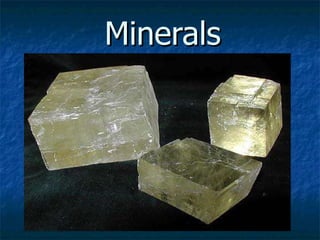
Minerals
What is a Mineral? Naturally Occurring Inorganic Solid Definite Chemical Formula Definite Crystal Structure
Naturally Occurring Formed by natural processes not in the laboratory. Is an ice cube a mineral? Is the ice on the windshield of a car a mineral? Minerals manufactured by humans are not considered minerals.
Inorganic Formed by inorganic processes; not living Minerals are not made from living things. Coal is made of carbon. Is it a mineral?
Solid Minerals cannot be a gas or a liquid. - H 2 O as ice in a glacier is a mineral, but  water is not.
Definite Crystal Structure Highly ordered atomic arrangement of atoms in regular geometric patterns  Apatite Feldspar Diamond Quartz Minerals are crystals with a repeated inner structure.
 
Definite Chemical Formula Minerals are expressed by a specific chemical formula. Gold (Au) Calcite  (CaCO 3 )   Quartz  (SiO 2 ) Pyrite  (FeS 2 ) Minerals made of only one type of atom (element) are called native elements. Gold Copper Silver
Types of minerals Minerals are most commonly classified by chemical composition.  The 2 main groups are silicates and nonsilicates.
Silicates Minerals containing a combination of silicon (Si) and oxygen (O) (most common elements in the earth’s crust) Silicate minerals comprise about 90% of the Earth’s crust. Silicates minerals often contain other elements such as aluminum, iron, magnesium, and potassium. Granite is a rock comprised of the minerals feldspar, biotite mica and quartz.
Feldspar Feldspar minerals make up half of the Earth’s crust and is the main component of most of the rocks found on the Earth’s surface. Feldspar Feldspar contains Si, O, Al, K, Na, and Ca
Biotite Mica soft and shiny minerals that separate easily into sheets biotite is one variety of mica
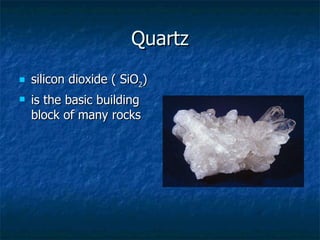
Quartz silicon dioxide ( SiO 2 ) is the basic building block of many rocks
Nonsilicates minerals that do not contain the combination of Si and O some of these minerals are made up of C, O, F, and S
Classes of nonsilicates Native Elements Carbonates Halides Oxides Sulfates Sulfides
Native Elements Native elements are composed of only 1 element About 20 exist including Au, Pt, C, Cu, S and Ag
Carbonates contain the combinations of carbon and Oxygen in their chemical structure calcite (CaCO 3  ) is an example carbonates are used in cement, building stones and fireworks
Halides form when atoms containing fluorine, chlorine, iodine, or bromine (halogens) combine with potassium or calcium Halite (NaCl) is better known as rock salt Fluorite can have many different colors Halides are often used in making fertilizers Fluorite
Oxides compounds formed when elements like aluminum or iron bond with oxygen Corundum (Al 2 O 3 ) and Magnetite (Fe 3 O 4 ) are important oxides Are used in abrasives and airplane parts
Sulfates minerals containing sulfur and oxygen (SO 4 ) gypsum (CaSO 4  * 2H 2 O) is a common example makes the white sand at White Sands National Monument in NM sulfates are commonly used in cosmetics, toothpaste and paints Gypsum
Sulfides minerals containing one or more elements such as lead, iron, or nickel combines with sulfur Galena (PbS) is a sulfide Sulfides are used to make batteries, medicines and electronic parts Galena
Composition of the Earth’s Crust - Oxygen (O) - Silicon (Si) - Aluminum (Al) - Iron (Fe) - Calcium (Ca) - Sodium (Na) - Potassium (K) - Magnesium (Mg) Eight Elements that make up over 98% of Earth’s Crust
Where Do Minerals Come From? Magma Evaporation In general, minerals form in two ways: Cooling magma - Crystallization of melted materials From solution - Crystallization of materials dissolved in water At the surface Beneath the surface
Magma Magma is molten material from the mantle that hardens to form rock. Lava is magma that reaches the surface. Minerals form as hot magma cools inside the crust, or as lava hardens on the surface. When these liquids cool to the solid state, they form crystals.
Size of Crystals Magma closer to the surface cools much faster, producing smaller crystals. Slow cooling leads to the formation of large crystals. When magma remains deep below the surface, it cools slowly over many thousands of years. The chemical composition of the magma The amount of gas the magma contains The rate at which the magma cools Depends of several factors:
Minerals from Hot Water Solutions This can happen on the ocean floor when ocean water seeps down through cracks in the crust. When a hot water solution begins to cool, the elements and compounds leave the solution and crystallize as minerals. A solution is a mixture in which one substance dissolves in another.   Sometimes, the elements that form a mineral dissolve in hot water and form a solution.
Minerals formed by Evaporation Gypsum Calcite crystals Minerals containing potassium Several other useful minerals also from by the evaporation of seawater: Minerals can also form when solutions evaporate.  Example: salt from sea water
Minerals formed by Metamorphism When rocks are put under extreme heat and pressure, the chemical composition of the rock can change, forming new minerals. Examples: calcite, garnet, graphite, hematite, magnetite, mica and talc.
How Are Minerals Identified? Color Luster Hardness Streak Density Crystal Shape Cleavage and Fracture Special Properties
Color Usually the first and most easily observed - Some minerals are the same color as others - Some minerals can have many colors Not a reliable way to identify a mineral QUARTZ ROSE QUARTZ SMOKY QUARTZ
Luster General appearance of a mineral surface in reflected light Glassy- Obsidian
Examples of luster Metallic Greasy: resembles the way petroleum jelly or a greasy surface reflects light Silky: resembles the way silk reflects light Earthy: dull, may be rough or dusty Waxy Adamantine: resembles the way a diamond shines   Vitreous: similar to glass Resinous: resembles the way plastic reflects light Pearly: resembles the way pearls shine Pitchy – looks like tar Fibrous – looks like fibers
Hardness Resistance to scratching by different items;  “scratchability” Mohs Hardness Scale is used to determine the hardness of minerals by comparing them to substances of known hardness: <  2 fingernail  3 penny  ~ 5 Steel of a pocket knife  5.5 Window Glass 6.6 Steel of a file  7 Quartz crystal
Mohs Mineral Hardness Scale 1)  Talc  2)  Gypsum  3)  Calcite  4)  Flourite  5)  Apatite  6)  Feldspar  7)  Quartz  8)  Topaz  9)  Corundum  10) Diamond Softest Hardest 1 2 3 4 5 6 7 8 9 10
Streak The color of a finely powdered mineral  Determined by rubbing the mineral on a piece of unglazed porcelain (streak plate)
Density The amount of matter in a given space  Specific Gravity is the comparison of a substance’s density to the density of water
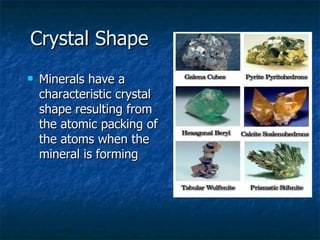
Crystal Shape Minerals have a characteristic crystal shape resulting from the atomic packing of the atoms when the mineral is forming
Cleavage and Fracture Cleavage  is the tendency  of a mineral to split or crack along parallel or flat planes Fracture  occurs when a mineral breaks at random lines instead of at consistent cleavage planes. Obsidian No Cleavage 1 Direction of Cleavage Conchoidal Fracture BIOTITE QUARTZ
Fracture
Special Properties Magnetism (Magnetite) Taste (Halite) Smell (Sulfur) Reaction to HCl (Calcite) Double refractive -  a thin, clear piece of calcite placed over an image will cause a double image Radioactivity - minerals containing radium or uranium can be detected by a Geiger counter Glowing under ultraviolet light (Fluorite)
Economic Importance of Minerals Minerals are in many things we see and use everyday such as; bricks, glass, cement, plaster, iron, gold
Every American Requires 40,000 Pounds of New Minerals per Year at this level of consumption the average newborn infant will need a lifetime supply of: -795 lbs of lead (car batteries, electric components) -757 lbs of zinc (to make brass, rubber, paints) -1500lbs of copper (electrical motors, wirings -3593 lbs aluminum (soda cans, aircraft) -32,700 lbs of iron (kitchen utensils, automobiles,  buildings) -28,213 lbs of salt (cooking, detergents) -1,238,101 lbs of stone, sand, gravel, cement (roads, homes, etc.)

Minerals

  • 1.
  • 2.
    What is aMineral? Naturally Occurring Inorganic Solid Definite Chemical Formula Definite Crystal Structure
  • 3.
    Naturally Occurring Formedby natural processes not in the laboratory. Is an ice cube a mineral? Is the ice on the windshield of a car a mineral? Minerals manufactured by humans are not considered minerals.
  • 4.
    Inorganic Formed byinorganic processes; not living Minerals are not made from living things. Coal is made of carbon. Is it a mineral?
  • 5.
    Solid Minerals cannotbe a gas or a liquid. - H 2 O as ice in a glacier is a mineral, but water is not.
  • 6.
    Definite Crystal StructureHighly ordered atomic arrangement of atoms in regular geometric patterns Apatite Feldspar Diamond Quartz Minerals are crystals with a repeated inner structure.
  • 7.
  • 8.
    Definite Chemical FormulaMinerals are expressed by a specific chemical formula. Gold (Au) Calcite (CaCO 3 ) Quartz (SiO 2 ) Pyrite (FeS 2 ) Minerals made of only one type of atom (element) are called native elements. Gold Copper Silver
  • 9.
    Types of mineralsMinerals are most commonly classified by chemical composition. The 2 main groups are silicates and nonsilicates.
  • 10.
    Silicates Minerals containinga combination of silicon (Si) and oxygen (O) (most common elements in the earth’s crust) Silicate minerals comprise about 90% of the Earth’s crust. Silicates minerals often contain other elements such as aluminum, iron, magnesium, and potassium. Granite is a rock comprised of the minerals feldspar, biotite mica and quartz.
  • 11.
    Feldspar Feldspar mineralsmake up half of the Earth’s crust and is the main component of most of the rocks found on the Earth’s surface. Feldspar Feldspar contains Si, O, Al, K, Na, and Ca
  • 12.
    Biotite Mica softand shiny minerals that separate easily into sheets biotite is one variety of mica
  • 13.
    Quartz silicon dioxide( SiO 2 ) is the basic building block of many rocks
  • 14.
    Nonsilicates minerals thatdo not contain the combination of Si and O some of these minerals are made up of C, O, F, and S
  • 15.
    Classes of nonsilicatesNative Elements Carbonates Halides Oxides Sulfates Sulfides
  • 16.
    Native Elements Nativeelements are composed of only 1 element About 20 exist including Au, Pt, C, Cu, S and Ag
  • 17.
    Carbonates contain thecombinations of carbon and Oxygen in their chemical structure calcite (CaCO 3 ) is an example carbonates are used in cement, building stones and fireworks
  • 18.
    Halides form whenatoms containing fluorine, chlorine, iodine, or bromine (halogens) combine with potassium or calcium Halite (NaCl) is better known as rock salt Fluorite can have many different colors Halides are often used in making fertilizers Fluorite
  • 19.
    Oxides compounds formedwhen elements like aluminum or iron bond with oxygen Corundum (Al 2 O 3 ) and Magnetite (Fe 3 O 4 ) are important oxides Are used in abrasives and airplane parts
  • 20.
    Sulfates minerals containingsulfur and oxygen (SO 4 ) gypsum (CaSO 4 * 2H 2 O) is a common example makes the white sand at White Sands National Monument in NM sulfates are commonly used in cosmetics, toothpaste and paints Gypsum
  • 21.
    Sulfides minerals containingone or more elements such as lead, iron, or nickel combines with sulfur Galena (PbS) is a sulfide Sulfides are used to make batteries, medicines and electronic parts Galena
  • 22.
    Composition of theEarth’s Crust - Oxygen (O) - Silicon (Si) - Aluminum (Al) - Iron (Fe) - Calcium (Ca) - Sodium (Na) - Potassium (K) - Magnesium (Mg) Eight Elements that make up over 98% of Earth’s Crust
  • 23.
    Where Do MineralsCome From? Magma Evaporation In general, minerals form in two ways: Cooling magma - Crystallization of melted materials From solution - Crystallization of materials dissolved in water At the surface Beneath the surface
  • 24.
    Magma Magma ismolten material from the mantle that hardens to form rock. Lava is magma that reaches the surface. Minerals form as hot magma cools inside the crust, or as lava hardens on the surface. When these liquids cool to the solid state, they form crystals.
  • 25.
    Size of CrystalsMagma closer to the surface cools much faster, producing smaller crystals. Slow cooling leads to the formation of large crystals. When magma remains deep below the surface, it cools slowly over many thousands of years. The chemical composition of the magma The amount of gas the magma contains The rate at which the magma cools Depends of several factors:
  • 26.
    Minerals from HotWater Solutions This can happen on the ocean floor when ocean water seeps down through cracks in the crust. When a hot water solution begins to cool, the elements and compounds leave the solution and crystallize as minerals. A solution is a mixture in which one substance dissolves in another. Sometimes, the elements that form a mineral dissolve in hot water and form a solution.
  • 27.
    Minerals formed byEvaporation Gypsum Calcite crystals Minerals containing potassium Several other useful minerals also from by the evaporation of seawater: Minerals can also form when solutions evaporate. Example: salt from sea water
  • 28.
    Minerals formed byMetamorphism When rocks are put under extreme heat and pressure, the chemical composition of the rock can change, forming new minerals. Examples: calcite, garnet, graphite, hematite, magnetite, mica and talc.
  • 29.
    How Are MineralsIdentified? Color Luster Hardness Streak Density Crystal Shape Cleavage and Fracture Special Properties
  • 30.
    Color Usually thefirst and most easily observed - Some minerals are the same color as others - Some minerals can have many colors Not a reliable way to identify a mineral QUARTZ ROSE QUARTZ SMOKY QUARTZ
  • 31.
    Luster General appearanceof a mineral surface in reflected light Glassy- Obsidian
  • 32.
    Examples of lusterMetallic Greasy: resembles the way petroleum jelly or a greasy surface reflects light Silky: resembles the way silk reflects light Earthy: dull, may be rough or dusty Waxy Adamantine: resembles the way a diamond shines Vitreous: similar to glass Resinous: resembles the way plastic reflects light Pearly: resembles the way pearls shine Pitchy – looks like tar Fibrous – looks like fibers
  • 33.
    Hardness Resistance toscratching by different items; “scratchability” Mohs Hardness Scale is used to determine the hardness of minerals by comparing them to substances of known hardness: < 2 fingernail 3 penny ~ 5 Steel of a pocket knife 5.5 Window Glass 6.6 Steel of a file 7 Quartz crystal
  • 34.
    Mohs Mineral HardnessScale 1) Talc 2) Gypsum 3) Calcite 4) Flourite 5) Apatite 6) Feldspar 7) Quartz 8) Topaz 9) Corundum 10) Diamond Softest Hardest 1 2 3 4 5 6 7 8 9 10
  • 35.
    Streak The colorof a finely powdered mineral Determined by rubbing the mineral on a piece of unglazed porcelain (streak plate)
  • 36.
    Density The amountof matter in a given space Specific Gravity is the comparison of a substance’s density to the density of water
  • 37.
    Crystal Shape Mineralshave a characteristic crystal shape resulting from the atomic packing of the atoms when the mineral is forming
  • 38.
    Cleavage and FractureCleavage is the tendency of a mineral to split or crack along parallel or flat planes Fracture occurs when a mineral breaks at random lines instead of at consistent cleavage planes. Obsidian No Cleavage 1 Direction of Cleavage Conchoidal Fracture BIOTITE QUARTZ
  • 39.
  • 40.
    Special Properties Magnetism(Magnetite) Taste (Halite) Smell (Sulfur) Reaction to HCl (Calcite) Double refractive - a thin, clear piece of calcite placed over an image will cause a double image Radioactivity - minerals containing radium or uranium can be detected by a Geiger counter Glowing under ultraviolet light (Fluorite)
  • 41.
    Economic Importance ofMinerals Minerals are in many things we see and use everyday such as; bricks, glass, cement, plaster, iron, gold
  • 42.
    Every American Requires40,000 Pounds of New Minerals per Year at this level of consumption the average newborn infant will need a lifetime supply of: -795 lbs of lead (car batteries, electric components) -757 lbs of zinc (to make brass, rubber, paints) -1500lbs of copper (electrical motors, wirings -3593 lbs aluminum (soda cans, aircraft) -32,700 lbs of iron (kitchen utensils, automobiles, buildings) -28,213 lbs of salt (cooking, detergents) -1,238,101 lbs of stone, sand, gravel, cement (roads, homes, etc.)