© 2010 M ETS MALA
Basic Microwave Engineering
AJAL.A.J - Dept of ECE
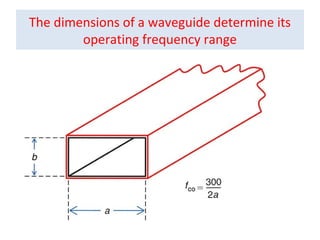
The dimensions of a waveguide determine its
operating frequency range
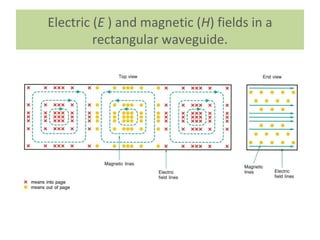
Electric (E ) and magnetic (H) fields in a
rectangular waveguide.
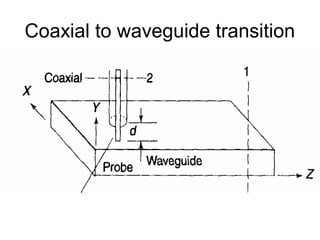
Coaxial to waveguide transition
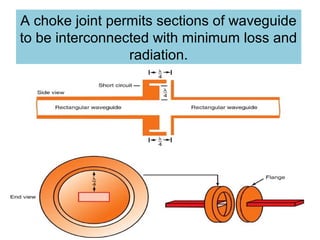
A choke joint permits sections of waveguide
to be interconnected with minimum loss and
radiation.
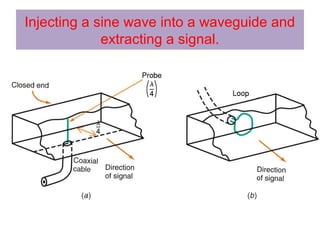
Injecting a sine wave into a waveguide and
extracting a signal.
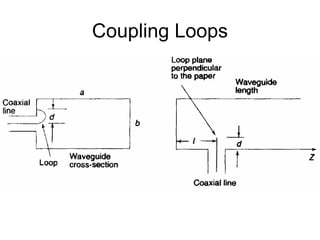
Coupling Loops
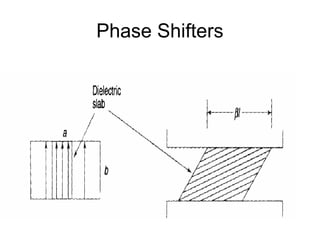
Phase Shifters
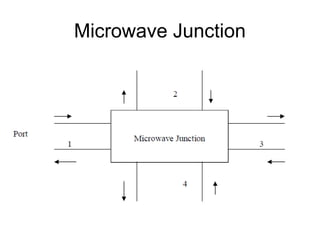
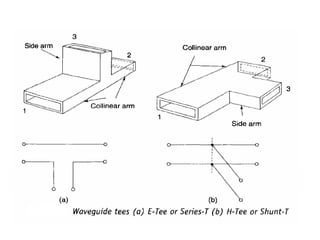
Microwave Junction
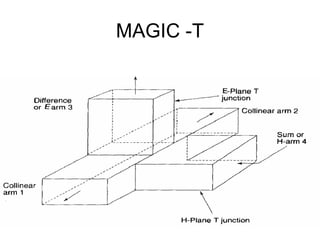
MAGIC -T
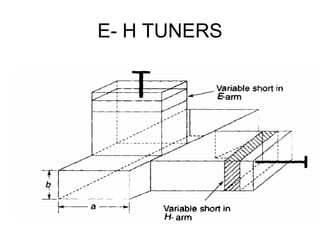
E- H TUNERS
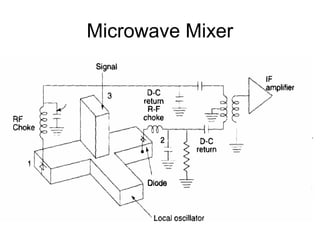
Microwave Mixer
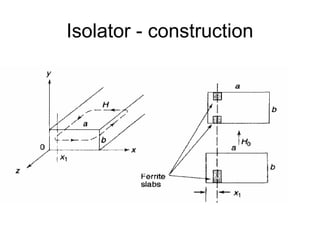
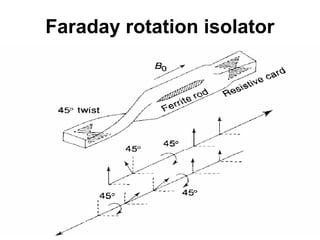
Isolators
• An isolator is a two-port non-reciprocal
device which produces a minimum
attenuation to wave propagation in one
direction and very high attenuation in the
opposite direction.
Working
• Thus when inserted between a signal
source and load almost all the signal
power can be transmitted to the load and
any reflected power from the load is not
fed back to the generator output port.
Advantages
• This eliminates variations of source power
output and frequency pulling due to
changing loads.
Isolator - construction
Faraday rotation isolator
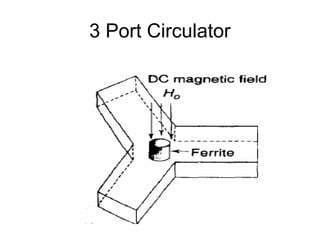
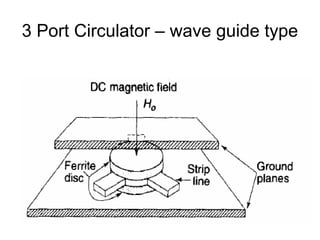
Circulators
– A circulator is a three-port microwave device used
for coupling energy in only one direction around a
closed loop.
– Microwave energy is applied to one port and
passed to another with minor attenuation,
however the signal will be greatly attenuated on
its way to a third port.
– The primary application of a circulator is a
diplexer, which allows a single antenna to be
shared by a transmitter and receiver.
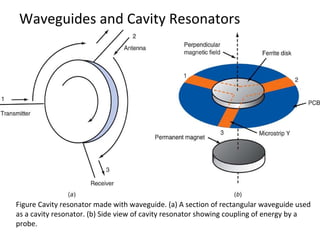
Waveguides and Cavity Resonators
Figure Cavity resonator made with waveguide. (a) A section of rectangular waveguide used
as a cavity resonator. (b) Side view of cavity resonator showing coupling of energy by a
probe.
Circulators
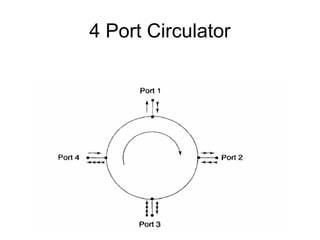
• A circulator is a multi port junction in which
the wave can travel from one port to next
immediate port in one direction only.
• Commonly used circulators are three-port
or four-port devices although more
number of ports is possible.
4 Port Circulator
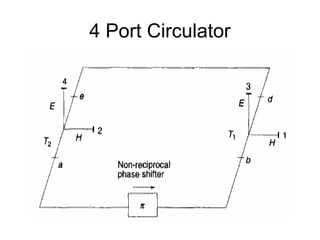
4 Port Circulator
3 Port Circulator
3 Port Circulator
3 Port Circulator – wave guide type
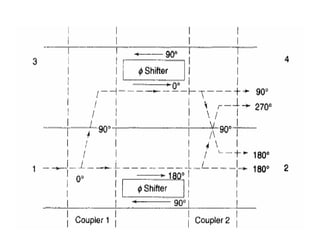
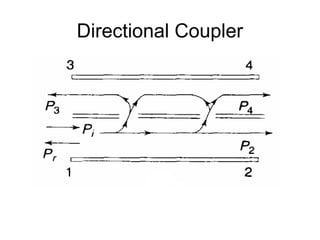
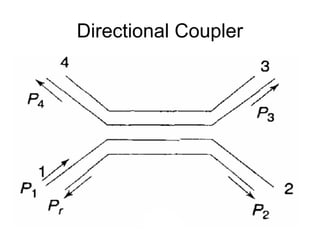
Directional Coupler
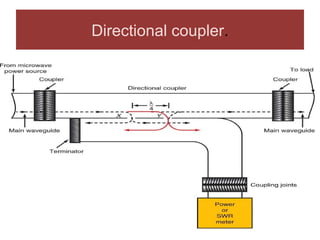
Directional coupler.
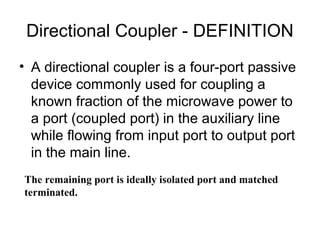
Directional Coupler - DEFINITION
• A directional coupler is a four-port passive
device commonly used for coupling a
known fraction of the microwave power to
a port (coupled port) in the auxiliary line
while flowing from input port to output port
in the main line.
The remaining port is ideally isolated port and matched
terminated.
There are three basic types of
directional couplers.
• One is a multiple aperture waveguide type,
• second one is a coupled coaxial, or strip or
micro strip line,
and the
• third one is branch line couplers
Directional Coupler
Directional Coupler
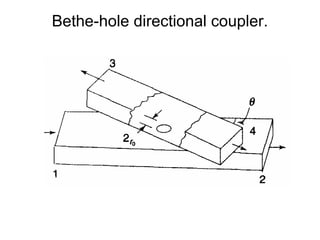
Bethe-hole directional coupler.
• The theory of the waveguide coupler was
first established by ‘ Bethe’ , using a single
hole in the common broad wall of two
rectangular waveguides.
• Commonly known as Bethe-hole
directional coupler.
Bethe-hole directional coupler.
Practical SCENARIO
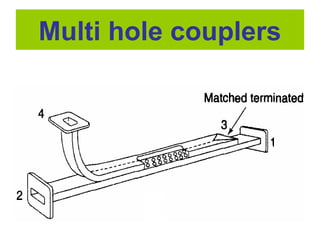
• Practical waveguide directional couplers
are multi hole couplers in which the
desired coupling response vs frequency
can be achieved by proper selection of the
number of holes and size of the holes.
Multi hole couplers
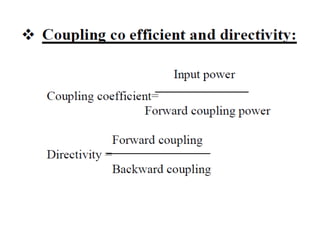
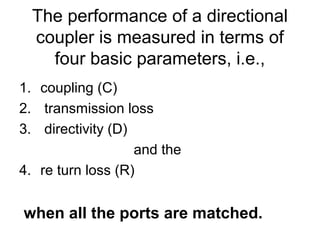
The performance of a directional
coupler is measured in terms of
four basic parameters, i.e.,
1. coupling (C)
2. transmission loss
3. directivity (D)
and the
4. re turn loss (R)
when all the ports are matched.
THANK
YOU

Microwave engineering basics