TRAPATT DIODE
IndusUniversity
Electronics & communication Presented by,
Dept. Ami Goswami (IU1241090014)
6th semester Vatsal Shah (IU1241090055)
INDUS UNIVERSITY
INDUS INSTITUTE OF TECHNOLOGY & ENGINEERING
AHMEDABAD
Subject: Microwave Engineering
Content
 Introduction
 Structure
 Principle Of Operation
 Advantages & Disadvantage
 Typical Parameters
 Application
 References
4/8/2015 2
TRAPATT DIODE
 The TRAPATT (Trapped Plasma Avalanche Triggered Transit)
diode is another microwave energy which is used as both
amplifier and oscillator.
 It was first reported by Prager in 1967.
 It operates efficiently below 10 GHz and need greater voltage
swing for its operation.
 It is a p-n junction diode characterized by the formation of a
trapped space charge plasma within the junction region.
 It is typically represented by a current pulse generator and the
diode’s depletion-layer capacitance.
4/8/2015 3
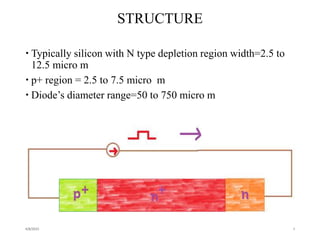
STRUCTURE
 Typically silicon with N type depletion region width=2.5 to
12.5 micro m
 p+ region = 2.5 to 7.5 micro m
 Diode’s diameter range=50 to 750 micro m
4/8/2015 4
PRINCIPLE OF OPERATION
 A high field avalanche zone propagates through the diode.
 Fills the depletion layer with a dense plasma of electrons and
holes that become trapped in the low field region behind the
zone.
4/8/2015 5
OPERATION
4/8/2015 6
OPERATION
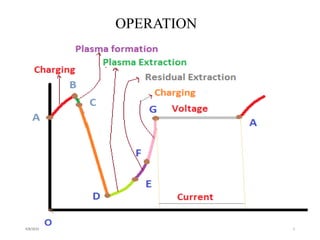
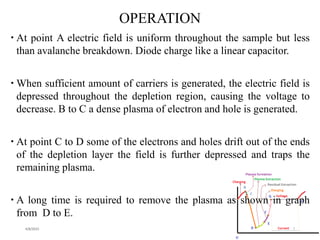
 At point A electric field is uniform throughout the sample but less
than avalanche breakdown. Diode charge like a linear capacitor.
 When sufficient amount of carriers is generated, the electric field is
depressed throughout the depletion region, causing the voltage to
decrease. B to C a dense plasma of electron and hole is generated.
 At point C to D some of the electrons and holes drift out of the ends
of the depletion layer the field is further depressed and traps the
remaining plasma.
 A long time is required to remove the plasma as shown in graph
from D to E.
4/8/2015 7
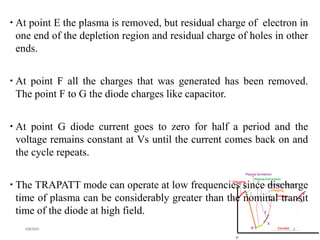
 At point E the plasma is removed, but residual charge of electron in
one end of the depletion region and residual charge of holes in other
ends.
 At point F all the charges that was generated has been removed.
The point F to G the diode charges like capacitor.
 At point G diode current goes to zero for half a period and the
voltage remains constant at Vs until the current comes back on and
the cycle repeats.
 The TRAPATT mode can operate at low frequencies since discharge
time of plasma can be considerably greater than the nominal transit
time of the diode at high field.
4/8/2015 8
Typical Parameters
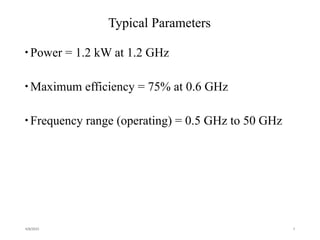
Power = 1.2 kW at 1.2 GHz
Maximum efficiency = 75% at 0.6 GHz
Frequency range (operating) = 0.5 GHz to 50 GHz
4/8/2015 9
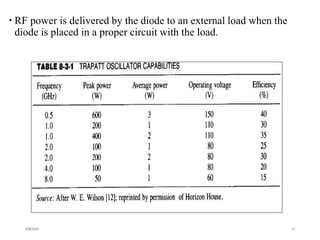
 RF power is delivered by the diode to an external load when the
diode is placed in a proper circuit with the load.
4/8/2015 10
Advantages
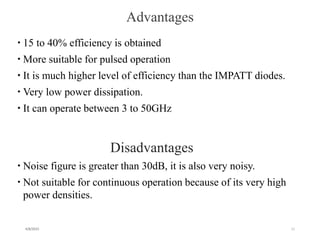
 15 to 40% efficiency is obtained
 More suitable for pulsed operation
 It is much higher level of efficiency than the IMPATT diodes.
 Very low power dissipation.
 It can operate between 3 to 50GHz
Disadvantages
 Noise figure is greater than 30dB, it is also very noisy.
 Not suitable for continuous operation because of its very high
power densities.
4/8/2015 11
APPLICATION
Low power Doppler radars or local oscillators for radars.
(http://www.spc.noaa.gov/faq/tornado/doppler.htm)
Instrumental Landing system
(http://microwave.landingsystem.com/)
Radio altimeter (http://www.pacificavionics.com/)
4/8/2015 12
REFERENCES
 Pozar, David M. (1993). Microwave Engineering Addison-
Wesley Publishing Company.
 Microwave devices and circuits- S.Y. Liao.
 http://microwave.landingsystem.com/
 http://www.pacificavionics.com/
 http://www.spc.noaa.gov/faq/tornado/doppler.htm
 http://www.nssl.noaa.gov/tools/radar/
4/8/2015 13
VATSAL N SHAH 14
Thank You
For Your Attention !
4/8/2015 15

Trapatt diode

  • 1.
    TRAPATT DIODE IndusUniversity Electronics &communication Presented by, Dept. Ami Goswami (IU1241090014) 6th semester Vatsal Shah (IU1241090055) INDUS UNIVERSITY INDUS INSTITUTE OF TECHNOLOGY & ENGINEERING AHMEDABAD Subject: Microwave Engineering
  • 2.
    Content  Introduction  Structure Principle Of Operation  Advantages & Disadvantage  Typical Parameters  Application  References 4/8/2015 2
  • 3.
    TRAPATT DIODE  TheTRAPATT (Trapped Plasma Avalanche Triggered Transit) diode is another microwave energy which is used as both amplifier and oscillator.  It was first reported by Prager in 1967.  It operates efficiently below 10 GHz and need greater voltage swing for its operation.  It is a p-n junction diode characterized by the formation of a trapped space charge plasma within the junction region.  It is typically represented by a current pulse generator and the diode’s depletion-layer capacitance. 4/8/2015 3
  • 4.
    STRUCTURE  Typically siliconwith N type depletion region width=2.5 to 12.5 micro m  p+ region = 2.5 to 7.5 micro m  Diode’s diameter range=50 to 750 micro m 4/8/2015 4
  • 5.
    PRINCIPLE OF OPERATION A high field avalanche zone propagates through the diode.  Fills the depletion layer with a dense plasma of electrons and holes that become trapped in the low field region behind the zone. 4/8/2015 5
  • 6.
  • 7.
    OPERATION  At pointA electric field is uniform throughout the sample but less than avalanche breakdown. Diode charge like a linear capacitor.  When sufficient amount of carriers is generated, the electric field is depressed throughout the depletion region, causing the voltage to decrease. B to C a dense plasma of electron and hole is generated.  At point C to D some of the electrons and holes drift out of the ends of the depletion layer the field is further depressed and traps the remaining plasma.  A long time is required to remove the plasma as shown in graph from D to E. 4/8/2015 7
  • 8.
     At pointE the plasma is removed, but residual charge of electron in one end of the depletion region and residual charge of holes in other ends.  At point F all the charges that was generated has been removed. The point F to G the diode charges like capacitor.  At point G diode current goes to zero for half a period and the voltage remains constant at Vs until the current comes back on and the cycle repeats.  The TRAPATT mode can operate at low frequencies since discharge time of plasma can be considerably greater than the nominal transit time of the diode at high field. 4/8/2015 8
  • 9.
    Typical Parameters Power =1.2 kW at 1.2 GHz Maximum efficiency = 75% at 0.6 GHz Frequency range (operating) = 0.5 GHz to 50 GHz 4/8/2015 9
  • 10.
     RF poweris delivered by the diode to an external load when the diode is placed in a proper circuit with the load. 4/8/2015 10
  • 11.
    Advantages  15 to40% efficiency is obtained  More suitable for pulsed operation  It is much higher level of efficiency than the IMPATT diodes.  Very low power dissipation.  It can operate between 3 to 50GHz Disadvantages  Noise figure is greater than 30dB, it is also very noisy.  Not suitable for continuous operation because of its very high power densities. 4/8/2015 11
  • 12.
    APPLICATION Low power Dopplerradars or local oscillators for radars. (http://www.spc.noaa.gov/faq/tornado/doppler.htm) Instrumental Landing system (http://microwave.landingsystem.com/) Radio altimeter (http://www.pacificavionics.com/) 4/8/2015 12
  • 13.
    REFERENCES  Pozar, DavidM. (1993). Microwave Engineering Addison- Wesley Publishing Company.  Microwave devices and circuits- S.Y. Liao.  http://microwave.landingsystem.com/  http://www.pacificavionics.com/  http://www.spc.noaa.gov/faq/tornado/doppler.htm  http://www.nssl.noaa.gov/tools/radar/ 4/8/2015 13
  • 14.
  • 15.
    Thank You For YourAttention ! 4/8/2015 15