

Scattering Matrix:
Foundation
Course Coordinator: Arpan Deyasi
Network parameters exist so far:
 Z-parameter
 Y-parameter
 ABCD parameter
These are derived from
terminal voltage and current measurements
require applications of short-circuit and open-circuit
terminations for evaluation
Shortcomings ??
Voltages and currents are distributed and vary with
their position in microwave frequencies
Active devices become unstable when terminated with
open or short circuits at high frequency
Effect of interconnecting leads between test equipments
and device under test becomes critical at high frequency
Over a wider spectrum of frequency, it is difficult to achieve
short and open circuits
Solution
Scattering parameters (S parameters)
It’s calculation is based on forward (incident) and
backward (reflected) travelling waves on terminal
transmission lines
The directly measurable quantities are amplitude
and phase of incident and reflected waves
Advantages of S parameters
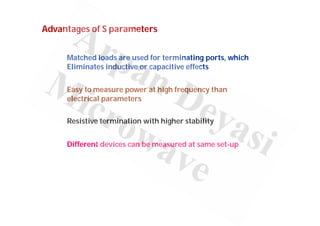
Matched loads are used for terminating ports, which
Eliminates inductive or capacitive effects
Easy to measure power at high frequency than
electrical parameters
Resistive termination with higher stability
Different devices can be measured at same set-up
Disadvantages of S parameters
Very difficult to interpret the measurements
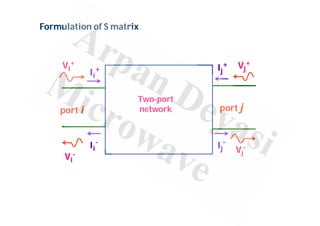
Formulation of S matrix
Two-port
network
Ii
+ Ij
+
Ij
-
Ii
-
port i port j
Vi
+ Vj
+
Vi
-
Vj
-
Formulation of S matrix
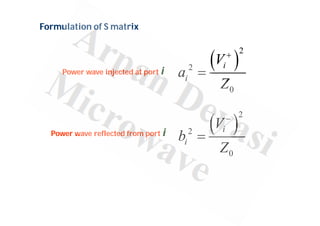
Power wave injected at port i
 
2
2
0
i
i
V
a
Z


Power wave reflected from port i
 
2
2
0
i
i
V
b
Z


Formulation of S matrix
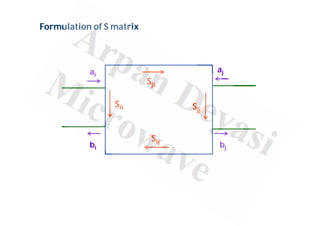
ai
aj
bi bj
Sji
Sij
Sii Sjj
Formulation of S matrix
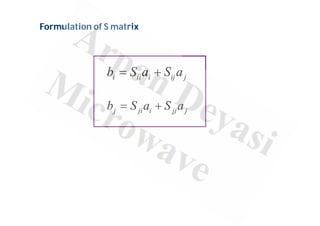
i ii i ij j
b S a S a
 
j ji i jj j
b S a S a
 
Formulation of S matrix
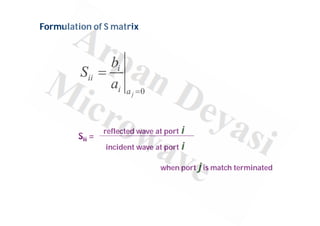
0
j
i
ii
i a
b
S
a 

Sii =
reflected wave at port i
incident wave at port i
when port j is match terminated
Formulation of S matrix
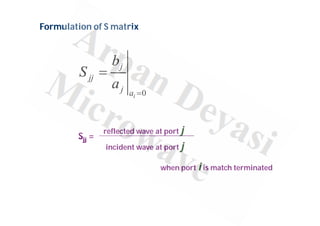
0
i
j
jj
j a
b
S
a


Sjj =
reflected wave at port j
incident wave at port j
when port i is match terminated
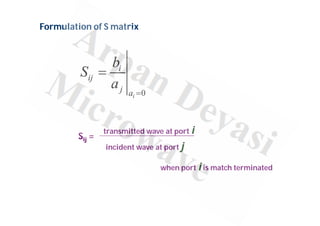
Formulation of S matrix
0
i
i
ij
j a
b
S
a


Sij =
transmitted wave at port i
incident wave at port j
when port i is match terminated
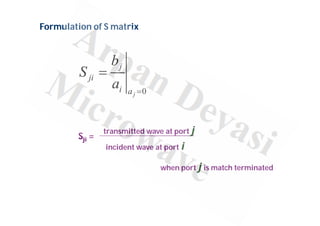
Formulation of S matrix
0
j
j
ji
i a
b
S
a 

Sji =
transmitted wave at port j
incident wave at port i
when port j is match terminated
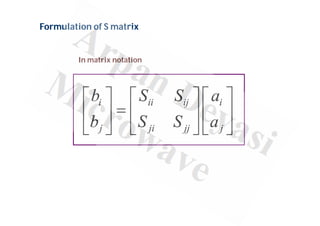
Formulation of S matrix
In matrix notation
i ii ij i
j ji jj j
b S S a
b S S a
     

     
     
Formulation of S matrix
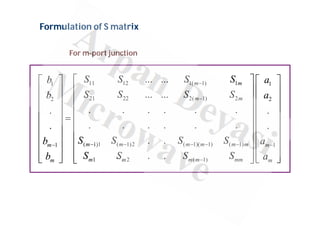
For m-port junction
11 12 1( 1) 1
1 1
21 22 2( 1) 2
2 2
( 1)1 ( 1)2 ( 1)( 1) ( 1)
1 1
1 2 ( 1)
... ...
... ...
. . . . . .
. .
. . . . . .
. .
. .
. .
m m
m m
m m m m m m
m m
m m m m mm
m m
S S S S
b a
S S S S
b a
S S S S
b a
S S S S
b a


    
 

 
   
 
   
 
   
 
   
  
   
 
   
 
   
 
   
   
 
   
 
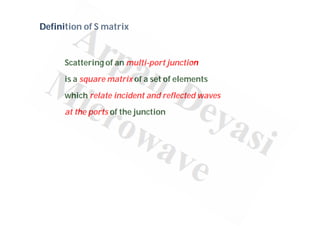
Definition of S matrix
Scattering of an multi-port junction
is a square matrix of a set of elements
which relate incident and reflected waves
at the ports of the junction
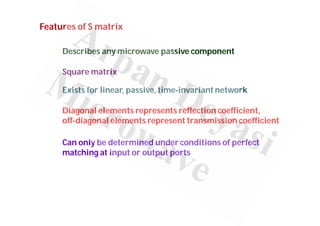
Features of S matrix
Describes any microwave passive component
Square matrix
Exists for linear, passive, time-invariant network
Diagonal elements represents reflection coefficient,
off-diagonal elements represent transmission coefficient
Can only be determined under conditions of perfect
matching at input or output ports
Reciprocity property of a network
If phase and power transfer do not change when
input and output ports are interchanged, then
the network is called reciprocal
o Reciprocal network should be LTI
o Reciprocal network can’t have dependent electrical sources
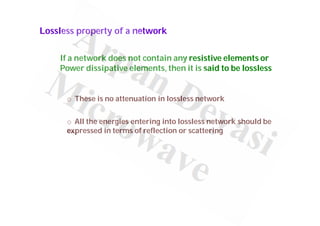
Lossless property of a network
If a network does not contain any resistive elements or
Power dissipative elements, then it is said to be lossless
o These is no attenuation in lossless network
o All the energies entering into lossless network should be
expressed in terms of reflection or scattering
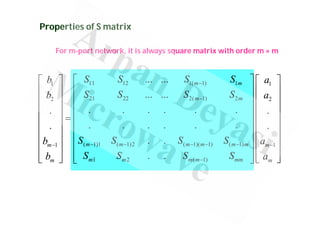
Properties of S matrix
For m-port network, it is always square matrix with order m × m
11 12 1( 1) 1
1 1
21 22 2( 1) 2
2 2
( 1)1 ( 1)2 ( 1)( 1) ( 1)
1 1
1 2 ( 1)
... ...
... ...
. . . . . .
. .
. . . . . .
. .
. .
. .
m m
m m
m m m m m m
m m
m m m m mm
m m
S S S S
b a
S S S S
b a
S S S S
b a
S S S S
b a


    
 

 
   
 
   
 
   
 
   
  
   
 
   
 
   
 
   
   
 
   
 
Properties of S matrix
Under perfect matched condition,
diagonal elements of [S] are equal to ‘0’
0
ii
S 
Properties of S matrix
[S] is symmetric for all reciprocal networks
   
T
S S

ij ji
S S

ii ij ii ji
ji jj ij jj
S S S S
S S S S
   

   
   
Properties of S matrix
For lossless network, [S] matrix is unitary
  
*
S S I

*
1 0
0 1
ii ij ii ij
ji jj ji jj
S S S S
S S S S
     

     
 
   
Properties of S matrix
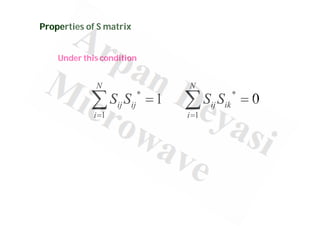
Under this condition
*
1
1
N
ij ij
i
S S


 *
1
0
N
ij ik
i
S S



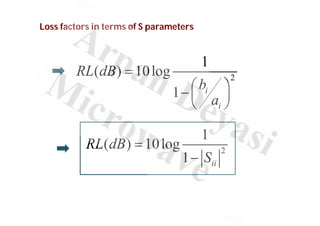
Loss factors in terms of S parameters
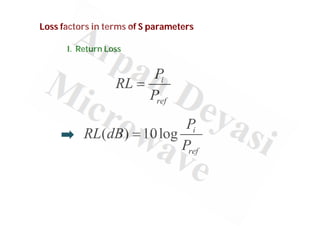
I. Return Loss
i
ref
P
RL
P

( ) 10log i
ref
P
RL dB
P

Loss factors in terms of S parameters
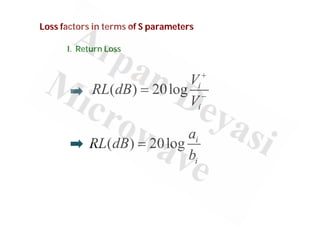
I. Return Loss
( ) 20log i
i
a
RL dB
b

( ) 20log i
i
V
RL dB
V



Loss factors in terms of S parameters
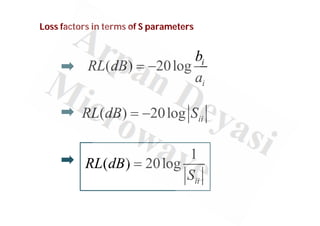
( ) 20log i
i
b
RL dB
a
 
( ) 20log ii
RL dB S
 
1
( ) 20log
ii
RL dB
S

Loss factors in terms of S parameters
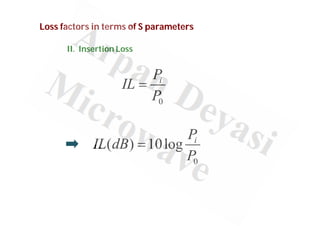
II. Insertion Loss
0
i
P
IL
P

0
( ) 10log i
P
IL dB
P

Loss factors in terms of S parameters
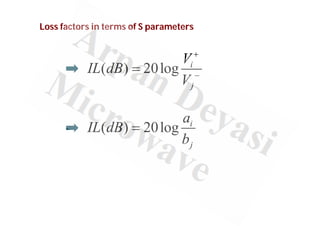
( ) 20log i
j
V
IL dB
V



( ) 20log i
j
a
IL dB
b

Loss factors in terms of S parameters
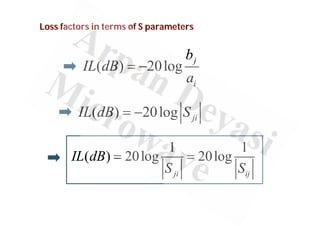
( ) 20log ji
IL dB S
 
( ) 20log j
i
b
IL dB
a
 
1 1
( ) 20log 20log
ji ij
IL dB
S S
 
Loss factors in terms of S parameters
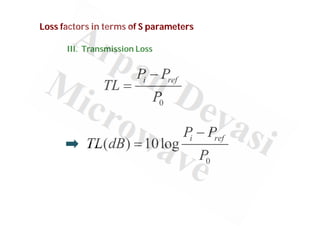
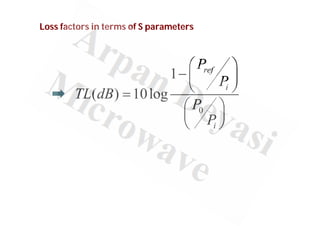
III. Transmission Loss
0
i ref
P P
TL
P


0
( ) 10log i ref
P P
TL dB
P


Loss factors in terms of S parameters
0
1
( ) 10log
ref
i
i
P
P
TL dB
P
P
 
 
 

 
 
 
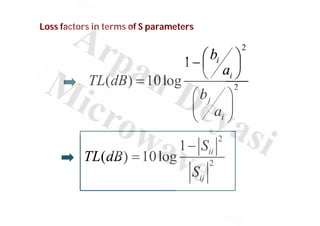
Loss factors in terms of S parameters
2
2
1
( ) 10log
i
i
j
i
b
a
TL dB
b
a
 
 
 

 
 
 
2
2
1
( ) 10log ii
ij
S
TL dB
S


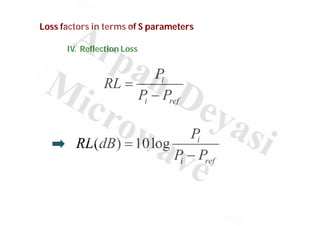
Loss factors in terms of S parameters
IV. Reflection Loss
i
i ref
P
RL
P P


( ) 10log i
i ref
P
RL dB
P P


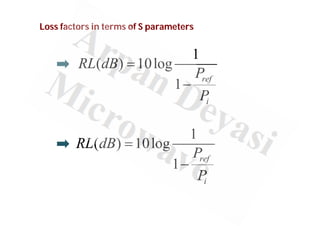
Loss factors in terms of S parameters
1
( ) 10log
1 ref
i
RL dB
P
P


1
( ) 10log
1 ref
i
RL dB
P
P


Loss factors in terms of S parameters
2
1
( ) 10log
1 i
i
RL dB
b
a

 
 
 
2
1
( ) 10log
1 ii
RL dB
S



Scattering matrix

  • 1.
  • 2.
    Network parameters existso far:  Z-parameter  Y-parameter  ABCD parameter These are derived from terminal voltage and current measurements require applications of short-circuit and open-circuit terminations for evaluation
  • 3.
    Shortcomings ?? Voltages andcurrents are distributed and vary with their position in microwave frequencies Active devices become unstable when terminated with open or short circuits at high frequency Effect of interconnecting leads between test equipments and device under test becomes critical at high frequency Over a wider spectrum of frequency, it is difficult to achieve short and open circuits
  • 4.
    Solution Scattering parameters (Sparameters) It’s calculation is based on forward (incident) and backward (reflected) travelling waves on terminal transmission lines The directly measurable quantities are amplitude and phase of incident and reflected waves
  • 5.
    Advantages of Sparameters Matched loads are used for terminating ports, which Eliminates inductive or capacitive effects Easy to measure power at high frequency than electrical parameters Resistive termination with higher stability Different devices can be measured at same set-up
  • 6.
    Disadvantages of Sparameters Very difficult to interpret the measurements
  • 7.
    Formulation of Smatrix Two-port network Ii + Ij + Ij - Ii - port i port j Vi + Vj + Vi - Vj -
  • 8.
    Formulation of Smatrix Power wave injected at port i   2 2 0 i i V a Z   Power wave reflected from port i   2 2 0 i i V b Z  
  • 9.
    Formulation of Smatrix ai aj bi bj Sji Sij Sii Sjj
  • 10.
    Formulation of Smatrix i ii i ij j b S a S a   j ji i jj j b S a S a  
  • 11.
    Formulation of Smatrix 0 j i ii i a b S a   Sii = reflected wave at port i incident wave at port i when port j is match terminated
  • 12.
    Formulation of Smatrix 0 i j jj j a b S a   Sjj = reflected wave at port j incident wave at port j when port i is match terminated
  • 13.
    Formulation of Smatrix 0 i i ij j a b S a   Sij = transmitted wave at port i incident wave at port j when port i is match terminated
  • 14.
    Formulation of Smatrix 0 j j ji i a b S a   Sji = transmitted wave at port j incident wave at port i when port j is match terminated
  • 15.
    Formulation of Smatrix In matrix notation i ii ij i j ji jj j b S S a b S S a                   
  • 16.
    Formulation of Smatrix For m-port junction 11 12 1( 1) 1 1 1 21 22 2( 1) 2 2 2 ( 1)1 ( 1)2 ( 1)( 1) ( 1) 1 1 1 2 ( 1) ... ... ... ... . . . . . . . . . . . . . . . . . . . . m m m m m m m m m m m m m m m m mm m m S S S S b a S S S S b a S S S S b a S S S S b a                                                                       
  • 17.
    Definition of Smatrix Scattering of an multi-port junction is a square matrix of a set of elements which relate incident and reflected waves at the ports of the junction
  • 18.
    Features of Smatrix Describes any microwave passive component Square matrix Exists for linear, passive, time-invariant network Diagonal elements represents reflection coefficient, off-diagonal elements represent transmission coefficient Can only be determined under conditions of perfect matching at input or output ports
  • 19.
    Reciprocity property ofa network If phase and power transfer do not change when input and output ports are interchanged, then the network is called reciprocal o Reciprocal network should be LTI o Reciprocal network can’t have dependent electrical sources
  • 20.
    Lossless property ofa network If a network does not contain any resistive elements or Power dissipative elements, then it is said to be lossless o These is no attenuation in lossless network o All the energies entering into lossless network should be expressed in terms of reflection or scattering
  • 21.
    Properties of Smatrix For m-port network, it is always square matrix with order m × m 11 12 1( 1) 1 1 1 21 22 2( 1) 2 2 2 ( 1)1 ( 1)2 ( 1)( 1) ( 1) 1 1 1 2 ( 1) ... ... ... ... . . . . . . . . . . . . . . . . . . . . m m m m m m m m m m m m m m m m mm m m S S S S b a S S S S b a S S S S b a S S S S b a                                                                       
  • 22.
    Properties of Smatrix Under perfect matched condition, diagonal elements of [S] are equal to ‘0’ 0 ii S 
  • 23.
    Properties of Smatrix [S] is symmetric for all reciprocal networks     T S S  ij ji S S  ii ij ii ji ji jj ij jj S S S S S S S S             
  • 24.
    Properties of Smatrix For lossless network, [S] matrix is unitary    * S S I  * 1 0 0 1 ii ij ii ij ji jj ji jj S S S S S S S S                   
  • 25.
    Properties of Smatrix Under this condition * 1 1 N ij ij i S S    * 1 0 N ij ik i S S   
  • 26.
    Loss factors interms of S parameters I. Return Loss i ref P RL P  ( ) 10log i ref P RL dB P 
  • 27.
    Loss factors interms of S parameters I. Return Loss ( ) 20log i i a RL dB b  ( ) 20log i i V RL dB V   
  • 28.
    Loss factors interms of S parameters ( ) 20log i i b RL dB a   ( ) 20log ii RL dB S   1 ( ) 20log ii RL dB S 
  • 29.
    Loss factors interms of S parameters II. Insertion Loss 0 i P IL P  0 ( ) 10log i P IL dB P 
  • 30.
    Loss factors interms of S parameters ( ) 20log i j V IL dB V    ( ) 20log i j a IL dB b 
  • 31.
    Loss factors interms of S parameters ( ) 20log ji IL dB S   ( ) 20log j i b IL dB a   1 1 ( ) 20log 20log ji ij IL dB S S  
  • 32.
    Loss factors interms of S parameters III. Transmission Loss 0 i ref P P TL P   0 ( ) 10log i ref P P TL dB P  
  • 33.
    Loss factors interms of S parameters 0 1 ( ) 10log ref i i P P TL dB P P             
  • 34.
    Loss factors interms of S parameters 2 2 1 ( ) 10log i i j i b a TL dB b a              2 2 1 ( ) 10log ii ij S TL dB S  
  • 35.
    Loss factors interms of S parameters IV. Reflection Loss i i ref P RL P P   ( ) 10log i i ref P RL dB P P  
  • 36.
    Loss factors interms of S parameters 1 ( ) 10log 1 ref i RL dB P P   1 ( ) 10log 1 ref i RL dB P P  
  • 37.
    Loss factors interms of S parameters 2 1 ( ) 10log 1 i i RL dB b a        2 1 ( ) 10log 1 ii RL dB S  