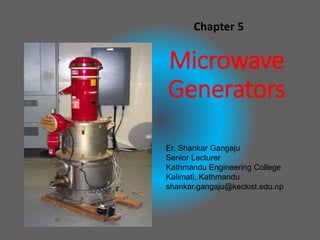
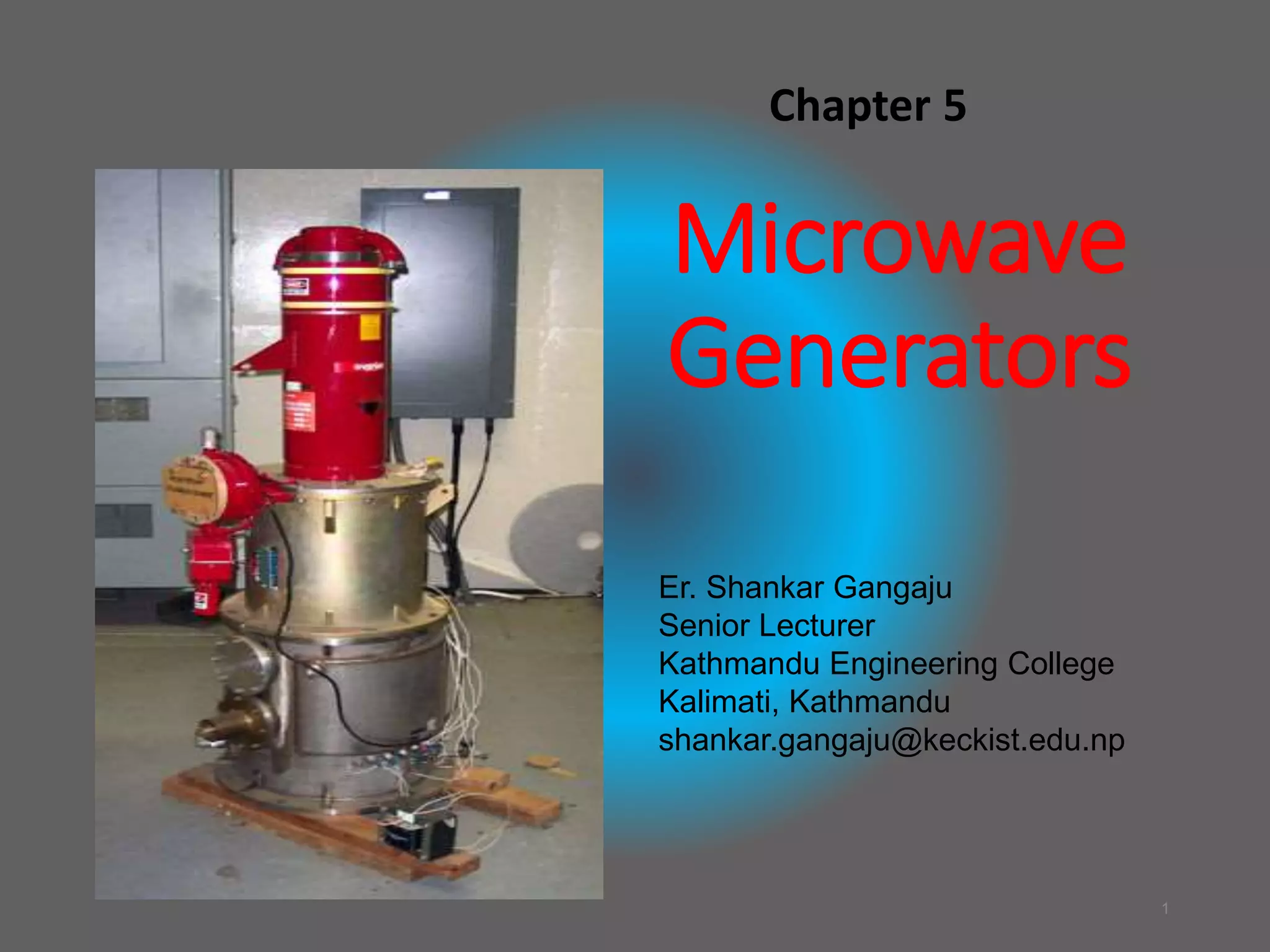
Microwave
Generators
Chapter 5
1
Er. Shankar Gangaju
Senior Lecturer
Kathmandu Engineering College
Kalimati, Kathmandu
shankar.gangaju@keckist.edu.np
Conventional Tubes at Microwaves
•The conventional tubes (triodes, pentodes) at
microwave frequencies become less effective when
used as an oscillator or amplifier.
•An amplifier requires greater amount of driving
power so the gain falls to unity or even less.
•Similarly the output of oscillator drops rapidly with
increase in frequency.
•There are many factors which deteriorate the
performance of microwave tubes at ultra high
frequency.
2
Limitations of Conventional Tubes
at Microwaves
•The factors contributing to reduction of output at
high frequencies are:
1. Circuit reactance
• Inter-electrode capacitance
• Lead inductance
2. Transit time effect
3. Cathode emission
4. Power loss due to skin effect, radiation,
dielectric loss.
3
Limitations of Conventional Tubes
at Microwaves
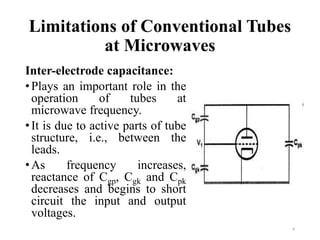
Inter-electrode capacitance:
•Plays an important role in the
operation of tubes at
microwave frequency.
•It is due to active parts of tube
structure, i.e., between the
leads.
•As frequency increases,
reactance of Cgp, Cgk and Cpk
decreases and begins to short
circuit the input and output
voltages.
4
Limitations of Conventional Tubes
at Microwaves
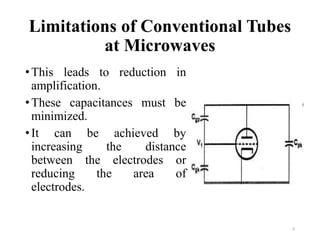
•This leads to reduction in
amplification.
•These capacitances must be
minimized.
•It can be achieved by
increasing the distance
between the electrodes or
reducing the area of
electrodes.
5
Limitations of Conventional Tubes
at Microwaves
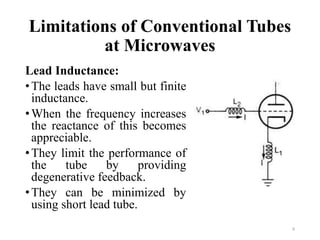
Lead Inductance:
•The leads have small but finite
inductance.
•When the frequency increases
the reactance of this becomes
appreciable.
•They limit the performance of
the tube by providing
degenerative feedback.
•They can be minimized by
using short lead tube.
6
Limitations of Conventional Tubes
at Microwaves
Transit Time Effect:
• The time taken by an electron to travel from the cathode
to anode plate of an electron tube is called transit time.
• The transit time is insignificant at low frequencies so
that it is generally not considered to be a hindering
factor.
• However, at high frequencies, transit time becomes an
appreciable portion of a signal cycle and begins to
hinder efficiency.
• For example, a transit time of 1 nanosecond, which is
not unusual, is only 0.001 cycle at a frequency of 1
megahertz.
• The same transit time becomes equal to the time
required for an entire cycle at 1,000 megahertz.
7
Limitations of Conventional Tubes
at Microwaves
•Transit time depends on electrode spacing and
existing voltage potentials.
•Transit times in excess of 0.1 cycle cause a
significant decrease in tube efficiency.
•This decrease in efficiency is caused, in part, by a
phase shift between plate current and grid voltage.
•To minimize the effect of transit time, the distance
between electrodes is to be reduced and higher
voltage must be applied.
•Compromise between inter- electrode capacitance
and transit time. 8
Limitations of Conventional Tubes
at Microwaves
Cathode Emission:
•High cathode emission can be achieved by
increasing area of cathode, increasing cathode
filament voltage and higher filament temperature.
•But increasing area of cathode increases the inter-
electrode capacitances.
•Also the cathode voltage and temperature cannot be
increased beyond a limit.
9
Limitations of Conventional Tubes
at Microwaves
Power Losses:
•The power losses associated with a tube and circuit
increases with frequency.
•At UHF, current flows in the surface layer due to
skin effect.
•The associated resistance and losses increase as
square root of frequency.
•The loss in glass tubes are dielectric losses.
10
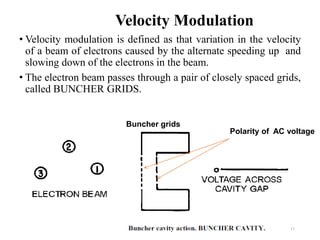
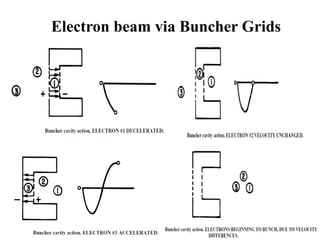
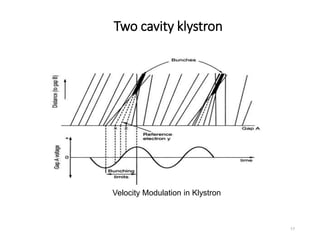
Velocity Modulation
• Velocity modulation is defined as that variation in the velocity
of a beam of electrons caused by the alternate speeding up and
slowing down of the electrons in the beam.
• The electron beam passes through a pair of closely spaced grids,
called BUNCHER GRIDS.
Buncher grids
Polarity of AC voltage
11
Electron beam via Buncher Grids
12
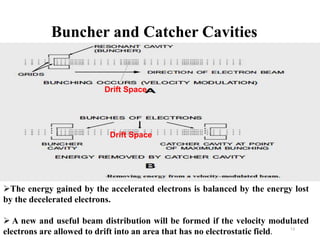
Buncher and Catcher Cavities
The energy gained by the accelerated electrons is balanced by the energy lost
by the decelerated electrons.
 A new and useful beam distribution will be formed if the velocity modulated
electrons are allowed to drift into an area that has no electrostatic field.
Drift Space
Drift Space
13
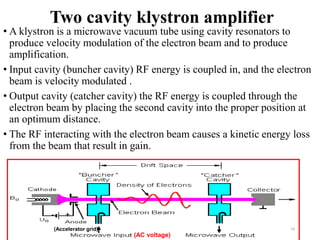
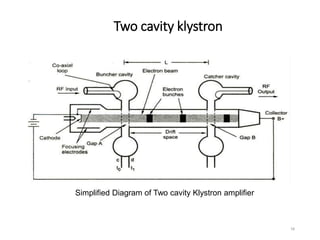
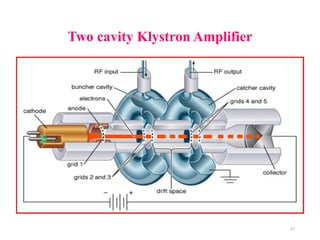
Two cavity klystron amplifier
• A klystron is a microwave vacuum tube using cavity resonators to
produce velocity modulation of the electron beam and to produce
amplification.
• Input cavity (buncher cavity) RF energy is coupled in, and the electron
beam is velocity modulated .
• Output cavity (catcher cavity) the RF energy is coupled through the
electron beam by placing the second cavity into the proper position at
an optimum distance.
• The RF interacting with the electron beam causes a kinetic energy loss
from the beam that result in gain.
+-
(Accelerator grid)
(AC voltage)
14
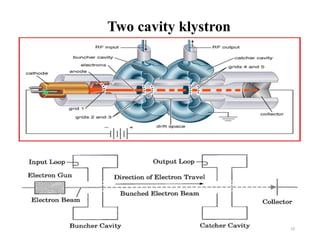
Two cavity klystron
15
Two cavity klystron
Simplified Diagram of Two cavity Klystron amplifier
16
Two cavity klystron
Velocity Modulation in Klystron
17
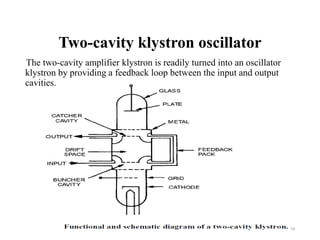
Two-cavity klystron oscillator
The two-cavity amplifier klystron is readily turned into an oscillator
klystron by providing a feedback loop between the input and output
cavities.
18
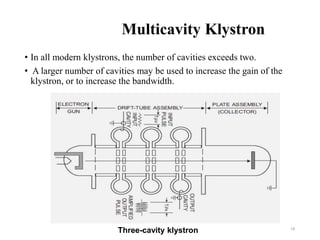
Multicavity Klystron
• In all modern klystrons, the number of cavities exceeds two.
• A larger number of cavities may be used to increase the gain of the
klystron, or to increase the bandwidth.
Three-cavity klystron 19
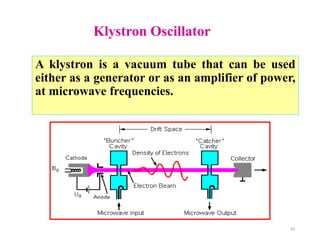
Klystron Oscillator
A klystron is a vacuum tube that can be used
either as a generator or as an amplifier of power,
at microwave frequencies.
20
Two cavity Klystron Amplifier
21
Applications
 As power output tubes
1. in UHF TV transmitters
2. in troposphere scatter transmitters
3. satellite communication ground station
4. radar transmitters
 As power oscillator (5 – 50 GHz), if used as a
klystron oscillator
22
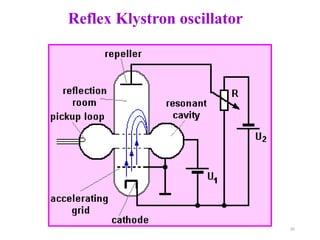
Reflex klystron Construction
A reflex klystron consists of an electron gun, a cavity with a pair
of grids and a repeller plate as shown in the above diagram.
In this klystron, a single pair of grids does the functions of both
the buncher and the catcher grids.
The main difference between two cavity reflex klystron amplifier
and reflex klystron is that the output cavity is omitted in reflex
klystron and the repeller or reflector electrode, placed a very short
distance from the single cavity, replaces the collector electrode.
23
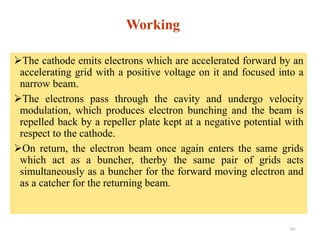
Working
The cathode emits electrons which are accelerated forward by an
accelerating grid with a positive voltage on it and focused into a
narrow beam.
The electrons pass through the cavity and undergo velocity
modulation, which produces electron bunching and the beam is
repelled back by a repeller plate kept at a negative potential with
respect to the cathode.
On return, the electron beam once again enters the same grids
which act as a buncher, therby the same pair of grids acts
simultaneously as a buncher for the forward moving electron and
as a catcher for the returning beam.
24
Reflex Klystron oscillator
25
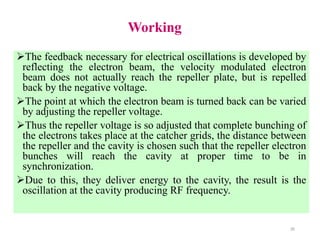
Working
The feedback necessary for electrical oscillations is developed by
reflecting the electron beam, the velocity modulated electron
beam does not actually reach the repeller plate, but is repelled
back by the negative voltage.
The point at which the electron beam is turned back can be varied
by adjusting the repeller voltage.
Thus the repeller voltage is so adjusted that complete bunching of
the electrons takes place at the catcher grids, the distance between
the repeller and the cavity is chosen such that the repeller electron
bunches will reach the cavity at proper time to be in
synchronization.
Due to this, they deliver energy to the cavity, the result is the
oscillation at the cavity producing RF frequency.
26
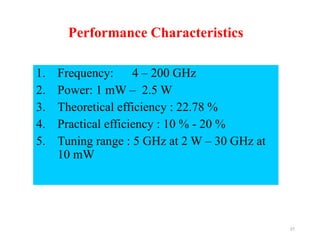
Performance Characteristics
1. Frequency: 4 – 200 GHz
2. Power: 1 mW – 2.5 W
3. Theoretical efficiency : 22.78 %
4. Practical efficiency : 10 % - 20 %
5. Tuning range : 5 GHz at 2 W – 30 GHz at
10 mW
27
Applications
 The reflex klystrons are used in
1. Radar receivers
2. Local oscillator in microwave receivers
3. Signal source in microwave generator of
variable frequency
4. Portable microwave links
5. Pump oscillator in parametric amplifier
28
Traveling Wave Tube
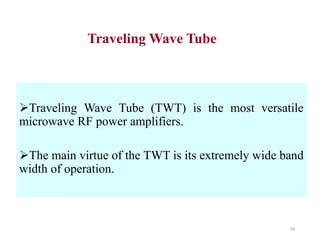
Traveling Wave Tube (TWT) is the most versatile
microwave RF power amplifiers.
The main virtue of the TWT is its extremely wide band
width of operation.
29
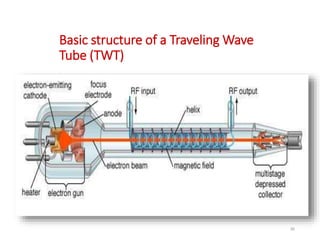
Basic structure of a Traveling Wave
Tube (TWT)
30
Traveling Wave Tube (TWT)
31
Basic structure
The basic structure of a TWT consists of a cathode and filament
heater plus an anode that is biased positively to accelerate the
electron beam forward and to focus it into a narrow beam.
The electrons are attracted by a positive plate called the collector,
which has given a high dc voltage.
The length of the tube is usually many wavelengths at the
operating frequency.
Surrounding the tube are either permanent magnets or
electromagnets that keep the electrons tightly focused into a
narrow beam.
32
Features
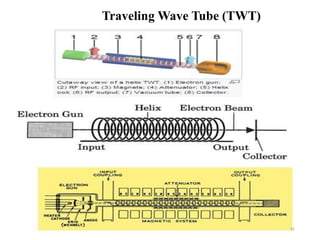
The unique feature of the TWT is a helix or coil that surrounds
the length of the tube and the electron beam passes through the
center or axis of the helix.
The microwave signal to be amplified is applied to the end of
the helix near the cathode and the output is taken from the end
of the helix near the collector.
The purpose of the helix is to provide path for RF signal.
The propagation of the RF signal along the helix is made
approximately equal to the velocity of the electron beam from
the cathode to the collector
33
Functioning
The passage of the microwave signal down the helix
produces electric and magnetic fields that will interact
with the electron beam.
The electromagnetic field produced by the helix causes
the electrons to be speeded up and slowed down, this
produces velocity modulation of the beam which
produces density modulation.
Density modulation causes bunches of electrons to
group together one wavelength apart and these bunch of
electrons travel down the length of the tube toward the
collector.
34
Functioning
The electron bunches induce voltages into the helix
which reinforce the voltage already present there. Due to
that the strength of the electromagnetic field on the helix
increases as the wave travels down the tube towards the
collector.
At the end of the helix, the signal is considerably
amplified. Coaxial cable or waveguide structures are
used to extract the energy from the helix.
35
Advantages
1. TWT has extremely wide bandwidth. Hence, it can
be made to amplify signals from UHF to hundreds of
gigahertz.
2. Most of the TWT’s have a frequency range of
approximately 2:1 in the desired segment of the
microwave region to be amplified.
3. The TWT’s can be used in both continuous and
pulsed modes of operation with power levels up to
several thousands watts.
36
Performance characteristics
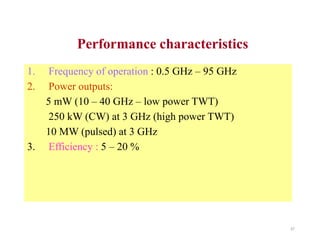
1. Frequency of operation : 0.5 GHz – 95 GHz
2. Power outputs:
5 mW (10 – 40 GHz – low power TWT)
250 kW (CW) at 3 GHz (high power TWT)
10 MW (pulsed) at 3 GHz
3. Efficiency : 5 – 20 %
37
Applications of TWT
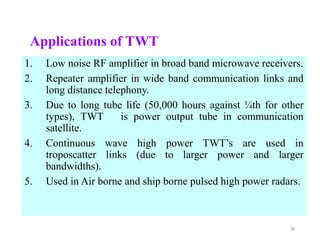
1. Low noise RF amplifier in broad band microwave receivers.
2. Repeater amplifier in wide band communication links and
long distance telephony.
3. Due to long tube life (50,000 hours against ¼th for other
types), TWT is power output tube in communication
satellite.
4. Continuous wave high power TWT’s are used in
troposcatter links (due to larger power and larger
bandwidths).
5. Used in Air borne and ship borne pulsed high power radars.
38
The Backward Wave Oscillator (BWO)
• A backward wave oscillator (BWO) also called carcinotron( trade
name)
• It is a vaccum tube that is used to generate microwaves upto the
terahertz range.
• Belongs to TWT family with a wide electronic tuning range.
• An electron gun generates an electron beam that is interacting with a
slow-wave structure.
• It sustains the oscillations by propagating a travelling wave
backwards against the beam.
• The generated EMW power has its group velocity directed oppositely
to the direction of motion of the electrons.
• The output power is coupled out near the electron gun.
39
The Backward Wave Oscillator (BWO)
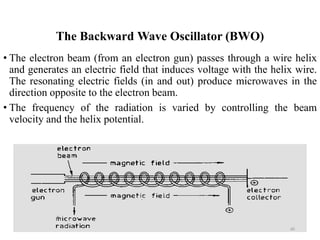
• The electron beam (from an electron gun) passes through a wire helix
and generates an electric field that induces voltage with the helix wire.
The resonating electric fields (in and out) produce microwaves in the
direction opposite to the electron beam.
• The frequency of the radiation is varied by controlling the beam
velocity and the helix potential.
40
Applications of Microwave tubes
• A klystron can be used either as a generator or as an amplifier of
power, at microwave frequencies.
Klystron as power output tubes
1. Satellite communication ground station
2. Radar transmitters
 The reflex klystrons are used in
1. Radar receivers
2. Local oscillator in microwave receivers
• BACKWARD WAVE OSCILLATOR (BWO)
1. Shorter & Thicker TWT
2. Microwave CW oscillator
3. 1-1000 GHz
41
Applications : Travelling Wave Tubes(TWT)
1. Low noise RF amplifier in broad band microwave
receivers.
2. Due to long tube life (50,000 hours against ¼th for
other types), TWT is power output tube in
communication satellite.
3. Continuous wave high power TWT’s are used in
troposcatter links (due to larger power and larger
bandwidths).
4. Used in Air borne and ship borne pulsed high power
radars.
42
Slow Wave Structures
• These are special circuits which are used in microwave tubes to
reduce the velocity of the wave in a certain direction so that the
electron beam and the signal wave can interact.
43
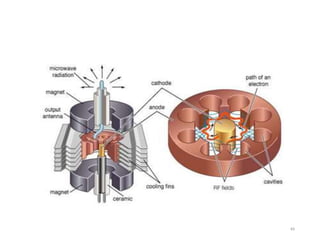
MAGNETRON
 The magnetron is a high-powered vacuum tube that
generates microwaves using the interaction of a stream of
electrons with a magnetic field.
 High-power oscillator
 Common in radar and microwave ovens
 Cathode in center, anode around outside
 Strong dc magnetic field around tube causes electrons from
cathode to spiral as they move toward anode
 Current of electrons generates microwaves in cavities
around outside
44
45
46
Operation
 In a magnetron, the source of electrons is a heated cathode
located on the axis of an anode structure containing a
number of microwave resonators.
 Electrons leave the cathode and are accelerated toward the
anode, due to the dc field established by the voltage source
E.
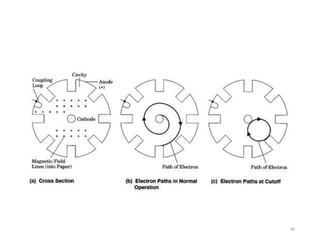
 The presence of a strong magnetic field B in the region
between cathode and anode produces a force on each
electron which is mutually perpendicular to the dc field and
the electron velocity vectors, thereby causing the electrons
to spiral away from the cathode in paths of varying
curvature, depending upon the initial electron velocity at the
time it leaves the cathode.
47
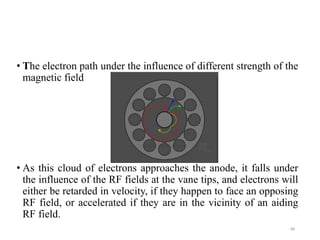
• The electron path under the influence of different strength of the
magnetic field
• As this cloud of electrons approaches the anode, it falls under
the influence of the RF fields at the vane tips, and electrons will
either be retarded in velocity, if they happen to face an opposing
RF field, or accelerated if they are in the vicinity of an aiding
RF field.
48
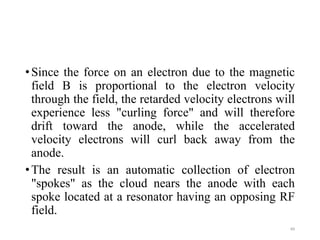
•Since the force on an electron due to the magnetic
field B is proportional to the electron velocity
through the field, the retarded velocity electrons will
experience less "curling force" and will therefore
drift toward the anode, while the accelerated
velocity electrons will curl back away from the
anode.
•The result is an automatic collection of electron
"spokes" as the cloud nears the anode with each
spoke located at a resonator having an opposing RF
field.
49
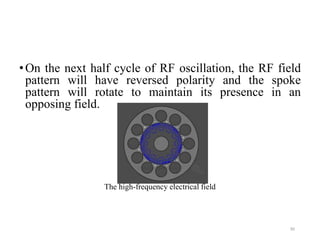
•On the next half cycle of RF oscillation, the RF field
pattern will have reversed polarity and the spoke
pattern will rotate to maintain its presence in an
opposing field.
The high-frequency electrical field
50

Microwave generators

  • 1.
    Microwave Generators Chapter 5 1 Er. ShankarGangaju Senior Lecturer Kathmandu Engineering College Kalimati, Kathmandu shankar.gangaju@keckist.edu.np
  • 2.
    Conventional Tubes atMicrowaves •The conventional tubes (triodes, pentodes) at microwave frequencies become less effective when used as an oscillator or amplifier. •An amplifier requires greater amount of driving power so the gain falls to unity or even less. •Similarly the output of oscillator drops rapidly with increase in frequency. •There are many factors which deteriorate the performance of microwave tubes at ultra high frequency. 2
  • 3.
    Limitations of ConventionalTubes at Microwaves •The factors contributing to reduction of output at high frequencies are: 1. Circuit reactance • Inter-electrode capacitance • Lead inductance 2. Transit time effect 3. Cathode emission 4. Power loss due to skin effect, radiation, dielectric loss. 3
  • 4.
    Limitations of ConventionalTubes at Microwaves Inter-electrode capacitance: •Plays an important role in the operation of tubes at microwave frequency. •It is due to active parts of tube structure, i.e., between the leads. •As frequency increases, reactance of Cgp, Cgk and Cpk decreases and begins to short circuit the input and output voltages. 4
  • 5.
    Limitations of ConventionalTubes at Microwaves •This leads to reduction in amplification. •These capacitances must be minimized. •It can be achieved by increasing the distance between the electrodes or reducing the area of electrodes. 5
  • 6.
    Limitations of ConventionalTubes at Microwaves Lead Inductance: •The leads have small but finite inductance. •When the frequency increases the reactance of this becomes appreciable. •They limit the performance of the tube by providing degenerative feedback. •They can be minimized by using short lead tube. 6
  • 7.
    Limitations of ConventionalTubes at Microwaves Transit Time Effect: • The time taken by an electron to travel from the cathode to anode plate of an electron tube is called transit time. • The transit time is insignificant at low frequencies so that it is generally not considered to be a hindering factor. • However, at high frequencies, transit time becomes an appreciable portion of a signal cycle and begins to hinder efficiency. • For example, a transit time of 1 nanosecond, which is not unusual, is only 0.001 cycle at a frequency of 1 megahertz. • The same transit time becomes equal to the time required for an entire cycle at 1,000 megahertz. 7
  • 8.
    Limitations of ConventionalTubes at Microwaves •Transit time depends on electrode spacing and existing voltage potentials. •Transit times in excess of 0.1 cycle cause a significant decrease in tube efficiency. •This decrease in efficiency is caused, in part, by a phase shift between plate current and grid voltage. •To minimize the effect of transit time, the distance between electrodes is to be reduced and higher voltage must be applied. •Compromise between inter- electrode capacitance and transit time. 8
  • 9.
    Limitations of ConventionalTubes at Microwaves Cathode Emission: •High cathode emission can be achieved by increasing area of cathode, increasing cathode filament voltage and higher filament temperature. •But increasing area of cathode increases the inter- electrode capacitances. •Also the cathode voltage and temperature cannot be increased beyond a limit. 9
  • 10.
    Limitations of ConventionalTubes at Microwaves Power Losses: •The power losses associated with a tube and circuit increases with frequency. •At UHF, current flows in the surface layer due to skin effect. •The associated resistance and losses increase as square root of frequency. •The loss in glass tubes are dielectric losses. 10
  • 11.
    Velocity Modulation • Velocitymodulation is defined as that variation in the velocity of a beam of electrons caused by the alternate speeding up and slowing down of the electrons in the beam. • The electron beam passes through a pair of closely spaced grids, called BUNCHER GRIDS. Buncher grids Polarity of AC voltage 11
  • 12.
    Electron beam viaBuncher Grids 12
  • 13.
    Buncher and CatcherCavities The energy gained by the accelerated electrons is balanced by the energy lost by the decelerated electrons.  A new and useful beam distribution will be formed if the velocity modulated electrons are allowed to drift into an area that has no electrostatic field. Drift Space Drift Space 13
  • 14.
    Two cavity klystronamplifier • A klystron is a microwave vacuum tube using cavity resonators to produce velocity modulation of the electron beam and to produce amplification. • Input cavity (buncher cavity) RF energy is coupled in, and the electron beam is velocity modulated . • Output cavity (catcher cavity) the RF energy is coupled through the electron beam by placing the second cavity into the proper position at an optimum distance. • The RF interacting with the electron beam causes a kinetic energy loss from the beam that result in gain. +- (Accelerator grid) (AC voltage) 14
  • 15.
  • 16.
    Two cavity klystron SimplifiedDiagram of Two cavity Klystron amplifier 16
  • 17.
    Two cavity klystron VelocityModulation in Klystron 17
  • 18.
    Two-cavity klystron oscillator Thetwo-cavity amplifier klystron is readily turned into an oscillator klystron by providing a feedback loop between the input and output cavities. 18
  • 19.
    Multicavity Klystron • Inall modern klystrons, the number of cavities exceeds two. • A larger number of cavities may be used to increase the gain of the klystron, or to increase the bandwidth. Three-cavity klystron 19
  • 20.
    Klystron Oscillator A klystronis a vacuum tube that can be used either as a generator or as an amplifier of power, at microwave frequencies. 20
  • 21.
    Two cavity KlystronAmplifier 21
  • 22.
    Applications  As poweroutput tubes 1. in UHF TV transmitters 2. in troposphere scatter transmitters 3. satellite communication ground station 4. radar transmitters  As power oscillator (5 – 50 GHz), if used as a klystron oscillator 22
  • 23.
    Reflex klystron Construction Areflex klystron consists of an electron gun, a cavity with a pair of grids and a repeller plate as shown in the above diagram. In this klystron, a single pair of grids does the functions of both the buncher and the catcher grids. The main difference between two cavity reflex klystron amplifier and reflex klystron is that the output cavity is omitted in reflex klystron and the repeller or reflector electrode, placed a very short distance from the single cavity, replaces the collector electrode. 23
  • 24.
    Working The cathode emitselectrons which are accelerated forward by an accelerating grid with a positive voltage on it and focused into a narrow beam. The electrons pass through the cavity and undergo velocity modulation, which produces electron bunching and the beam is repelled back by a repeller plate kept at a negative potential with respect to the cathode. On return, the electron beam once again enters the same grids which act as a buncher, therby the same pair of grids acts simultaneously as a buncher for the forward moving electron and as a catcher for the returning beam. 24
  • 25.
  • 26.
    Working The feedback necessaryfor electrical oscillations is developed by reflecting the electron beam, the velocity modulated electron beam does not actually reach the repeller plate, but is repelled back by the negative voltage. The point at which the electron beam is turned back can be varied by adjusting the repeller voltage. Thus the repeller voltage is so adjusted that complete bunching of the electrons takes place at the catcher grids, the distance between the repeller and the cavity is chosen such that the repeller electron bunches will reach the cavity at proper time to be in synchronization. Due to this, they deliver energy to the cavity, the result is the oscillation at the cavity producing RF frequency. 26
  • 27.
    Performance Characteristics 1. Frequency:4 – 200 GHz 2. Power: 1 mW – 2.5 W 3. Theoretical efficiency : 22.78 % 4. Practical efficiency : 10 % - 20 % 5. Tuning range : 5 GHz at 2 W – 30 GHz at 10 mW 27
  • 28.
    Applications  The reflexklystrons are used in 1. Radar receivers 2. Local oscillator in microwave receivers 3. Signal source in microwave generator of variable frequency 4. Portable microwave links 5. Pump oscillator in parametric amplifier 28
  • 29.
    Traveling Wave Tube TravelingWave Tube (TWT) is the most versatile microwave RF power amplifiers. The main virtue of the TWT is its extremely wide band width of operation. 29
  • 30.
    Basic structure ofa Traveling Wave Tube (TWT) 30
  • 31.
  • 32.
    Basic structure The basicstructure of a TWT consists of a cathode and filament heater plus an anode that is biased positively to accelerate the electron beam forward and to focus it into a narrow beam. The electrons are attracted by a positive plate called the collector, which has given a high dc voltage. The length of the tube is usually many wavelengths at the operating frequency. Surrounding the tube are either permanent magnets or electromagnets that keep the electrons tightly focused into a narrow beam. 32
  • 33.
    Features The unique featureof the TWT is a helix or coil that surrounds the length of the tube and the electron beam passes through the center or axis of the helix. The microwave signal to be amplified is applied to the end of the helix near the cathode and the output is taken from the end of the helix near the collector. The purpose of the helix is to provide path for RF signal. The propagation of the RF signal along the helix is made approximately equal to the velocity of the electron beam from the cathode to the collector 33
  • 34.
    Functioning The passage ofthe microwave signal down the helix produces electric and magnetic fields that will interact with the electron beam. The electromagnetic field produced by the helix causes the electrons to be speeded up and slowed down, this produces velocity modulation of the beam which produces density modulation. Density modulation causes bunches of electrons to group together one wavelength apart and these bunch of electrons travel down the length of the tube toward the collector. 34
  • 35.
    Functioning The electron bunchesinduce voltages into the helix which reinforce the voltage already present there. Due to that the strength of the electromagnetic field on the helix increases as the wave travels down the tube towards the collector. At the end of the helix, the signal is considerably amplified. Coaxial cable or waveguide structures are used to extract the energy from the helix. 35
  • 36.
    Advantages 1. TWT hasextremely wide bandwidth. Hence, it can be made to amplify signals from UHF to hundreds of gigahertz. 2. Most of the TWT’s have a frequency range of approximately 2:1 in the desired segment of the microwave region to be amplified. 3. The TWT’s can be used in both continuous and pulsed modes of operation with power levels up to several thousands watts. 36
  • 37.
    Performance characteristics 1. Frequencyof operation : 0.5 GHz – 95 GHz 2. Power outputs: 5 mW (10 – 40 GHz – low power TWT) 250 kW (CW) at 3 GHz (high power TWT) 10 MW (pulsed) at 3 GHz 3. Efficiency : 5 – 20 % 37
  • 38.
    Applications of TWT 1.Low noise RF amplifier in broad band microwave receivers. 2. Repeater amplifier in wide band communication links and long distance telephony. 3. Due to long tube life (50,000 hours against ¼th for other types), TWT is power output tube in communication satellite. 4. Continuous wave high power TWT’s are used in troposcatter links (due to larger power and larger bandwidths). 5. Used in Air borne and ship borne pulsed high power radars. 38
  • 39.
    The Backward WaveOscillator (BWO) • A backward wave oscillator (BWO) also called carcinotron( trade name) • It is a vaccum tube that is used to generate microwaves upto the terahertz range. • Belongs to TWT family with a wide electronic tuning range. • An electron gun generates an electron beam that is interacting with a slow-wave structure. • It sustains the oscillations by propagating a travelling wave backwards against the beam. • The generated EMW power has its group velocity directed oppositely to the direction of motion of the electrons. • The output power is coupled out near the electron gun. 39
  • 40.
    The Backward WaveOscillator (BWO) • The electron beam (from an electron gun) passes through a wire helix and generates an electric field that induces voltage with the helix wire. The resonating electric fields (in and out) produce microwaves in the direction opposite to the electron beam. • The frequency of the radiation is varied by controlling the beam velocity and the helix potential. 40
  • 41.
    Applications of Microwavetubes • A klystron can be used either as a generator or as an amplifier of power, at microwave frequencies. Klystron as power output tubes 1. Satellite communication ground station 2. Radar transmitters  The reflex klystrons are used in 1. Radar receivers 2. Local oscillator in microwave receivers • BACKWARD WAVE OSCILLATOR (BWO) 1. Shorter & Thicker TWT 2. Microwave CW oscillator 3. 1-1000 GHz 41
  • 42.
    Applications : TravellingWave Tubes(TWT) 1. Low noise RF amplifier in broad band microwave receivers. 2. Due to long tube life (50,000 hours against ¼th for other types), TWT is power output tube in communication satellite. 3. Continuous wave high power TWT’s are used in troposcatter links (due to larger power and larger bandwidths). 4. Used in Air borne and ship borne pulsed high power radars. 42
  • 43.
    Slow Wave Structures •These are special circuits which are used in microwave tubes to reduce the velocity of the wave in a certain direction so that the electron beam and the signal wave can interact. 43
  • 44.
    MAGNETRON  The magnetronis a high-powered vacuum tube that generates microwaves using the interaction of a stream of electrons with a magnetic field.  High-power oscillator  Common in radar and microwave ovens  Cathode in center, anode around outside  Strong dc magnetic field around tube causes electrons from cathode to spiral as they move toward anode  Current of electrons generates microwaves in cavities around outside 44
  • 45.
  • 46.
  • 47.
    Operation  In amagnetron, the source of electrons is a heated cathode located on the axis of an anode structure containing a number of microwave resonators.  Electrons leave the cathode and are accelerated toward the anode, due to the dc field established by the voltage source E.  The presence of a strong magnetic field B in the region between cathode and anode produces a force on each electron which is mutually perpendicular to the dc field and the electron velocity vectors, thereby causing the electrons to spiral away from the cathode in paths of varying curvature, depending upon the initial electron velocity at the time it leaves the cathode. 47
  • 48.
    • The electronpath under the influence of different strength of the magnetic field • As this cloud of electrons approaches the anode, it falls under the influence of the RF fields at the vane tips, and electrons will either be retarded in velocity, if they happen to face an opposing RF field, or accelerated if they are in the vicinity of an aiding RF field. 48
  • 49.
    •Since the forceon an electron due to the magnetic field B is proportional to the electron velocity through the field, the retarded velocity electrons will experience less "curling force" and will therefore drift toward the anode, while the accelerated velocity electrons will curl back away from the anode. •The result is an automatic collection of electron "spokes" as the cloud nears the anode with each spoke located at a resonator having an opposing RF field. 49
  • 50.
    •On the nexthalf cycle of RF oscillation, the RF field pattern will have reversed polarity and the spoke pattern will rotate to maintain its presence in an opposing field. The high-frequency electrical field 50