WAVEGUIDES
     CALDERON
    DE GUZMAN
      QUITEVIS
RF Waveguides
• Form of RF feeder used for microwave
  applications
• Used in a variety of applications to
  carry radio frequency energy from one
  point to another
• System of material that is designed
  to confine electromagnetic waves in
  a direction defined by its physical
  boundaries
Waveguides
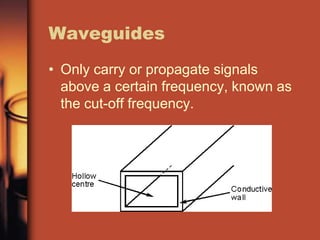
• Only carry or propagate signals
  above a certain frequency, known as
  the cut-off frequency.
RF Waveguide
TYPES
Rectangular waveguide
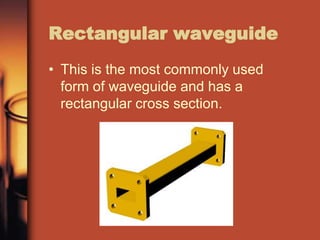
• This is the most commonly used
  form of waveguide and has a
  rectangular cross section.
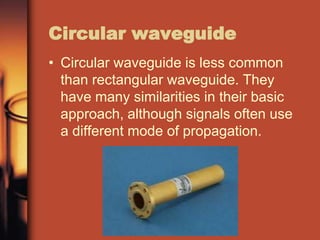
Circular waveguide
• Circular waveguide is less common
  than rectangular waveguide. They
  have many similarities in their basic
  approach, although signals often use
  a different mode of propagation.
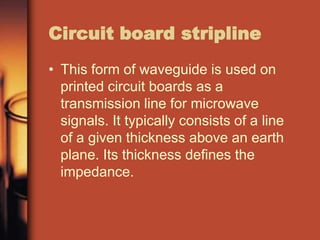
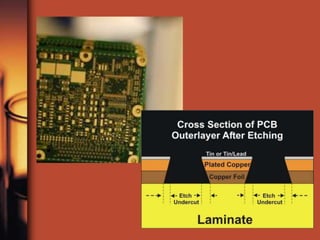
Circuit board stripline
• This form of waveguide is used on
  printed circuit boards as a
  transmission line for microwave
  signals. It typically consists of a line
  of a given thickness above an earth
  plane. Its thickness defines the
  impedance.
Waveguides
Theory of Propagation
• According to waveguide theory there
  are a number of different types of
  electromagnetic wave that can
  propagate within the waveguide.
  These different types of waves
  correspond to the different elements
  within an electromagnetic wave.
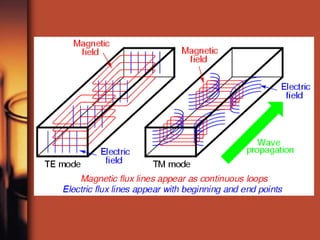
TE Waves
• Transverse electric waves, also
  sometimes called H waves, are
  characterised by the fact that the
  electric vector (E) is always
  perpendicular to the direction of
  propagation.
TM Waves
• Transverse magnetic waves, also
  called E waves are characterised by
  the fact that the magnetic vector (H
  vector) is always perpendicular to
  the direction of propagation.
TEM waves
• Cannot be propagated within a
  waveguide, but is included for
  completeness. It is the mode that is
  commonly used within coaxial and
  open wire feeders. The TEM wave is
  characterised by the fact that both
  the electric vector (E vector) and the
  magnetic vector (H vector) are
  perpendicular to the direction of
  propagation.
Waveguide Theory
Rules of Thumb
• For rectangular waveguides, the
  TE10 mode of propagation is the
  lowest mode that is supported.
• For rectangular waveguides, the
  waveguide width, i.e. the widest
  internal dimension of the cross
  section, determines the lower cut-off
  frequency and is equal to 1/2
  wavelength of the lower cut-off
  frequency.
• For rectangular waveguides, the
  TE01 mode occurs when the height
  equals 1/2 wavelength of the cut-off
  frequency.
• For rectangular waveguides, the
  TE20, occurs when the width equals
  one wavelength of the lower cut-off
  frequency.
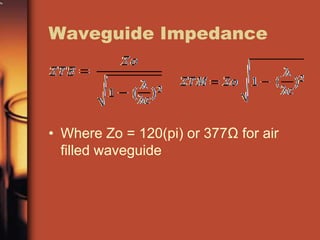
Waveguide Impedance


• Where Zo = 120(pi) or 377Ω for air
  filled waveguide
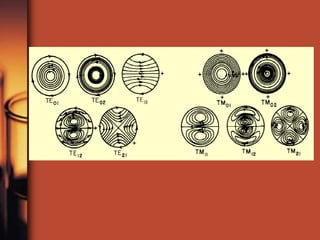
Circular/Cylindrical Waveguides

 • Waveguide having a circular cross-
   section, used whenever a rotating
   element (radar antenna) should be
   attached to the transmitter/receiver.
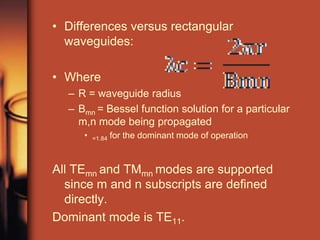
• Differences versus rectangular
  waveguides:

• Where
  – R = waveguide radius
  – Bmn = Bessel function solution for a particular
    m,n mode being propagated
     •   =1.84   for the dominant mode of operation


All TEmn and TMmn modes are supported
  since m and n subscripts are defined
  directly.
Dominant mode is TE11.
Advantages            Disadvantages
• High power-         • Polarization
  handling capacity     may rotate
• Lower
  attenuation for a
  given cutoff
  wavelength
Waveguides

Waveguides

  • 1.
    WAVEGUIDES CALDERON DE GUZMAN QUITEVIS
  • 2.
    RF Waveguides • Formof RF feeder used for microwave applications • Used in a variety of applications to carry radio frequency energy from one point to another • System of material that is designed to confine electromagnetic waves in a direction defined by its physical boundaries
  • 3.
    Waveguides • Only carryor propagate signals above a certain frequency, known as the cut-off frequency.
  • 4.
  • 5.
    Rectangular waveguide • Thisis the most commonly used form of waveguide and has a rectangular cross section.
  • 6.
    Circular waveguide • Circularwaveguide is less common than rectangular waveguide. They have many similarities in their basic approach, although signals often use a different mode of propagation.
  • 7.
    Circuit board stripline •This form of waveguide is used on printed circuit boards as a transmission line for microwave signals. It typically consists of a line of a given thickness above an earth plane. Its thickness defines the impedance.
  • 10.
  • 11.
    • According towaveguide theory there are a number of different types of electromagnetic wave that can propagate within the waveguide. These different types of waves correspond to the different elements within an electromagnetic wave.
  • 12.
    TE Waves • Transverseelectric waves, also sometimes called H waves, are characterised by the fact that the electric vector (E) is always perpendicular to the direction of propagation.
  • 13.
    TM Waves • Transversemagnetic waves, also called E waves are characterised by the fact that the magnetic vector (H vector) is always perpendicular to the direction of propagation.
  • 14.
    TEM waves • Cannotbe propagated within a waveguide, but is included for completeness. It is the mode that is commonly used within coaxial and open wire feeders. The TEM wave is characterised by the fact that both the electric vector (E vector) and the magnetic vector (H vector) are perpendicular to the direction of propagation.
  • 16.
  • 17.
    • For rectangularwaveguides, the TE10 mode of propagation is the lowest mode that is supported. • For rectangular waveguides, the waveguide width, i.e. the widest internal dimension of the cross section, determines the lower cut-off frequency and is equal to 1/2 wavelength of the lower cut-off frequency.
  • 18.
    • For rectangularwaveguides, the TE01 mode occurs when the height equals 1/2 wavelength of the cut-off frequency. • For rectangular waveguides, the TE20, occurs when the width equals one wavelength of the lower cut-off frequency.
  • 19.
    Waveguide Impedance • WhereZo = 120(pi) or 377Ω for air filled waveguide
  • 20.
    Circular/Cylindrical Waveguides •Waveguide having a circular cross- section, used whenever a rotating element (radar antenna) should be attached to the transmitter/receiver.
  • 21.
    • Differences versusrectangular waveguides: • Where – R = waveguide radius – Bmn = Bessel function solution for a particular m,n mode being propagated • =1.84 for the dominant mode of operation All TEmn and TMmn modes are supported since m and n subscripts are defined directly. Dominant mode is TE11.
  • 22.
    Advantages Disadvantages • High power- • Polarization handling capacity may rotate • Lower attenuation for a given cutoff wavelength