MICROSCOPE
- AN
INTRODUCTION

Malathi Murugesan,
I year M.D.,
Department of Microbiology
Chengalpet medical college.
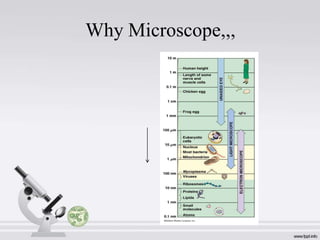
Why Microscope,,,
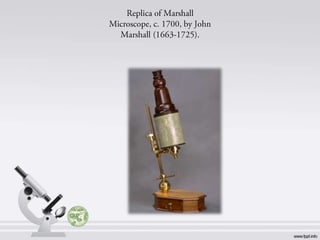
History of the Micro(organism)scope
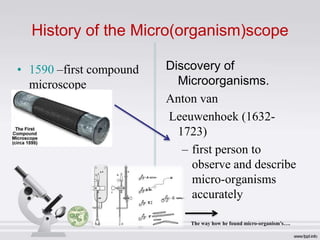
• 1590 –first compound
microscope

Discovery of
Microorganisms.
Anton van
Leeuwenhoek (16321723)
– first person to
observe and describe
micro-organisms
accurately
The way how he found micro-organism’s….
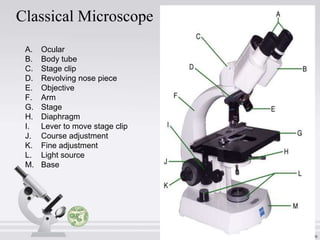
Classical Microscope
A.
B.
C.
D.
E.
F.
G.
H.
I.
J.
K.
L.
M.

Ocular
Body tube
Stage clip
Revolving nose piece
Objective
Arm
Stage
Diaphragm
Lever to move stage clip
Course adjustment
Fine adjustment
Light source
Base
Parts of Microscope,,,
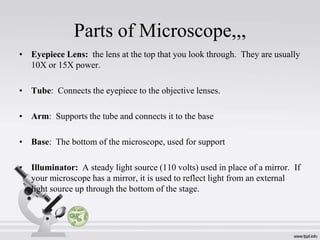
• Eyepiece Lens: the lens at the top that you look through. They are usually
10X or 15X power.

• Tube: Connects the eyepiece to the objective lenses.
• Arm: Supports the tube and connects it to the base
• Base: The bottom of the microscope, used for support
• Illuminator: A steady light source (110 volts) used in place of a mirror. If
your microscope has a mirror, it is used to reflect light from an external
light source up through the bottom of the stage.
Cont,,,
• Stage: The flat platform where you place your slides. Stage clips hold the
slides in place. If your microscope has a mechanical stage, you will be able
to move the slide around by turning two knobs. One moves it left and
right, the other moves it up and down.
• Revolving Nosepiece or Turret: This is the part that holds two or more
objective lenses and can be rotated to easily change power.
• Rack Stop: This is an adjustment that determines how close the objective
lens can get to the slide.
• Diaphragm or Iris: This diaphragm has different sized holes and is used
to vary the intensity and size of the cone of light that is projected upward
into the slide.
Lens
Objective lens

Condenser Lens

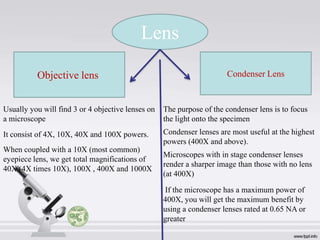
Usually you will find 3 or 4 objective lenses on
a microscope

The purpose of the condenser lens is to focus
the light onto the specimen

It consist of 4X, 10X, 40X and 100X powers.

Condenser lenses are most useful at the highest
powers (400X and above).

When coupled with a 10X (most common)
eyepiece lens, we get total magnifications of
40X (4X times 10X), 100X , 400X and 1000X

Microscopes with in stage condenser lenses
render a sharper image than those with no lens
(at 400X)
If the microscope has a maximum power of
400X, you will get the maximum benefit by
using a condenser lenses rated at 0.65 NA or
greater
Microscope Vocabulary
• Magnification: increase of an object’s
apparent size
• Resolution: power to show details clearly
Both are needed to see a clear image
Types of Microscopy
•
•
•
•
•
•
•

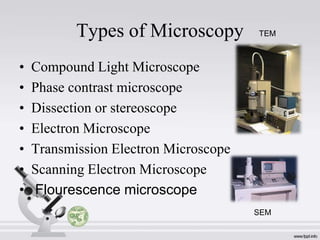
TEM

Compound Light Microscope
Phase contrast microscope
Dissection or stereoscope
Electron Microscope
Transmission Electron Microscope
Scanning Electron Microscope
Flourescence microscope
SEM
Light mechanism
• What is Light???
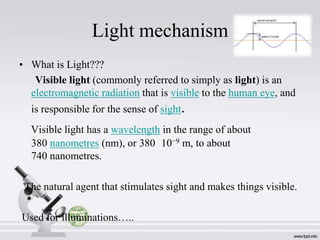
Visible light (commonly referred to simply as light) is an
electromagnetic radiation that is visible to the human eye, and
is responsible for the sense of sight.
Visible light has a wavelength in the range of about
380 nanometres (nm), or 380 10−9 m, to about
740 nanometres.
The natural agent that stimulates sight and makes things visible.
Used for illuminations…..
Angle of Incidence
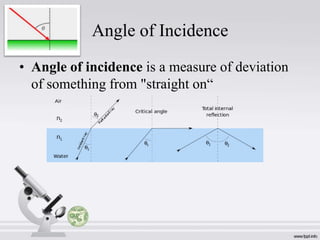
• Angle of incidence is a measure of deviation
of something from "straight on―
Snell’s Law

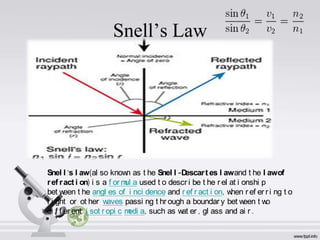
Snel l 's l aw(al so know as t he Snel l –D
n
escar t es l awand t he l awof
r ef r act i on) i s a f or m a used t o descr i be t he r el at i onshi p
ul
bet w
een t he angl es of i nci dence and r ef r act i on, w
hen r ef er r i ng t o
l i ght or ot her w
aves passi ng t hr ough a boundar y bet w
een t w
o
di f f er ent i sot r opi c m a, such as w er , gl ass and ai r .
edi
at
Cont,,,
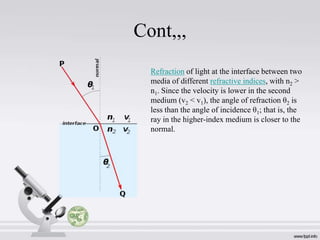
Refraction of light at the interface between two
media of different refractive indices, with n2 >
n1. Since the velocity is lower in the second
medium (v2 < v1), the angle of refraction θ2 is
less than the angle of incidence θ1; that is, the
ray in the higher-index medium is closer to the
normal.
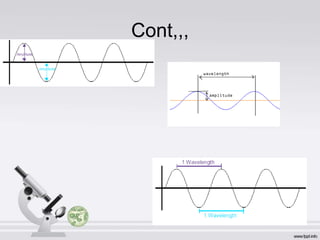
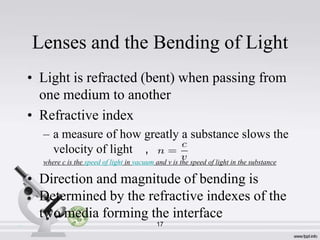
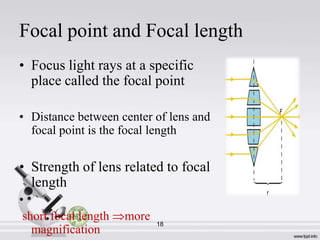
Do light waves have amplitude???
•

Of course it has,

•

Yes… Waves in general have three properties
Frequency (related to wavelength), Amplitude, and Speed
Freq- No of cycles.

•
•

•

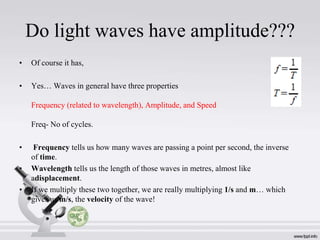
Frequency tells us how many waves are passing a point per second, the inverse
of time.
Wavelength tells us the length of those waves in metres, almost like
adisplacement.
If we multiply these two together, we are really multiplying 1/s and m… which
gives us m/s, the velocity of the wave!
Cont,,,
Lenses and the Bending of Light
• Light is refracted (bent) when passing from
one medium to another
• Refractive index
– a measure of how greatly a substance slows the
velocity of light ,
where c is the speed of light in vacuum and v is the speed of light in the substance

• Direction and magnitude of bending is
Determined by the refractive indexes of the
two media forming the interface
.

17
Focal point and Focal length
• Focus light rays at a specific
place called the focal point
• Distance between center of lens and
focal point is the focal length

• Strength of lens related to focal
length
•
short focal length
magnification

more

18
The Light Microscope
• Many types
–
–
–
–

bright-field microscope
dark-field microscope
phase-contrast microscope
fluorescence microscopes

• are compound microscopes
– image formed by action of 2 lenses

19
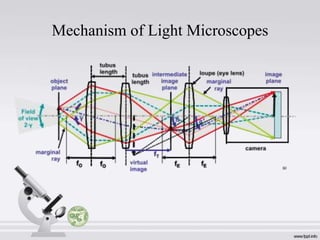
Mechanism of Light Microscopes
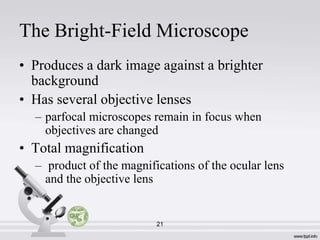
The Bright-Field Microscope
• Produces a dark image against a brighter
background
• Has several objective lenses
– parfocal microscopes remain in focus when
objectives are changed

• Total magnification
– product of the magnifications of the ocular lens
and the objective lens

21
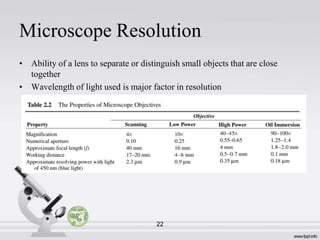
Microscope Resolution
• Ability of a lens to separate or distinguish small objects that are close
together
• Wavelength of light used is major factor in resolution
shorter wavelength greater resolution

22
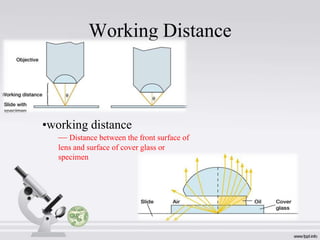
Working Distance

•working distance
— Distance between the front surface of
lens and surface of cover glass or
specimen
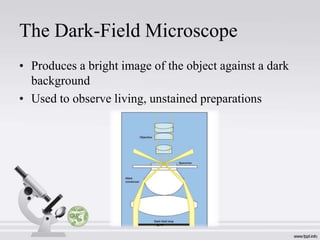
The Dark-Field Microscope
• Produces a bright image of the object against a dark
background
• Used to observe living, unstained preparations

24
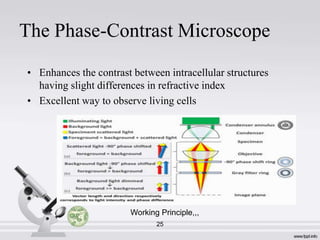
The Phase-Contrast Microscope
• Enhances the contrast between intracellular structures
having slight differences in refractive index
• Excellent way to observe living cells

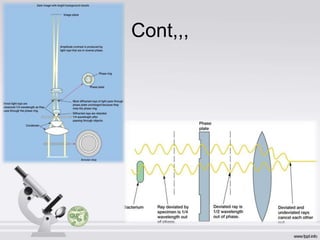
Working Principle,,,
25
Cont,,,
The Differential Interference
Contrast Microscope
• Creates image by detecting differences in
refractive indices and thickness of different
parts of specimen
• Excellent way to observe living cells

27
Thanking you

microscopes- a brief introduction

  • 1.
    MICROSCOPE - AN INTRODUCTION Malathi Murugesan, Iyear M.D., Department of Microbiology Chengalpet medical college.
  • 3.
  • 4.
    History of theMicro(organism)scope • 1590 –first compound microscope Discovery of Microorganisms. Anton van Leeuwenhoek (16321723) – first person to observe and describe micro-organisms accurately The way how he found micro-organism’s….
  • 5.
    Classical Microscope A. B. C. D. E. F. G. H. I. J. K. L. M. Ocular Body tube Stageclip Revolving nose piece Objective Arm Stage Diaphragm Lever to move stage clip Course adjustment Fine adjustment Light source Base
  • 6.
    Parts of Microscope,,, •Eyepiece Lens: the lens at the top that you look through. They are usually 10X or 15X power. • Tube: Connects the eyepiece to the objective lenses. • Arm: Supports the tube and connects it to the base • Base: The bottom of the microscope, used for support • Illuminator: A steady light source (110 volts) used in place of a mirror. If your microscope has a mirror, it is used to reflect light from an external light source up through the bottom of the stage.
  • 7.
    Cont,,, • Stage: Theflat platform where you place your slides. Stage clips hold the slides in place. If your microscope has a mechanical stage, you will be able to move the slide around by turning two knobs. One moves it left and right, the other moves it up and down. • Revolving Nosepiece or Turret: This is the part that holds two or more objective lenses and can be rotated to easily change power. • Rack Stop: This is an adjustment that determines how close the objective lens can get to the slide. • Diaphragm or Iris: This diaphragm has different sized holes and is used to vary the intensity and size of the cone of light that is projected upward into the slide.
  • 8.
    Lens Objective lens Condenser Lens Usuallyyou will find 3 or 4 objective lenses on a microscope The purpose of the condenser lens is to focus the light onto the specimen It consist of 4X, 10X, 40X and 100X powers. Condenser lenses are most useful at the highest powers (400X and above). When coupled with a 10X (most common) eyepiece lens, we get total magnifications of 40X (4X times 10X), 100X , 400X and 1000X Microscopes with in stage condenser lenses render a sharper image than those with no lens (at 400X) If the microscope has a maximum power of 400X, you will get the maximum benefit by using a condenser lenses rated at 0.65 NA or greater
  • 9.
    Microscope Vocabulary • Magnification:increase of an object’s apparent size • Resolution: power to show details clearly Both are needed to see a clear image
  • 10.
    Types of Microscopy • • • • • • • TEM CompoundLight Microscope Phase contrast microscope Dissection or stereoscope Electron Microscope Transmission Electron Microscope Scanning Electron Microscope Flourescence microscope SEM
  • 11.
    Light mechanism • Whatis Light??? Visible light (commonly referred to simply as light) is an electromagnetic radiation that is visible to the human eye, and is responsible for the sense of sight. Visible light has a wavelength in the range of about 380 nanometres (nm), or 380 10−9 m, to about 740 nanometres. The natural agent that stimulates sight and makes things visible. Used for illuminations…..
  • 12.
    Angle of Incidence •Angle of incidence is a measure of deviation of something from "straight on―
  • 13.
    Snell’s Law Snel l's l aw(al so know as t he Snel l –D n escar t es l awand t he l awof r ef r act i on) i s a f or m a used t o descr i be t he r el at i onshi p ul bet w een t he angl es of i nci dence and r ef r act i on, w hen r ef er r i ng t o l i ght or ot her w aves passi ng t hr ough a boundar y bet w een t w o di f f er ent i sot r opi c m a, such as w er , gl ass and ai r . edi at
  • 14.
    Cont,,, Refraction of lightat the interface between two media of different refractive indices, with n2 > n1. Since the velocity is lower in the second medium (v2 < v1), the angle of refraction θ2 is less than the angle of incidence θ1; that is, the ray in the higher-index medium is closer to the normal.
  • 15.
    Do light waveshave amplitude??? • Of course it has, • Yes… Waves in general have three properties Frequency (related to wavelength), Amplitude, and Speed Freq- No of cycles. • • • Frequency tells us how many waves are passing a point per second, the inverse of time. Wavelength tells us the length of those waves in metres, almost like adisplacement. If we multiply these two together, we are really multiplying 1/s and m… which gives us m/s, the velocity of the wave!
  • 16.
  • 17.
    Lenses and theBending of Light • Light is refracted (bent) when passing from one medium to another • Refractive index – a measure of how greatly a substance slows the velocity of light , where c is the speed of light in vacuum and v is the speed of light in the substance • Direction and magnitude of bending is Determined by the refractive indexes of the two media forming the interface . 17
  • 18.
    Focal point andFocal length • Focus light rays at a specific place called the focal point • Distance between center of lens and focal point is the focal length • Strength of lens related to focal length • short focal length magnification more 18
  • 19.
    The Light Microscope •Many types – – – – bright-field microscope dark-field microscope phase-contrast microscope fluorescence microscopes • are compound microscopes – image formed by action of 2 lenses 19
  • 20.
    Mechanism of LightMicroscopes
  • 21.
    The Bright-Field Microscope •Produces a dark image against a brighter background • Has several objective lenses – parfocal microscopes remain in focus when objectives are changed • Total magnification – product of the magnifications of the ocular lens and the objective lens 21
  • 22.
    Microscope Resolution • Abilityof a lens to separate or distinguish small objects that are close together • Wavelength of light used is major factor in resolution shorter wavelength greater resolution 22
  • 23.
    Working Distance •working distance —Distance between the front surface of lens and surface of cover glass or specimen
  • 24.
    The Dark-Field Microscope •Produces a bright image of the object against a dark background • Used to observe living, unstained preparations 24
  • 25.
    The Phase-Contrast Microscope •Enhances the contrast between intracellular structures having slight differences in refractive index • Excellent way to observe living cells Working Principle,,, 25
  • 26.
  • 27.
    The Differential Interference ContrastMicroscope • Creates image by detecting differences in refractive indices and thickness of different parts of specimen • Excellent way to observe living cells 27
  • 28.

Editor's Notes

  • #2 MalathiMurugesan Presenting By,,,Department of Microbiology
  • #9  Usually you will find 3 or 4 objective lenses on a microscope
  • #11 TEMSEM
  • #26 Working Principle,,,
  • #29 Thanking you