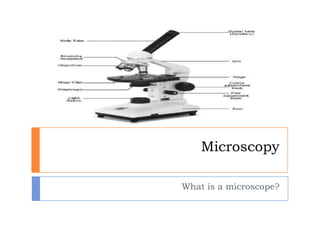
Microscopy
What is a microscope?
Microscope
 Microscope is a tool
which can help you see
tiny objects and living
organisms. It makes them
look bigger.
 This ability of the
microscope is called its
magnifying power or
magnification.
Microscope
 The microscope also has the capacity to distinguish
small gaps between two separate points which
humans cannot distinguish. It is called its resolving
power or resolution.
Light microscope
 Light microscope uses diffused light from the sun or
artificial light to illuminate the object to be observed.
Microscopy
What are the parts of the microscope?
1. Arm
 Supports the body tube.
2. Base
 Supports and stabilizes the
microscope.
3. Eyepiece / ocular lens
 Magnifies image produced
by objective lens.
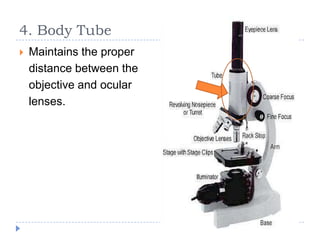
4. Body Tube
 Maintains the proper
distance between the
objective and ocular
lenses.
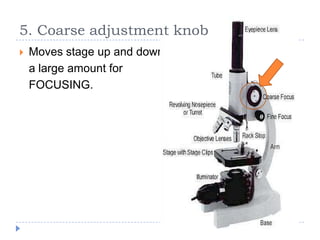
 Moves stage up and down
a large amount for
FOCUSING.
5. Coarse adjustment knob
 Moves stage up and down
a tiny amount to
SHARPEN the image.
6. Fine adjustment knob
7. Light source
 (lamp or mirror) Provides
light for viewing the slide.
 Projects light UPWARDS
through the diaphragm,
the SPECIMEN, and
the LENSES.
8. Diaphragm
 Controls the amount of
light passing through
the slide.
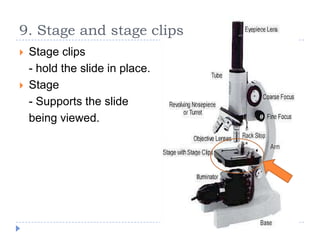
 Stage clips
- hold the slide in place.
 Stage
- Supports the slide
being viewed.
9. Stage and stage clips
10. Objective lenses
 Focus and magnify
light coming through the
slide.
 Rotates to allow use of
different power objectives.
11. Revolving nosepiece
 Supports the arm and
controls the body of the
microscope.
12. Inclination joint
Basic Microscope Technique
Rules to Follow
1. If you must carry a microscope, always hold it with one
hand on the arm and the other under the base.
2. Always lower the stage or raise the objectives all the way
before placing a slide under the objectives.
3. Always begin working with the LOW POWER (shortest)
objective first.
4. Observe the slide from the side, not looking through the
eye piece, when using the coarse focus to avoid running
the objective lens into the slide.
5. Never use the coarse focus adjustment when on the
medium or high power objectives. Focus on low power
first and then rotate the higher power objective into place.
Make final focus adjustments with the fine focus
adjustment.
Answer Each Question
1. The lens closest to your eye when you use a
microscope is the __________.
2. When using the microscope, always begin work with
the __________ objective first.
3. Which knob should you never use while on medium
or high power? Explain why.
4. The lens closest to the slide is the ___________.
5. When using the coarse focus knob, how should you
be view the slide? Explain why.
6. Carry the microscope with one hand on the
________. and the other on the __________.
End of discussion

Microscopy

  • 1.
  • 2.
    Microscope  Microscope isa tool which can help you see tiny objects and living organisms. It makes them look bigger.  This ability of the microscope is called its magnifying power or magnification.
  • 3.
    Microscope  The microscopealso has the capacity to distinguish small gaps between two separate points which humans cannot distinguish. It is called its resolving power or resolution.
  • 4.
    Light microscope  Lightmicroscope uses diffused light from the sun or artificial light to illuminate the object to be observed.
  • 5.
    Microscopy What are theparts of the microscope?
  • 6.
    1. Arm  Supportsthe body tube.
  • 7.
    2. Base  Supportsand stabilizes the microscope.
  • 8.
    3. Eyepiece /ocular lens  Magnifies image produced by objective lens.
  • 9.
    4. Body Tube Maintains the proper distance between the objective and ocular lenses.
  • 10.
     Moves stageup and down a large amount for FOCUSING. 5. Coarse adjustment knob
  • 11.
     Moves stageup and down a tiny amount to SHARPEN the image. 6. Fine adjustment knob
  • 12.
    7. Light source (lamp or mirror) Provides light for viewing the slide.  Projects light UPWARDS through the diaphragm, the SPECIMEN, and the LENSES.
  • 13.
    8. Diaphragm  Controlsthe amount of light passing through the slide.
  • 14.
     Stage clips -hold the slide in place.  Stage - Supports the slide being viewed. 9. Stage and stage clips
  • 15.
    10. Objective lenses Focus and magnify light coming through the slide.
  • 16.
     Rotates toallow use of different power objectives. 11. Revolving nosepiece
  • 17.
     Supports thearm and controls the body of the microscope. 12. Inclination joint
  • 18.
    Basic Microscope Technique Rulesto Follow 1. If you must carry a microscope, always hold it with one hand on the arm and the other under the base. 2. Always lower the stage or raise the objectives all the way before placing a slide under the objectives. 3. Always begin working with the LOW POWER (shortest) objective first. 4. Observe the slide from the side, not looking through the eye piece, when using the coarse focus to avoid running the objective lens into the slide. 5. Never use the coarse focus adjustment when on the medium or high power objectives. Focus on low power first and then rotate the higher power objective into place. Make final focus adjustments with the fine focus adjustment.
  • 19.
    Answer Each Question 1.The lens closest to your eye when you use a microscope is the __________. 2. When using the microscope, always begin work with the __________ objective first. 3. Which knob should you never use while on medium or high power? Explain why. 4. The lens closest to the slide is the ___________. 5. When using the coarse focus knob, how should you be view the slide? Explain why. 6. Carry the microscope with one hand on the ________. and the other on the __________.
  • 20.