



Presentation of
Micro-Biology
Topic:
Magnification and resolution
of microscope
Presented by: Amna Shahzadi
Roll no: 854(023816)
BS zoology(semester 7)
Professor Sir Fazal Illahi Butt
Important terminologies
01
02
03
A microscope is a laboratory instrument
used to examine objects that are too
small to be seen by the naked eye.
MICROSCOPE
Microscopy is the science of investigating
small objects and structures using a
microscopic.
MICROSCOPY
The increase in size of optical image over
the size of the object being viewed.
MAGNIFICATION
Important terminologies
04
05
06
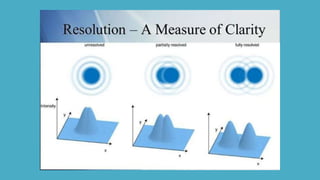
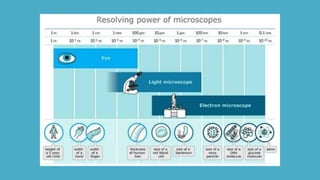
The ability to distinguish two adjacent
points as distinct and separate.
RESOLVING POWER
Numerical aperture is a number that
expresses the ability of a lens to resolve
fine detail in the object being observed.
NUMERICAL APERTURE
Resolution The smallest distance by whic
h two objects can be separated and still b
e visualized as separate objects.
RESOLUTION
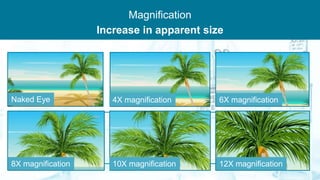
Magnification
Increase in apparent size
Naked Eye 4X magnification 6X magnification
8X magnification 10X magnification 12X magnification
Welcome!!
This PowerPoint
Template has clean
and neutral design that
can be adapted to any
content and meets
various market
segments.
Your Text Here
This PowerPoint Template has clean and neutral design that can be adapted to
any content and meets various market segments.
Magnification vs. Resolution
Insert the title of your subtitle Here
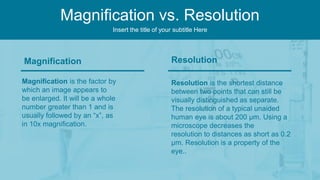
Magnification
Magnification is the factor by
which an image appears to
be enlarged. It will be a whole
number greater than 1 and is
usually followed by an “x”, as
in 10x magnification.
Resolution is the shortest distance
between two points that can still be
visually distinguished as separate.
The resolution of a typical unaided
human eye is about 200 µm. Using a
microscope decreases the
resolution to distances as short as 0.2
µm. Resolution is a property of the
eye..
Resolution
Welcome!!
This PowerPoint
Template has clean
and neutral design that
can be adapted to any
content and meets
various market
segments.
Your Text Here
This PowerPoint Template has clean and neutral design that can be adapted to
any content and meets various market segments.
Resolving Power
Mere increase in size (greater magnification) without
the ability to distinguish structural details (greater
resolution) is not beneficial. To state it differently, the
largest magnification produced by a microscope may
not be the most useful because the image obtained
may be unclear or fuzzy. The more lines or dots per
unit area that can be seen distinctly as separate lines
or dots, the greater is the resolving power of the
microscope system. The resolving power of a
microscope is a function of the wavelength of light used
and the numerical aperture (NA) of the lens system.
Explanation
Numerical Aperture
The angle 0 subtended by the optical axis and the outermost rays still covered by
the objective is the measure of the aperture of the objective; it is the half. aperture
angle (Fig. 4-3). The magnitude of this angle is expressed as a sine value. The sine
value of the half-aperture angle multiplied by the refractive index n of the .medium
filling the space between the front lens and the cover slip gives the numerical
aperture (NA): NA = n sin 8 With dry objectives the value of n is 1, since I is the
refractive index of elk When immersion oil is used (Fig. 4-3) as the medium. n is
1.56, and if 0 is 5" then
NA = n sin 8 = 1.56 x sin 58° = 1.56 x 0.85 = 1.33
Na for drive object is less than 1.0,oil immersion objectives have an NA value
greater than 1.0
FOR WATER n =1.33
FOR OIL n = 1.56
Explanation
Limit of Resolution
The limit of resolution is the smallest distance by which two objects can be
separated and still be distinguishable as two separate objects. the greatest
resolution} in light microscopy is obtained with the shortest wavelength of visible
light and an objective with the maximum NA. The relationship between NA and
resolution can be expressed as follows:
d =λ/(2NA)
where d = resolution and λ = wavelength of light.
Using the values 1.3 for NA and 0.55 µm, the wavelength of green light, for X,
resolution can be calculated as
d = 0.55 2 x 1.30
= 0.21
From these calculations we may conclude that the smallest details that can be seen
by the typical. light microscope are those having dimensions of approximately
0.2 µm.
Explanation
Any Question
You want to ask ?
Thank YOU
Stay blessed

Magnification and resolution of microscope

  • 1.
  • 2.
    Topic: Magnification and resolution ofmicroscope Presented by: Amna Shahzadi Roll no: 854(023816) BS zoology(semester 7) Professor Sir Fazal Illahi Butt
  • 3.
    Important terminologies 01 02 03 A microscopeis a laboratory instrument used to examine objects that are too small to be seen by the naked eye. MICROSCOPE Microscopy is the science of investigating small objects and structures using a microscopic. MICROSCOPY The increase in size of optical image over the size of the object being viewed. MAGNIFICATION
  • 4.
    Important terminologies 04 05 06 The abilityto distinguish two adjacent points as distinct and separate. RESOLVING POWER Numerical aperture is a number that expresses the ability of a lens to resolve fine detail in the object being observed. NUMERICAL APERTURE Resolution The smallest distance by whic h two objects can be separated and still b e visualized as separate objects. RESOLUTION
  • 5.
    Magnification Increase in apparentsize Naked Eye 4X magnification 6X magnification 8X magnification 10X magnification 12X magnification
  • 6.
    Welcome!! This PowerPoint Template hasclean and neutral design that can be adapted to any content and meets various market segments. Your Text Here This PowerPoint Template has clean and neutral design that can be adapted to any content and meets various market segments.
  • 7.
    Magnification vs. Resolution Insertthe title of your subtitle Here Magnification Magnification is the factor by which an image appears to be enlarged. It will be a whole number greater than 1 and is usually followed by an “x”, as in 10x magnification. Resolution is the shortest distance between two points that can still be visually distinguished as separate. The resolution of a typical unaided human eye is about 200 µm. Using a microscope decreases the resolution to distances as short as 0.2 µm. Resolution is a property of the eye.. Resolution
  • 8.
    Welcome!! This PowerPoint Template hasclean and neutral design that can be adapted to any content and meets various market segments. Your Text Here This PowerPoint Template has clean and neutral design that can be adapted to any content and meets various market segments.
  • 9.
    Resolving Power Mere increasein size (greater magnification) without the ability to distinguish structural details (greater resolution) is not beneficial. To state it differently, the largest magnification produced by a microscope may not be the most useful because the image obtained may be unclear or fuzzy. The more lines or dots per unit area that can be seen distinctly as separate lines or dots, the greater is the resolving power of the microscope system. The resolving power of a microscope is a function of the wavelength of light used and the numerical aperture (NA) of the lens system. Explanation
  • 10.
    Numerical Aperture The angle0 subtended by the optical axis and the outermost rays still covered by the objective is the measure of the aperture of the objective; it is the half. aperture angle (Fig. 4-3). The magnitude of this angle is expressed as a sine value. The sine value of the half-aperture angle multiplied by the refractive index n of the .medium filling the space between the front lens and the cover slip gives the numerical aperture (NA): NA = n sin 8 With dry objectives the value of n is 1, since I is the refractive index of elk When immersion oil is used (Fig. 4-3) as the medium. n is 1.56, and if 0 is 5" then NA = n sin 8 = 1.56 x sin 58° = 1.56 x 0.85 = 1.33 Na for drive object is less than 1.0,oil immersion objectives have an NA value greater than 1.0 FOR WATER n =1.33 FOR OIL n = 1.56 Explanation
  • 11.
    Limit of Resolution Thelimit of resolution is the smallest distance by which two objects can be separated and still be distinguishable as two separate objects. the greatest resolution} in light microscopy is obtained with the shortest wavelength of visible light and an objective with the maximum NA. The relationship between NA and resolution can be expressed as follows: d =λ/(2NA) where d = resolution and λ = wavelength of light. Using the values 1.3 for NA and 0.55 µm, the wavelength of green light, for X, resolution can be calculated as d = 0.55 2 x 1.30 = 0.21 From these calculations we may conclude that the smallest details that can be seen by the typical. light microscope are those having dimensions of approximately 0.2 µm. Explanation
  • 12.
  • 13.