INFECTION
C.SWAMINATHAN
Assistant Professor of Microbiology
Vivekanandha College of Arts and Science for Women (Autonomous)
Tiruchengode - 637 205
Tamilnadu, South India
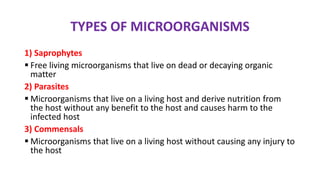
TYPES OF MICROORGANISMS
1) Saprophytes
 Free living microorganisms that live on dead or decaying organic
matter
2) Parasites
 Microorganisms that live on a living host and derive nutrition from
the host without any benefit to the host and causes harm to the
infected host
3) Commensals
 Microorganisms that live on a living host without causing any injury to
the host
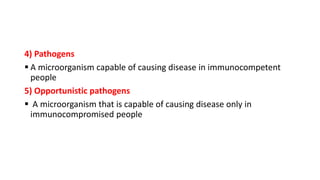
4) Pathogens
 A microorganism capable of causing disease in immunocompetent
people
5) Opportunistic pathogens
 A microorganism that is capable of causing disease only in
immunocompromised people
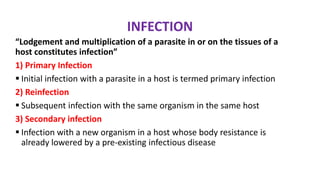
INFECTION
“Lodgement and multiplication of a parasite in or on the tissues of a
host constitutes infection”
1) Primary Infection
 Initial infection with a parasite in a host is termed primary infection
2) Reinfection
 Subsequent infection with the same organism in the same host
3) Secondary infection
 Infection with a new organism in a host whose body resistance is
already lowered by a pre-existing infectious disease
4) Cross infection
 Infection with a new organism from another host or another external
source in a patient who is already suffering from a disease
5) Nosocomial infection
 Cross infections acquired in hospitals are hospital acquired /
nosocomial infections
6) Iatrogenic infection
 Physician induced infections resulting from investigative or therapeutic
procedures
Based on clinical effects
1) Inapparent infection / subclinical infection
 Clinical effects are not apparent
2) Atypical infection
 Typical or characteristic clinical manifestations of the particular
infectious disease are not present
3) Latent infection
 Some organisms may remain in a latent or hidden stage in host and
subsequently they multiply to produce clinical disease when host
resistance is lowered
SOURCES OF INFECTION
ENDOGENOUS SOURCE
 Source of infection is the normal bacterial flora
 Normal flora are usually not pathogenic but in certain situation
become pathogenic and cause infections
• e.g. E.coli present as normal flora of the intestine may cause UTI
EXOGENOUS SOURCE
 Source of infections is from outside the host’s body
 Exogenous source include humans, animals, insects, food and water
1) Humans
A) Patient
B) Carrier
 Carrier is a person who harbours pathogenic microorganisms without
showing any signs and symptoms of disease
a) Healthy carrier
 Healthy carrier is one who harbours the pathogen without ever
suffering from the disease caused by the pathogen
b) Convalescent carrier
 A convalescent carrier is one who has recovered from the disease and
continues to harbour the pathogen in his body
c) Temporary carrier
 Temporary carrier is the host who harbours the microorganisms up to
six months after recovering from the disease caused by the same
pathogen
d) Chronic carrier
 Chronic carrier is the host who harbours the microorganisms for many
years after recovering from the clinical disease caused by the same
pathogen
2) Animals
 Cattles – Brucellosis, TB, Anthrax
 Goat – Brucellosis, Sheep – Anthrax
 Dog – Rabies, Rat - Leptospirosis
3) Insects
 Insects that transmit infections are called vectors
 The disease transmitted by insects are called arthropod borne
diseases
Mechanical vector
 Flies – transmit dysentery and typhoid fever
Biological vector
 Female anopheles mosquito – transmit malaria
4) Food
 Food items contaminated with pathogens act as source of infection
and cause diarrhoea, dysentery, food poisoning and gastroenteritis
5) Water
 Water contaminated with pathogens act as source of infection and
cause
Leptospirosis
Cholera
Dysentery
Hepatitis A
MODE OF TRANSMISSION1) Contact
Direct contact
 Occurs through act of touching, kissing, sex, etc
 e.g. Common cold, Staphylococcus infection
 e.g. STD – Gonorrhea, Syphilis, AIDS
Indirect contact
 Occurs through inanimate objects
 e.g. Influenza, TB
2) Inoculation
 Infection can be transmitted by inoculation of microorganisms directly in to
tissues of the host
 e.g. Tetanus, Rabies
3) Ingestion
 Ingestion of food and water contaminated with microorganisms can
transmit infections
 e.g. Cholera, Typhoid, Food poisoning, Hepatitis A, Poliomyelitis
4) Inhalation
 Measles, Influenza, Whooping cough, TB
5) Insects
 Rat flea – transmit plague
 Mosquito – transmit malaria
 Lice – transmit relapsing fever
FACTORS PREDISPOSING TO MICROBIAL
PATHOGENICITY
1) Adhesion
 Attachment of bacteria to body surfaces
 Adhesions – Pili, Glycocalyx
2) Invasiveness
 Ability of a pathogen to spread in the host tissues after establishing
infection
 e.g. Streptococcal septicaemia following wound infection
3) Toxigenicity
Exotoxins
 Proteins
 Heat stable
 Highly antigenic
 1 mg tetanus toxin – kill more than 1 million guinea pigs
 3 kg botulinum toxin – can kill all the inhabitants of the world
Endotoxins
 Lipopolysaccharide
 Heat stable
 Weakly antigenic
4) Plasmids
 Plasmid borne virulence factors are
 Enterotoxin production by E.coli and S.aureus
5) Bacteriophages
 In diphtheria bacilli, the gene for toxin production is present in tox+
corynephages
6) Communicability
 Ability of a microorganism to spread from one host to another
7) Other Bacterial Products
 Coagulase – prevents phagocytosis by forming a fibrin barrier around
the bacteria
 Fibrinolysin – promotes the spread of infection by breaking down fibrin
barrier in tissues
 Hyaluronidase – split hyaluronic acid and facilitate the spread of
infection along tissue spaces
 Leucocidins – damage leukocytes
 Hemolysin – destroys RBCs
8) Bacterial appendages
 Capule of K.pneumonia – prevents phagocytosis
 Vi Ag of S.typhi and K Ag of E.coli help the bacteria to withstand
phagocytosis
9) Biofilm
 Aggregate of interactive bacteria attached to a solid surface or to
each other and encased in an exopolysaccharide matrix.

Infection

  • 1.
    INFECTION C.SWAMINATHAN Assistant Professor ofMicrobiology Vivekanandha College of Arts and Science for Women (Autonomous) Tiruchengode - 637 205 Tamilnadu, South India
  • 2.
    TYPES OF MICROORGANISMS 1)Saprophytes  Free living microorganisms that live on dead or decaying organic matter 2) Parasites  Microorganisms that live on a living host and derive nutrition from the host without any benefit to the host and causes harm to the infected host 3) Commensals  Microorganisms that live on a living host without causing any injury to the host
  • 3.
    4) Pathogens  Amicroorganism capable of causing disease in immunocompetent people 5) Opportunistic pathogens  A microorganism that is capable of causing disease only in immunocompromised people
  • 4.
    INFECTION “Lodgement and multiplicationof a parasite in or on the tissues of a host constitutes infection” 1) Primary Infection  Initial infection with a parasite in a host is termed primary infection 2) Reinfection  Subsequent infection with the same organism in the same host 3) Secondary infection  Infection with a new organism in a host whose body resistance is already lowered by a pre-existing infectious disease
  • 5.
    4) Cross infection Infection with a new organism from another host or another external source in a patient who is already suffering from a disease 5) Nosocomial infection  Cross infections acquired in hospitals are hospital acquired / nosocomial infections 6) Iatrogenic infection  Physician induced infections resulting from investigative or therapeutic procedures
  • 6.
    Based on clinicaleffects 1) Inapparent infection / subclinical infection  Clinical effects are not apparent 2) Atypical infection  Typical or characteristic clinical manifestations of the particular infectious disease are not present 3) Latent infection  Some organisms may remain in a latent or hidden stage in host and subsequently they multiply to produce clinical disease when host resistance is lowered
  • 7.
    SOURCES OF INFECTION ENDOGENOUSSOURCE  Source of infection is the normal bacterial flora  Normal flora are usually not pathogenic but in certain situation become pathogenic and cause infections • e.g. E.coli present as normal flora of the intestine may cause UTI EXOGENOUS SOURCE  Source of infections is from outside the host’s body  Exogenous source include humans, animals, insects, food and water
  • 8.
    1) Humans A) Patient B)Carrier  Carrier is a person who harbours pathogenic microorganisms without showing any signs and symptoms of disease a) Healthy carrier  Healthy carrier is one who harbours the pathogen without ever suffering from the disease caused by the pathogen b) Convalescent carrier  A convalescent carrier is one who has recovered from the disease and continues to harbour the pathogen in his body
  • 9.
    c) Temporary carrier Temporary carrier is the host who harbours the microorganisms up to six months after recovering from the disease caused by the same pathogen d) Chronic carrier  Chronic carrier is the host who harbours the microorganisms for many years after recovering from the clinical disease caused by the same pathogen 2) Animals  Cattles – Brucellosis, TB, Anthrax  Goat – Brucellosis, Sheep – Anthrax  Dog – Rabies, Rat - Leptospirosis
  • 10.
    3) Insects  Insectsthat transmit infections are called vectors  The disease transmitted by insects are called arthropod borne diseases Mechanical vector  Flies – transmit dysentery and typhoid fever Biological vector  Female anopheles mosquito – transmit malaria 4) Food  Food items contaminated with pathogens act as source of infection and cause diarrhoea, dysentery, food poisoning and gastroenteritis
  • 11.
    5) Water  Watercontaminated with pathogens act as source of infection and cause Leptospirosis Cholera Dysentery Hepatitis A
  • 12.
    MODE OF TRANSMISSION1)Contact Direct contact  Occurs through act of touching, kissing, sex, etc  e.g. Common cold, Staphylococcus infection  e.g. STD – Gonorrhea, Syphilis, AIDS Indirect contact  Occurs through inanimate objects  e.g. Influenza, TB 2) Inoculation  Infection can be transmitted by inoculation of microorganisms directly in to tissues of the host  e.g. Tetanus, Rabies
  • 13.
    3) Ingestion  Ingestionof food and water contaminated with microorganisms can transmit infections  e.g. Cholera, Typhoid, Food poisoning, Hepatitis A, Poliomyelitis 4) Inhalation  Measles, Influenza, Whooping cough, TB 5) Insects  Rat flea – transmit plague  Mosquito – transmit malaria  Lice – transmit relapsing fever
  • 14.
    FACTORS PREDISPOSING TOMICROBIAL PATHOGENICITY 1) Adhesion  Attachment of bacteria to body surfaces  Adhesions – Pili, Glycocalyx 2) Invasiveness  Ability of a pathogen to spread in the host tissues after establishing infection  e.g. Streptococcal septicaemia following wound infection
  • 15.
    3) Toxigenicity Exotoxins  Proteins Heat stable  Highly antigenic  1 mg tetanus toxin – kill more than 1 million guinea pigs  3 kg botulinum toxin – can kill all the inhabitants of the world Endotoxins  Lipopolysaccharide  Heat stable  Weakly antigenic
  • 16.
    4) Plasmids  Plasmidborne virulence factors are  Enterotoxin production by E.coli and S.aureus 5) Bacteriophages  In diphtheria bacilli, the gene for toxin production is present in tox+ corynephages 6) Communicability  Ability of a microorganism to spread from one host to another 7) Other Bacterial Products  Coagulase – prevents phagocytosis by forming a fibrin barrier around the bacteria
  • 17.
     Fibrinolysin –promotes the spread of infection by breaking down fibrin barrier in tissues  Hyaluronidase – split hyaluronic acid and facilitate the spread of infection along tissue spaces  Leucocidins – damage leukocytes  Hemolysin – destroys RBCs 8) Bacterial appendages  Capule of K.pneumonia – prevents phagocytosis  Vi Ag of S.typhi and K Ag of E.coli help the bacteria to withstand phagocytosis
  • 18.
    9) Biofilm  Aggregateof interactive bacteria attached to a solid surface or to each other and encased in an exopolysaccharide matrix.