Institute for Microbiology, Medical Faculty of Masaryk University  and St. Anna Faculty Hospital in Brno Miroslav Votava, Vladana Woznicová PATHOGENICITY AND VIRULENCE Lecture for 2nd-year students March 3 0 , 200 9
Pathogenicity  =  A bility of a microbe  to be  harmful  to health and to cause disease I nfectiousness  = ability to cause infection Infection  – broader term than disease In the disease ,   symptoms of disease  are present   (the infection is  manifest  one)   But the infection may proceed without symptoms ( inapparent  infection) Apart from infections ,  microbes can cause food  poisoning ,   as well
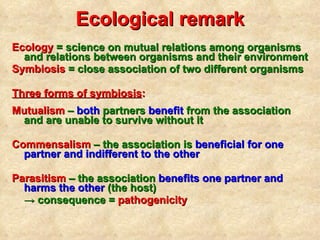
Ecological remark Ecology  = science on mutual relations among organisms and relations between organisms and their environment Symbiosis  = close association of two di fferent  organisms Three forms of symbiosis :   Mutualism  –  both  partners  benefit  from the association and are unable to survive without it Commensalism  – the association  is  beneficial for one partner and indifferent to the other   Parasitism  – the association  benefits one partner and harms the other  (the host)  ->  consequence =  pathogenicity
Infection Definition of infection is not an easy one Infection  = situation when the  etiological agent  of infection  invades  an organism and  multiplies  in it; or it settles on bodily surfaces and acts adversely there    Colonization  = settlement of bodily surface by a  nonpathogenic  microbe (or by a pathogen that does not cause pathological symptoms there)
History of infectious diseases   Physiological thesis of Hippocrates: (Infectious) disease = consequence of certain inadequacy of organism Microbial antithesis of Pasteur and Koch: The cause of the infectious disease is a microbe Ecological synthesis: = synthesis of physiological thesis and microbial antithesis – for the  occurence  of the  infectious  disease  the microbe, host and environment  are responsible
 
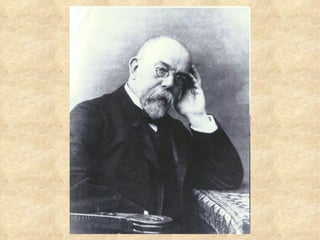
Koch´s postulates   A particular  microbe is the etiological agent, if it is present  in every case  of the disease and  its localization in the body corresponds to  the  damages observed; it is  isolated from the host  and kept in pure culture for several generations;  by means of the microbe grown in this way it is possible to imitate the  disease on another host ; it is  again isolated  from the experimentally infected  host.
Relationship between the microbe and the host   Dynamic  and influenced by the  environment   microbe   host environment Illness is not a rule – peaceful coexistence is usually better for the parasite In spite of that the host tries  to get rid  of the parasite  – to destroy, remove  or at least  to localize it
Pathogenicity Pathogenicity   depends on   both  microbial and host  species Particular  microbial species is  pathogenic  for a specific host species only, for another species it may be  non-pathogenic This host species is  susceptible  to the relevant microbial species, to  a  different microbial species it can be  resistant
Primary and opportune pathogens   Primary (obligate) pathogens ->  disease also in otherwise healthy individuals: chiefly agents of  classical infections  (diphtheria, typhoid fever, plague, gonorrhea, tetanus, influenza, morbilli etc.) Opportunistic (facultative) pathogens ->  disease under certain conditions or at a certain disposition only: usually members of  normal flora   when they reach another site in the body  or when the immunity of the individual is lowered
Natural and experimental pathogenicity   Microbes naturally pathogenic  for  man   &   animals: Staph. aureus, Francisella tularensis, Clostridium botulinum,  rabies v., tick-borne encephalitis v. Microbes pathogenic for animals experimentally: Bacillus anthracis, Streptococcus pneumoniae, Clostridium tetani –  mouse  Mycobact. tuberculosis,  rickettsiae  –  guinea pig   Treponema pallidum,  herpes simplex v. – rabbit  Mi c robes pathogenic for man only:  Neisseria gonorrhoeae, Haemophilus ducreyi Mi c robes non-pathogenic for man: Majority of soil and water microorganisms
 
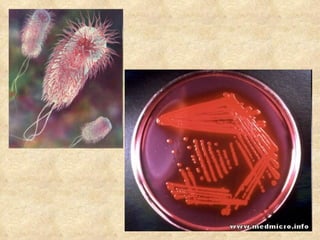
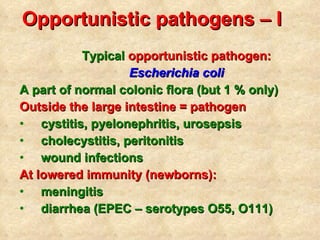
Opportunistic pathogens – I   Typical  opportunistic pathogen: Escherichia coli A part of normal colonic flora (but 1 % only) Outside the large intestine = pathogen cystitis, pyelonephritis, urosepsis cholecystitis, peritonitis wound infections At lowered immunity (newborns):  meningitis   diarrhea (EPEC – serotypes O55, O111)
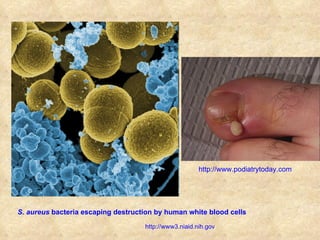
S. aureus  bacteria escaping destruction by human white blood cells   http://www3.niaid.nih.gov http://www.podiatrytoday.com
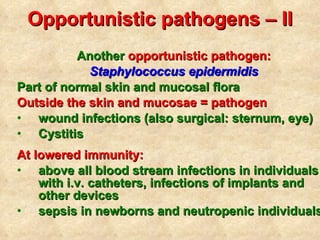
Opportunistic pathogens – II Another  opportunistic pathogen: Staphylococcus epidermidis Part of normal skin and mucosal flora Outside the skin and mucosae = pathogen wound infections (also surgical: sternum, eye) Cystitis At lowered immunity: above all blood stream infections in individuals with i.v. catheters, infections of implants and other devices sepsis in newborns and neutropenic individuals
Virulence  Virulence  =  degree  (measure)  of pathogenicity Virulence  = property of certain  strain  – a pathogenic species can incorporate  highly virulent strains  as well as almost  avirulent  ones Indicator of strain virulence:  ability to kill LD 50  = 50% lethal dose (the amount of microbe that is able to kill exactly ½ of experimental animals) Increasing virulence:  repeated passages of the strain (be cautious with the strains from dissection material) Attenuation  = artificial  weakening of virulence
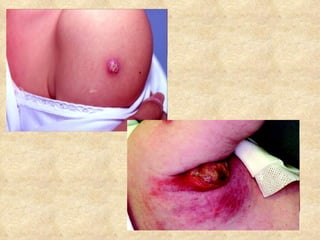
Attenuation   BCG-vaccine  (bacille Calmette-Guérin)  against TBC Original strain:  Mycobacterium bovis  –  is less pathogenic for man than  Mycob. tuberculosis The selected  strain was tormented 12 years on potato with bile  until it lost most of its virulence (it is almost avirulent) In   a normal newborn  BCG   causes  only a local process   in the site of injection or in a regional lymph node Very rarely in an  immunodeficient newborn  it can cause the  generalized infection
 
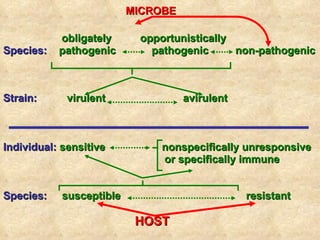
  MICROBE     obligately   opportunistically Species:   pathogenic  pathogenic  non-pathogenic   Strain:   virulent  avirulent   Individual:  sensitive  nonspecifically unresponsive  or specifically immune Species:   susceptible  resistant HOST
Recommended reading material   Paul de Kruif: Microbe Hunters Paul de Kruif: Men against Death Axel Munthe: The Story of San Michele Sinclair Lewis: Arrowsmith André Maurois: La vie de Sir Alexander Fleming Hans Zinsser: Rats, Lice, and History Thank you for your attention

07 pathogenicity and_virulence

  • 1.
    Institute for Microbiology,Medical Faculty of Masaryk University and St. Anna Faculty Hospital in Brno Miroslav Votava, Vladana Woznicová PATHOGENICITY AND VIRULENCE Lecture for 2nd-year students March 3 0 , 200 9
  • 2.
    Pathogenicity = A bility of a microbe to be harmful to health and to cause disease I nfectiousness = ability to cause infection Infection – broader term than disease In the disease , symptoms of disease are present (the infection is manifest one) But the infection may proceed without symptoms ( inapparent infection) Apart from infections , microbes can cause food poisoning , as well
  • 3.
    Ecological remark Ecology = science on mutual relations among organisms and relations between organisms and their environment Symbiosis = close association of two di fferent organisms Three forms of symbiosis : Mutualism – both partners benefit from the association and are unable to survive without it Commensalism – the association is beneficial for one partner and indifferent to the other Parasitism – the association benefits one partner and harms the other (the host) -> consequence = pathogenicity
  • 4.
    Infection Definition ofinfection is not an easy one Infection = situation when the etiological agent of infection invades an organism and multiplies in it; or it settles on bodily surfaces and acts adversely there  Colonization = settlement of bodily surface by a nonpathogenic microbe (or by a pathogen that does not cause pathological symptoms there)
  • 5.
    History of infectiousdiseases Physiological thesis of Hippocrates: (Infectious) disease = consequence of certain inadequacy of organism Microbial antithesis of Pasteur and Koch: The cause of the infectious disease is a microbe Ecological synthesis: = synthesis of physiological thesis and microbial antithesis – for the occurence of the infectious disease the microbe, host and environment are responsible
  • 6.
  • 7.
    Koch´s postulates A particular microbe is the etiological agent, if it is present in every case of the disease and its localization in the body corresponds to the damages observed; it is isolated from the host and kept in pure culture for several generations; by means of the microbe grown in this way it is possible to imitate the disease on another host ; it is again isolated from the experimentally infected host.
  • 8.
    Relationship between themicrobe and the host Dynamic and influenced by the environment microbe host environment Illness is not a rule – peaceful coexistence is usually better for the parasite In spite of that the host tries to get rid of the parasite – to destroy, remove or at least to localize it
  • 9.
    Pathogenicity Pathogenicity depends on both microbial and host species Particular microbial species is pathogenic for a specific host species only, for another species it may be non-pathogenic This host species is susceptible to the relevant microbial species, to a different microbial species it can be resistant
  • 10.
    Primary and opportunepathogens Primary (obligate) pathogens -> disease also in otherwise healthy individuals: chiefly agents of classical infections (diphtheria, typhoid fever, plague, gonorrhea, tetanus, influenza, morbilli etc.) Opportunistic (facultative) pathogens -> disease under certain conditions or at a certain disposition only: usually members of normal flora when they reach another site in the body or when the immunity of the individual is lowered
  • 11.
    Natural and experimentalpathogenicity Microbes naturally pathogenic for man & animals: Staph. aureus, Francisella tularensis, Clostridium botulinum, rabies v., tick-borne encephalitis v. Microbes pathogenic for animals experimentally: Bacillus anthracis, Streptococcus pneumoniae, Clostridium tetani – mouse Mycobact. tuberculosis, rickettsiae – guinea pig Treponema pallidum, herpes simplex v. – rabbit Mi c robes pathogenic for man only: Neisseria gonorrhoeae, Haemophilus ducreyi Mi c robes non-pathogenic for man: Majority of soil and water microorganisms
  • 12.
  • 13.
    Opportunistic pathogens –I Typical opportunistic pathogen: Escherichia coli A part of normal colonic flora (but 1 % only) Outside the large intestine = pathogen cystitis, pyelonephritis, urosepsis cholecystitis, peritonitis wound infections At lowered immunity (newborns): meningitis diarrhea (EPEC – serotypes O55, O111)
  • 14.
    S. aureus bacteria escaping destruction by human white blood cells http://www3.niaid.nih.gov http://www.podiatrytoday.com
  • 15.
    Opportunistic pathogens –II Another opportunistic pathogen: Staphylococcus epidermidis Part of normal skin and mucosal flora Outside the skin and mucosae = pathogen wound infections (also surgical: sternum, eye) Cystitis At lowered immunity: above all blood stream infections in individuals with i.v. catheters, infections of implants and other devices sepsis in newborns and neutropenic individuals
  • 16.
    Virulence Virulence = degree (measure) of pathogenicity Virulence = property of certain strain – a pathogenic species can incorporate highly virulent strains as well as almost avirulent ones Indicator of strain virulence: ability to kill LD 50 = 50% lethal dose (the amount of microbe that is able to kill exactly ½ of experimental animals) Increasing virulence: repeated passages of the strain (be cautious with the strains from dissection material) Attenuation = artificial weakening of virulence
  • 17.
    Attenuation BCG-vaccine (bacille Calmette-Guérin) against TBC Original strain: Mycobacterium bovis – is less pathogenic for man than Mycob. tuberculosis The selected strain was tormented 12 years on potato with bile until it lost most of its virulence (it is almost avirulent) In a normal newborn BCG causes only a local process in the site of injection or in a regional lymph node Very rarely in an immunodeficient newborn it can cause the generalized infection
  • 18.
  • 19.
    MICROBE obligately opportunistically Species: pathogenic pathogenic non-pathogenic Strain: virulent avirulent Individual: sensitive nonspecifically unresponsive or specifically immune Species: susceptible resistant HOST
  • 20.
    Recommended reading material Paul de Kruif: Microbe Hunters Paul de Kruif: Men against Death Axel Munthe: The Story of San Michele Sinclair Lewis: Arrowsmith André Maurois: La vie de Sir Alexander Fleming Hans Zinsser: Rats, Lice, and History Thank you for your attention