PORUKARA COLLEGE OF EDUCATION
CHAMPAKULAM
Submitted to,
Ms. Teena Maria Thomas
Submitted by,
Arya B
B.Ed English
WELCOME
MICRO TEACHING
INTRODUCTION
1. Microteaching is a teaching scaled – down in
content of the lesson, size of the class and
duration of teaching.
2. The process of teaching is broken down into its
components.
3. A teacher teaches a small topic to a small
group of students.
4. It has been used worldwide since its invention
a Stanford University in the late 1950’s by
Dwight W Allen.
• “A device which provides the novice and
experienced teacher alike, new opportunities to
improve teaching.”
- David B
• “It is a training technique which requires pupil-
teachers to teach a single concept using
specified teaching skills to a small number of
pupils in a short duration of time”
- Passi B K
Definition’s
OBJECTIVES
• To enable teacher trainee to learn and
assimilate new teaching skills under
controlled conditions.
• To enable teacher trainee to gain
confidence in teaching and to master
a number of skills by dealing with a
small group of pupils.
• To give proper guidance to trainee as
how to teach well.
CHARACTERISTICS
• It is training technique for teacher
trainees.
• It offers safe practice ground.
• Practicing one skill at a time.
• Reducing the class size to 5-10 pupil.
• Reducing the duration of lesson to 5-
10 minutes.
• It gives instant feedback.
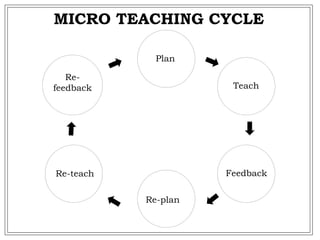
MICRO TEACHING CYCLE
Re-
feedback
Plan
Re-teach
Re-plan
Teach
Feedback
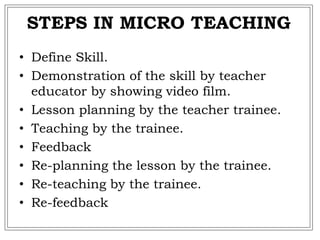
STEPS IN MICRO TEACHING
• Define Skill.
• Demonstration of the skill by teacher
educator by showing video film.
• Lesson planning by the teacher trainee.
• Teaching by the trainee.
• Feedback
• Re-planning the lesson by the trainee.
• Re-teaching by the trainee.
• Re-feedback
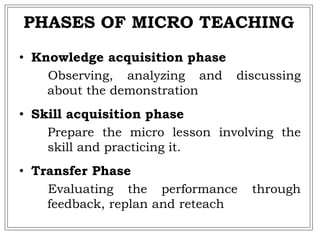
PHASES OF MICRO TEACHING
• Knowledge acquisition phase
Observing, analyzing and discussing
about the demonstration
• Skill acquisition phase
Prepare the micro lesson involving the
skill and practicing it.
• Transfer Phase
Evaluating the performance through
feedback, replan and reteach
• It help teachers improve teaching
performance.
• It develop teacher’s confidence.
• It proceeds from simple to complex.
• It gives ready feedback.
• It modifies teachers behaviour.
• It facilities attainments of teaching skills.
ADVANTAGES
LIMITATIONS
• It requires competent teacher trainees..
• It doesn’t guarantee success in teaching.
• It makes teaching process rigid.
• Strict scheduling of time affects creativity
of teachers.
• Teaching is not the totality of isolated
teaching skills.
THANK YOU

Micro teaching

  • 1.
    PORUKARA COLLEGE OFEDUCATION CHAMPAKULAM Submitted to, Ms. Teena Maria Thomas Submitted by, Arya B B.Ed English
  • 2.
  • 3.
  • 4.
    INTRODUCTION 1. Microteaching isa teaching scaled – down in content of the lesson, size of the class and duration of teaching. 2. The process of teaching is broken down into its components. 3. A teacher teaches a small topic to a small group of students. 4. It has been used worldwide since its invention a Stanford University in the late 1950’s by Dwight W Allen.
  • 5.
    • “A devicewhich provides the novice and experienced teacher alike, new opportunities to improve teaching.” - David B • “It is a training technique which requires pupil- teachers to teach a single concept using specified teaching skills to a small number of pupils in a short duration of time” - Passi B K Definition’s
  • 6.
    OBJECTIVES • To enableteacher trainee to learn and assimilate new teaching skills under controlled conditions. • To enable teacher trainee to gain confidence in teaching and to master a number of skills by dealing with a small group of pupils. • To give proper guidance to trainee as how to teach well.
  • 7.
    CHARACTERISTICS • It istraining technique for teacher trainees. • It offers safe practice ground. • Practicing one skill at a time. • Reducing the class size to 5-10 pupil. • Reducing the duration of lesson to 5- 10 minutes. • It gives instant feedback.
  • 8.
  • 9.
    STEPS IN MICROTEACHING • Define Skill. • Demonstration of the skill by teacher educator by showing video film. • Lesson planning by the teacher trainee. • Teaching by the trainee. • Feedback • Re-planning the lesson by the trainee. • Re-teaching by the trainee. • Re-feedback
  • 10.
    PHASES OF MICROTEACHING • Knowledge acquisition phase Observing, analyzing and discussing about the demonstration • Skill acquisition phase Prepare the micro lesson involving the skill and practicing it. • Transfer Phase Evaluating the performance through feedback, replan and reteach
  • 11.
    • It helpteachers improve teaching performance. • It develop teacher’s confidence. • It proceeds from simple to complex. • It gives ready feedback. • It modifies teachers behaviour. • It facilities attainments of teaching skills. ADVANTAGES
  • 12.
    LIMITATIONS • It requirescompetent teacher trainees.. • It doesn’t guarantee success in teaching. • It makes teaching process rigid. • Strict scheduling of time affects creativity of teachers. • Teaching is not the totality of isolated teaching skills.
  • 13.