MICRO TEACHING
Presented by
Soumya ranjan parida
WHAT IS MICRO-TEACHING
 “Micro-teaching is a scaled down teaching
encounter in class size and class time.”-D W
Allen
 “Micro-teaching is a teacher education
technique which allows teachers to apply
clear defined teaching skills to carefully
prepared lessons in a planned series of five
to ten minutes encounter with a small
group of real students, often with an
opportunity to observe the result on video-
tape.”- R N Bush
Objectives
 To improve teachers’ teaching skill
 To improve skill of public speaking
 To review a topic
 Update knowledge
 To enable the teacher to concise
 An organized way of planning
 To improve specific knowledge
 To change a routine
 To cover syllabus
STEPS IN MICRO-TEACHING
 Orientation of student teacher
 Discussion of teaching skills
 Selection of particular skills
 Presentation
 Observation of a model lesson
 Preparation of micro lesson plan
 Practice of skill
 Providing feedback
Cont…
 Creation of micro-teaching setting
 Re-planning
 Re-teaching
 Providing Re-feedback
 Integration of teaching skills
Advantages
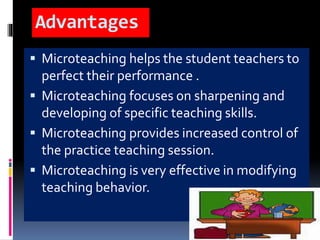
 Microteaching helps the student teachers to
perfect their performance .
 Microteaching focuses on sharpening and
developing of specific teaching skills.
 Microteaching provides increased control of
the practice teaching session.
 Microteaching is very effective in modifying
teaching behavior.
Advantages
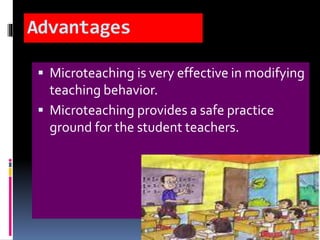
 Microteaching is very effective in modifying
teaching behavior.
 Microteaching provides a safe practice
ground for the student teachers.
Disadvantages
 Skill Oriented rather than content
 Scope of microteaching is narrow
 Required competent teacher educator
 Tends to reduce creativity of teacher
 Time consuming
 Alone may not be adequate
 Carried on in a controlled situation only
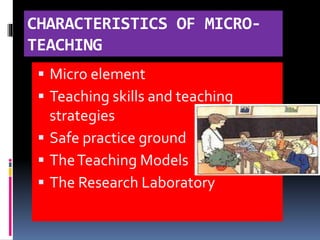
CHARACTERISTICS OF MICRO-
TEACHING
 Micro element
 Teaching skills and teaching
strategies
 Safe practice ground
 TheTeaching Models
 The Research Laboratory
Basic principles of micro-
teaching-
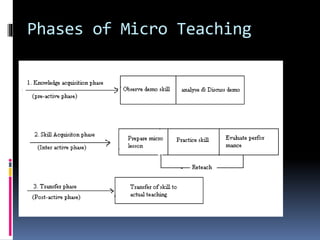
Phases of Micro Teaching
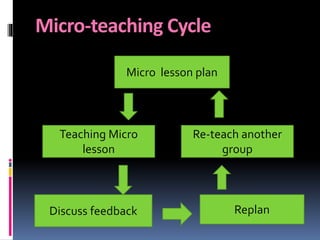
Micro-teaching Cycle
Micro lesson plan
Discuss feedback
Teaching Micro
lesson
Re-teach another
group
Replan
Apparatus Needed in Micro-
teaching
 Video on camera with a zoom lens
 Video tape recorders
 Two monitor
 Recording tapes
 Two clock
DURATION OF THE MICRO-
TEACHING IN INDIA
 Teaching 6 minutes
 Feedback 6 minutes
 Re-planning 12 minutes
 Re-teaching 6 minutes
 Re-feedback 6 minutes
 TOTAL = 36 minutes
Strategy of Micro-teaching
 Supervisor has to conduct orientation
training for teacher trainees on each
teaching skill.
 Supervisor has to prepare time-schedule
of micro lesson for each teacher trainee.
 Delivery of lesson under controlled
conditions by the pupils teacher.
 Supervision of the lesson by the supervisor
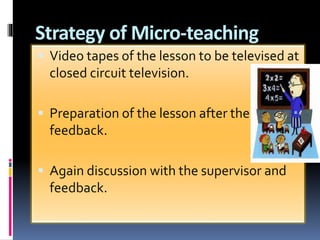
Strategy of Micro-teaching
 Video tapes of the lesson to be televised at
closed circuit television.
 Preparation of the lesson after the
feedback.
 Again discussion with the supervisor and
feedback.
TEACHING SKILL DEVELOPED FROM
MICRO-TEACHING
 Set induction
 Stimulus variation
 Closure
 Silence and non verbal cues
 Reinforcement of student participation
 Asking question
 Probing question
 Divergent question
 Attending behavior
 Illustration
 Lecturing
 Planner repetition
 Communication completeness
SUMMARIZATION
Conclusion
THANK YOU

Microteachingbcm 101117090614-phpapp02

  • 2.
  • 3.
    WHAT IS MICRO-TEACHING “Micro-teaching is a scaled down teaching encounter in class size and class time.”-D W Allen  “Micro-teaching is a teacher education technique which allows teachers to apply clear defined teaching skills to carefully prepared lessons in a planned series of five to ten minutes encounter with a small group of real students, often with an opportunity to observe the result on video- tape.”- R N Bush
  • 4.
    Objectives  To improveteachers’ teaching skill  To improve skill of public speaking  To review a topic  Update knowledge  To enable the teacher to concise  An organized way of planning  To improve specific knowledge  To change a routine  To cover syllabus
  • 5.
    STEPS IN MICRO-TEACHING Orientation of student teacher  Discussion of teaching skills  Selection of particular skills  Presentation  Observation of a model lesson  Preparation of micro lesson plan  Practice of skill  Providing feedback
  • 6.
    Cont…  Creation ofmicro-teaching setting  Re-planning  Re-teaching  Providing Re-feedback  Integration of teaching skills
  • 7.
    Advantages  Microteaching helpsthe student teachers to perfect their performance .  Microteaching focuses on sharpening and developing of specific teaching skills.  Microteaching provides increased control of the practice teaching session.  Microteaching is very effective in modifying teaching behavior.
  • 8.
    Advantages  Microteaching isvery effective in modifying teaching behavior.  Microteaching provides a safe practice ground for the student teachers.
  • 9.
    Disadvantages  Skill Orientedrather than content  Scope of microteaching is narrow  Required competent teacher educator  Tends to reduce creativity of teacher  Time consuming  Alone may not be adequate  Carried on in a controlled situation only
  • 10.
    CHARACTERISTICS OF MICRO- TEACHING Micro element  Teaching skills and teaching strategies  Safe practice ground  TheTeaching Models  The Research Laboratory
  • 11.
    Basic principles ofmicro- teaching-
  • 12.
  • 13.
    Micro-teaching Cycle Micro lessonplan Discuss feedback Teaching Micro lesson Re-teach another group Replan
  • 14.
    Apparatus Needed inMicro- teaching  Video on camera with a zoom lens  Video tape recorders  Two monitor  Recording tapes  Two clock
  • 15.
    DURATION OF THEMICRO- TEACHING IN INDIA  Teaching 6 minutes  Feedback 6 minutes  Re-planning 12 minutes  Re-teaching 6 minutes  Re-feedback 6 minutes  TOTAL = 36 minutes
  • 16.
    Strategy of Micro-teaching Supervisor has to conduct orientation training for teacher trainees on each teaching skill.  Supervisor has to prepare time-schedule of micro lesson for each teacher trainee.  Delivery of lesson under controlled conditions by the pupils teacher.  Supervision of the lesson by the supervisor
  • 17.
    Strategy of Micro-teaching Video tapes of the lesson to be televised at closed circuit television.  Preparation of the lesson after the feedback.  Again discussion with the supervisor and feedback.
  • 18.
    TEACHING SKILL DEVELOPEDFROM MICRO-TEACHING  Set induction  Stimulus variation  Closure  Silence and non verbal cues  Reinforcement of student participation  Asking question  Probing question  Divergent question
  • 19.
     Attending behavior Illustration  Lecturing  Planner repetition  Communication completeness
  • 20.
  • 23.
  • 24.