MICRO-
TEACHING
BY
Dr. SMITA SRIVASTAVA
Assistant Professor
Faculty of Education
Integral University , Lucknow
Meaning
• Micro-teaching is a teacher training and faculty
development technique whereby the teacher reviews
a recording of a teaching session, in order to get
constructive feedback from peers and/or students
about what has worked and what improvements can
be made to their teaching technique. Micro-teaching
was invented in the mid-1960s at Stanford University
by Dwight W. Allen, and has subsequently been
used to develop educators in all forms of education.
Objectives of Micro-teaching
• To enable teacher trainees to learn and assimilate new
teaching skills under controlled conditions.
• To enable teacher trainees to master a number of
teaching skills.
• To enable teacher trainees to gain confidence in
teaching.
Characteristics of Micro-teaching
• Microteaching is a highly individualized training device
• Microteaching is an experiment in the field of teacher
education which has been incorporated in the practice
teaching schedule
• It is a student teaching skill training technique and not a
teaching technique or method
• Microteaching is micro in the sense that it scale down
the complexities of real teaching
• Practicing one skill at a time
Contd.
• Reducing the class size to 5 – 10 pupil
• Reducing the duration of lesson to 5 – 10 minutes
• Limiting the content to a single concept
• immediate feedback helps in improving, fixing and
motivating learning
• The student are providing immediate feedback in
terms of peer group feedback, tape recorded/CCTV
• Microteaching advocates the choice and practice of
one skill at a time
Steps of Micro-teaching
• The Micro-teaching programme involves the following steps:
Step I Particular skill to be practiced is explained to the teacher
trainees in terms of the purpose and components of the skill
with suitable examples.
Step II The teacher trainer gives the demonstration of the skill
in Micro-teaching in simulated conditions to the teacher
trainees.
Step III The teacher trainee plans a short lesson plan on the
basis of the demonstrated skill for his/her practice.
Step IV The teacher trainee teaches the lesson to a small group
of pupils. His lesson is supervised by the supervisor and peers.
Contd.
• Step V On the basis of the observation of a lesson, the supervisor
gives feedback to the teacher trainee. The supervisor reinforces the
instances of effective use of the skill and draws attention of the
teacher trainee to the points where he could not do well.
Step VI In the light of the feed-back given by the supervisor, the
teacher trainee re-plans the lesson plan in order to use the skill in
more effective manner in the second trial.
Step VII The revised lesson is taught to another comparable group
of pupils.
Step VIII The supervisor observes the re-teach lesson and gives
re-feed back to the teacher trainee with convincing arguments and
reasons.
Step IX The ‘teach – re-teach’ cycle may be repeated several times
till adequate mastery level is achieved.
Micro-teaching Cycle
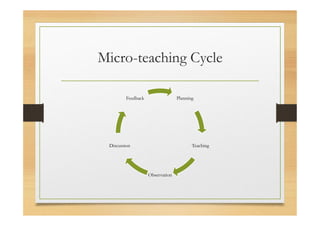
• The six steps generally involved in micro-teaching
cycle are Plan , Teach , Feedback
Re-plan , Re-teach , Re-feedback. There can be
variations as per requirement of the objective of
practice session. These steps are diagrammatically
represented in the following figure :
Micro-teaching Cycle
Planning
Teaching
Observation
Discussion
Feedback
Plan :
• This involves the selection of the topic and related
content of such a nature in which the use of
components of the skill under practice may be made
easily and conveniently. The topic is analyzed into
different activities of the teacher and the pupils. The
activities are planned in such a logical sequence
where maximum application of the components of a
skill is possible.
Teach :
• This involves the attempts of the teacher trainee to
use the components of the skill in suitable situations
coming up in the process of teaching-learning as per
his/her planning of activities. If the situation is
different and not as visualized(in the planning of the
activities, the teacher should modify his/her
behaviour as per the demand of the situation in the
class. He should have the courage and confidence to
handle the situation arising in the class effectively.
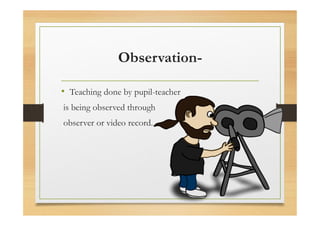
Observation-
• Teaching done by pupil-teacher
is being observed through
observer or video record.
Discussion-
On the basis of observation or recording
clip a discussion is being done
between pupil teacher
and observer.
Feedback :
• This term refers to giving information to the teacher
trainee about his performance. The information
includes the points of strength as well as weakness
relating to his/her performance. This helps the
teacher trainee to improve upon his/her performance
in the desired direction.
Re-plan :
• The teacher trainee re-plans his lesson incorporating
the points of strength and removing the points not
skilfully handled during teaching in the previous
attempt either on the same topic or on another topic
suiting to the teacher trainee for improvement.
Re-teach & Re-feedback
• Re-teach : This involves teaching to the same group of
pupils if the topic is changed or to a different group of
pupils if the topic is the same. This is done to remove
boredom or monotony of the pupil. The teacher trainee
teaches the class with renewed courage and confidence to
perform better than the previous attempt.
Re-feedback : This is the most important component of
Micro-teaching for behaviour modification of teacher
trainee in the desired direction in each and every skill
practice.
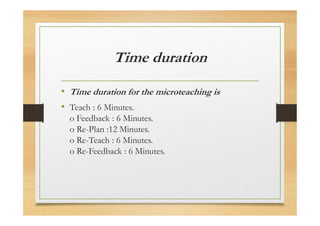
Time duration
• Time duration for the microteaching is
• Teach : 6 Minutes.
o Feedback : 6 Minutes.
o Re-Plan :12 Minutes.
o Re-Teach : 6 Minutes.
o Re-Feedback : 6 Minutes.
Merits/Advantages
• It helps to develop and master important teaching skills.
• It helps to accomplish specific teacher competencies.
• It caters the need of individual differences in the teacher
training.
• It is more effective in modifying teacher behaviour.
• It is an individualized training technique.
• It employs real teaching situation for developing skills.
• It reduces the complexity of teaching process as it is a
scaled down teaching.
• It helps to get deeper knowledge regarding the art of
teaching.
Limitations
• It is skill oriented; Content not emphasized.
• A large number of trainees cannot be given the
opportunity for re-teaching and re-planning.
• It is very time consuming technique.
• It requires special classroom setting.
• It covers only a few specific skills.
• It deviates from normal classroom teaching.
• It may raise administrative problem while arranging
micro lessons
References
• Pictures from Bing Image search
• www.google.com
THANKS

Micro teaching pdf

  • 1.
    MICRO- TEACHING BY Dr. SMITA SRIVASTAVA AssistantProfessor Faculty of Education Integral University , Lucknow
  • 2.
    Meaning • Micro-teaching isa teacher training and faculty development technique whereby the teacher reviews a recording of a teaching session, in order to get constructive feedback from peers and/or students about what has worked and what improvements can be made to their teaching technique. Micro-teaching was invented in the mid-1960s at Stanford University by Dwight W. Allen, and has subsequently been used to develop educators in all forms of education.
  • 3.
    Objectives of Micro-teaching •To enable teacher trainees to learn and assimilate new teaching skills under controlled conditions. • To enable teacher trainees to master a number of teaching skills. • To enable teacher trainees to gain confidence in teaching.
  • 4.
    Characteristics of Micro-teaching •Microteaching is a highly individualized training device • Microteaching is an experiment in the field of teacher education which has been incorporated in the practice teaching schedule • It is a student teaching skill training technique and not a teaching technique or method • Microteaching is micro in the sense that it scale down the complexities of real teaching • Practicing one skill at a time
  • 5.
    Contd. • Reducing theclass size to 5 – 10 pupil • Reducing the duration of lesson to 5 – 10 minutes • Limiting the content to a single concept • immediate feedback helps in improving, fixing and motivating learning • The student are providing immediate feedback in terms of peer group feedback, tape recorded/CCTV • Microteaching advocates the choice and practice of one skill at a time
  • 6.
    Steps of Micro-teaching •The Micro-teaching programme involves the following steps: Step I Particular skill to be practiced is explained to the teacher trainees in terms of the purpose and components of the skill with suitable examples. Step II The teacher trainer gives the demonstration of the skill in Micro-teaching in simulated conditions to the teacher trainees. Step III The teacher trainee plans a short lesson plan on the basis of the demonstrated skill for his/her practice. Step IV The teacher trainee teaches the lesson to a small group of pupils. His lesson is supervised by the supervisor and peers.
  • 7.
    Contd. • Step VOn the basis of the observation of a lesson, the supervisor gives feedback to the teacher trainee. The supervisor reinforces the instances of effective use of the skill and draws attention of the teacher trainee to the points where he could not do well. Step VI In the light of the feed-back given by the supervisor, the teacher trainee re-plans the lesson plan in order to use the skill in more effective manner in the second trial. Step VII The revised lesson is taught to another comparable group of pupils. Step VIII The supervisor observes the re-teach lesson and gives re-feed back to the teacher trainee with convincing arguments and reasons. Step IX The ‘teach – re-teach’ cycle may be repeated several times till adequate mastery level is achieved.
  • 8.
    Micro-teaching Cycle • Thesix steps generally involved in micro-teaching cycle are Plan , Teach , Feedback Re-plan , Re-teach , Re-feedback. There can be variations as per requirement of the objective of practice session. These steps are diagrammatically represented in the following figure :
  • 9.
  • 10.
    Plan : • Thisinvolves the selection of the topic and related content of such a nature in which the use of components of the skill under practice may be made easily and conveniently. The topic is analyzed into different activities of the teacher and the pupils. The activities are planned in such a logical sequence where maximum application of the components of a skill is possible.
  • 11.
    Teach : • Thisinvolves the attempts of the teacher trainee to use the components of the skill in suitable situations coming up in the process of teaching-learning as per his/her planning of activities. If the situation is different and not as visualized(in the planning of the activities, the teacher should modify his/her behaviour as per the demand of the situation in the class. He should have the courage and confidence to handle the situation arising in the class effectively.
  • 12.
    Observation- • Teaching doneby pupil-teacher is being observed through observer or video record.
  • 13.
    Discussion- On the basisof observation or recording clip a discussion is being done between pupil teacher and observer.
  • 14.
    Feedback : • Thisterm refers to giving information to the teacher trainee about his performance. The information includes the points of strength as well as weakness relating to his/her performance. This helps the teacher trainee to improve upon his/her performance in the desired direction.
  • 15.
    Re-plan : • Theteacher trainee re-plans his lesson incorporating the points of strength and removing the points not skilfully handled during teaching in the previous attempt either on the same topic or on another topic suiting to the teacher trainee for improvement.
  • 16.
    Re-teach & Re-feedback •Re-teach : This involves teaching to the same group of pupils if the topic is changed or to a different group of pupils if the topic is the same. This is done to remove boredom or monotony of the pupil. The teacher trainee teaches the class with renewed courage and confidence to perform better than the previous attempt. Re-feedback : This is the most important component of Micro-teaching for behaviour modification of teacher trainee in the desired direction in each and every skill practice.
  • 17.
    Time duration • Timeduration for the microteaching is • Teach : 6 Minutes. o Feedback : 6 Minutes. o Re-Plan :12 Minutes. o Re-Teach : 6 Minutes. o Re-Feedback : 6 Minutes.
  • 18.
    Merits/Advantages • It helpsto develop and master important teaching skills. • It helps to accomplish specific teacher competencies. • It caters the need of individual differences in the teacher training. • It is more effective in modifying teacher behaviour. • It is an individualized training technique. • It employs real teaching situation for developing skills. • It reduces the complexity of teaching process as it is a scaled down teaching. • It helps to get deeper knowledge regarding the art of teaching.
  • 19.
    Limitations • It isskill oriented; Content not emphasized. • A large number of trainees cannot be given the opportunity for re-teaching and re-planning. • It is very time consuming technique. • It requires special classroom setting. • It covers only a few specific skills. • It deviates from normal classroom teaching. • It may raise administrative problem while arranging micro lessons
  • 20.
    References • Pictures fromBing Image search • www.google.com THANKS