WELCOME
MICRO-TEACHING
Presented by
AKHILA SANTHOSH
WHAT IS MICRO –TEACHING?
Micro-teaching is a scaled down sample
of teaching in which a teacher teaches a
small unit to a small group of 5 to 10
pupils for a small period of 5 to 10
minutes.
DEFINITION OF MICRO-TEACHING
Micro teaching is defined as “a scaled down
teaching encounter in a class size and class
time”.it is also defined as “a teacher training
procedure which reduces the teaching situation
to simpler and more controlled encounter
achieved by limiting the practice teaching to a
specific skill and reducing teaching time and
class size”.
OBJECTIVES OF MICRO-TEACHING
1. To enable teacher-trainees to learn and
assimilate new teaching skills under controlled
conditions.
2. To enable teacher-trainees to gain confidence
in teaching, and to master a number of skills
by dealing with a small of pupils.
CHARACTERISTICS OF MICRO- TEACHING
1. It is a scaled down teaching.
2. It is less complex than regular teaching.
3. It involves fewer numbers if students,
usually 5 to 10.
4. It’s duration is short – about 5 to 10
minutes.
STEPS IN MICRO- TEACHING
1. Defining the skills to be developed in terms of
specific teaching behaviour.
2. Demonstration of the skill by the teacher educator
by taking a lesson.
3. Based on the model, preparation of a lesson plan
by the teacher trainee, for a suitable topic, which
calls for the skill anticipated.
4. Teaching of the lesson by the teacher trainee in a
stimulated set up, in the presence of observer.
5. Providing of immediate feed-back to the
teacher trainee by the observers with a view
to help him improve the skill.
6. Arranging re-planning, re-teaching and re-
feedback sessions.
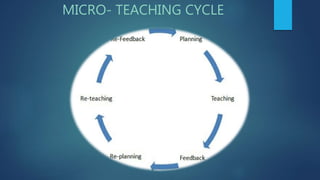
7. Repetition of ‘plan, teach, feedback, re-
planning, re-teaching and re-feedback’ cycle
till the skill is acquired.
MICRO- TEACHING CYCLE
MICRO-TEACHING PROCEDURE
 Micro-teaching procedure involves three phases. They are:
1. Knowledge acquisition phase : Observing the demonstration
of the skill and analyzing it and discussing about the
demonstration.
2. Skill acquisition phase : Preparing the micro lesson involving
the skill and practicing the skill while teaching.
3. Transfer phase : Evaluating performance through feedback,
re-plan, re-teach and transfer of skill to actual class teaching
in macro sessions.
ADVANTAGES OF MICRO-TEACHING
 Micro-teaching is flexible and adaptable to different needs and
purposes. It has many advantages as listed below:
1. Teacher-trainees trained through micro-teaching are found to perform
better than those trained by traditional method.
2. It employs real teaching for the purpose of developing skills.
3. It helps accomplish specific teacher competencies.
4. The teaching practice gains a higher degree of organisation because
factors such as time, number of students, etc. could be controlled.
5. It helps gain deeper knowledge due to feedback and re-
plan, re-teach cycles.
6. It is more effective in modifying teacher behavior.
7. It helps in developing important teaching skills such as
questioning, reinforcement of student participation, etc.
8. It is an effective technique for transfer of teaching
competencies to class room.
9. It provides many opportunities to trainees to build up
desired patterns of behavior in a non-threatening set up.
LIMITATIONS OF MICRO-TEACHING
1. It is skill oriented; content is not
emphasized.
2. It emphasizes specific skills; but neglects
integrated skills.
3. It covers only a few specific skills.
4. It may raise administrative problems
while arranging micro lessons.
THANK YOU…

MICRO TEACHING

  • 1.
  • 2.
  • 3.
    WHAT IS MICRO–TEACHING? Micro-teaching is a scaled down sample of teaching in which a teacher teaches a small unit to a small group of 5 to 10 pupils for a small period of 5 to 10 minutes.
  • 5.
    DEFINITION OF MICRO-TEACHING Microteaching is defined as “a scaled down teaching encounter in a class size and class time”.it is also defined as “a teacher training procedure which reduces the teaching situation to simpler and more controlled encounter achieved by limiting the practice teaching to a specific skill and reducing teaching time and class size”.
  • 6.
    OBJECTIVES OF MICRO-TEACHING 1.To enable teacher-trainees to learn and assimilate new teaching skills under controlled conditions. 2. To enable teacher-trainees to gain confidence in teaching, and to master a number of skills by dealing with a small of pupils.
  • 7.
    CHARACTERISTICS OF MICRO-TEACHING 1. It is a scaled down teaching. 2. It is less complex than regular teaching. 3. It involves fewer numbers if students, usually 5 to 10. 4. It’s duration is short – about 5 to 10 minutes.
  • 8.
    STEPS IN MICRO-TEACHING 1. Defining the skills to be developed in terms of specific teaching behaviour. 2. Demonstration of the skill by the teacher educator by taking a lesson. 3. Based on the model, preparation of a lesson plan by the teacher trainee, for a suitable topic, which calls for the skill anticipated. 4. Teaching of the lesson by the teacher trainee in a stimulated set up, in the presence of observer.
  • 9.
    5. Providing ofimmediate feed-back to the teacher trainee by the observers with a view to help him improve the skill. 6. Arranging re-planning, re-teaching and re- feedback sessions. 7. Repetition of ‘plan, teach, feedback, re- planning, re-teaching and re-feedback’ cycle till the skill is acquired.
  • 10.
  • 11.
    MICRO-TEACHING PROCEDURE  Micro-teachingprocedure involves three phases. They are: 1. Knowledge acquisition phase : Observing the demonstration of the skill and analyzing it and discussing about the demonstration. 2. Skill acquisition phase : Preparing the micro lesson involving the skill and practicing the skill while teaching. 3. Transfer phase : Evaluating performance through feedback, re-plan, re-teach and transfer of skill to actual class teaching in macro sessions.
  • 12.
    ADVANTAGES OF MICRO-TEACHING Micro-teaching is flexible and adaptable to different needs and purposes. It has many advantages as listed below: 1. Teacher-trainees trained through micro-teaching are found to perform better than those trained by traditional method. 2. It employs real teaching for the purpose of developing skills. 3. It helps accomplish specific teacher competencies. 4. The teaching practice gains a higher degree of organisation because factors such as time, number of students, etc. could be controlled.
  • 13.
    5. It helpsgain deeper knowledge due to feedback and re- plan, re-teach cycles. 6. It is more effective in modifying teacher behavior. 7. It helps in developing important teaching skills such as questioning, reinforcement of student participation, etc. 8. It is an effective technique for transfer of teaching competencies to class room. 9. It provides many opportunities to trainees to build up desired patterns of behavior in a non-threatening set up.
  • 14.
    LIMITATIONS OF MICRO-TEACHING 1.It is skill oriented; content is not emphasized. 2. It emphasizes specific skills; but neglects integrated skills. 3. It covers only a few specific skills. 4. It may raise administrative problems while arranging micro lessons.
  • 15.