PORUKARA COLLEGE OF EDUCATION
Submitted To,
Mrs Sindhu M V
Teacher in charge
Submitted by,
Anju joseph
English
Roll no:4
WELCOME
TOPIC: MICRO-TEACHING
INTRODUCTION
• D W Allen Stanford university is the founder of micro teaching in
1960’s.
• Dwight Allen and his colleges from the Stanford university developed
a training program to improve verbal and non-verbal aspects of
teacher’s speech and general performance.
DEFINITION
• Micro teaching is defined as a scaled down teaching encounter in a
class size and class time.
OBJECTIVES
• To enable teacher-trainees to learn and assimilate new teaching skills
under controlled conditions.
• To acquire knowledge.
• To increase confidence level.
CHARACTERISTICS
• It is scaled down teaching.
• It is less complex than regular teaching.
• It involves lesser number of students usually 5 to 10.
• Its duration is short about 5 to 10 minutes.
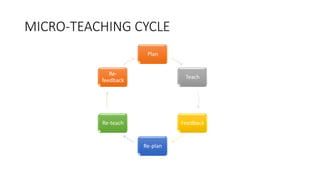
MICRO-TEACHING CYCLE
Plan
Teach
Feedback
Re-plan
Re-teach
Re-
feedback
MICRO-TEACHING PROCEDURES
Micro-teaching procedure involves 3 phases:-
1. Knowledge acquisition phase.
2. Skill acquisition phase.
3. Transfer acquisition phase.
STEPS IN MICRO-TEACHING
• Defining the skill.
• Demonstration of the skill.
• Select suitable topic.
• Write a lesson plan.
• Take a class in front of observers.
• Providing of immediate feedback.
• Arranging Re-planning, Re-teach and Re-feedback.
• Repetition of plan, teach and feedback.
TYPES OF SKILLS
• Skill of introducing a lesson.
• Skill of stimulus variation.
• Skill of explaining.
• Skill of using back board.
• Skill of illustrating with examples.
• Skill of probing questions.
• Skill of fluency in questioning.
• Skill of Re-inforcement.
ADVANTAGES OF MICRO-TEACHING
• For better performance.
• Purpose of skill development.
• Helping in teaching competency.
• Feedback.
• Modifying the teachers behavior.
CONCLUSION
Micro-teaching helps a teacher-trainee to improve his own teaching.
It is concerned with development and modification of discrete
classroom teaching skills. Micro-teaching involves study of a specific
teaching skill. Micro-teaching is now accepted as an efficient instrument
for teacher training.

Anju ppt

  • 1.
    PORUKARA COLLEGE OFEDUCATION Submitted To, Mrs Sindhu M V Teacher in charge Submitted by, Anju joseph English Roll no:4
  • 2.
  • 3.
  • 4.
    INTRODUCTION • D WAllen Stanford university is the founder of micro teaching in 1960’s. • Dwight Allen and his colleges from the Stanford university developed a training program to improve verbal and non-verbal aspects of teacher’s speech and general performance.
  • 5.
    DEFINITION • Micro teachingis defined as a scaled down teaching encounter in a class size and class time.
  • 6.
    OBJECTIVES • To enableteacher-trainees to learn and assimilate new teaching skills under controlled conditions. • To acquire knowledge. • To increase confidence level.
  • 7.
    CHARACTERISTICS • It isscaled down teaching. • It is less complex than regular teaching. • It involves lesser number of students usually 5 to 10. • Its duration is short about 5 to 10 minutes.
  • 8.
  • 9.
    MICRO-TEACHING PROCEDURES Micro-teaching procedureinvolves 3 phases:- 1. Knowledge acquisition phase. 2. Skill acquisition phase. 3. Transfer acquisition phase.
  • 10.
    STEPS IN MICRO-TEACHING •Defining the skill. • Demonstration of the skill. • Select suitable topic. • Write a lesson plan. • Take a class in front of observers. • Providing of immediate feedback. • Arranging Re-planning, Re-teach and Re-feedback. • Repetition of plan, teach and feedback.
  • 11.
    TYPES OF SKILLS •Skill of introducing a lesson. • Skill of stimulus variation. • Skill of explaining. • Skill of using back board. • Skill of illustrating with examples. • Skill of probing questions. • Skill of fluency in questioning. • Skill of Re-inforcement.
  • 12.
    ADVANTAGES OF MICRO-TEACHING •For better performance. • Purpose of skill development. • Helping in teaching competency. • Feedback. • Modifying the teachers behavior.
  • 13.
    CONCLUSION Micro-teaching helps ateacher-trainee to improve his own teaching. It is concerned with development and modification of discrete classroom teaching skills. Micro-teaching involves study of a specific teaching skill. Micro-teaching is now accepted as an efficient instrument for teacher training.