MICROTEACHING
PRESENTER
Dr. Bitan
Sengupta
Introduction
Definition of Microteaching
Evolution of Microteaching
Objectives of Microteaching
Concept of Microteaching
Phases of Microteaching
Microteaching cycle
Steps of Microteaching
Advantages and disadvantages of Microteaching
Microteaching Vs classroom teaching
summary
Introduction
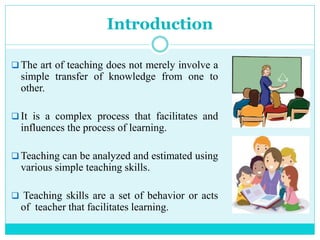
 The art of teaching does not merely involve a
simple transfer of knowledge from one to
other.
 It is a complex process that facilitates and
influences the process of learning.
 Teaching can be analyzed and estimated using
various simple teaching skills.
 Teaching skills are a set of behavior or acts
of teacher that facilitates learning.
Introduction cont.
 The traditional medical teaching emphasizes
on the transmission of factual knowledge and
hence, the teachers are the main source of
information.
 The conventional methods of medical teacher
training are found not adequate to learn the
specific teaching skills.
 These teaching skill can be acquired only
through more structured and cheaper training
techniques.
Introduction cont.
 Allen and his group evolved one technique
in late sixties to improve the skills of
teachers which is known as Microteaching.
 Microteaching allows to learn each skill to
the maximum extent as there is a chance of
listening, observing, and practicing.
 It has become an excellent vehicle of
providing training to medical teachers to
improve their teaching skills.
Dwight W. Allen
(1931)
Definition of Microteaching
 D.W. Allen (1966) - “Micro-teaching is a scaled down
teaching encounter in class size and class time.”
 D.W. Allen & A.W. Eve (1968) - “Microteaching is
defined as a system of controlled practice that makes it
possible to concentrate on specified teaching behavior
and to practice teaching under controlled conditions.’’
Evolution of Microteaching
 The idea of micro-teaching was originated at Stanford University
in USA in 1963, during an experimental project on teaching skills.
 A team of experts lead by D.W. Allen was assigned to develop a
tool to measure the attainment of teaching skills.
 One of the team member was investigating the utility of video
recording of the class interaction and the behaviors of the trainee in
the development of technical teaching skills.
 This lead to the development of a systematic and accurate method
of giving feedback to the teacher trainee.
Objective
To enable teacher trainees to learn and
assimilate new teaching skills under
controlled conditions.
To enable teacher trainees to master a
number of teaching skills.
To enable teacher trainees to gain
confidence in teaching.
Concept of microteaching
 Teaching skills can be practiced one by one up to the mastery
level under specific and simplified situations.
 Appropriate feedback, can be very helpful for obtaining a
mastery level in each skill.
 When all skills have been mastered one by one, then they can be
integrated for real class room teaching and can be conveniently
transferred to the actual classroom teaching situation.
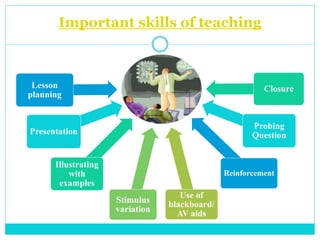
Lesson
planning
Presentation
Illustrating
with
examples
Stimulus
variation
Use of
blackboard/
AV aids
Reinforcement
Probing
Question
Closure
Important skills of teaching
Characteristics
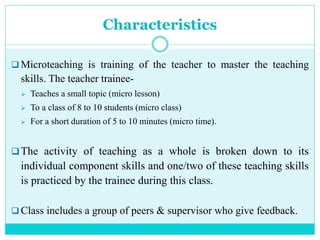
 Microteaching is training of the teacher to master the teaching
skills. The teacher trainee-
 Teaches a small topic (micro lesson)
 To a class of 8 to 10 students (micro class)
 For a short duration of 5 to 10 minutes (micro time).
The activity of teaching as a whole is broken down to its
individual component skills and one/two of these teaching skills
is practiced by the trainee during this class.
 Class includes a group of peers & supervisor who give feedback.
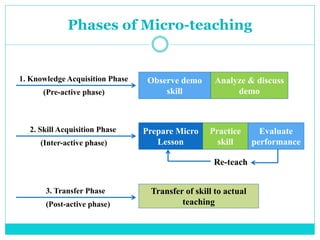
Phases of Micro-teaching
1. Knowledge Acquisition Phase
(Pre-active phase)
Observe demo
skill
Analyze & discuss
demo
2. Skill Acquisition Phase Prepare Micro
Lesson
Practice
skill
Evaluate
performance
3. Transfer Phase
Re-teach
Transfer of skill to actual
teaching
(Inter-active phase)
(Post-active phase)
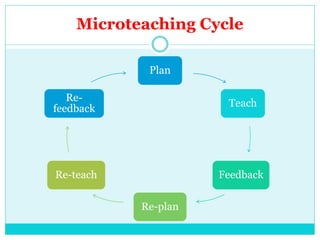
Microteaching Cycle
Plan
Teach
Feedback
Re-plan
Re-teach
Re-
feedback
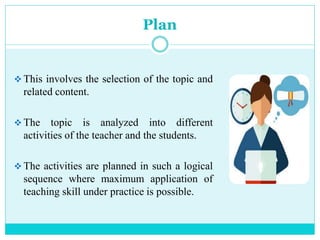
Plan
 This involves the selection of the topic and
related content.
 The topic is analyzed into different
activities of the teacher and the students.
 The activities are planned in such a logical
sequence where maximum application of
teaching skill under practice is possible.
Teach
 This involves the attempts of the teacher
trainee to practice the teaching skill under
suitable situations.
 If the situation is different and not as per the
planning, the teacher should modify the
behavior as per the demand of the Class.
 He/she should have the courage and
confidence to handle the situation arising in
the class effectively.
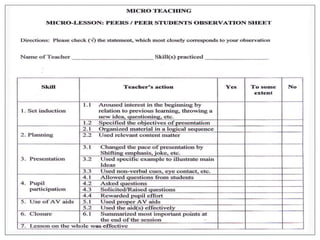
Feedback
 Feedback refers to giving information to the
teacher trainee about his performance.
 The information includes the points of
strengths as well as weaknesses related to
his/her performance.
 This helps the teacher trainee to improve
his/her performance in the desired direction.
Re-plan
 The teacher trainee re-plans his lesson
Incorporating the points of strength and
removing the points not skillfully handled
during teaching in the previous attempt.
 The re-planning is either on the same topic or
on another topic suitable to the teacher
trainee for his/her improvement.
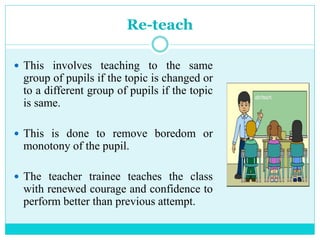
Re-teach
 This involves teaching to the same
group of pupils if the topic is changed or
to a different group of pupils if the topic
is same.
 This is done to remove boredom or
monotony of the pupil.
 The teacher trainee teaches the class
with renewed courage and confidence to
perform better than previous attempt.
Re-feedback
 This is the most important
component of Micro-teaching .
 It is for behavior modification of
teacher trainee in the desired
direction in each and every skill
practice.
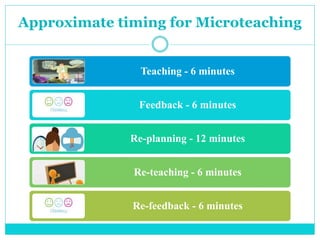
Approximate timing for Microteaching
Teaching - 6 minutes
Feedback - 6 minutes
Re-planning - 12 minutes
Re-teaching - 6 minutes
Re-feedback - 6 minutes
Steps of Microteaching
 Step I - Particular skill to be practiced is explained to the teacher
trainees.
 Step II - The teacher trainer gives the demonstration of the skill to
the teacher trainees.
 Step III - The teacher trainee plans a micro lesson plan.
 Step IV - The teacher trainee teaches the lesson to a small group of
pupils.
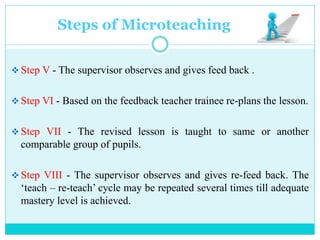
Steps of Microteaching
 Step V - The supervisor observes and gives feed back .
 Step VI - Based on the feedback teacher trainee re-plans the lesson.
 Step VII - The revised lesson is taught to same or another
comparable group of pupils.
 Step VIII - The supervisor observes and gives re-feed back. The
‘teach – re-teach’ cycle may be repeated several times till adequate
mastery level is achieved.
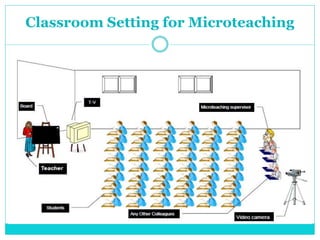
Classroom Setting for Microteaching
Advantages
 It builds up confidence in the teacher.
 It can be done in small setting.
 Provide constructive feedback.
 Teaching skills can be learn by breaking them into smaller parts.
 Much more comfortable for the teacher than a real classroom
situation because of the smaller length of lecture and less number
of students.
 Can be used for polishing the teaching skills by both beginner and
senior teacher.
Limitation
 It is skill oriented; Content not emphasized.
 Need a person for supervision.
 It is very time consuming technique.
 It covers only a few specific skills.
 A large number of trainees cannot be given the opportunity for
re-teaching and re-planning.
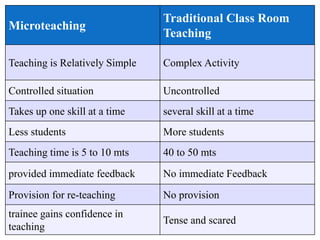
Microteaching
Traditional Class Room
Teaching
Teaching is Relatively Simple Complex Activity
Controlled situation Uncontrolled
Takes up one skill at a time several skill at a time
Less students More students
Teaching time is 5 to 10 mts 40 to 50 mts
provided immediate feedback No immediate Feedback
Provision for re-teaching No provision
trainee gains confidence in
teaching
Tense and scared
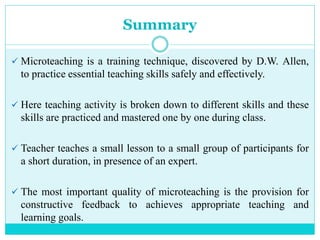
Summary
 Microteaching is a training technique, discovered by D.W. Allen,
to practice essential teaching skills safely and effectively.
 Here teaching activity is broken down to different skills and these
skills are practiced and mastered one by one during class.
 Teacher teaches a small lesson to a small group of participants for
a short duration, in presence of an expert.
 The most important quality of microteaching is the provision for
constructive feedback to achieves appropriate teaching and
learning goals.
Microteaching seminar ppt

Microteaching seminar ppt

  • 1.
  • 2.
    Introduction Definition of Microteaching Evolutionof Microteaching Objectives of Microteaching Concept of Microteaching Phases of Microteaching Microteaching cycle Steps of Microteaching Advantages and disadvantages of Microteaching Microteaching Vs classroom teaching summary
  • 3.
    Introduction  The artof teaching does not merely involve a simple transfer of knowledge from one to other.  It is a complex process that facilitates and influences the process of learning.  Teaching can be analyzed and estimated using various simple teaching skills.  Teaching skills are a set of behavior or acts of teacher that facilitates learning.
  • 4.
    Introduction cont.  Thetraditional medical teaching emphasizes on the transmission of factual knowledge and hence, the teachers are the main source of information.  The conventional methods of medical teacher training are found not adequate to learn the specific teaching skills.  These teaching skill can be acquired only through more structured and cheaper training techniques.
  • 5.
    Introduction cont.  Allenand his group evolved one technique in late sixties to improve the skills of teachers which is known as Microteaching.  Microteaching allows to learn each skill to the maximum extent as there is a chance of listening, observing, and practicing.  It has become an excellent vehicle of providing training to medical teachers to improve their teaching skills. Dwight W. Allen (1931)
  • 6.
    Definition of Microteaching D.W. Allen (1966) - “Micro-teaching is a scaled down teaching encounter in class size and class time.”  D.W. Allen & A.W. Eve (1968) - “Microteaching is defined as a system of controlled practice that makes it possible to concentrate on specified teaching behavior and to practice teaching under controlled conditions.’’
  • 7.
    Evolution of Microteaching The idea of micro-teaching was originated at Stanford University in USA in 1963, during an experimental project on teaching skills.  A team of experts lead by D.W. Allen was assigned to develop a tool to measure the attainment of teaching skills.  One of the team member was investigating the utility of video recording of the class interaction and the behaviors of the trainee in the development of technical teaching skills.  This lead to the development of a systematic and accurate method of giving feedback to the teacher trainee.
  • 8.
    Objective To enable teachertrainees to learn and assimilate new teaching skills under controlled conditions. To enable teacher trainees to master a number of teaching skills. To enable teacher trainees to gain confidence in teaching.
  • 9.
    Concept of microteaching Teaching skills can be practiced one by one up to the mastery level under specific and simplified situations.  Appropriate feedback, can be very helpful for obtaining a mastery level in each skill.  When all skills have been mastered one by one, then they can be integrated for real class room teaching and can be conveniently transferred to the actual classroom teaching situation.
  • 10.
  • 11.
    Characteristics  Microteaching istraining of the teacher to master the teaching skills. The teacher trainee-  Teaches a small topic (micro lesson)  To a class of 8 to 10 students (micro class)  For a short duration of 5 to 10 minutes (micro time). The activity of teaching as a whole is broken down to its individual component skills and one/two of these teaching skills is practiced by the trainee during this class.  Class includes a group of peers & supervisor who give feedback.
  • 12.
    Phases of Micro-teaching 1.Knowledge Acquisition Phase (Pre-active phase) Observe demo skill Analyze & discuss demo 2. Skill Acquisition Phase Prepare Micro Lesson Practice skill Evaluate performance 3. Transfer Phase Re-teach Transfer of skill to actual teaching (Inter-active phase) (Post-active phase)
  • 13.
  • 14.
    Plan  This involvesthe selection of the topic and related content.  The topic is analyzed into different activities of the teacher and the students.  The activities are planned in such a logical sequence where maximum application of teaching skill under practice is possible.
  • 15.
    Teach  This involvesthe attempts of the teacher trainee to practice the teaching skill under suitable situations.  If the situation is different and not as per the planning, the teacher should modify the behavior as per the demand of the Class.  He/she should have the courage and confidence to handle the situation arising in the class effectively.
  • 16.
    Feedback  Feedback refersto giving information to the teacher trainee about his performance.  The information includes the points of strengths as well as weaknesses related to his/her performance.  This helps the teacher trainee to improve his/her performance in the desired direction.
  • 18.
    Re-plan  The teachertrainee re-plans his lesson Incorporating the points of strength and removing the points not skillfully handled during teaching in the previous attempt.  The re-planning is either on the same topic or on another topic suitable to the teacher trainee for his/her improvement.
  • 19.
    Re-teach  This involvesteaching to the same group of pupils if the topic is changed or to a different group of pupils if the topic is same.  This is done to remove boredom or monotony of the pupil.  The teacher trainee teaches the class with renewed courage and confidence to perform better than previous attempt.
  • 20.
    Re-feedback  This isthe most important component of Micro-teaching .  It is for behavior modification of teacher trainee in the desired direction in each and every skill practice.
  • 21.
    Approximate timing forMicroteaching Teaching - 6 minutes Feedback - 6 minutes Re-planning - 12 minutes Re-teaching - 6 minutes Re-feedback - 6 minutes
  • 22.
    Steps of Microteaching Step I - Particular skill to be practiced is explained to the teacher trainees.  Step II - The teacher trainer gives the demonstration of the skill to the teacher trainees.  Step III - The teacher trainee plans a micro lesson plan.  Step IV - The teacher trainee teaches the lesson to a small group of pupils.
  • 23.
    Steps of Microteaching Step V - The supervisor observes and gives feed back .  Step VI - Based on the feedback teacher trainee re-plans the lesson.  Step VII - The revised lesson is taught to same or another comparable group of pupils.  Step VIII - The supervisor observes and gives re-feed back. The ‘teach – re-teach’ cycle may be repeated several times till adequate mastery level is achieved.
  • 24.
    Classroom Setting forMicroteaching
  • 25.
    Advantages  It buildsup confidence in the teacher.  It can be done in small setting.  Provide constructive feedback.  Teaching skills can be learn by breaking them into smaller parts.  Much more comfortable for the teacher than a real classroom situation because of the smaller length of lecture and less number of students.  Can be used for polishing the teaching skills by both beginner and senior teacher.
  • 26.
    Limitation  It isskill oriented; Content not emphasized.  Need a person for supervision.  It is very time consuming technique.  It covers only a few specific skills.  A large number of trainees cannot be given the opportunity for re-teaching and re-planning.
  • 27.
    Microteaching Traditional Class Room Teaching Teachingis Relatively Simple Complex Activity Controlled situation Uncontrolled Takes up one skill at a time several skill at a time Less students More students Teaching time is 5 to 10 mts 40 to 50 mts provided immediate feedback No immediate Feedback Provision for re-teaching No provision trainee gains confidence in teaching Tense and scared
  • 28.
    Summary  Microteaching isa training technique, discovered by D.W. Allen, to practice essential teaching skills safely and effectively.  Here teaching activity is broken down to different skills and these skills are practiced and mastered one by one during class.  Teacher teaches a small lesson to a small group of participants for a short duration, in presence of an expert.  The most important quality of microteaching is the provision for constructive feedback to achieves appropriate teaching and learning goals.