MICROTEACHING
Micro-teaching technique was first adopted at Stanford
University, USA in 1961 by Dwight W. Allen and his
co-workers and is now followed in many countries with
modified and improved techniques. It is a training
procedure for teacher preparation aimed at simplifying the
complexities of the regular teaching process.
Micro teaching is a scaled down sample of
teaching in which a teacher teaches a small unit
to a small group of 5 to 10 pupils for a small
period of 5 to 10 minutes. Such a situation offers a
helpful setting for a teacher to acquire new
teaching skills and to refine old ones.
Micro-teaching is a new design for teacher training,
which provides trainees with feedback about their
performance immediately after completion of
lessons.
Definition of Micro-teaching
Micro-teaching is defined as "a scaled down teaching
encounter in a class size and class time" (Allen).
It is also defined as "a teacher training procedure which
reduces the teaching situation to simpler and more
controlled encounter achieved by limiting the practice
teaching to a specific skill and reducing teaching time
and class size."
Micro-teaching is essentially a training technique. It is
called 'Micro' due to many reasons. First of all the
teacher teaches or give practice to a small group
(5-10 students) for a short duration (5-10 minutes).
Moreover it involves only a very small piece of
content and concentrates at a time on a single sub
skill of the major skill, which is magnified. Thus
micro-teaching attempts to reduce the complex
teaching into manageable proportions.
Objectives of Micro-teaching
1. To enable teacher-trainees to learn and assimilate new
teaching skills under controlled conditions.
2. To enable teacher-trainees to gain confidence in
teaching, and to master a number of skills by dealing with a
small group of pupils.
Characteristics of Micro-teaching
● It is a scaled down teaching
● A single skill is attempted at a time
● Specific and immediate feedback is given
● It is less complex than regular teaching
● It involves lesser number of students, usually 5 to 10
● It's duration is short- about 5 to 10 minutes
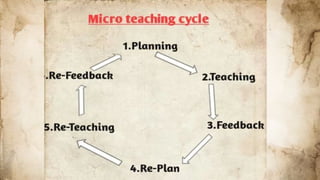
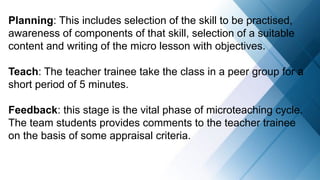
Planning: This includes selection of the skill to be practised,
awareness of components of that skill, selection of a suitable
content and writing of the micro lesson with objectives.
Teach: The teacher trainee take the class in a peer group for a
short period of 5 minutes.
Feedback: this stage is the vital phase of microteaching cycle.
The team students provides comments to the teacher trainee
on the basis of some appraisal criteria.
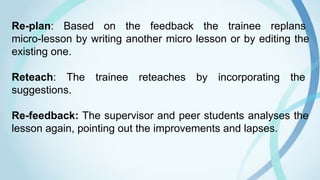
Re-plan: Based on the feedback the trainee replans
micro-lesson by writing another micro lesson or by editing the
existing one.
Reteach: The trainee reteaches by incorporating the
suggestions.
Re-feedback: The supervisor and peer students analyses the
lesson again, pointing out the improvements and lapses.
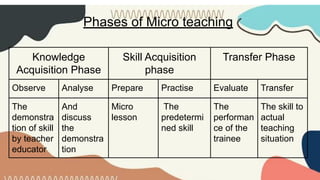
Knowledge
Acquisition Phase
Skill Acquisition
phase
Transfer Phase
Observe Analyse Prepare Practise Evaluate Transfer
The
demonstra
tion of skill
by teacher
educator
And
discuss
the
demonstra
tion
Micro
lesson
The
predetermi
ned skill
The
performan
ce of the
trainee
The skill to
actual
teaching
situation
Phases of Micro teaching
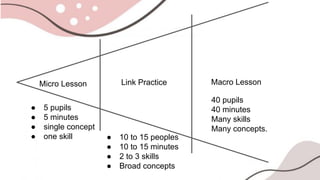
Micro Lesson Link Practice
● 5 pupils
● 5 minutes
● single concept
● one skill ● 10 to 15 peoples
● 10 to 15 minutes
● 2 to 3 skills
● Broad concepts
Macro Lesson
40 pupils
40 minutes
Many skills
Many concepts.
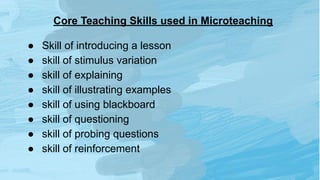
Core Teaching Skills used in Microteaching
● Skill of introducing a lesson
● skill of stimulus variation
● skill of explaining
● skill of illustrating examples
● skill of using blackboard
● skill of questioning
● skill of probing questions
● skill of reinforcement
Skill of Introducing a Lesson
Introduction usually leads right into the presentation phase
of the lesson. The introduction provides interest and
motivation to the students. It focuses students' attention on
lesson and its purposes. It also convinces that they will
benefit from the lesson. Asking questions, showing
pictures, telling stories, bringing a real object,
demonstration, doing simple experiment etc. are few of
introduction.
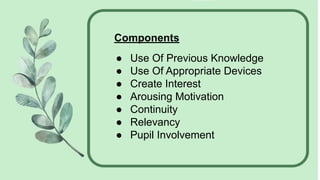
Components
● Use Of Previous Knowledge
● Use Of Appropriate Devices
● Create Interest
● Arousing Motivation
● Continuity
● Relevancy
● Pupil Involvement
Skill of Stimulus Variation
Boredom is the regular feature of classrooms. There is a
need of maintaining attention and generating interest
throughout the class. The deliberate change in the
attention drawing behaviours of the teacher in order to
secure and sustain pupil's attention towards the lesson.
Components
● Teacher Movement
● Teacher Gestures
● Changing Speech Pattern
● Changing Interaction Style
● Focusing
● Pausing
● Oral Visual Switching
● Pupil Involvement
Skill of Explaining
Explanation is the fluency in using words sentences traces
appropriately to describe a phenomenon process or object.
The components of explanation include:
COMPONENTS
● Use of appropriate beginning statement
● Use of explaining links
● Use of mediators
● Fluency
● Questions to test pupil understanding
● Use of appropriate concluding statement
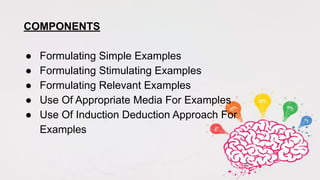
Skill of Illustrating with Examples
The skill of illustration involves describing an idea,
concept or principle, by using various examples may be
aural like analogies, stories, anecdotes, etc. Examples
could be also of visual type, like charts, maps, diagrams,
specimens, etc….
COMPONENTS
● Formulating Simple Examples
● Formulating Stimulating Examples
● Formulating Relevant Examples
● Use Of Appropriate Media For Examples
● Use Of Induction Deduction Approach For
Examples
Skill of using blackboard
Blackboards are widely used in education and training.
It is one of the easiest means of illustrating an
important point. A good blackboard work brings clarity
and adds value to the instruction.
Components
● Legibility
● neatness
● brevity
● continuity
● appropriateness
● speed
● teacher position
Skill of Questioning
Questioning is an integral part of teaching
learning process, asking good and a pertinent
question is essential for the progress of the
lesson. They are used to link previous
knowledge, stimulate thinking, diagnose,
learning difficulties and to assess knowledge
imparted.
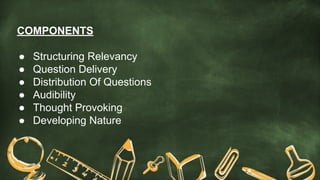
COMPONENTS
● Structuring Relevancy
● Question Delivery
● Distribution Of Questions
● Audibility
● Thought Provoking
● Developing Nature
Skill of Probing Questions
This is about dealing with students responses
for exploring deeper knowledge, probing
questions may be used for prompting, seeking
further information, refocusing increasing
critical awareness and redirection.
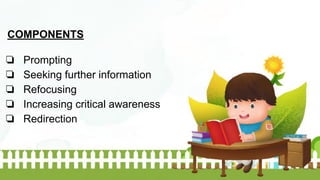
COMPONENTS
❏ Prompting
❏ Seeking further information
❏ Refocusing
❏ Increasing critical awareness
❏ Redirection
Skill of Reinforcement
Reinforcement helps to influence pupils behaviour in the
desired direction. In the teaching learning process,
reinforcement can be judiciously used to ensure better
learning outcomes.
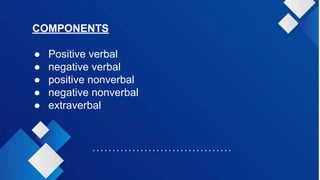
COMPONENTS
● Positive verbal
● negative verbal
● positive nonverbal
● negative nonverbal
● extraverbal