Achievement Test Blue Print
Presented by
Rahul Bharti
B.Ed.(Science) Sem. 1st
Class Roll No.- B-20
Presented to
Prof Nagendra Kumar
Faculty of Education
Banaras Hindu University
Varanasi
Achievement tests
It is an important tool in school evaluation and has great
significance in measuring instructional progress and
progress of the students in the subject area.
Defintions-
  Any test that measures the accomplishments of an individual after
a period of training or learning…………. NM Downie
  The type of ability test that describes what a person has learned to
do………Throndike and Hagen
USES OF ACHIEVEMENT TEST-
 Achievement test scores are often used in an
educational system to determine what level of
instruction for which a student is prepared.
 High achievement scores usually indicate a
mastery of grade-level material, and the readiness
for advanced instruction.
 Low achievement scores can indicate the need for
remediation or repeating a course grade
Blue Print of Achievement Test
BLUE PRINT-
 A blueprint is a guide for making something —
it's a design or pattern that can be followed.
Want to build the best tree house ever? Draw
up a blueprint and follow the design
carefully.
 The literal meaning of a blueprint is a paper
— which is blue — with plans for a building
printed on it.
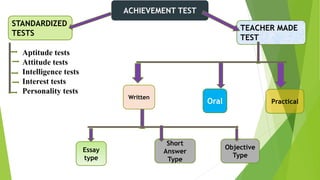
ACHIEVEMENT TEST
STANDARDIZED
TESTS
TEACHER MADE
TEST
Essay
type
Practical
Written
Oral
Aptitude tests
Attitude tests
Intelligence tests
Interest tests
Personality tests
Short
Answer
Type
Objective
Type
Objective and characteristics-
 Identify and explain reasons for performing tests.
 Understand , communicate testing terminology to
clearly with students and colleagues.
 Evaluate a test’s validity and reliability.
 Select appropriate tests.
 Administer test protocols properly and safely
Functions-
 It provides basis for promotion to the next grade.
 To find out where each student stands in various academic
areas.
 It helps in determination about the placement of the
students in a particular section.
 To motivate the students before a new assignment has taken
up.
 To expose pupil’s difficulties which the teacher can help
them to solve.
Steps involved in development of
Achievement Test-
1.Planning of test
2.Preparation of a design for the test
3.Preparation of the blueprint
4.Writing of items
5.Preparation of the scoring key and marking
scheme
6.Preparation of question-wise analysis
1.Planning of test
 Objective of the Test
 Determine the maximum time and maximum marks
2. Preparation of a design for the test
Important factors to be considered in design for the test are:
•Weightage to objectives
•Weightage to content
•Weightage to form of questions
•Weightage to difficulty level.
3.Preparation of the blueprint-
 Blue print is a three-dimensional chart giving
the placement of the objectives, content and
form of questions.
4.Writing of items-
 The paper setter write items according to the blue
print.
 The difficulty level has to be considered while
writing the items.
 It should also checked whether all the questions
included can be answered within the time allotted.
 It is advisable to arrange the questions in the order
of their difficulty level.
5.Preparation of the scoring key and
marking scheme
6.Preparation of Question-wise Analysis-
 It helps to know the strengths and weakness of the test, to tally
the question paper and the blueprint, and to determine the
content validity of the test.
Interpretation-
 Students find section A easier
 Question related to the topic STRUCTURE OF
PLANT are not clear to the some students
 FLOWER topic is clear to most of the students
 it means teacher has taught accurately in the
class
Conclusion-
 Achievement tests and testing are part of education,
business, and the regulation of professions in the United
States and are increasing in use internationally. The
development of high-quality, accessible achievement tests
requires substantial knowledge of a content area – such as
mathematics, language arts, or science – and the design of
test items or tasks that are fair and valid measures of
important knowledge and skills in a given content area.
Achievement test blue print

Achievement test blue print

  • 1.
    Achievement Test BluePrint Presented by Rahul Bharti B.Ed.(Science) Sem. 1st Class Roll No.- B-20 Presented to Prof Nagendra Kumar Faculty of Education Banaras Hindu University Varanasi
  • 2.
    Achievement tests It isan important tool in school evaluation and has great significance in measuring instructional progress and progress of the students in the subject area. Defintions-   Any test that measures the accomplishments of an individual after a period of training or learning…………. NM Downie   The type of ability test that describes what a person has learned to do………Throndike and Hagen
  • 3.
    USES OF ACHIEVEMENTTEST-  Achievement test scores are often used in an educational system to determine what level of instruction for which a student is prepared.  High achievement scores usually indicate a mastery of grade-level material, and the readiness for advanced instruction.  Low achievement scores can indicate the need for remediation or repeating a course grade
  • 4.
    Blue Print ofAchievement Test
  • 5.
    BLUE PRINT-  Ablueprint is a guide for making something — it's a design or pattern that can be followed. Want to build the best tree house ever? Draw up a blueprint and follow the design carefully.  The literal meaning of a blueprint is a paper — which is blue — with plans for a building printed on it.
  • 6.
    ACHIEVEMENT TEST STANDARDIZED TESTS TEACHER MADE TEST Essay type Practical Written Oral Aptitudetests Attitude tests Intelligence tests Interest tests Personality tests Short Answer Type Objective Type
  • 7.
    Objective and characteristics- Identify and explain reasons for performing tests.  Understand , communicate testing terminology to clearly with students and colleagues.  Evaluate a test’s validity and reliability.  Select appropriate tests.  Administer test protocols properly and safely
  • 8.
    Functions-  It providesbasis for promotion to the next grade.  To find out where each student stands in various academic areas.  It helps in determination about the placement of the students in a particular section.  To motivate the students before a new assignment has taken up.  To expose pupil’s difficulties which the teacher can help them to solve.
  • 9.
    Steps involved indevelopment of Achievement Test- 1.Planning of test 2.Preparation of a design for the test 3.Preparation of the blueprint 4.Writing of items 5.Preparation of the scoring key and marking scheme 6.Preparation of question-wise analysis
  • 10.
    1.Planning of test Objective of the Test  Determine the maximum time and maximum marks 2. Preparation of a design for the test Important factors to be considered in design for the test are: •Weightage to objectives •Weightage to content •Weightage to form of questions •Weightage to difficulty level.
  • 12.
    3.Preparation of theblueprint-  Blue print is a three-dimensional chart giving the placement of the objectives, content and form of questions. 4.Writing of items-  The paper setter write items according to the blue print.  The difficulty level has to be considered while writing the items.  It should also checked whether all the questions included can be answered within the time allotted.  It is advisable to arrange the questions in the order of their difficulty level.
  • 14.
    5.Preparation of thescoring key and marking scheme
  • 15.
    6.Preparation of Question-wiseAnalysis-  It helps to know the strengths and weakness of the test, to tally the question paper and the blueprint, and to determine the content validity of the test.
  • 16.
    Interpretation-  Students findsection A easier  Question related to the topic STRUCTURE OF PLANT are not clear to the some students  FLOWER topic is clear to most of the students  it means teacher has taught accurately in the class
  • 17.
    Conclusion-  Achievement testsand testing are part of education, business, and the regulation of professions in the United States and are increasing in use internationally. The development of high-quality, accessible achievement tests requires substantial knowledge of a content area – such as mathematics, language arts, or science – and the design of test items or tasks that are fair and valid measures of important knowledge and skills in a given content area.