-BY:
MRS.ANUSHA P S
I YEAR MSc NURSING
NURSING EDUCATION
PRESENTATION ON
MICROTEACHING
CONCEPT OF MICROTEACHING
• Microteaching is a teacher training Technique which helps the teacher to master the
teaching skills.
• It requires the teacher trainee,
 To teach a single concept of the content
 Using a specified teaching skill
 For a short time
 To a very small number of pupils
In this way the teacher trainee practices the teaching skill in terms of definable,
observable, measurable and controllable form with repeated cycles till he attains
mastery in the use of skill
DEFINITION
• ‘‘Microteaching is scaled down teaching encounter in class size and
time.’’
- D W Allen{1966}
• Microteaching is defined as ‘‘a system of controlled practice that
makes it possible to concentrate on specified teaching behavior and to
practice teaching under controlled conditions.’’
- D w Allen and A W Eve (1968)
• Microteaching is a ‘‘ scaled down teaching encounter in which a
teacher teaches a small unit to a group of 5 pupils for a period of 5 to
20 minutes’’
- L C Singh(1977)
OBJECTIVES OF MICROTEACHING
• To enable teacher trainees to learn and assimilate new teaching
skills under controlled conditions
• To enable teacher trainees to master a number of teaching skills
• To enable teacher trainees to gain confidence in teaching
CHARATERISTICS OF MICRO TEACHING
• Microteaching is a highly individualized training device
• Microteaching is an experiment in the field of teacher education which has been
incorporated in the practice teaching schedule.
• It is a student teaching technique not a teaching technique or method
• Microteaching is micro in the sense that it scaled down the real complexities of real
teaching.
• Practicing one skill at a time
• Reducing class size to 5 -10 pupil
• Reducing duration of lesson 5 – 10 mins
• Limiting the content to a single concept
• Immediate feedback helps in improving, fixing and motivating learning .
• The student are providing immediate feed back in terms of peer group feedback ,tape
recorded/CCTV
• Micro teaching advocates the choice and practice of one skill at a time.
STEPS OF MICROTEACHING
• STEP 1- particular skill to be practiced is explained to the
teacher trainees in terms of the purpose and components
of the skill with suitable examples.
• STEP 2- the teacher trainer gives demonstration of the
skill in microteaching in simulated conditions to the
teacher trainees.
• STEP 3 – the teacher trainee plans a short lesson on the
basis of the demonstrated skill for his/her practice
• STEP 4- the teacher trainer teaches lesson to a small group
of pupils.
• STEP 5- on the basis of observation the supervisor gives
feedback to the trainee
• Step 6- on the basis of feedback given by the supervisor
the trainee re-plan to the lesson plan in order to use skill
in more effective manner in the second trial.
• Step 7-the revised lesson is taught to another comparable
group of pupils.
• Step 8- the supervisor observes the re-teaching lesson
and gives re-feedback to the trainee.
• Step 9- the teach–re-teach cycle may be repeated several
times till adequate mastery level is achieved.
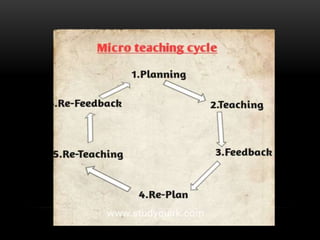
• Planning: in planning the student teacher plans his own
lesson and select his own skills to demonstrate his
lesson.
• Teaching: teaching is also reffered as modelling. The
teacher trainee teaches the planned topic for 6 min for a
group of 5 to 10 pupils. The lesson will be supervised by
supervisors and other teacher trainees.
• Feedback: the supervisor or the teacher trainer who
attended the lesson gives quick feeback for necessary
modifications for in about 5 mins.
MICROTEACHING CYCLES
• Re-plan: the teacher trainee re-plans the lesson
incorporating the points of strength and removing the
points not skillfully handled during teaching in the previous
attempt.
• Re-teach: this involves teaching to the same group of pupils
or to the different group in case the topic is same.The
teacher trainee teaches the class with renewed courge and
confidence to perform better than the previous attempt
• Re-Feedback: modification of behavoiur of teacher trainee
in the desired direction in each and every skill practice.
TIME DURATION FOR MICROTEACHING
• Teach: 5 minutes
• Feedback: 5 minutes
• Re-plan: 10 minutes
• Re-teach :5 minutes
• Re-feedbck :5 minutes.
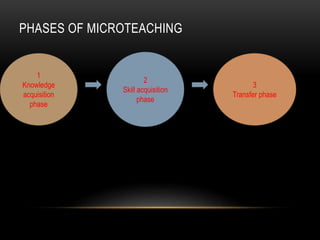
PHASES OF MICROTEACHING
1
Knowledge
acquisition
phase
3
Transfer phase
2
Skill acquisition
phase
PHASES OF MICROTEACHING
Includes three phase:
Phase1:Knowledge acquisition phase {pre-active phase}
It includes activities such as:
• Provide knowledge about teaching skills
• Observe the demonstration of teaching skills
• Analyze and discuss the demonstration of the teaching skill.
Phase 2: skill acquisition phase {inter-active phase}
Includes activities such as :
• Planning and preparing micro lesson for a skill
• Practicing the skill
• Evaluation of the practiced skill(feedback)
• Re-plan, Re-teach and Re-Feedback till the desired level of the skill is achieved.
Phase 3: Transfer phase {post–Active Phase}:
• Giving the oppurtunity to use the mastered skill in the normal
classroom teaching.
• Integrate the different skill practice via link practice.
MERITS OF MICRO TEACHING
• It helps to develop and master the important teaching skills.
• It helps to accomplish specific teacher competencies.
• It caters the need of individual differences in the teacher
training.
• It is more effective in modifying the teacher behavior
• It is an individualized training technique.
• It employs real teaching situation for developing skills
• It gets a deeper knowledge regarding the art of teaching.
LIMITATIONS OF MICROTEACHING:
• It is skill oriented; content not emphasized
• A large number of trainees cannot be given the opportunity for
the re-teaching and re-planning
• It is very time consuming technique
• It requires special classroom setting
• It covers only a few specific skills
• It deviates from normal classroom teaching
• It may rise administrative problems while arranging micro
lessons
MICROTEACHING IN INDIA
• The department of teacher education in the NCERT designed a
project to study the effectiveness of microteaching in 1975 in
collaboration with the centre of Advanced Study in Education
(CASE) Baroda.
• Research and training programme for teacher educators were
also initiated in collaboration with the department of education
,university of Indore.
• Passi,Singh and Jangira developed instructional materials which
were used to train teachers.
microteaching.pptx

microteaching.pptx

  • 1.
    -BY: MRS.ANUSHA P S IYEAR MSc NURSING NURSING EDUCATION PRESENTATION ON MICROTEACHING
  • 2.
    CONCEPT OF MICROTEACHING •Microteaching is a teacher training Technique which helps the teacher to master the teaching skills. • It requires the teacher trainee,  To teach a single concept of the content  Using a specified teaching skill  For a short time  To a very small number of pupils In this way the teacher trainee practices the teaching skill in terms of definable, observable, measurable and controllable form with repeated cycles till he attains mastery in the use of skill
  • 3.
    DEFINITION • ‘‘Microteaching isscaled down teaching encounter in class size and time.’’ - D W Allen{1966} • Microteaching is defined as ‘‘a system of controlled practice that makes it possible to concentrate on specified teaching behavior and to practice teaching under controlled conditions.’’ - D w Allen and A W Eve (1968) • Microteaching is a ‘‘ scaled down teaching encounter in which a teacher teaches a small unit to a group of 5 pupils for a period of 5 to 20 minutes’’ - L C Singh(1977)
  • 4.
    OBJECTIVES OF MICROTEACHING •To enable teacher trainees to learn and assimilate new teaching skills under controlled conditions • To enable teacher trainees to master a number of teaching skills • To enable teacher trainees to gain confidence in teaching
  • 5.
    CHARATERISTICS OF MICROTEACHING • Microteaching is a highly individualized training device • Microteaching is an experiment in the field of teacher education which has been incorporated in the practice teaching schedule. • It is a student teaching technique not a teaching technique or method • Microteaching is micro in the sense that it scaled down the real complexities of real teaching. • Practicing one skill at a time • Reducing class size to 5 -10 pupil • Reducing duration of lesson 5 – 10 mins • Limiting the content to a single concept • Immediate feedback helps in improving, fixing and motivating learning . • The student are providing immediate feed back in terms of peer group feedback ,tape recorded/CCTV • Micro teaching advocates the choice and practice of one skill at a time.
  • 6.
    STEPS OF MICROTEACHING •STEP 1- particular skill to be practiced is explained to the teacher trainees in terms of the purpose and components of the skill with suitable examples. • STEP 2- the teacher trainer gives demonstration of the skill in microteaching in simulated conditions to the teacher trainees. • STEP 3 – the teacher trainee plans a short lesson on the basis of the demonstrated skill for his/her practice • STEP 4- the teacher trainer teaches lesson to a small group of pupils.
  • 7.
    • STEP 5-on the basis of observation the supervisor gives feedback to the trainee • Step 6- on the basis of feedback given by the supervisor the trainee re-plan to the lesson plan in order to use skill in more effective manner in the second trial. • Step 7-the revised lesson is taught to another comparable group of pupils. • Step 8- the supervisor observes the re-teaching lesson and gives re-feedback to the trainee. • Step 9- the teach–re-teach cycle may be repeated several times till adequate mastery level is achieved.
  • 9.
    • Planning: inplanning the student teacher plans his own lesson and select his own skills to demonstrate his lesson. • Teaching: teaching is also reffered as modelling. The teacher trainee teaches the planned topic for 6 min for a group of 5 to 10 pupils. The lesson will be supervised by supervisors and other teacher trainees. • Feedback: the supervisor or the teacher trainer who attended the lesson gives quick feeback for necessary modifications for in about 5 mins. MICROTEACHING CYCLES
  • 10.
    • Re-plan: theteacher trainee re-plans the lesson incorporating the points of strength and removing the points not skillfully handled during teaching in the previous attempt. • Re-teach: this involves teaching to the same group of pupils or to the different group in case the topic is same.The teacher trainee teaches the class with renewed courge and confidence to perform better than the previous attempt • Re-Feedback: modification of behavoiur of teacher trainee in the desired direction in each and every skill practice.
  • 11.
    TIME DURATION FORMICROTEACHING • Teach: 5 minutes • Feedback: 5 minutes • Re-plan: 10 minutes • Re-teach :5 minutes • Re-feedbck :5 minutes.
  • 12.
  • 13.
    PHASES OF MICROTEACHING Includesthree phase: Phase1:Knowledge acquisition phase {pre-active phase} It includes activities such as: • Provide knowledge about teaching skills • Observe the demonstration of teaching skills • Analyze and discuss the demonstration of the teaching skill. Phase 2: skill acquisition phase {inter-active phase} Includes activities such as : • Planning and preparing micro lesson for a skill • Practicing the skill • Evaluation of the practiced skill(feedback) • Re-plan, Re-teach and Re-Feedback till the desired level of the skill is achieved.
  • 14.
    Phase 3: Transferphase {post–Active Phase}: • Giving the oppurtunity to use the mastered skill in the normal classroom teaching. • Integrate the different skill practice via link practice.
  • 15.
    MERITS OF MICROTEACHING • It helps to develop and master the important teaching skills. • It helps to accomplish specific teacher competencies. • It caters the need of individual differences in the teacher training. • It is more effective in modifying the teacher behavior • It is an individualized training technique. • It employs real teaching situation for developing skills • It gets a deeper knowledge regarding the art of teaching.
  • 16.
    LIMITATIONS OF MICROTEACHING: •It is skill oriented; content not emphasized • A large number of trainees cannot be given the opportunity for the re-teaching and re-planning • It is very time consuming technique • It requires special classroom setting • It covers only a few specific skills • It deviates from normal classroom teaching • It may rise administrative problems while arranging micro lessons
  • 17.
    MICROTEACHING IN INDIA •The department of teacher education in the NCERT designed a project to study the effectiveness of microteaching in 1975 in collaboration with the centre of Advanced Study in Education (CASE) Baroda. • Research and training programme for teacher educators were also initiated in collaboration with the department of education ,university of Indore. • Passi,Singh and Jangira developed instructional materials which were used to train teachers.