By:
   Michael
Krutzkamp
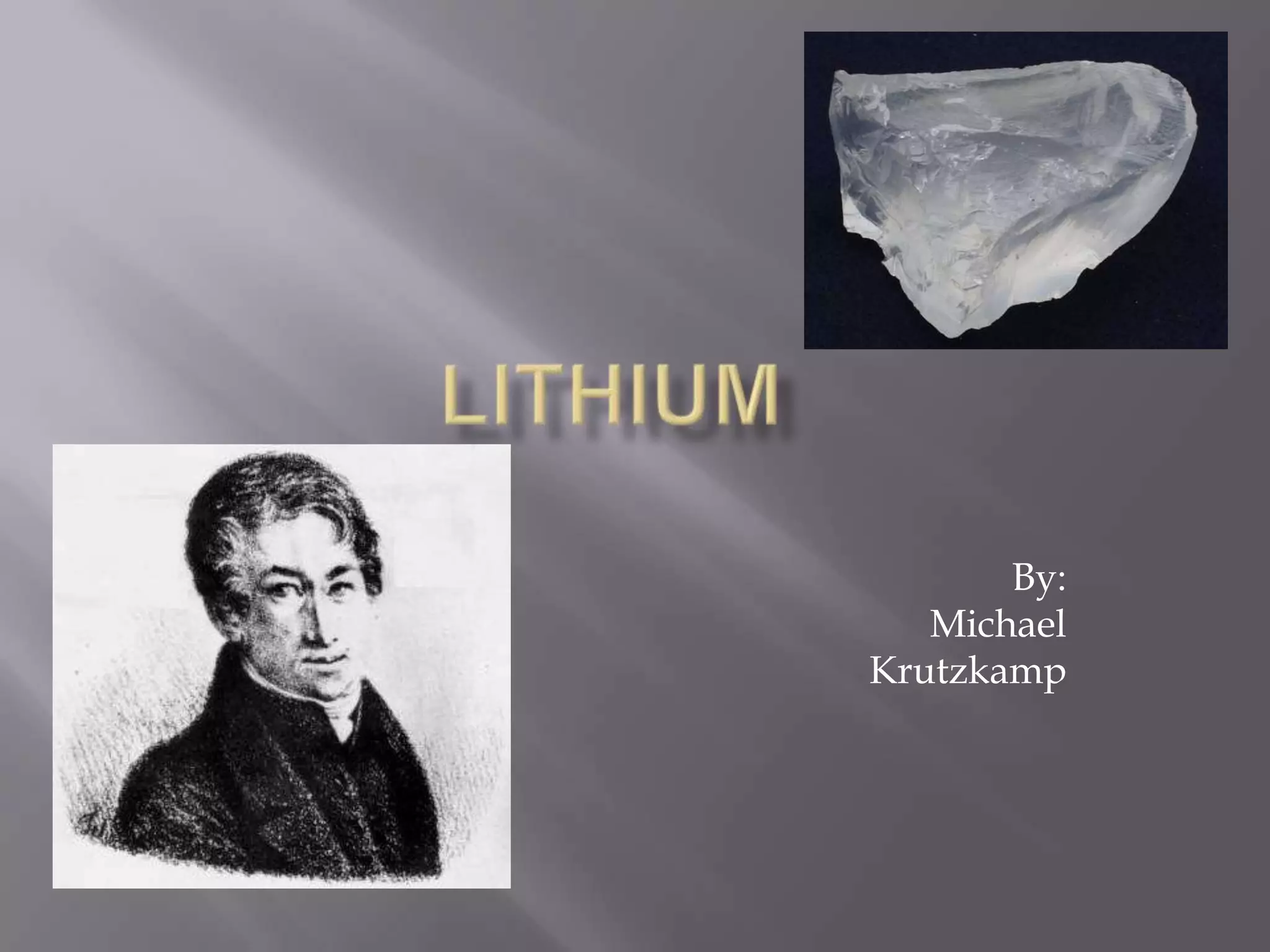
   Meaning
       “Lithos” which is Greek for “stone”
       Given this name because it was discovered in a stone
        unlike other common Group 1 elements which were
        found in plant sources
   Discovered
       By Johan Arfvedson in 1817
       In Stockholm, Sweden, during an analysis of petalite
   Solid at Room Temperature
   Lightest Solid Metal
   Soft and has a Silvery-White color
   Melting Point: 180.5 oC
   Boiling Point: 1342 oC
   Density: .53 g.cm-3 at 20 oC
   Many of its chemical and physical properties
    are more similar to the properties of the
    alkaline earth metals rather than the properties
    of its own group.
   Major Isotopes
       Has 7 isotopes with mass numbers 5 to 11 but only 2
        are stable: Li6 and Li7
   Has a high specific heat capacity
       3.58 J/gK
   Burns with a red flame but when burning
    extremely well the flame turns a bright white
   It is the only common element that reacts with
    nitrogen at room temperature
   Found in the Earth’s crust
       Abundance of 20 parts per million by weight or 60
        parts per million by moles
   Highly reactive and does not occur freely in
    nature
   Cost:
       $27 per 100 grams for Pure Lithium
       $9.50 per 100 grams for Bulk Lithium
   Used in rechargeable Lithium ion Batteries
   Also has various nuclear applications
       Used as a coolant in nuclear breeder reactors
       Is a source of Tritium
         Formed by bombarding Lithium with Neutrons
   Lithium Carbonate
       Used as a mood-stabilizing drug
   Lithium Chloride and Bromide
       Used as Desiccants
   Lithium Stearate
       Used as an all-purpose and high-temperature
        Lubricant
   www.lenntech.com/periodic/elements/li.htm
   www.answers.com/Q/What_does_lithium
    _mean
   www.webelements.com/lithium/history.html
   www.chemicool.com/elements/lithium.html

Lithium (Michael Krutzkamp)

  • 1.
    By: Michael Krutzkamp
  • 2.
    Meaning  “Lithos” which is Greek for “stone”  Given this name because it was discovered in a stone unlike other common Group 1 elements which were found in plant sources  Discovered  By Johan Arfvedson in 1817  In Stockholm, Sweden, during an analysis of petalite
  • 3.
    Solid at Room Temperature  Lightest Solid Metal  Soft and has a Silvery-White color  Melting Point: 180.5 oC  Boiling Point: 1342 oC  Density: .53 g.cm-3 at 20 oC
  • 4.
    Many of its chemical and physical properties are more similar to the properties of the alkaline earth metals rather than the properties of its own group.  Major Isotopes  Has 7 isotopes with mass numbers 5 to 11 but only 2 are stable: Li6 and Li7  Has a high specific heat capacity  3.58 J/gK
  • 5.
    Burns with a red flame but when burning extremely well the flame turns a bright white  It is the only common element that reacts with nitrogen at room temperature
  • 6.
    Found in the Earth’s crust  Abundance of 20 parts per million by weight or 60 parts per million by moles  Highly reactive and does not occur freely in nature  Cost:  $27 per 100 grams for Pure Lithium  $9.50 per 100 grams for Bulk Lithium
  • 7.
    Used in rechargeable Lithium ion Batteries  Also has various nuclear applications  Used as a coolant in nuclear breeder reactors  Is a source of Tritium  Formed by bombarding Lithium with Neutrons
  • 8.
    Lithium Carbonate  Used as a mood-stabilizing drug  Lithium Chloride and Bromide  Used as Desiccants  Lithium Stearate  Used as an all-purpose and high-temperature Lubricant
  • 9.
    www.lenntech.com/periodic/elements/li.htm  www.answers.com/Q/What_does_lithium _mean  www.webelements.com/lithium/history.html  www.chemicool.com/elements/lithium.html