Dalton’s At   mic TheoryGroup 2Balicanta, Christopher JohnMagdaong, Jeremy JayPerez, Mika Emmanuel JerricoPagulayan, GianneTan, Mara LoisJohn Dalton1766 - 1844
A History on the Idea of ATOMS450 BCE - Democritus, a Greek philosopher, once coined the term “atomos”, meaning “indivisible”, this he refers to the smallest part of matter that is so small that it is impossible to divide it further. Now, it became the modern “Atom”.1789 - Antoine Lavoisier, a French chemist, discovered the law of conservation of matter, and said that the “element” is the most basic substance and cannot be broken down by methods of chemistry.1799- Joseph Proust hypothesized the Law of Definite Composition that particles combine at definite proportions to form a compound.I wonder why all Greek philosophers look alike!Lavoisier, the guy who was responsible for THIS SUBJECT
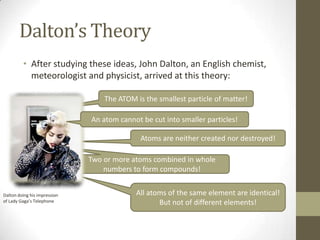
Dalton’s TheoryAfter studying these ideas, John Dalton, an English chemist, meteorologist and physicist, arrived at this theory:The ATOM is the smallest particle of matter!An atom cannot be cut into smaller particles!Atoms are neither created nor destroyed!Two or more atoms combined in whole numbers to form compounds!All atoms of the same element are identical!But not of different elements!Dalton doing his impression of Lady Gaga’s Telephone
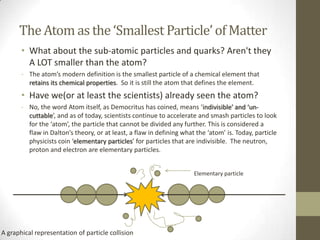
The Atom as the ‘Smallest Particle’ of MatterWhat about the sub-atomic particles and quarks? Aren't they A LOT smaller than the atom?The atom’s modern definition is the smallest particle of a chemical element that retains its chemical properties.  So it is still the atom that defines the element. Have we(or at least the scientists) already seen the atom?No, the word Atom itself, as Democritus has coined, means ‘indivisible’ and ‘un-cuttable’, and as of today, scientists continue to accelerate and smash particles to look for the ‘atom’, the particle that cannot be divided any further. This is considered a flaw in Dalton’s theory, or at least, a flaw in defining what the ‘atom’ is. Today, particle physicists coin ‘elementary particles’ for particles that are indivisible.  The neutron, proton and electron are elementary particles.Elementary particleA graphical representation of particle collision
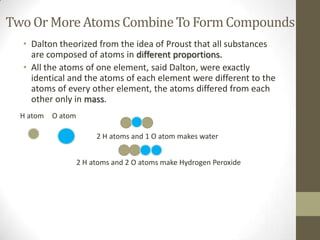
Two Or More Atoms Combine To Form CompoundsDalton theorized from the idea of Proust that all substances are composed of atoms in different proportions. All the atoms of one element, said Dalton, were exactly identical and the atoms of each element were different to the atoms of every other element, the atoms differed from each other only in mass.H atom	O atom2 H atoms and 1 O atom makes water2 H atoms and 2 O atoms make Hydrogen Peroxide
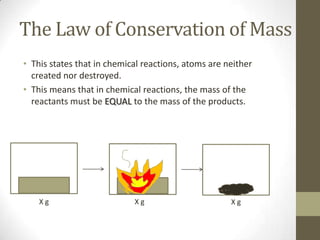
The Law of Conservation of MassThis states that in chemical reactions, atoms are neither created nor destroyed.This means that in chemical reactions, the mass of the reactants must be EQUAL to the mass of the products.X gX gX g
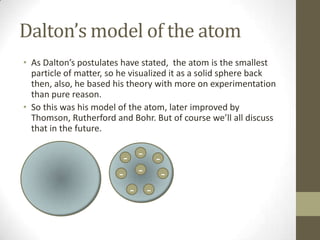
Dalton’s model of the atomAs Dalton’s postulates have stated,  the atom is the smallest particle of matter, so he visualized it as a solid sphere back then, also, he based his theory with more on experimentation than pure reason.So this was his model of the atom, later improved by Thomson, Rutherford and Bohr. But of course we’ll all discuss that in the future.--------

Dalton’s Atomic Theory

  • 1.
    Dalton’s At mic TheoryGroup 2Balicanta, Christopher JohnMagdaong, Jeremy JayPerez, Mika Emmanuel JerricoPagulayan, GianneTan, Mara LoisJohn Dalton1766 - 1844
  • 2.
    A History onthe Idea of ATOMS450 BCE - Democritus, a Greek philosopher, once coined the term “atomos”, meaning “indivisible”, this he refers to the smallest part of matter that is so small that it is impossible to divide it further. Now, it became the modern “Atom”.1789 - Antoine Lavoisier, a French chemist, discovered the law of conservation of matter, and said that the “element” is the most basic substance and cannot be broken down by methods of chemistry.1799- Joseph Proust hypothesized the Law of Definite Composition that particles combine at definite proportions to form a compound.I wonder why all Greek philosophers look alike!Lavoisier, the guy who was responsible for THIS SUBJECT
  • 3.
    Dalton’s TheoryAfter studyingthese ideas, John Dalton, an English chemist, meteorologist and physicist, arrived at this theory:The ATOM is the smallest particle of matter!An atom cannot be cut into smaller particles!Atoms are neither created nor destroyed!Two or more atoms combined in whole numbers to form compounds!All atoms of the same element are identical!But not of different elements!Dalton doing his impression of Lady Gaga’s Telephone
  • 4.
    The Atom asthe ‘Smallest Particle’ of MatterWhat about the sub-atomic particles and quarks? Aren't they A LOT smaller than the atom?The atom’s modern definition is the smallest particle of a chemical element that retains its chemical properties. So it is still the atom that defines the element. Have we(or at least the scientists) already seen the atom?No, the word Atom itself, as Democritus has coined, means ‘indivisible’ and ‘un-cuttable’, and as of today, scientists continue to accelerate and smash particles to look for the ‘atom’, the particle that cannot be divided any further. This is considered a flaw in Dalton’s theory, or at least, a flaw in defining what the ‘atom’ is. Today, particle physicists coin ‘elementary particles’ for particles that are indivisible. The neutron, proton and electron are elementary particles.Elementary particleA graphical representation of particle collision
  • 5.
    Two Or MoreAtoms Combine To Form CompoundsDalton theorized from the idea of Proust that all substances are composed of atoms in different proportions. All the atoms of one element, said Dalton, were exactly identical and the atoms of each element were different to the atoms of every other element, the atoms differed from each other only in mass.H atom O atom2 H atoms and 1 O atom makes water2 H atoms and 2 O atoms make Hydrogen Peroxide
  • 6.
    The Law ofConservation of MassThis states that in chemical reactions, atoms are neither created nor destroyed.This means that in chemical reactions, the mass of the reactants must be EQUAL to the mass of the products.X gX gX g
  • 7.
    Dalton’s model ofthe atomAs Dalton’s postulates have stated, the atom is the smallest particle of matter, so he visualized it as a solid sphere back then, also, he based his theory with more on experimentation than pure reason.So this was his model of the atom, later improved by Thomson, Rutherford and Bohr. But of course we’ll all discuss that in the future.--------