Silicon; Si
   Samantha Brossart
       Dr. Walters
CHE 120 fall semester, 2011
History
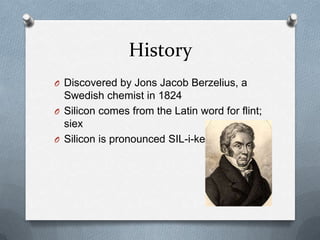
O Discovered by Jons Jacob Berzelius, a
  Swedish chemist in 1824
O Silicon comes from the Latin word for flint;
  siex
O Silicon is pronounced SIL-i-ken
Properties
Silicon:
O Is a solid at room temperature.
O Melts at 1687 K (1414°C or 2577°F).
O Boils at 3538 K (3265°C or 5909°F).
O Has a density of 2.3296 grams per cubic
  centimeters
O At room temperature two allotropes exist;
  amorphous and crystalline.
  O Amorphous appears as a brown power.
  O Crystalline has a metallic luster and a grayish
     color.
Availability
O Silicon is the seventh most abundant
  element in the universe and the second
  on the earths crust.
O SiO2 Silicon dioxide is silicon's most
  common compound, and also the most
  abundant compound in the earths crust.
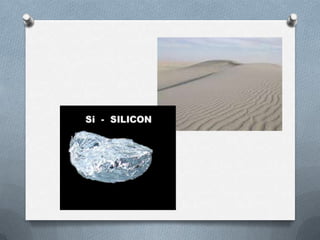
  Commonly Silicon Dioxide takes the form
  of ordinary sand, but also exists as
  quartz, rock
  crystal, amethyst, agate, flint, jasper and
  opal
Uses
O Sodium silicate (Na2SiO3), also known as
  water glass, is used in the production of
  soaps, adhesives and as an egg
  preservative.
O Silicon tetrachloride (SiCl4) is used to
  create smoke screens.
O Silicon is also an important ingredient in
  silicone, a class of material that is used for
  such things as lubricants, polishing
  agents, electrical insulators and medical
  implants.
References
O Berzelius Jons Jacob. Scientific Identity.
  Smithsonian Institution Libraries. Web. 11
  November 2011.
O The Element Silicon. Jefferson Lab. Steve
  Gagnon. Web. 11 November 2011.
O Mineral’s; Silicon. The Mineral Mine. Long
  Beach, CA. web. 11 November 2011.
O Silicon Facts. About.com Chemistry. Anne
  Marie Helmenstine, Ph.D. Web. 11
  November 2011.

Silicon (Samantha Brossart)

  • 1.
    Silicon; Si Samantha Brossart Dr. Walters CHE 120 fall semester, 2011
  • 2.
    History O Discovered byJons Jacob Berzelius, a Swedish chemist in 1824 O Silicon comes from the Latin word for flint; siex O Silicon is pronounced SIL-i-ken
  • 3.
    Properties Silicon: O Is asolid at room temperature. O Melts at 1687 K (1414°C or 2577°F). O Boils at 3538 K (3265°C or 5909°F). O Has a density of 2.3296 grams per cubic centimeters O At room temperature two allotropes exist; amorphous and crystalline. O Amorphous appears as a brown power. O Crystalline has a metallic luster and a grayish color.
  • 4.
    Availability O Silicon isthe seventh most abundant element in the universe and the second on the earths crust. O SiO2 Silicon dioxide is silicon's most common compound, and also the most abundant compound in the earths crust. Commonly Silicon Dioxide takes the form of ordinary sand, but also exists as quartz, rock crystal, amethyst, agate, flint, jasper and opal
  • 5.
    Uses O Sodium silicate(Na2SiO3), also known as water glass, is used in the production of soaps, adhesives and as an egg preservative. O Silicon tetrachloride (SiCl4) is used to create smoke screens. O Silicon is also an important ingredient in silicone, a class of material that is used for such things as lubricants, polishing agents, electrical insulators and medical implants.
  • 7.
    References O Berzelius JonsJacob. Scientific Identity. Smithsonian Institution Libraries. Web. 11 November 2011. O The Element Silicon. Jefferson Lab. Steve Gagnon. Web. 11 November 2011. O Mineral’s; Silicon. The Mineral Mine. Long Beach, CA. web. 11 November 2011. O Silicon Facts. About.com Chemistry. Anne Marie Helmenstine, Ph.D. Web. 11 November 2011.