By Amber Boyers
 What does the name
 mean?
   The name has Greek
   origin. It comes from the
   word “Bromos”, which
   means stench. Which
   relates to the foul odor
   of the element.
 Where was it discovered? By who?
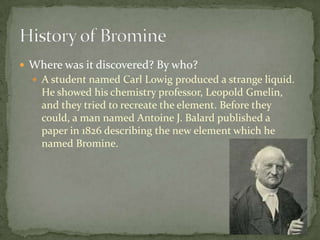
   A student named Carl Lowig produced a strange liquid.
    He showed his chemistry professor, Leopold Gmelin,
    and they tried to recreate the element. Before they
    could, a man named Antoine J. Balard published a
    paper in 1826 describing the new element which he
    named Bromine.
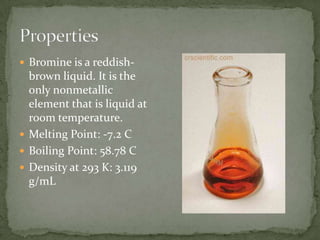
 Bromine is a reddish-
  brown liquid. It is the
  only nonmetallic
  element that is liquid at
  room temperature.
 Melting Point: -7.2 C
 Boiling Point: 58.78 C
 Density at 293 K: 3.119
  g/mL
 When in the form of         Abundances of the
  bromide, it can be found    element in different
  in salt springs and salt    environments
  deposits.                     % in Universe 7×10⁻⁷%
 It can be found in the        % in Sun N/A
  earth’s crust.                % in Meteorites
                                 0.00012%
                                % in Earth's Crust
                                 0.0003%
                                % in Oceans 0.0067%
                                % in Humans 0.00029%
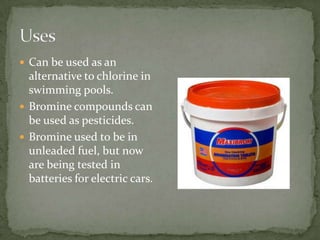
 Can be used as an
  alternative to chlorine in
  swimming pools.
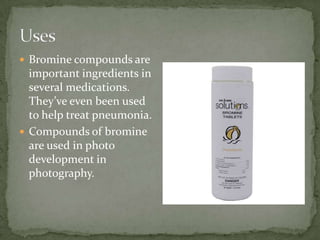
 Bromine compounds can
  be used as pesticides.
 Bromine used to be in
  unleaded fuel, but now
  are being tested in
  batteries for electric cars.
 Bromine compounds are
  important ingredients in
  several medications.
  They’ve even been used
  to help treat pneumonia.
 Compounds of bromine
  are used in photo
  development in
  photography.
 The atomic mass is
  79.904 amu.
 It is a halogen.
 Electron Configuration:
  [Ar] 3d^10 4s^2 4p^5
 Some veterinarians
  measure bromine levels
  as a treatment for dogs
  with epilepsy.
 http://www.periodic-table.org.uk/element-
    bromine.htm
   http://www.chemicalelements.com/elements/br.html
   http://education.jlab.org/itselemental/ele035.html
   http://www.bt.cdc.gov/agent/bromine/basics/pdf/fact
    sheet.pdf
   http://www.bromine-info.org/en/Bromine-
    Applications/
   http://www.freeresource.com/bromine-br-fun-facts-
    and-information-about-the-element

Bromine (Amber Boyers)

  • 1.
  • 2.
     What doesthe name mean?  The name has Greek origin. It comes from the word “Bromos”, which means stench. Which relates to the foul odor of the element.
  • 3.
     Where wasit discovered? By who?  A student named Carl Lowig produced a strange liquid. He showed his chemistry professor, Leopold Gmelin, and they tried to recreate the element. Before they could, a man named Antoine J. Balard published a paper in 1826 describing the new element which he named Bromine.
  • 4.
     Bromine isa reddish- brown liquid. It is the only nonmetallic element that is liquid at room temperature.  Melting Point: -7.2 C  Boiling Point: 58.78 C  Density at 293 K: 3.119 g/mL
  • 5.
     When inthe form of  Abundances of the bromide, it can be found element in different in salt springs and salt environments deposits.  % in Universe 7×10⁻⁷%  It can be found in the  % in Sun N/A earth’s crust.  % in Meteorites 0.00012%  % in Earth's Crust 0.0003%  % in Oceans 0.0067%  % in Humans 0.00029%
  • 6.
     Can beused as an alternative to chlorine in swimming pools.  Bromine compounds can be used as pesticides.  Bromine used to be in unleaded fuel, but now are being tested in batteries for electric cars.
  • 7.
     Bromine compoundsare important ingredients in several medications. They’ve even been used to help treat pneumonia.  Compounds of bromine are used in photo development in photography.
  • 8.
     The atomicmass is 79.904 amu.  It is a halogen.  Electron Configuration: [Ar] 3d^10 4s^2 4p^5  Some veterinarians measure bromine levels as a treatment for dogs with epilepsy.
  • 9.
     http://www.periodic-table.org.uk/element- bromine.htm  http://www.chemicalelements.com/elements/br.html  http://education.jlab.org/itselemental/ele035.html  http://www.bt.cdc.gov/agent/bromine/basics/pdf/fact sheet.pdf  http://www.bromine-info.org/en/Bromine- Applications/  http://www.freeresource.com/bromine-br-fun-facts- and-information-about-the-element