PRESENTATION TOPIC
“ELECTROCHEMICAL CELLS’’
Saman Tanoli
Department: Chemistry
“ELECTROCHEMICAL CELLS’’
CONTENTS:
 DEFINITION
 COMPONENTS
 TYPES
 VOLTAIC or GALVANIC CELLS
 ELECTROLYTIC CELLS
 DIFFERENCE BETWEEN GALVANIC & ELECTROLYTIC CELLS
 APPLICATIONS OF ELECTROCHEMICAL CELLS
DEFINITION;
An electrochemical cell is a device that can
generate electrical energy from the chemical reactions
occurring in it, or use the electrical energy supplied to it to
facilitate chemical reactions in it. These devices are capable of
converting chemical energy into electrical energy, or vice
versa..
EXAMPLE;
A common example of an electrochemical cell is a
standard 1.5-volt cell which is used to power many electrical
appliances such as TV remotes and clocks.
COMPONENTS;
Here is the list of the all the components.
Two half cells
Two metal electrodes
One voltmeter
One salt bridge
Two aqueous solutions for each half cell
All of these components create the Electrochemical
Cell.
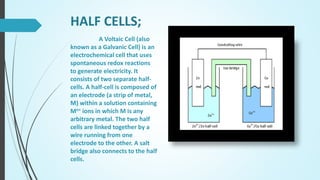
HALF CELLS;
A Voltaic Cell (also
known as a Galvanic Cell) is an
electrochemical cell that uses
spontaneous redox reactions
to generate electricity. It
consists of two separate half-
cells. A half-cell is composed of
an electrode (a strip of metal,
M) within a solution containing
Mn+ ions in which M is any
arbitrary metal. The two half
cells are linked together by a
wire running from one
electrode to the other. A salt
bridge also connects to the half
cells.
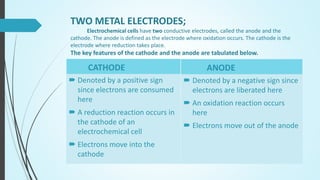
TWO METAL ELECTRODES;
Electrochemical cells have two conductive electrodes, called the anode and the
cathode. The anode is defined as the electrode where oxidation occurs. The cathode is the
electrode where reduction takes place.
The key features of the cathode and the anode are tabulated below.
CATHODE
 Denoted by a positive sign
since electrons are consumed
here
 A reduction reaction occurs in
the cathode of an
electrochemical cell
 Electrons move into the
cathode
ANODE
 Denoted by a negative sign since
electrons are liberated here
 An oxidation reaction occurs
here
 Electrons move out of the anode
VOLTMETER;
DEFINITION;
A voltmeter is an instrument
used for measuring electric potential
difference between two points in an
electric circuit.
Electric potential is
the potential energy per charge. The
concept of electric potential is used
to express the effect of
an electric field of a source in terms
of the location within
the electric field.
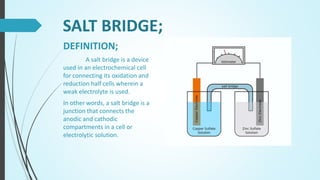
SALT BRIDGE;
DEFINITION;
A salt bridge is a device
used in an electrochemical cell
for connecting its oxidation and
reduction half cells wherein a
weak electrolyte is used.
In other words, a salt bridge is a
junction that connects the
anodic and cathodic
compartments in a cell or
electrolytic solution.
TYPES OF ELECTROCHEMICAL CELLS;
Electrochemical Cells are of two types.
1. Voltaic or Galvanic Cells
2. Electrolytic Cells
VOLTAIC CELL
 A voltaic cell, often known as a
galvanic cell, provides
electrical energy. The source
of this energy is a
spontaneous chemical
reaction, more specifically a
spontaneous redox reaction.
 The energy conversion is
achieved by spontaneous (ΔG
< 0) redox reactions producing
a flow of electrons.
ELECTROLYTIC CELL
 In an electrolytic cell,
electrical energy is used to
drive a non-spontaneous
chemical reaction.
 A flow of electrons drives non-
spontaneous (ΔG ≥ 0) redox
reactions.
CONTINUED……………..
VOLTAIC CELL
 For example, all batteries are
made of one or more voltaic
cells; batteries go flat when
most or all of their reactants
have been converted to
products, transforming their
chemical potential energy to
electrical energy.
 A battery powering something
is an example of a galvanic
cell.
ELECTROLYTIC CELL
 For example, water can be
split into hydrogen and oxygen
in an electrolytic cell. Also,
when a rechargeable battery is
recharged, it operates as an
electrolytic cell.
 Examples of electrolytic cells
also include those that convert
aluminum ore to aluminum
metal.
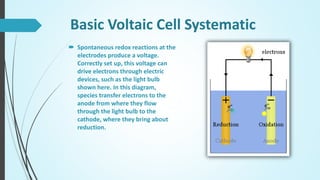
Basic Voltaic Cell Systematic
 Spontaneous redox reactions at the
electrodes produce a voltage.
Correctly set up, this voltage can
drive electrons through electric
devices, such as the light bulb
shown here. In this diagram,
species transfer electrons to the
anode from where they flow
through the light bulb to the
cathode, where they bring about
reduction.
 Non-spontaneous redox
reactions are driven by an
external voltage. The
electrolytic cell's processes
are the opposite of the voltaic
cell's. The current from the
power source pushes
electrons on to the cathode,
where they cause reduction of
species to take place.
Basic Electrolytic Cell Systematic
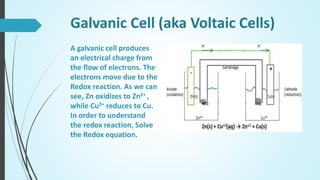
Galvanic Cell (aka Voltaic Cells)
A galvanic cell produces
an electrical charge from
the flow of electrons. The
electrons move due to the
Redox reaction. As we can
see, Zn oxidizes to Zn2+ ,
while Cu2+ reduces to Cu.
In order to understand
the redox reaction, Solve
the Redox equation.
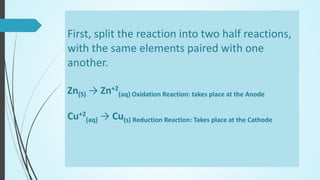
First, split the reaction into two half reactions,
with the same elements paired with one
another.
Zn(S) → Zn+2
(aq) Oxidation Reaction: takes place at the Anode
Cu+2
(aq) → Cu(s) Reduction Reaction: Takes place at the Cathode
Next, we balance the two equations.
Oxidation: Zn(S) →Zn2+
(aq) + 2e- (Anode)
Reduction: 2e- + Cu2+
(aq) → Cu(s) (Cathode)
Spontaneous redox reaction releases energy; The system does work on the
surroundings.
Electrolytic Cell;
An electrolytic cell is a cell which requires
an outside electrical source to initiate the
redox reaction. The process of how
electric energy drives the non-
spontaneous reaction is
called electrolysis. Whereas the galvanic
cell used a redox reaction to make
electrons flow, the electrolytic cell uses
electron movement (in the source of
electricity) to cause the redox reaction. In
an electrolytic cell, electrons are forced to
flow in the opposite direction. Since the
direction is reversed of the voltaic cell,
the E0
cell for electrolytic cell is negative.
Also, in order to force the electrons to
flow in the opposite direction, the
electromotive force that connects the two
electrode-the battery must be larger than
the magnitude of E0
cell. This additional
requirement of voltage is
called overpotential.
Electrolytic cell for the example above:
Oxidation: Cu(s) → Cu2+ (aq)+2e- (anode)
Reduction: Zn2+ (aq)+2e- → Zn(s) (cathode)
(Nonspontaneous redox reaction absorbs energy to
drive it; The surroundings do work on the system. )
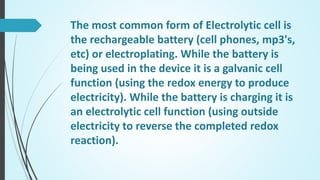
The most common form of Electrolytic cell is
the rechargeable battery (cell phones, mp3's,
etc) or electroplating. While the battery is
being used in the device it is a galvanic cell
function (using the redox energy to produce
electricity). While the battery is charging it is
an electrolytic cell function (using outside
electricity to reverse the completed redox
reaction).
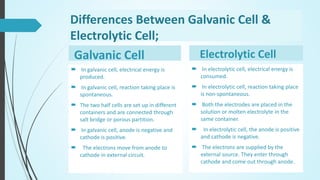
Differences Between Galvanic Cell &
Electrolytic Cell;
Galvanic Cell
 In galvanic cell, electrical energy is
produced.
 In galvanic cell, reaction taking place is
spontaneous.
 The two half cells are set up in different
containers and are connected through
salt bridge or porous partition.
 In galvanic cell, anode is negative and
cathode is positive.
 The electrons move from anode to
cathode in external circuit.
Electrolytic Cell
 In electrolytic cell, electrical energy is
consumed.
 In electrolytic cell, reaction taking place
is non-spontaneous.
 Both the electrodes are placed in the
solution or molten electrolyte in the
same container.
 In electrolytic cell, the anode is positive
and cathode is negative.
 The electrons are supplied by the
external source. They enter through
cathode and come out through anode.
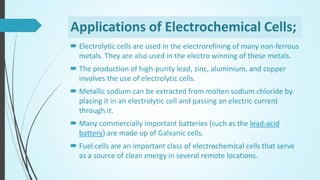
Applications of Electrochemical Cells;
 Electrolytic cells are used in the electrorefining of many non-ferrous
metals. They are also used in the electro winning of these metals.
 The production of high-purity lead, zinc, aluminium, and copper
involves the use of electrolytic cells.
 Metallic sodium can be extracted from molten sodium chloride by
placing it in an electrolytic cell and passing an electric current
through it.
 Many commercially important batteries (such as the lead-acid
battery) are made up of Galvanic cells.
 Fuel cells are an important class of electrochemical cells that serve
as a source of clean energy in several remote locations.
THANK YOU

Electrochemical cells.

  • 1.
  • 2.
    “ELECTROCHEMICAL CELLS’’ CONTENTS:  DEFINITION COMPONENTS  TYPES  VOLTAIC or GALVANIC CELLS  ELECTROLYTIC CELLS  DIFFERENCE BETWEEN GALVANIC & ELECTROLYTIC CELLS  APPLICATIONS OF ELECTROCHEMICAL CELLS
  • 3.
    DEFINITION; An electrochemical cellis a device that can generate electrical energy from the chemical reactions occurring in it, or use the electrical energy supplied to it to facilitate chemical reactions in it. These devices are capable of converting chemical energy into electrical energy, or vice versa.. EXAMPLE; A common example of an electrochemical cell is a standard 1.5-volt cell which is used to power many electrical appliances such as TV remotes and clocks.
  • 4.
    COMPONENTS; Here is thelist of the all the components. Two half cells Two metal electrodes One voltmeter One salt bridge Two aqueous solutions for each half cell All of these components create the Electrochemical Cell.
  • 5.
    HALF CELLS; A VoltaicCell (also known as a Galvanic Cell) is an electrochemical cell that uses spontaneous redox reactions to generate electricity. It consists of two separate half- cells. A half-cell is composed of an electrode (a strip of metal, M) within a solution containing Mn+ ions in which M is any arbitrary metal. The two half cells are linked together by a wire running from one electrode to the other. A salt bridge also connects to the half cells.
  • 6.
    TWO METAL ELECTRODES; Electrochemicalcells have two conductive electrodes, called the anode and the cathode. The anode is defined as the electrode where oxidation occurs. The cathode is the electrode where reduction takes place. The key features of the cathode and the anode are tabulated below. CATHODE  Denoted by a positive sign since electrons are consumed here  A reduction reaction occurs in the cathode of an electrochemical cell  Electrons move into the cathode ANODE  Denoted by a negative sign since electrons are liberated here  An oxidation reaction occurs here  Electrons move out of the anode
  • 7.
    VOLTMETER; DEFINITION; A voltmeter isan instrument used for measuring electric potential difference between two points in an electric circuit. Electric potential is the potential energy per charge. The concept of electric potential is used to express the effect of an electric field of a source in terms of the location within the electric field.
  • 8.
    SALT BRIDGE; DEFINITION; A saltbridge is a device used in an electrochemical cell for connecting its oxidation and reduction half cells wherein a weak electrolyte is used. In other words, a salt bridge is a junction that connects the anodic and cathodic compartments in a cell or electrolytic solution.
  • 9.
    TYPES OF ELECTROCHEMICALCELLS; Electrochemical Cells are of two types. 1. Voltaic or Galvanic Cells 2. Electrolytic Cells
  • 10.
    VOLTAIC CELL  Avoltaic cell, often known as a galvanic cell, provides electrical energy. The source of this energy is a spontaneous chemical reaction, more specifically a spontaneous redox reaction.  The energy conversion is achieved by spontaneous (ΔG < 0) redox reactions producing a flow of electrons. ELECTROLYTIC CELL  In an electrolytic cell, electrical energy is used to drive a non-spontaneous chemical reaction.  A flow of electrons drives non- spontaneous (ΔG ≥ 0) redox reactions.
  • 11.
    CONTINUED…………….. VOLTAIC CELL  Forexample, all batteries are made of one or more voltaic cells; batteries go flat when most or all of their reactants have been converted to products, transforming their chemical potential energy to electrical energy.  A battery powering something is an example of a galvanic cell. ELECTROLYTIC CELL  For example, water can be split into hydrogen and oxygen in an electrolytic cell. Also, when a rechargeable battery is recharged, it operates as an electrolytic cell.  Examples of electrolytic cells also include those that convert aluminum ore to aluminum metal.
  • 12.
    Basic Voltaic CellSystematic  Spontaneous redox reactions at the electrodes produce a voltage. Correctly set up, this voltage can drive electrons through electric devices, such as the light bulb shown here. In this diagram, species transfer electrons to the anode from where they flow through the light bulb to the cathode, where they bring about reduction.
  • 13.
     Non-spontaneous redox reactionsare driven by an external voltage. The electrolytic cell's processes are the opposite of the voltaic cell's. The current from the power source pushes electrons on to the cathode, where they cause reduction of species to take place. Basic Electrolytic Cell Systematic
  • 14.
    Galvanic Cell (akaVoltaic Cells) A galvanic cell produces an electrical charge from the flow of electrons. The electrons move due to the Redox reaction. As we can see, Zn oxidizes to Zn2+ , while Cu2+ reduces to Cu. In order to understand the redox reaction, Solve the Redox equation.
  • 15.
    First, split thereaction into two half reactions, with the same elements paired with one another. Zn(S) → Zn+2 (aq) Oxidation Reaction: takes place at the Anode Cu+2 (aq) → Cu(s) Reduction Reaction: Takes place at the Cathode
  • 16.
    Next, we balancethe two equations. Oxidation: Zn(S) →Zn2+ (aq) + 2e- (Anode) Reduction: 2e- + Cu2+ (aq) → Cu(s) (Cathode) Spontaneous redox reaction releases energy; The system does work on the surroundings.
  • 17.
    Electrolytic Cell; An electrolyticcell is a cell which requires an outside electrical source to initiate the redox reaction. The process of how electric energy drives the non- spontaneous reaction is called electrolysis. Whereas the galvanic cell used a redox reaction to make electrons flow, the electrolytic cell uses electron movement (in the source of electricity) to cause the redox reaction. In an electrolytic cell, electrons are forced to flow in the opposite direction. Since the direction is reversed of the voltaic cell, the E0 cell for electrolytic cell is negative. Also, in order to force the electrons to flow in the opposite direction, the electromotive force that connects the two electrode-the battery must be larger than the magnitude of E0 cell. This additional requirement of voltage is called overpotential.
  • 18.
    Electrolytic cell forthe example above: Oxidation: Cu(s) → Cu2+ (aq)+2e- (anode) Reduction: Zn2+ (aq)+2e- → Zn(s) (cathode) (Nonspontaneous redox reaction absorbs energy to drive it; The surroundings do work on the system. )
  • 19.
    The most commonform of Electrolytic cell is the rechargeable battery (cell phones, mp3's, etc) or electroplating. While the battery is being used in the device it is a galvanic cell function (using the redox energy to produce electricity). While the battery is charging it is an electrolytic cell function (using outside electricity to reverse the completed redox reaction).
  • 20.
    Differences Between GalvanicCell & Electrolytic Cell; Galvanic Cell  In galvanic cell, electrical energy is produced.  In galvanic cell, reaction taking place is spontaneous.  The two half cells are set up in different containers and are connected through salt bridge or porous partition.  In galvanic cell, anode is negative and cathode is positive.  The electrons move from anode to cathode in external circuit. Electrolytic Cell  In electrolytic cell, electrical energy is consumed.  In electrolytic cell, reaction taking place is non-spontaneous.  Both the electrodes are placed in the solution or molten electrolyte in the same container.  In electrolytic cell, the anode is positive and cathode is negative.  The electrons are supplied by the external source. They enter through cathode and come out through anode.
  • 21.
    Applications of ElectrochemicalCells;  Electrolytic cells are used in the electrorefining of many non-ferrous metals. They are also used in the electro winning of these metals.  The production of high-purity lead, zinc, aluminium, and copper involves the use of electrolytic cells.  Metallic sodium can be extracted from molten sodium chloride by placing it in an electrolytic cell and passing an electric current through it.  Many commercially important batteries (such as the lead-acid battery) are made up of Galvanic cells.  Fuel cells are an important class of electrochemical cells that serve as a source of clean energy in several remote locations.
  • 22.