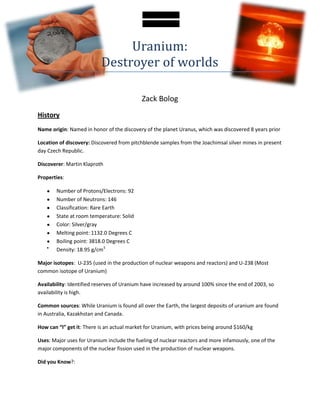
Uranium:
                          Destroyer of worlds

                                            Zack Bolog
History
Name origin: Named in honor of the discovery of the planet Uranus, which was discovered 8 years prior

Location of discovery: Discovered from pitchblende samples from the Joachimsal silver mines in present
day Czech Republic.

Discoverer: Martin Klaproth

Properties:

       Number of Protons/Electrons: 92
       Number of Neutrons: 146
       Classification: Rare Earth
       State at room temperature: Solid
       Color: Silver/gray
       Melting point: 1132.0 Degrees C
       Boiling point: 3818.0 Degrees C
       Density: 18.95 g/cm3

Major isotopes: U-235 (used in the production of nuclear weapons and reactors) and U-238 (Most
common isotope of Uranium)

Availability: Identified reserves of Uranium have increased by around 100% since the end of 2003, so
availability is high.

Common sources: While Uranium is found all over the Earth, the largest deposits of uranium are found
in Australia, Kazakhstan and Canada.

How can “I” get it: There is an actual market for Uranium, with prices being around $160/kg

Uses: Major uses for Uranium include the fueling of nuclear reactors and more infamously, one of the
major components of the nuclear fission used in the production of nuclear weapons.

Did you Know?:
Uranium is found EVERYWHERE on Earth, including the very food that we eat and also our own
       tissue!
       The weight of a baseball is 5.25 oz…..a Uranium ball of the same dimensions would weigh 8.5
       pounds!
       Uranium is 40 times more abundant than silver, making cheap husbands the leading cause of
       Radiation poisoning amongst housewives (source needed)
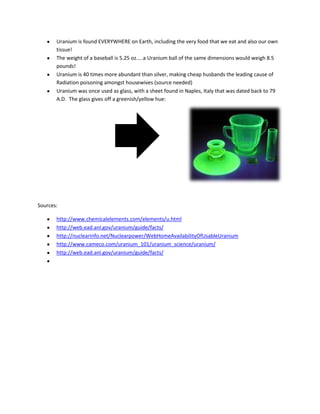
       Uranium was once used as glass, with a sheet found in Naples, Italy that was dated back to 79
       A.D. The glass gives off a greenish/yellow hue:


Sources:

       http://www.chemicalelements.com/elements/u.html
       http://web.ead.anl.gov/uranium/guide/facts/
       http://nuclearinfo.net/Nuclearpower/WebHomeAvailabilityOfUsableUranium
       http://www.cameco.com/uranium_101/uranium_science/uranium/
       http://web.ead.anl.gov/uranium/guide/facts/

Uranium (Zack Bolog)

  • 2.
    Uranium: Destroyer of worlds Zack Bolog History Name origin: Named in honor of the discovery of the planet Uranus, which was discovered 8 years prior Location of discovery: Discovered from pitchblende samples from the Joachimsal silver mines in present day Czech Republic. Discoverer: Martin Klaproth Properties: Number of Protons/Electrons: 92 Number of Neutrons: 146 Classification: Rare Earth State at room temperature: Solid Color: Silver/gray Melting point: 1132.0 Degrees C Boiling point: 3818.0 Degrees C Density: 18.95 g/cm3 Major isotopes: U-235 (used in the production of nuclear weapons and reactors) and U-238 (Most common isotope of Uranium) Availability: Identified reserves of Uranium have increased by around 100% since the end of 2003, so availability is high. Common sources: While Uranium is found all over the Earth, the largest deposits of uranium are found in Australia, Kazakhstan and Canada. How can “I” get it: There is an actual market for Uranium, with prices being around $160/kg Uses: Major uses for Uranium include the fueling of nuclear reactors and more infamously, one of the major components of the nuclear fission used in the production of nuclear weapons. Did you Know?:
  • 3.
    Uranium is foundEVERYWHERE on Earth, including the very food that we eat and also our own tissue! The weight of a baseball is 5.25 oz…..a Uranium ball of the same dimensions would weigh 8.5 pounds! Uranium is 40 times more abundant than silver, making cheap husbands the leading cause of Radiation poisoning amongst housewives (source needed) Uranium was once used as glass, with a sheet found in Naples, Italy that was dated back to 79 A.D. The glass gives off a greenish/yellow hue: Sources: http://www.chemicalelements.com/elements/u.html http://web.ead.anl.gov/uranium/guide/facts/ http://nuclearinfo.net/Nuclearpower/WebHomeAvailabilityOfUsableUranium http://www.cameco.com/uranium_101/uranium_science/uranium/ http://web.ead.anl.gov/uranium/guide/facts/