Strontium
History of Strontium
• Discovered in 1790 by Adair Crawford in
  Strontian, Scotland.
• The element was later isolated by Sir Humphry
  Davy.
Properties
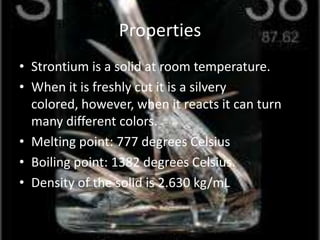
• Strontium is a solid at room temperature.
• When it is freshly cut it is a silvery
  colored, however, when it reacts it can turn
  many different colors.
• Melting point: 777 degrees Celsius
• Boiling point: 1382 degrees Celsius.
• Density of the solid is 2.630 kg/mL
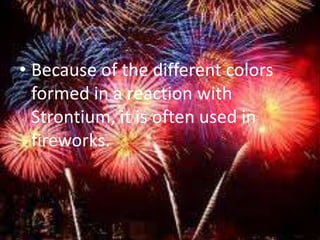
• Because of the different colors
  formed in a reaction with
  Strontium, it is often used in
  fireworks.
Here is a video that shows how
 Strontium can change the color of a
      flame, making it useful in
            pyrotechnics.

• http://www.youtube.com/watch?v=vltFchuGi
  0Y
Uses
• Strontium does not exist by itself, but it can be
  found in Strontium salts and other compounds.
• Strontium salts (strontium sulphate) is used in
  pyrotechnics.
• Strontium titanate has an extremely high
  refractive index so it is known to be used as a
  gemstone.
• Radioactive Strontium ( Strontium 90) granules
  are found in nuclear bombs.
Availability
• Even though Strontium does not exist by
  itself, things like Strontium Chloride can be
  bought in small amounts from many
  pyrotechnic suppliers.
• This usually costs about $100 for 100 grams..
Works Cited
• Winter, Mark. Strontium The Essentials. 1993-2011. Web. 11
  November 2011.
• Strontium- Strontium Supplements. 2005-2011. Web. 13
  November 2011.
• "Strontium." Chemicool Periodic Table. Chemicool.com. 24
  Feb. 2011. Web. 11/15/2011
• <http://www.chemicool.com/elements/strontium.html>.

Strontium (Keri Nickoson)

  • 1.
  • 2.
    History of Strontium •Discovered in 1790 by Adair Crawford in Strontian, Scotland. • The element was later isolated by Sir Humphry Davy.
  • 3.
    Properties • Strontium isa solid at room temperature. • When it is freshly cut it is a silvery colored, however, when it reacts it can turn many different colors. • Melting point: 777 degrees Celsius • Boiling point: 1382 degrees Celsius. • Density of the solid is 2.630 kg/mL
  • 4.
    • Because ofthe different colors formed in a reaction with Strontium, it is often used in fireworks.
  • 5.
    Here is avideo that shows how Strontium can change the color of a flame, making it useful in pyrotechnics. • http://www.youtube.com/watch?v=vltFchuGi 0Y
  • 6.
    Uses • Strontium doesnot exist by itself, but it can be found in Strontium salts and other compounds. • Strontium salts (strontium sulphate) is used in pyrotechnics. • Strontium titanate has an extremely high refractive index so it is known to be used as a gemstone. • Radioactive Strontium ( Strontium 90) granules are found in nuclear bombs.
  • 7.
    Availability • Even thoughStrontium does not exist by itself, things like Strontium Chloride can be bought in small amounts from many pyrotechnic suppliers. • This usually costs about $100 for 100 grams..
  • 8.
    Works Cited • Winter,Mark. Strontium The Essentials. 1993-2011. Web. 11 November 2011. • Strontium- Strontium Supplements. 2005-2011. Web. 13 November 2011. • "Strontium." Chemicool Periodic Table. Chemicool.com. 24 Feb. 2011. Web. 11/15/2011 • <http://www.chemicool.com/elements/strontium.html>.