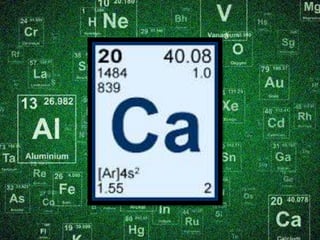
CALCIUM
By: Ma. Lourdes B. Paulo
HUMSS 12-A
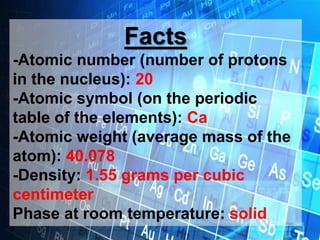
Facts
-Atomic number (number of protons
in the nucleus): 20
-Atomic symbol (on the periodic
table of the elements): Ca
-Atomic weight (average mass of the
atom): 40.078
-Density: 1.55 grams per cubic
centimeter
Phase at room temperature: solid
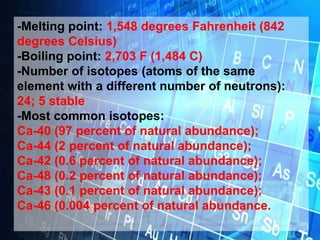
-Melting point: 1,548 degrees Fahrenheit (842
degrees Celsius)
-Boiling point: 2,703 F (1,484 C)
-Number of isotopes (atoms of the same
element with a different number of neutrons):
24; 5 stable
-Most common isotopes:
Ca-40 (97 percent of natural abundance);
Ca-44 (2 percent of natural abundance);
Ca-42 (0.6 percent of natural abundance);
Ca-48 (0.2 percent of natural abundance);
Ca-43 (0.1 percent of natural abundance);
Ca-46 (0.004 percent of natural abundance.
History
-Lime (calcium oxide, CaO) was the useful material obtained by
heating limestone and used for centuries to make plaster and
mortar. Antoine Lavoisier classified it as an ‘earth’ because it
seemed impossible to reduce it further, but he suspected it was
the oxide of an unknown element. In 1808, Humphry Davy tried to
reduce moist lime by electrolysis, just as he had done with
sodium and potassium, but he was not successful. So he tried a
mixture of lime and mercury oxide and while this produced an
amalgam of calcium and mercury, it was not enough to confirm
that he’d obtained a new element. (Jöns Jacob Berzelius had
conducted a similar experiment and also obtained the amalgam.)
Davy tried using more lime in the mixture and produced more of
the amalgam from which he distilled off the mercury leaving just
calcium.
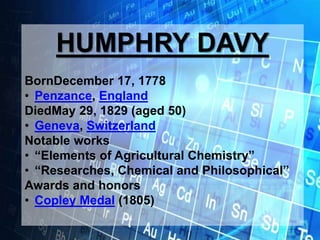
HUMPHRY DAVY
BornDecember 17, 1778
• Penzance, England
DiedMay 29, 1829 (aged 50)
• Geneva, Switzerland
Notable works
• “Elements of Agricultural Chemistry”
• “Researches, Chemical and Philosophical”
Awards and honors
• Copley Medal (1805)
HUMPHRY DAVY
Appearance
-Calcium is a silvery-white, soft
metal that tarnishes rapidly in air
and reacts with water.
Uses
-Calcium metal is used as a reducing agent in preparing other
metals such as thorium and uranium. It is also used as an alloying
agent for aluminium, beryllium, copper, lead and magnesium alloys.
-Calcium compounds are widely used. There are vast deposits of
limestone (calcium carbonate) used directly as a building stone and
indirectly for cement. When limestone is heated in kilns it gives off
carbon dioxide gas leaving behind quicklime (calcium oxide). This
reacts vigorously with water to give slaked lime (calcium
hydroxide). Slaked lime is used to make cement, as a soil
conditioner and in water treatment to reduce acidity, and in the
chemicals industry. It is also used in steel making to remove
impurities from the molten iron ore. When mixed with sand, slaked
lime takes up carbon dioxide from the air and hardens as lime
plaster.
-Gypsum (calcium sulfate) is used by builders as a plaster and by
nurses for setting bones, as ‘plaster of Paris’.
Biological role
-Calcium is essential to all living things,
particularly for the growth of healthy teeth and
bones. Calcium phosphate is the main
component of bone. The average human
contains about 1 kilogram of calcium.
-Children and pregnant women are encouraged
to eat foods rich in calcium, such as milk and
dairy products, leafy green vegetables, fish and
nuts and seeds.
Natural abundance
-Calcium is the fifth most abundant metal in the
Earth’s crust (4.1%). It is not found uncombined in
nature, but occurs abundantly as limestone (calcium
carbonate), gypsum (calcium sulfate), fluorite (calcium
fluoride) and apatite (calcium chloro- or fluoro-
phosphate).
-Hard water contains dissolved calcium bicarbonate.
When this filters through the ground and reaches a
cave, it precipitates out to form stalactites and
stalagmites.
-Calcium metal is prepared commercially by heating
lime with aluminium in a vacuum.
ACTIVITY
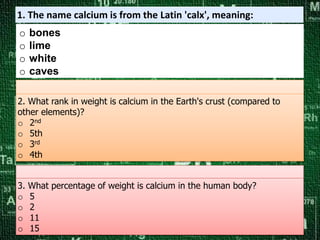
1. The name calcium is from the Latin 'calx', meaning:
o bones
o lime
o white
o caves
2. What rank in weight is calcium in the Earth's crust (compared to
other elements)?
o 2nd
o 5th
o 3rd
o 4th
3. What percentage of weight is calcium in the human body?
o 5
o 2
o 11
o 15
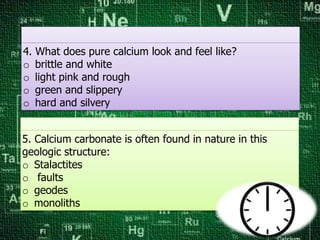
4. What does pure calcium look and feel like?
o brittle and white
o light pink and rough
o green and slippery
o hard and silvery
5. Calcium carbonate is often found in nature in this
geologic structure:
o Stalactites
o faults
o geodes
o monoliths
Answers:
1. Lime
2. 5th
It is fifth behind oxygen, silicon, aluminum, and iron. After calcium comes
sodium (6th), potassium (7th), and magnesium (8th).
3. 2 Almost all (98 percent) of our approximately three pounds of calcium
is contained in our bones, about 1 percent in our teeth, and the rest in the
other tissues and the circulation.
4. Hard and silvery The metal has a silvery color, is rather hard, and is
prepared by electrolysis of the fused chloride to which calcium fluoride is
added to lower the melting point.
5. Stalactites
In caves, with their twin structure stalagmites.

Chemical Element:Calcium

  • 1.
    CALCIUM By: Ma. LourdesB. Paulo HUMSS 12-A
  • 3.
    Facts -Atomic number (numberof protons in the nucleus): 20 -Atomic symbol (on the periodic table of the elements): Ca -Atomic weight (average mass of the atom): 40.078 -Density: 1.55 grams per cubic centimeter Phase at room temperature: solid
  • 4.
    -Melting point: 1,548degrees Fahrenheit (842 degrees Celsius) -Boiling point: 2,703 F (1,484 C) -Number of isotopes (atoms of the same element with a different number of neutrons): 24; 5 stable -Most common isotopes: Ca-40 (97 percent of natural abundance); Ca-44 (2 percent of natural abundance); Ca-42 (0.6 percent of natural abundance); Ca-48 (0.2 percent of natural abundance); Ca-43 (0.1 percent of natural abundance); Ca-46 (0.004 percent of natural abundance.
  • 5.
    History -Lime (calcium oxide,CaO) was the useful material obtained by heating limestone and used for centuries to make plaster and mortar. Antoine Lavoisier classified it as an ‘earth’ because it seemed impossible to reduce it further, but he suspected it was the oxide of an unknown element. In 1808, Humphry Davy tried to reduce moist lime by electrolysis, just as he had done with sodium and potassium, but he was not successful. So he tried a mixture of lime and mercury oxide and while this produced an amalgam of calcium and mercury, it was not enough to confirm that he’d obtained a new element. (Jöns Jacob Berzelius had conducted a similar experiment and also obtained the amalgam.) Davy tried using more lime in the mixture and produced more of the amalgam from which he distilled off the mercury leaving just calcium.
  • 6.
    HUMPHRY DAVY BornDecember 17,1778 • Penzance, England DiedMay 29, 1829 (aged 50) • Geneva, Switzerland Notable works • “Elements of Agricultural Chemistry” • “Researches, Chemical and Philosophical” Awards and honors • Copley Medal (1805)
  • 7.
  • 8.
    Appearance -Calcium is asilvery-white, soft metal that tarnishes rapidly in air and reacts with water.
  • 9.
    Uses -Calcium metal isused as a reducing agent in preparing other metals such as thorium and uranium. It is also used as an alloying agent for aluminium, beryllium, copper, lead and magnesium alloys. -Calcium compounds are widely used. There are vast deposits of limestone (calcium carbonate) used directly as a building stone and indirectly for cement. When limestone is heated in kilns it gives off carbon dioxide gas leaving behind quicklime (calcium oxide). This reacts vigorously with water to give slaked lime (calcium hydroxide). Slaked lime is used to make cement, as a soil conditioner and in water treatment to reduce acidity, and in the chemicals industry. It is also used in steel making to remove impurities from the molten iron ore. When mixed with sand, slaked lime takes up carbon dioxide from the air and hardens as lime plaster. -Gypsum (calcium sulfate) is used by builders as a plaster and by nurses for setting bones, as ‘plaster of Paris’.
  • 10.
    Biological role -Calcium isessential to all living things, particularly for the growth of healthy teeth and bones. Calcium phosphate is the main component of bone. The average human contains about 1 kilogram of calcium. -Children and pregnant women are encouraged to eat foods rich in calcium, such as milk and dairy products, leafy green vegetables, fish and nuts and seeds.
  • 11.
    Natural abundance -Calcium isthe fifth most abundant metal in the Earth’s crust (4.1%). It is not found uncombined in nature, but occurs abundantly as limestone (calcium carbonate), gypsum (calcium sulfate), fluorite (calcium fluoride) and apatite (calcium chloro- or fluoro- phosphate). -Hard water contains dissolved calcium bicarbonate. When this filters through the ground and reaches a cave, it precipitates out to form stalactites and stalagmites. -Calcium metal is prepared commercially by heating lime with aluminium in a vacuum.
  • 12.
  • 13.
    1. The namecalcium is from the Latin 'calx', meaning: o bones o lime o white o caves 2. What rank in weight is calcium in the Earth's crust (compared to other elements)? o 2nd o 5th o 3rd o 4th 3. What percentage of weight is calcium in the human body? o 5 o 2 o 11 o 15
  • 14.
    4. What doespure calcium look and feel like? o brittle and white o light pink and rough o green and slippery o hard and silvery 5. Calcium carbonate is often found in nature in this geologic structure: o Stalactites o faults o geodes o monoliths
  • 15.
    Answers: 1. Lime 2. 5th Itis fifth behind oxygen, silicon, aluminum, and iron. After calcium comes sodium (6th), potassium (7th), and magnesium (8th). 3. 2 Almost all (98 percent) of our approximately three pounds of calcium is contained in our bones, about 1 percent in our teeth, and the rest in the other tissues and the circulation. 4. Hard and silvery The metal has a silvery color, is rather hard, and is prepared by electrolysis of the fused chloride to which calcium fluoride is added to lower the melting point. 5. Stalactites In caves, with their twin structure stalagmites.