 Technetium was mistakenly
  reported as having been
  discovered in 1925. At this
  time, it was named masurium.
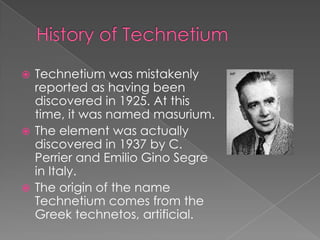
 The element was actually
  discovered in 1937 by C.
  Perrier and Emilio Gino Segre
  in Italy.
 The origin of the name
  Technetium comes from the
  Greek technetos, artificial.
   Technetium is a solid at room
    temperature.
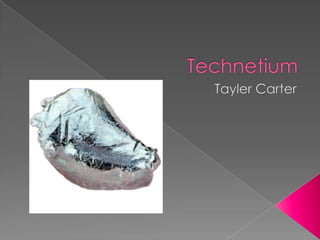
   The color of technetium is silver/gray.
   Melting point: 2200°C
    Boiling Point: 4877°C
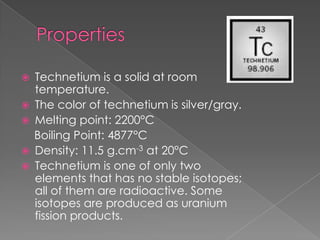
   Density: 11.5 g.cm-3 at 20°C
   Technetium is one of only two
    elements that has no stable isotopes;
    all of them are radioactive. Some
    isotopes are produced as uranium
    fission products.
 Technetium was the first artificially
  produced element. It was created by
  bombarding molybdenum atoms with
  neutrons.
 Today, this is still how we produce
  technetium. When molybdenum
  captures a neutron, it decays into
  technetium.
 The cost of technetium is around $60 per
  gram.
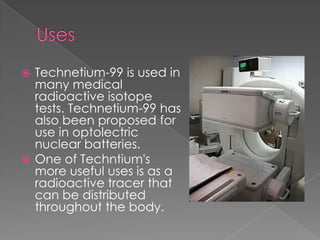
 Technetium-99 is used in
  many medical
  radioactive isotope
  tests. Technetium-99 has
  also been proposed for
  use in optolectric
  nuclear batteries.
 One of Techntium's
  more useful uses is as a
  radioactive tracer that
  can be distributed
  throughout the body.
   http://www.chemistry.pomona.edu/chemistry/
    periodic_table/Elements/Technetium/uses.html
   http://www.webelements.com/technetium/hist
    ory.html
   http://www.lenntech.com/periodic/elements/t
    c.htm#Atomic%20number
   http://chemistry.about.com/od/elementfacts/
    a/technetium.htm
   http://education.jlab.org/itselemental/ele043.h
    tml
   http://www.hobart.k12.in.us/ksms/PeriodicTabl
    e/technetium.htm

Technetium (Tayler Carter)

  • 2.
     Technetium wasmistakenly reported as having been discovered in 1925. At this time, it was named masurium.  The element was actually discovered in 1937 by C. Perrier and Emilio Gino Segre in Italy.  The origin of the name Technetium comes from the Greek technetos, artificial.
  • 3.
    Technetium is a solid at room temperature.  The color of technetium is silver/gray.  Melting point: 2200°C Boiling Point: 4877°C  Density: 11.5 g.cm-3 at 20°C  Technetium is one of only two elements that has no stable isotopes; all of them are radioactive. Some isotopes are produced as uranium fission products.
  • 4.
     Technetium wasthe first artificially produced element. It was created by bombarding molybdenum atoms with neutrons.  Today, this is still how we produce technetium. When molybdenum captures a neutron, it decays into technetium.  The cost of technetium is around $60 per gram.
  • 5.
     Technetium-99 isused in many medical radioactive isotope tests. Technetium-99 has also been proposed for use in optolectric nuclear batteries.  One of Techntium's more useful uses is as a radioactive tracer that can be distributed throughout the body.
  • 6.
    http://www.chemistry.pomona.edu/chemistry/ periodic_table/Elements/Technetium/uses.html  http://www.webelements.com/technetium/hist ory.html  http://www.lenntech.com/periodic/elements/t c.htm#Atomic%20number  http://chemistry.about.com/od/elementfacts/ a/technetium.htm  http://education.jlab.org/itselemental/ele043.h tml  http://www.hobart.k12.in.us/ksms/PeriodicTabl e/technetium.htm