Samantha Johnson
What’s in a name?
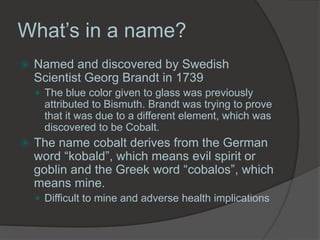
   Named and discovered by Swedish
    Scientist Georg Brandt in 1739
     The blue color given to glass was previously
      attributed to Bismuth. Brandt was trying to prove
      that it was due to a different element, which was
      discovered to be Cobalt.
   The name cobalt derives from the German
    word “kobald”, which means evil spirit or
    goblin and the Greek word “cobalos”, which
    means mine.
     Difficult to mine and adverse health implications
General Properties
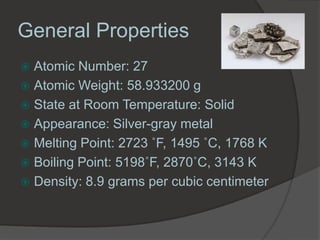
 Atomic Number: 27
 Atomic Weight: 58.933200 g
 State at Room Temperature: Solid
 Appearance: Silver-gray metal
 Melting Point: 2723 ˚F, 1495 ˚C, 1768 K
 Boiling Point: 5198˚F, 2870˚C, 3143 K
 Density: 8.9 grams per cubic centimeter
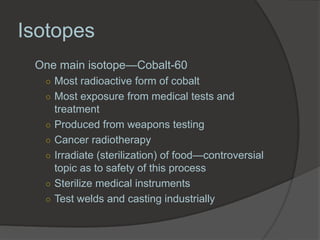
Isotopes
 One main isotope—Cobalt-60
  ○ Most radioactive form of cobalt
  ○ Most exposure from medical tests and
      treatment
  ○   Produced from weapons testing
  ○   Cancer radiotherapy
  ○   Irradiate (sterilization) of food—controversial
      topic as to safety of this process
  ○   Sterilize medical instruments
  ○   Test welds and casting industrially
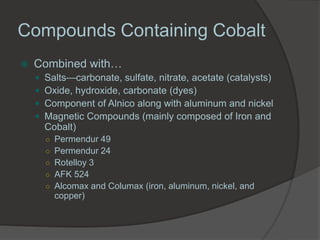
Compounds Containing Cobalt
   Combined with…
       Salts—carbonate, sulfate, nitrate, acetate (catalysts)
       Oxide, hydroxide, carbonate (dyes)
       Component of Alnico along with aluminum and nickel
       Magnetic Compounds (mainly composed of Iron and
        Cobalt)
        ○ Permendur 49
        ○ Permendur 24
        ○ Rotelloy 3
        ○ AFK 524
        ○ Alcomax and Columax (iron, aluminum, nickel, and
          copper)
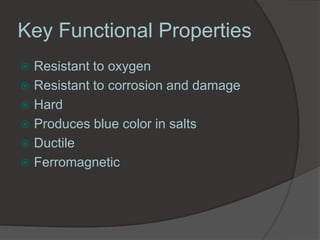
Key Functional Properties
 Resistant to oxygen
 Resistant to corrosion and damage
 Hard
 Produces blue color in salts
 Ductile
 Ferromagnetic
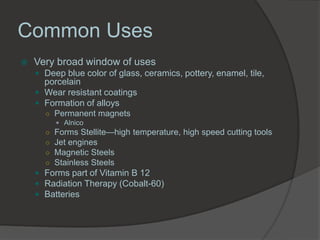
Common Uses
   Very broad window of uses
     Deep blue color of glass, ceramics, pottery, enamel, tile,
      porcelain
     Wear resistant coatings
     Formation of alloys
      ○ Permanent magnets
         Alnico
      ○ Forms Stellite—high temperature, high speed cutting tools
      ○ Jet engines
      ○ Magnetic Steels
      ○ Stainless Steels
     Forms part of Vitamin B 12
     Radiation Therapy (Cobalt-60)
     Batteries
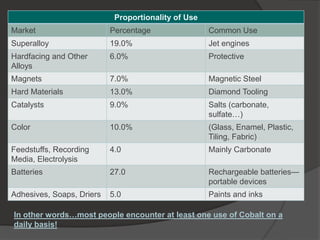
Proportionality of Use
Market                     Percentage                Common Use
Superalloy                 19.0%                     Jet engines
Hardfacing and Other       6.0%                      Protective
Alloys
Magnets                    7.0%                      Magnetic Steel
Hard Materials             13.0%                     Diamond Tooling
Catalysts                  9.0%                      Salts (carbonate,
                                                     sulfate…)
Color                      10.0%                     (Glass, Enamel, Plastic,
                                                     Tiling, Fabric)
Feedstuffs, Recording      4.0                       Mainly Carbonate
Media, Electrolysis
Batteries                  27.0                      Rechargeable batteries—
                                                     portable devices
Adhesives, Soaps, Driers   5.0                       Paints and inks

In other words…most people encounter at least one use of Cobalt on a
daily basis!
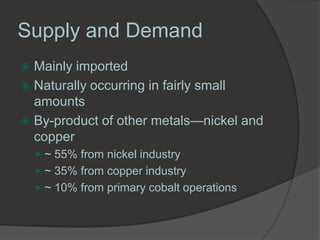
Supply and Demand
 Mainly imported
 Naturally occurring in fairly small
  amounts
 By-product of other metals—nickel and
  copper
     ~ 55% from nickel industry
     ~ 35% from copper industry
     ~ 10% from primary cobalt operations
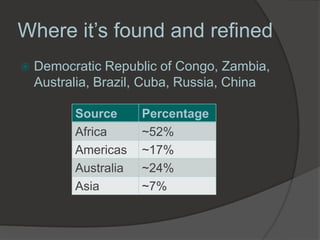
Where it’s found and refined
   Democratic Republic of Congo, Zambia,
    Australia, Brazil, Cuba, Russia, China

          Source      Percentage
          Africa      ~52%
          Americas    ~17%
          Australia   ~24%
          Asia        ~7%
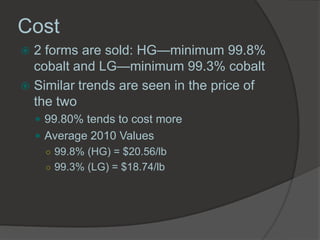
Cost
 2 forms are sold: HG—minimum 99.8%
  cobalt and LG—minimum 99.3% cobalt
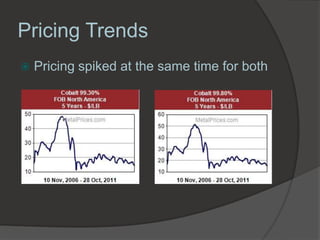
 Similar trends are seen in the price of
  the two
     99.80% tends to cost more
     Average 2010 Values
      ○ 99.8% (HG) = $20.56/lb
      ○ 99.3% (LG) = $18.74/lb
Pricing Trends
   Pricing spiked at the same time for both
Bibliography
   A conglomerate of the information on the following websites
    was used:
   http://www.mii.org/Minerals/photocobalt.html
   http://education.jlab.org/itselemental/ele027.html
   http://www.chemicool.com/elements/cobalt.html
   http://chemistry.about.com/od/elementfacts/a/cobalt.htm
   http://len7288.hubpages.com/hub/Uses-of-Cobalt-in-Medicine-
    and-Industrial-Manufacturing
   http://education.jlab.org/itselemental/ele027.html
   http://www.thecdi.com/cdi/images/documents/facts/COBALT_FA
    CTS-Properties_and_Main_Uses.pdf
   http://www.metalprices.com/freesite/metals/co/co.asp
   http://www.thecdi.com/cobaltfacts.php
   http://www.evs.anl.gov/pub/doc/Cobalt.pdf
   http://www.epa.gov/superfund/health/contaminants/radiation/pdf
    s/cobalt.pdf

Cobalt (Samantha Johnson)

  • 1.
  • 2.
    What’s in aname?  Named and discovered by Swedish Scientist Georg Brandt in 1739  The blue color given to glass was previously attributed to Bismuth. Brandt was trying to prove that it was due to a different element, which was discovered to be Cobalt.  The name cobalt derives from the German word “kobald”, which means evil spirit or goblin and the Greek word “cobalos”, which means mine.  Difficult to mine and adverse health implications
  • 3.
    General Properties  AtomicNumber: 27  Atomic Weight: 58.933200 g  State at Room Temperature: Solid  Appearance: Silver-gray metal  Melting Point: 2723 ˚F, 1495 ˚C, 1768 K  Boiling Point: 5198˚F, 2870˚C, 3143 K  Density: 8.9 grams per cubic centimeter
  • 4.
    Isotopes One mainisotope—Cobalt-60 ○ Most radioactive form of cobalt ○ Most exposure from medical tests and treatment ○ Produced from weapons testing ○ Cancer radiotherapy ○ Irradiate (sterilization) of food—controversial topic as to safety of this process ○ Sterilize medical instruments ○ Test welds and casting industrially
  • 5.
    Compounds Containing Cobalt  Combined with…  Salts—carbonate, sulfate, nitrate, acetate (catalysts)  Oxide, hydroxide, carbonate (dyes)  Component of Alnico along with aluminum and nickel  Magnetic Compounds (mainly composed of Iron and Cobalt) ○ Permendur 49 ○ Permendur 24 ○ Rotelloy 3 ○ AFK 524 ○ Alcomax and Columax (iron, aluminum, nickel, and copper)
  • 6.
    Key Functional Properties Resistant to oxygen  Resistant to corrosion and damage  Hard  Produces blue color in salts  Ductile  Ferromagnetic
  • 7.
    Common Uses  Very broad window of uses  Deep blue color of glass, ceramics, pottery, enamel, tile, porcelain  Wear resistant coatings  Formation of alloys ○ Permanent magnets  Alnico ○ Forms Stellite—high temperature, high speed cutting tools ○ Jet engines ○ Magnetic Steels ○ Stainless Steels  Forms part of Vitamin B 12  Radiation Therapy (Cobalt-60)  Batteries
  • 8.
    Proportionality of Use Market Percentage Common Use Superalloy 19.0% Jet engines Hardfacing and Other 6.0% Protective Alloys Magnets 7.0% Magnetic Steel Hard Materials 13.0% Diamond Tooling Catalysts 9.0% Salts (carbonate, sulfate…) Color 10.0% (Glass, Enamel, Plastic, Tiling, Fabric) Feedstuffs, Recording 4.0 Mainly Carbonate Media, Electrolysis Batteries 27.0 Rechargeable batteries— portable devices Adhesives, Soaps, Driers 5.0 Paints and inks In other words…most people encounter at least one use of Cobalt on a daily basis!
  • 9.
    Supply and Demand Mainly imported  Naturally occurring in fairly small amounts  By-product of other metals—nickel and copper  ~ 55% from nickel industry  ~ 35% from copper industry  ~ 10% from primary cobalt operations
  • 10.
    Where it’s foundand refined  Democratic Republic of Congo, Zambia, Australia, Brazil, Cuba, Russia, China Source Percentage Africa ~52% Americas ~17% Australia ~24% Asia ~7%
  • 11.
    Cost  2 formsare sold: HG—minimum 99.8% cobalt and LG—minimum 99.3% cobalt  Similar trends are seen in the price of the two  99.80% tends to cost more  Average 2010 Values ○ 99.8% (HG) = $20.56/lb ○ 99.3% (LG) = $18.74/lb
  • 12.
    Pricing Trends  Pricing spiked at the same time for both
  • 13.
    Bibliography  A conglomerate of the information on the following websites was used:  http://www.mii.org/Minerals/photocobalt.html  http://education.jlab.org/itselemental/ele027.html  http://www.chemicool.com/elements/cobalt.html  http://chemistry.about.com/od/elementfacts/a/cobalt.htm  http://len7288.hubpages.com/hub/Uses-of-Cobalt-in-Medicine- and-Industrial-Manufacturing  http://education.jlab.org/itselemental/ele027.html  http://www.thecdi.com/cdi/images/documents/facts/COBALT_FA CTS-Properties_and_Main_Uses.pdf  http://www.metalprices.com/freesite/metals/co/co.asp  http://www.thecdi.com/cobaltfacts.php  http://www.evs.anl.gov/pub/doc/Cobalt.pdf  http://www.epa.gov/superfund/health/contaminants/radiation/pdf s/cobalt.pdf