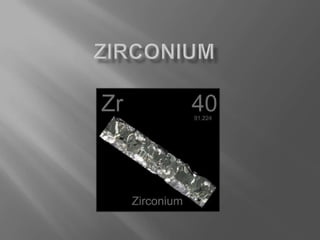
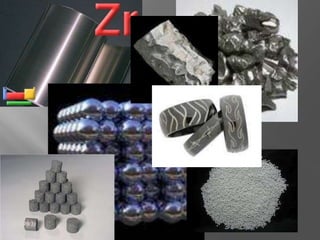
   Atomic Number: 40

   Symbol: Zr

   Group: 4B (Transition Metal)

   Atomic Weight: 91.224

   Electron Configuration: [Kr] 4d2 5s2


   Specific Heat: 0.281 J/g°C
   Melting Point: 1852.0 °C

   Boiling Point: 4377.0 °C

   Density: 6.506 g/cm3

   State at Room Temp: Solid

   Color: Grayish-white
   Martin Heinrich Klaproth, a leading German
    chemist in his time, discovered zirconium as
    part of the compound zircon in 1789. Zircon’s
    chemical name is zirconium silicate and its
    formula is ZrSiO4.

   Zirconium was named from the Persian word
    ā€œzargunā€ meaning ā€œgold-like.ā€ This name was
    not a reference to its chemical properties, but
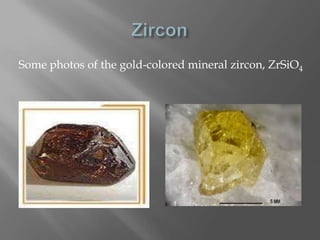
    rather to the gold color of the mineral zircon.
Some photos of the gold-colored mineral zircon, ZrSiO4
   Although recognized as an element in
    1789, zirconium was not isolated until 1824 by
    a Swedish chemist named Jƶns Jacob Berzelius.

   He isolated the element by heating a mixture of
    potassium and potassium zirconium fluoride in
    an iron tube. The reaction produced a black
    powder that was 93% zirconium.
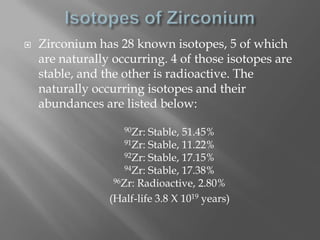
   Zirconium has 28 known isotopes, 5 of which
    are naturally occurring. 4 of those isotopes are
    stable, and the other is radioactive. The
    naturally occurring isotopes and their
    abundances are listed below:
                    90Zr:  Stable, 51.45%
                     91Zr: Stable, 11.22%
                     92Zr: Stable, 17.15%
                     94Zr: Stable, 17.38%
                  96Zr: Radioactive, 2.80%

                 (Half-life 3.8 X 10¹⁹ years)
   Zirconium is most easily found in mineral
    deposits of zircon (previously mentioned) and
    in zirconium dioxide, ZrO2 , which is most
    often associated with lunar rocks.

   Obtaining pure zirconium is very difficult
    because it is chemically similar to hafnium, an
    element of the same group which is always
    found mixed with deposits of zirconium.

   Commercial-grade zirconium can contain
    anywhere from 1 – 3% hafnium.
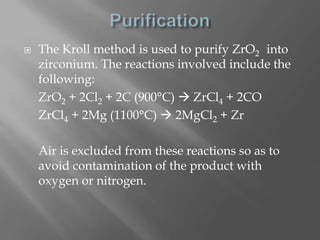
   The Kroll method is used to purify ZrO2 into
    zirconium. The reactions involved include the
    following:
    ZrO2 + 2Cl2 + 2C (900°C)  ZrCl4 + 2CO
    ZrCl4 + 2Mg (1100°C)  2MgCl2 + Zr

    Air is excluded from these reactions so as to
    avoid contamination of the product with
    oxygen or nitrogen.
   Zirconium is resistant to corrosion by acids and
    bases, as well as salt water and various other
    agents. For that reason, it is used in high
    performance pumps and valves.

    Since it does not easily absorb
    neutrons, zirconium is widely used in nuclear
    reactors. The zirconium used for this purpose must
    be nearly free of hafnium, as hafnium can absorb
    neutrons.

   Zirconium is also used as an alloying agent in
    steel, to make surgical equipment, and as a
    ā€œgetterā€ or a material that combines with and
    removes trace gases from vacuum tubes.
   The majority of zirconium compounds are used to
    make gems in jewelry.

   Colorless specimens of zircon (ZrSiO4) are often
    used as inexpensive replacements for diamonds.
    These are known as ā€œMatura Diamonds.ā€

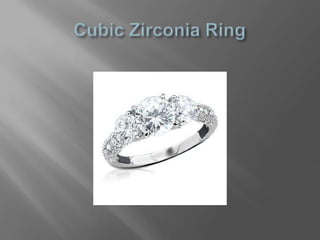
   Cubic zirconia (a form of is also a popular
    synthetic gem. It can be colorless, but is easily
    dyed almost any color. Many inexpensive
    ā€œbirthstoneā€ or engagement rings involve the use
    of cubic zirconia.
   Zirconium dioxide (ZrO2) can withstand very high
    temperatures and is used to make crucibles and to
    line the walls of high temperature furnaces

   Zirconium carbonate (3ZrO2Ā·CO2Ā·H2O) is used in
    lotions to treat poison ivy.

   Many different Zirconium compounds are used to
    make paints, pigments, paper, and adhesives.
   Cubic zirconia is judged on a standard of cut
    and clarity, as are diamonds. At one time, the
    gems were though to have been ā€œsoft
    diamonds.ā€

   When finely divided, the metal may ignite
    spontaneously in air, especially at elevated
    temperatures.

   Zirconium of about 99.6% purity is available at
    a cost of about $150/kg.
   http://chemistry.about.com/od/elementfacts
    /a/zirconium.htm

   http://www.facts-about.org.uk/science-
    element-zirconium.htm

   http://www.chemicool.com/elements/zirconi
    um.html

Zirconium (Haley Post)

  • 2.
     Atomic Number: 40  Symbol: Zr  Group: 4B (Transition Metal)  Atomic Weight: 91.224  Electron Configuration: [Kr] 4d2 5s2  Specific Heat: 0.281 J/g°C
  • 3.
     Melting Point: 1852.0 °C  Boiling Point: 4377.0 °C  Density: 6.506 g/cm3  State at Room Temp: Solid  Color: Grayish-white
  • 4.
     Martin Heinrich Klaproth, a leading German chemist in his time, discovered zirconium as part of the compound zircon in 1789. Zircon’s chemical name is zirconium silicate and its formula is ZrSiO4.  Zirconium was named from the Persian word ā€œzargunā€ meaning ā€œgold-like.ā€ This name was not a reference to its chemical properties, but rather to the gold color of the mineral zircon.
  • 5.
    Some photos ofthe gold-colored mineral zircon, ZrSiO4
  • 6.
     Although recognized as an element in 1789, zirconium was not isolated until 1824 by a Swedish chemist named Jƶns Jacob Berzelius.  He isolated the element by heating a mixture of potassium and potassium zirconium fluoride in an iron tube. The reaction produced a black powder that was 93% zirconium.
  • 7.
     Zirconium has 28 known isotopes, 5 of which are naturally occurring. 4 of those isotopes are stable, and the other is radioactive. The naturally occurring isotopes and their abundances are listed below: 90Zr: Stable, 51.45% 91Zr: Stable, 11.22% 92Zr: Stable, 17.15% 94Zr: Stable, 17.38% 96Zr: Radioactive, 2.80% (Half-life 3.8 X 10¹⁹ years)
  • 8.
     Zirconium is most easily found in mineral deposits of zircon (previously mentioned) and in zirconium dioxide, ZrO2 , which is most often associated with lunar rocks.  Obtaining pure zirconium is very difficult because it is chemically similar to hafnium, an element of the same group which is always found mixed with deposits of zirconium.  Commercial-grade zirconium can contain anywhere from 1 – 3% hafnium.
  • 9.
     The Kroll method is used to purify ZrO2 into zirconium. The reactions involved include the following: ZrO2 + 2Cl2 + 2C (900°C)  ZrCl4 + 2CO ZrCl4 + 2Mg (1100°C)  2MgCl2 + Zr Air is excluded from these reactions so as to avoid contamination of the product with oxygen or nitrogen.
  • 10.
     Zirconium is resistant to corrosion by acids and bases, as well as salt water and various other agents. For that reason, it is used in high performance pumps and valves.  Since it does not easily absorb neutrons, zirconium is widely used in nuclear reactors. The zirconium used for this purpose must be nearly free of hafnium, as hafnium can absorb neutrons.  Zirconium is also used as an alloying agent in steel, to make surgical equipment, and as a ā€œgetterā€ or a material that combines with and removes trace gases from vacuum tubes.
  • 11.
     The majority of zirconium compounds are used to make gems in jewelry.  Colorless specimens of zircon (ZrSiO4) are often used as inexpensive replacements for diamonds. These are known as ā€œMatura Diamonds.ā€  Cubic zirconia (a form of is also a popular synthetic gem. It can be colorless, but is easily dyed almost any color. Many inexpensive ā€œbirthstoneā€ or engagement rings involve the use of cubic zirconia.
  • 12.
     Zirconium dioxide (ZrO2) can withstand very high temperatures and is used to make crucibles and to line the walls of high temperature furnaces  Zirconium carbonate (3ZrO2Ā·CO2Ā·H2O) is used in lotions to treat poison ivy.  Many different Zirconium compounds are used to make paints, pigments, paper, and adhesives.
  • 13.
     Cubic zirconia is judged on a standard of cut and clarity, as are diamonds. At one time, the gems were though to have been ā€œsoft diamonds.ā€  When finely divided, the metal may ignite spontaneously in air, especially at elevated temperatures.  Zirconium of about 99.6% purity is available at a cost of about $150/kg.
  • 16.
     http://chemistry.about.com/od/elementfacts /a/zirconium.htm  http://www.facts-about.org.uk/science- element-zirconium.htm  http://www.chemicool.com/elements/zirconi um.html