Rb
Rubidium
by: Howard Daniel Wood
Properties of Rubidium
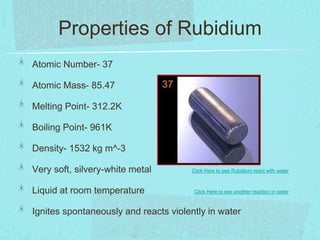
Atomic Number- 37
Atomic Mass- 85.47
Melting Point- 312.2K
Boiling Point- 961K
Density- 1532 kg m^-3
Very soft, silvery-white metal Click Here to see Rubidium react with water
Liquid at room temperature Click Here to see another reaction in water
Ignites spontaneously and reacts violently in water
History of Rubidium
Discovered in 1861 by R.W.
Busen and G. Kirchhoff in
Germany by spectroscopic
examination of lepidolite
Rubidium gets its name
from
the Latin word rubidius,
which translates to deep
red, this a reference to its
dark red lines under a
spectroscope
Key Isotopes
Nuclide 85Rb 86Rb 87Rb
Atomic Mass 84.91 85.91 86.91
Natural
Abundance
72.17% 0% 27.84%
Half-Life Stable 18.66 days 5x10^11 years
Availability of Rubidium
23rd most abundant element in the Earth’s crust
Minerals such as lepidolite, leucite, and carnallite
contain Rubidium
Rubidium can be bought in small quantities for around
$25 per gram
Rubidium Compounds
Most common used rubidium compound is Rubidium
Chloride
It is used to induce cells to take up DNA in
biochemistry
Rubidium Hydroxide is another compound that is
used to make other rubidium chemical processes
And Rubidium Carbonate is used in some optical
classes
Uses of Rubidium
There are few uses outside of research for rubidium
There has been some research done in the
development of thinner batteries
Has been prospected for a working fluid for vapor
turbines and in thermoelectric generators
Used as a photocell component
Can be found in some special optical glasses
Its slight radioactivity has been used to find brain
tumors, because it collects at the site of a tumor and
Works Cited
http://www.youtube.com/watch?v=0XLGopBovoI
http://www.youtube.com/watch?v=lpTHI1B0Zc8
http://www.hobart.k12.in.us/ksms/PeriodicTable/rubidium.htm
http://periodic.lanl.gov/elements/37.html
http://www.rsc.org/chemsoc/visualelements/pages/data/rubidium_data.html

Rubidium (Howard Wood)