Technetium – Tc
The lone element on the Periodic
Table.
[98]
43
History
• The Element Technetium is defined as...
“A radioactive metal, the first synthetically
produced element, used as a tracer and to
inhibit corrosion in steel.”1
• The name is derived from the Greek
‘tekhnetos’, meaning artificial.1
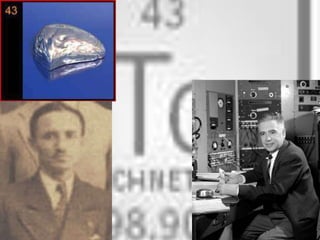
• It was discovered by Emilio Segre and Carlo
Perrier in 1937 in Italy.1
Properties
• Technetium’s Melting point is a very toast
2,200°C (2,473.15K, or 3,992°F)1
• Its Boiling Point is 4,877°C (5150.15K, or
8811°F)1
• Its normally a solid at room temperature (No
Way!!!!!)1
• Its color is silver.2
Properties Cont’d…..
• The density, at 20°C, is 11.5 g/cm3
1
• In order to use it with steel, you must melt the
technetium and meld it with steel to make
rust-proof steel that’s radioactive.1
• Major Isotopes of Technetium are Tc-97, 98,
99, and 99m. ( “m” means metastable)3.
• Tc- 97, 98, & 99 are long living isotopes,
dangerous to health. Tc-99m is used as a
tracer in medicine.3
Availability
• Technetium is not commonly found on earth.
Some scientists claim that there are very little
amounts of it in the crust.
• Technetium is found in some “red giant” stars.
(scientists viewed and analyzed the emission
spectrum and found a series matching
Technetium’s)
• Most Technetium is created in a nuclear reactor.
• In 1960, it was priced at $2,800 per gram, no it is
$60 a gram to O.R.N.L permit holders.4
• O.R.N.L stands for Oak ridge National
Laboratory.
Uses
• Can be made into an alloy with steel to
prevent corrosion of steel, but this makes the
steel radioactive.
• Is also used as a tracer in medicine. It deposits
in the brain, liver, kidneys, spleen, and bones.
Resources
1. http://www.facts-about.org.uk/science-
element-technetium.htm
2. http://www.rsc.org/chemsoc/visualelements/pa
ges/technetium.html
3. http://www.ead.anl.gov/pub/doc/technetium.p
df
4. http://www.radiochemistry.org/periodictable/el
ements/43.html
5. http://www.ornl.gov/info/ornlreview/rev25-
2/net1625.html

Technetium (Zach Ewing)

  • 1.
    Technetium – Tc Thelone element on the Periodic Table. [98] 43
  • 2.
    History • The ElementTechnetium is defined as... “A radioactive metal, the first synthetically produced element, used as a tracer and to inhibit corrosion in steel.”1 • The name is derived from the Greek ‘tekhnetos’, meaning artificial.1 • It was discovered by Emilio Segre and Carlo Perrier in 1937 in Italy.1
  • 3.
    Properties • Technetium’s Meltingpoint is a very toast 2,200°C (2,473.15K, or 3,992°F)1 • Its Boiling Point is 4,877°C (5150.15K, or 8811°F)1 • Its normally a solid at room temperature (No Way!!!!!)1 • Its color is silver.2
  • 4.
    Properties Cont’d….. • Thedensity, at 20°C, is 11.5 g/cm3 1 • In order to use it with steel, you must melt the technetium and meld it with steel to make rust-proof steel that’s radioactive.1 • Major Isotopes of Technetium are Tc-97, 98, 99, and 99m. ( “m” means metastable)3. • Tc- 97, 98, & 99 are long living isotopes, dangerous to health. Tc-99m is used as a tracer in medicine.3
  • 5.
    Availability • Technetium isnot commonly found on earth. Some scientists claim that there are very little amounts of it in the crust. • Technetium is found in some “red giant” stars. (scientists viewed and analyzed the emission spectrum and found a series matching Technetium’s) • Most Technetium is created in a nuclear reactor. • In 1960, it was priced at $2,800 per gram, no it is $60 a gram to O.R.N.L permit holders.4 • O.R.N.L stands for Oak ridge National Laboratory.
  • 6.
    Uses • Can bemade into an alloy with steel to prevent corrosion of steel, but this makes the steel radioactive. • Is also used as a tracer in medicine. It deposits in the brain, liver, kidneys, spleen, and bones.
  • 8.
    Resources 1. http://www.facts-about.org.uk/science- element-technetium.htm 2. http://www.rsc.org/chemsoc/visualelements/pa ges/technetium.html 3.http://www.ead.anl.gov/pub/doc/technetium.p df 4. http://www.radiochemistry.org/periodictable/el ements/43.html 5. http://www.ornl.gov/info/ornlreview/rev25- 2/net1625.html