History of Cadmium
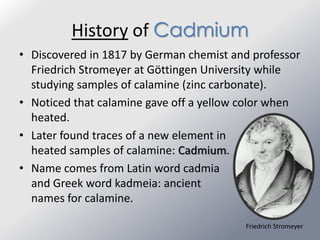
• Discovered in 1817 by German chemist and professor
  Friedrich Stromeyer at Göttingen University while
  studying samples of calamine (zinc carbonate).
• Noticed that calamine gave off a yellow color when
  heated.
• Later found traces of a new element in
  heated samples of calamine: Cadmium.
• Name comes from Latin word cadmia
  and Greek word kadmeia: ancient
  names for calamine.

                                         Friedrich Stromeyer
Properties of
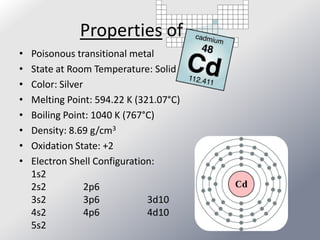
•   Poisonous transitional metal
•   State at Room Temperature: Solid
•   Color: Silver
•   Melting Point: 594.22 K (321.07°C)
•   Boiling Point: 1040 K (767°C)
•   Density: 8.69 g/cm3
•   Oxidation State: +2
•   Electron Shell Configuration:
    1s2
    2s2           2p6
    3s2           3p6          3d10
    4s2           4p6          4d10
    5s2
Properties of
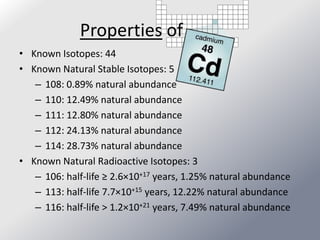
• Known Isotopes: 44
• Known Natural Stable Isotopes: 5
   – 108: 0.89% natural abundance
   – 110: 12.49% natural abundance
   – 111: 12.80% natural abundance
   – 112: 24.13% natural abundance
   – 114: 28.73% natural abundance
• Known Natural Radioactive Isotopes: 3
   – 106: half-life ≥ 2.6×10+17 years, 1.25% natural abundance
   – 113: half-life 7.7×10+15 years, 12.22% natural abundance
   – 116: half-life > 1.2×10+21 years, 7.49% natural abundance
Availability of
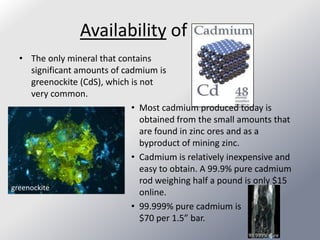
  • The only mineral that contains
     significant amounts of cadmium is
     greenockite (CdS), which is not
     very common.
                              • Most cadmium produced today is
                                 obtained from the small amounts that
                                 are found in zinc ores and as a
                                 byproduct of mining zinc.
                              • Cadmium is relatively inexpensive and
                                 easy to obtain. A 99.9% pure cadmium
                                 rod weighing half a pound is only $15
greenockite
                                 online.
                              • 99.999% pure cadmium is
                                 $70 per 1.5” bar.
                                                           99.999% pure
Uses of
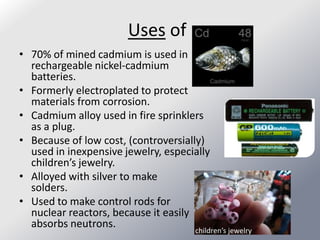
• 70% of mined cadmium is used in
  rechargeable nickel-cadmium
  batteries.
• Formerly electroplated to protect
  materials from corrosion.
• Cadmium alloy used in fire sprinklers
  as a plug.
• Because of low cost, (controversially)
  used in inexpensive jewelry, especially
  children’s jewelry.
• Alloyed with silver to make
  solders.
• Used to make control rods for
  nuclear reactors, because it easily
  absorbs neutrons.
                                     children’s jewelry
Uses of CADMIUM
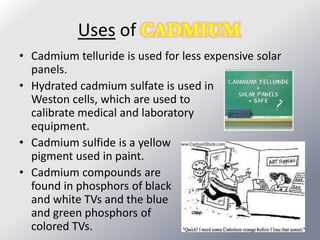
• Cadmium telluride is used for less expensive solar
  panels.
• Hydrated cadmium sulfate is used in
  Weston cells, which are used to
  calibrate medical and laboratory
  equipment.
• Cadmium sulfide is a yellow
  pigment used in paint.
• Cadmium compounds are
  found in phosphors of black
  and white TVs and the blue
  and green phosphors of
  colored TVs.
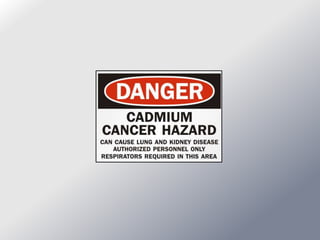
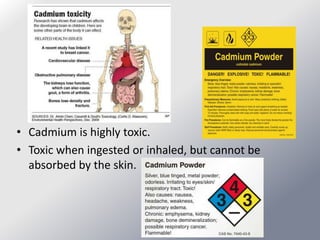
• Cadmium is highly toxic.
• Toxic when ingested or inhaled, but cannot be
  absorbed by the skin.
Exposure to
• Most exposure occurs from cigarette
  smoke and coal burning.
• Car engine exhaust contains cadmium.
• May be found in groundwater contaminated by landfills,
  phosphate fertilizers, or crops grown with contaminated
  water or fertilizer.
• Cadmium is used as a heat stabilizer in PVC pipes and
  PVC coating material.
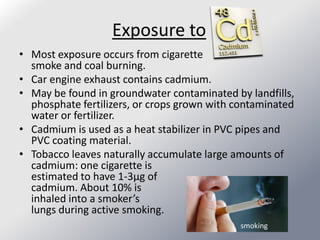
• Tobacco leaves naturally accumulate large amounts of
  cadmium: one cigarette is
  estimated to have 1-3μg of
  cadmium. About 10% is
  inhaled into a smoker’s
  lungs during active smoking.
                                             smoking
Sources
•   http://www.sciencephoto.com/media/228534/enlarge
•   http://education.jlab.org/itselemental/ele048.html
•   http://www.chemistryexplained.com/elements/A-C/Cadmium.html
•   http://chemistry.about.com/od/elementfacts/ig/Atom-Diagrams/Cadmium-Atom.htm
•   http://www.online-
    shop.hk/index.php?main_page=product_info&cPath=9_29&products_id=2043&zenid=a3f37640ee
    dad9afa6be41090effed21
•   http://www.glitterforall.com/?p=2445
•   http://www.blcleathertech.com/testing-services/cadmium-testing.htm
•   http://www.museumwales.ac.uk/en/800/?mineral=260
•   http://www.cartoonstock.com/directory/c/cadmium.asp
•   http://www.cleveland.com/world/index.ssf/2010/01/chinese_kids_jewelry_makers_sa.html
•   http://edwindwianto.wordpress.com/page/33/
•   http://solar-energy-news-and-views.blogspot.com/2011_04_01_archive.html
•   http://www.clickgreen.org.uk/news/national-news/12823-new-nuclear-power-could-supply-every-
    home-in-the-uk.html
•   http://www.rotometals.com/PhotoGallery.asp?ProductCode=CADMIUM%5FSTICKS
•   http://www.caslab.com/News/cadmium-testing.html
•   http://www.cafepress.com.au/russellkightley.266156458
•   http://www.non-toxickids.net/2010/01/more-news-about-toxic-cadmium-jewelry.html
•   http://www.everydayexposures.com/toxins/toxic-metals/cadmium
•   http://periodictable.com/Elements/048/index.html

Cadmium (Rebekka Meeks)

  • 2.
    History of Cadmium •Discovered in 1817 by German chemist and professor Friedrich Stromeyer at Göttingen University while studying samples of calamine (zinc carbonate). • Noticed that calamine gave off a yellow color when heated. • Later found traces of a new element in heated samples of calamine: Cadmium. • Name comes from Latin word cadmia and Greek word kadmeia: ancient names for calamine. Friedrich Stromeyer
  • 3.
    Properties of • Poisonous transitional metal • State at Room Temperature: Solid • Color: Silver • Melting Point: 594.22 K (321.07°C) • Boiling Point: 1040 K (767°C) • Density: 8.69 g/cm3 • Oxidation State: +2 • Electron Shell Configuration: 1s2 2s2 2p6 3s2 3p6 3d10 4s2 4p6 4d10 5s2
  • 4.
    Properties of • KnownIsotopes: 44 • Known Natural Stable Isotopes: 5 – 108: 0.89% natural abundance – 110: 12.49% natural abundance – 111: 12.80% natural abundance – 112: 24.13% natural abundance – 114: 28.73% natural abundance • Known Natural Radioactive Isotopes: 3 – 106: half-life ≥ 2.6×10+17 years, 1.25% natural abundance – 113: half-life 7.7×10+15 years, 12.22% natural abundance – 116: half-life > 1.2×10+21 years, 7.49% natural abundance
  • 5.
    Availability of • The only mineral that contains significant amounts of cadmium is greenockite (CdS), which is not very common. • Most cadmium produced today is obtained from the small amounts that are found in zinc ores and as a byproduct of mining zinc. • Cadmium is relatively inexpensive and easy to obtain. A 99.9% pure cadmium rod weighing half a pound is only $15 greenockite online. • 99.999% pure cadmium is $70 per 1.5” bar. 99.999% pure
  • 6.
    Uses of • 70%of mined cadmium is used in rechargeable nickel-cadmium batteries. • Formerly electroplated to protect materials from corrosion. • Cadmium alloy used in fire sprinklers as a plug. • Because of low cost, (controversially) used in inexpensive jewelry, especially children’s jewelry. • Alloyed with silver to make solders. • Used to make control rods for nuclear reactors, because it easily absorbs neutrons. children’s jewelry
  • 7.
    Uses of CADMIUM •Cadmium telluride is used for less expensive solar panels. • Hydrated cadmium sulfate is used in Weston cells, which are used to calibrate medical and laboratory equipment. • Cadmium sulfide is a yellow pigment used in paint. • Cadmium compounds are found in phosphors of black and white TVs and the blue and green phosphors of colored TVs.
  • 8.
    • Cadmium ishighly toxic. • Toxic when ingested or inhaled, but cannot be absorbed by the skin.
  • 9.
    Exposure to • Mostexposure occurs from cigarette smoke and coal burning. • Car engine exhaust contains cadmium. • May be found in groundwater contaminated by landfills, phosphate fertilizers, or crops grown with contaminated water or fertilizer. • Cadmium is used as a heat stabilizer in PVC pipes and PVC coating material. • Tobacco leaves naturally accumulate large amounts of cadmium: one cigarette is estimated to have 1-3μg of cadmium. About 10% is inhaled into a smoker’s lungs during active smoking. smoking
  • 10.
    Sources • http://www.sciencephoto.com/media/228534/enlarge • http://education.jlab.org/itselemental/ele048.html • http://www.chemistryexplained.com/elements/A-C/Cadmium.html • http://chemistry.about.com/od/elementfacts/ig/Atom-Diagrams/Cadmium-Atom.htm • http://www.online- shop.hk/index.php?main_page=product_info&cPath=9_29&products_id=2043&zenid=a3f37640ee dad9afa6be41090effed21 • http://www.glitterforall.com/?p=2445 • http://www.blcleathertech.com/testing-services/cadmium-testing.htm • http://www.museumwales.ac.uk/en/800/?mineral=260 • http://www.cartoonstock.com/directory/c/cadmium.asp • http://www.cleveland.com/world/index.ssf/2010/01/chinese_kids_jewelry_makers_sa.html • http://edwindwianto.wordpress.com/page/33/ • http://solar-energy-news-and-views.blogspot.com/2011_04_01_archive.html • http://www.clickgreen.org.uk/news/national-news/12823-new-nuclear-power-could-supply-every- home-in-the-uk.html • http://www.rotometals.com/PhotoGallery.asp?ProductCode=CADMIUM%5FSTICKS • http://www.caslab.com/News/cadmium-testing.html • http://www.cafepress.com.au/russellkightley.266156458 • http://www.non-toxickids.net/2010/01/more-news-about-toxic-cadmium-jewelry.html • http://www.everydayexposures.com/toxins/toxic-metals/cadmium • http://periodictable.com/Elements/048/index.html