GROUP 18 NOBLE GASES
1. Consist of Helium (He), Neon (Ne), Argon (Ar), Krypton (Kr), Xenon (Xe) and Oganesson (Og).
Elements Electron arrangement
Helium 2
Neon 2.8
Argon 2.8.8
Krypton 2.8.18.8
Xenon 2.8.18.18.8
Radon 2.8.18.32.18.8
Oganesson 2.8.18.32.32.18.8
2. Noble gases are chemically inert because the outermost shell of the atom has achieved duplet
electron arrangement for helium and octet electron arrangement for others.
3. Noble gases do not react with other elements (the atom does not accept, lose or share electrons).
4. These gases exist as monoatomic gases.
5. Going down group 18 :
a) The atomic size is increasing because the number of shells increases.
b) The melting point and boiling points are very low because the atoms of the noble gases atoms
are attracted by weak Van der Waals force, hence less energy is required to overcome these
forces.
However, melting point and boiling point increase going down the group because atomic
size increases, causing the Van der Waals forces to increase and more energy is required to
overcome these forces.
c) The density is low and increase gradually because the mass increases greatly compared to
the volume when increasing down the group.
6. All noble gases are insoluble in water and cannot conduct electricity in all conditions.
7. Uses of noble gases :
Noble gases Uses
Helium
Neon
Argon
Krypton
Xenon
Radon
Oganesson
GROUP 1 ALKALI METALS
1. Consists of Lithium (Li), Sodium (Na), Potassium (K), Cesium (Cs) and Francium (Fr).
Elements Symbol Proton number Electron arrangement Number of shells
Lithium Li 3
Sodium Na 11
Potassium K 19
2. Physical properties :
a) Grey solid with shiny surfaces
b) Softer and the density is lower compared to other metals.
c) Lower melting points compared to other metals.
3. Changes in physical properties going down the group :
a) Atomic size increases because the number of shells increases.
b) Density increases because mass increases faster than the increase in radius.
c) Melting and boiling points decrease because when the atomic size increases, the metal bonds
get weaker.
4. Chemical properties of Group 1 elements :
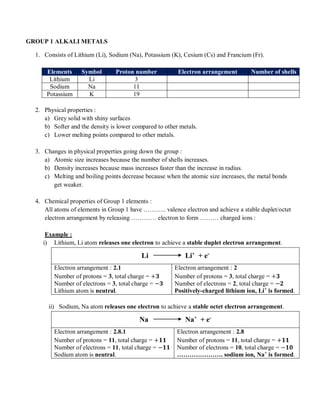
All atoms of elements in Group 1 have ……….. valence electron and achieve a stable duplet/octet
electron arrangement by releasing ………… electron to form ……… charged ions :
Example :
i) Lithium, Li atom releases one electron to achieve a stable duplet electron arrangement.
Li Li+
+ e-
Electron arrangement : 2.1 Electron arrangement : 2
Number of protons = 3, total charge = +𝟑 Number of protons = 3, total charge = +𝟑
Number of electrons = 3, total charge = −𝟑 Number of electrons = 2, total charge = −𝟐
Lithium atom is neutral. Positively-charged lithium ion, Li+
is formed.
ii) Sodium, Na atom releases one electron to achieve a stable octet electron arrangement.
Na Na+
+ e-
Electron arrangement : 2.8.1 Electron arrangement : 2.8
Number of protons = 11, total charge = +𝟏𝟏 Number of protons = 11, total charge = +𝟏𝟏
Number of electrons = 11, total charge = −𝟏𝟏 Number of electrons = 10, total charge = −𝟏𝟎
Sodium atom is neutral. …………………. sodium ion, Na+
is formed.
iii) All elements in Group 1 have similar chemical properties because all atoms in Group 1 have
one valence electron and achieve the stable duplet/octet electron arrangement by
……………… its valence electron to form a ………………. charged ions.
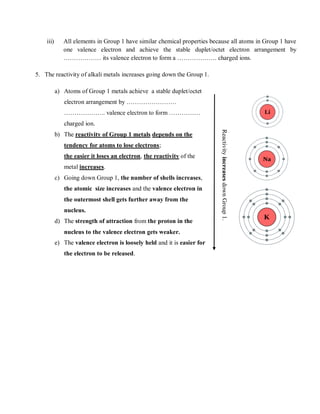
5. The reactivity of alkali metals increases going down the Group 1.
a) Atoms of Group 1 metals achieve a stable duplet/octet
electron arrangement by ……………………
……………….. valence electron to form ……………
charged ion.
b) The reactivity of Group 1 metals depends on the
tendency for atoms to lose electrons;
the easier it loses an electron, the reactivity of the
metal increases.
c) Going down Group 1, the number of shells increases,
the atomic size increases and the valence electron in
the outermost shell gets further away from the
nucleus.
d) The strength of attraction from the proton in the
nucleus to the valence electron gets weaker.
e) The valence electron is loosely held and it is easier for
the electron to be released.
Reactivity
increases
down
Group
1.
6. Chemical reactions of Group 1 elements :
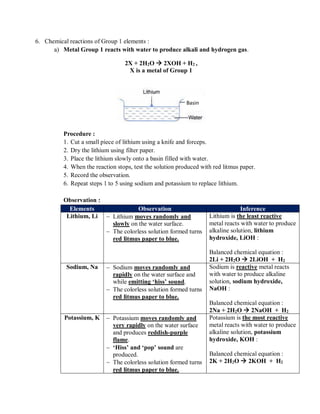
a) Metal Group 1 reacts with water to produce alkali and hydrogen gas.
2X + 2H2O  2XOH + H2 ,
X is a metal of Group 1
Procedure :
1. Cut a small piece of lithium using a knife and forceps.
2. Dry the lithium using filter paper.
3. Place the lithium slowly onto a basin filled with water.
4. When the reaction stops, test the solution produced with red litmus paper.
5. Record the observation.
6. Repeat steps 1 to 5 using sodium and potassium to replace lithium.
Observation :
Elements Observation Inference
Lithium, Li  Lithium moves randomly and
slowly on the water surface.
 The colorless solution formed turns
red litmus paper to blue.
Lithium is the least reactive
metal reacts with water to produce
alkaline solution, lithium
hydroxide, LiOH :
Balanced chemical equation :
2Li + 2H2O  2LiOH + H2
Sodium, Na  Sodium moves randomly and
rapidly on the water surface and
while emitting ‘hiss’ sound.
 The colorless solution formed turns
red litmus paper to blue.
Sodium is reactive metal reacts
with water to produce alkaline
solution, sodium hydroxide,
NaOH :
Balanced chemical equation :
2Na + 2H2O  2NaOH + H2
Potassium, K  Potassium moves randomly and
very rapidly on the water surface
and produces reddish-purple
flame.
 ‘Hiss’ and ‘pop’ sound are
produced.
 The colorless solution formed turns
red litmus paper to blue.
Potassium is the most reactive
metal reacts with water to produce
alkaline solution, potassium
hydroxide, KOH :
Balanced chemical equation :
2K + 2H2O  2KOH + H2
Basin
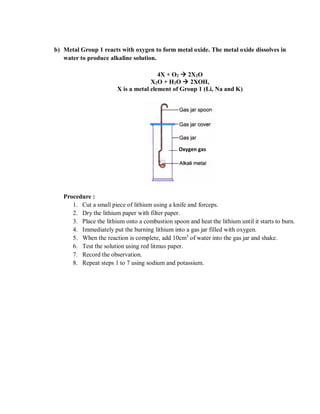
b) Metal Group 1 reacts with oxygen to form metal oxide. The metal oxide dissolves in
water to produce alkaline solution.
4X + O2  2X2O
X2O + H2O  2XOH,
X is a metal element of Group 1 (Li, Na and K)
Procedure :
1. Cut a small piece of lithium using a knife and forceps.
2. Dry the lithium paper with filter paper.
3. Place the lithium onto a combustion spoon and heat the lithium until it starts to burn.
4. Immediately put the burning lithium into a gas jar filled with oxygen.
5. When the reaction is complete, add 10cm3
of water into the gas jar and shake.
6. Test the solution using red litmus paper.
7. Record the observation.
8. Repeat steps 1 to 7 using sodium and potassium.
Oxygen gas
Observation :
Elements Observation Inference Reactivity
Lithium,
Li
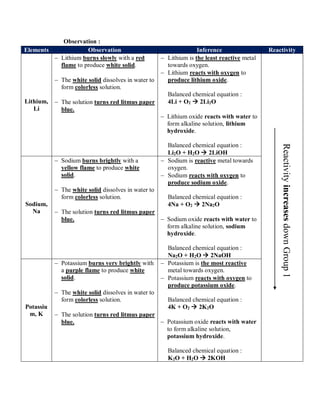
 Lithium burns slowly with a red
flame to produce white solid.
 The white solid dissolves in water to
form colorless solution.
 The solution turns red litmus paper
blue.
 Lithium is the least reactive metal
towards oxygen.
 Lithium reacts with oxygen to
produce lithium oxide.
Balanced chemical equation :
4Li + O2  2Li2O
 Lithium oxide reacts with water to
form alkaline solution, lithium
hydroxide.
Balanced chemical equation :
Li2O + H2O  2LiOH
Sodium,
Na
 Sodium burns brightly with a
yellow flame to produce white
solid.
 The white solid dissolves in water to
form colorless solution.
 The solution turns red litmus paper
blue.
 Sodium is reactive metal towards
oxygen.
 Sodium reacts with oxygen to
produce sodium oxide.
Balanced chemical equation :
4Na + O2  2Na2O
 Sodium oxide reacts with water to
form alkaline solution, sodium
hydroxide.
Balanced chemical equation :
Na2O + H2O  2NaOH
Potassiu
m, K
 Potassium burns very brightly with
a purple flame to produce white
solid.
 The white solid dissolves in water to
form colorless solution.
 The solution turns red litmus paper
blue.
 Potassium is the most reactive
metal towards oxygen.
 Potassium reacts with oxygen to
produce potassium oxide.
Balanced chemical equation :
4K + O2  2K2O
 Potassium oxide reacts with water
to form alkaline solution,
potassium hydroxide.
Balanced chemical equation :
K2O + H2O  2KOH
Reactivity
increases
down
Group
1
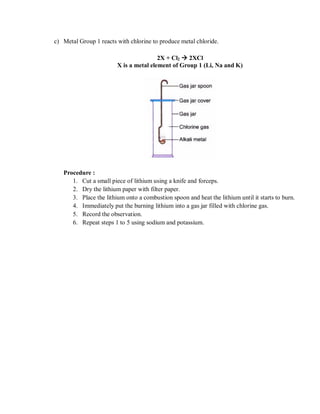
c) Metal Group 1 reacts with chlorine to produce metal chloride.
2X + Cl2  2XCl
X is a metal element of Group 1 (Li, Na and K)
Procedure :
1. Cut a small piece of lithium using a knife and forceps.
2. Dry the lithium paper with filter paper.
3. Place the lithium onto a combustion spoon and heat the lithium until it starts to burn.
4. Immediately put the burning lithium into a gas jar filled with chlorine gas.
5. Record the observation.
6. Repeat steps 1 to 5 using sodium and potassium.
Observation :
Elements Observation Inference Reactivity
Lithium,
Li
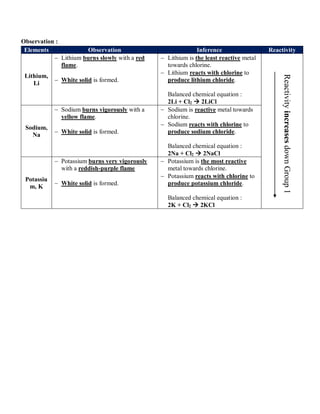
 Lithium burns slowly with a red
flame.
 White solid is formed.
 Lithium is the least reactive metal
towards chlorine.
 Lithium reacts with chlorine to
produce lithium chloride.
Balanced chemical equation :
2Li + Cl2  2LiCl
Sodium,
Na
 Sodium burns vigorously with a
yellow flame.
 White solid is formed.
 Sodium is reactive metal towards
chlorine.
 Sodium reacts with chlorine to
produce sodium chloride.
Balanced chemical equation :
2Na + Cl2  2NaCl
Potassiu
m, K
 Potassium burns very vigorously
with a reddish-purple flame
 White solid is formed.
 Potassium is the most reactive
metal towards chlorine.
 Potassium reacts with chlorine to
produce potassium chloride.
Balanced chemical equation :
2K + Cl2  2KCl
Reactivity
increases
down
Group
1
GROUP 17 HALOGENS
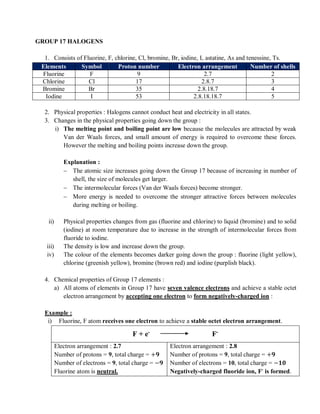
1. Consists of Fluorine, F, chlorine, Cl, bromine, Br, iodine, I, astatine, As and tenessine, Ts.
Elements Symbol Proton number Electron arrangement Number of shells
Fluorine F 9 2.7 2
Chlorine Cl 17 2.8.7 3
Bromine Br 35 2.8.18.7 4
Iodine I 53 2.8.18.18.7 5
2. Physical properties : Halogens cannot conduct heat and electricity in all states.
3. Changes in the physical properties going down the group :
i) The melting point and boiling point are low because the molecules are attracted by weak
Van der Waals forces, and small amount of energy is required to overcome these forces.
However the melting and boiling points increase down the group.
Explanation :
 The atomic size increases going down the Group 17 because of increasing in number of
shell, the size of molecules get larger.
 The intermolecular forces (Van der Waals forces) become stronger.
 More energy is needed to overcome the stronger attractive forces between molecules
during melting or boiling.
ii) Physical properties changes from gas (fluorine and chlorine) to liquid (bromine) and to solid
(iodine) at room temperature due to increase in the strength of intermolecular forces from
fluoride to iodine.
iii) The density is low and increase down the group.
iv) The colour of the elements becomes darker going down the group : fluorine (light yellow),
chlorine (greenish yellow), bromine (brown red) and iodine (purplish black).
4. Chemical properties of Group 17 elements :
a) All atoms of elements in Group 17 have seven valence electrons and achieve a stable octet
electron arrangement by accepting one electron to form negatively-charged ion :
Example :
i) Fluorine, F atom receives one electron to achieve a stable octet electron arrangement.
F + e-
F-
Electron arrangement : 2.7 Electron arrangement : 2.8
Number of protons = 9, total charge = +𝟗 Number of protons = 9, total charge = +𝟗
Number of electrons = 9, total charge = −𝟗 Number of electrons = 10, total charge = −𝟏𝟎
Fluorine atom is neutral. Negatively-charged fluoride ion, F-
is formed.
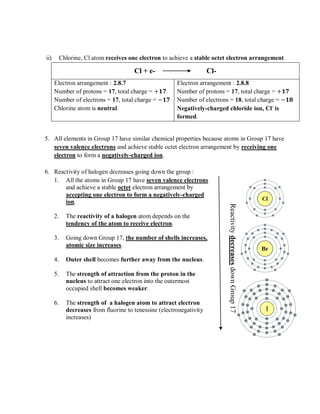
ii) Chlorine, Cl atom receives one electron to achieve a stable octet electron arrangement.
Cl + e- Cl-
Electron arrangement : 2.8.7 Electron arrangement : 2.8.8
Number of protons = 17, total charge = +𝟏𝟕 Number of protons = 17, total charge = +𝟏𝟕
Number of electrons = 17, total charge = −𝟏𝟕 Number of electrons = 18, total charge = −𝟏𝟖
Chlorine atom is neutral. Negatively-charged chloride ion, Cl-
is
formed.
5. All elements in Group 17 have similar chemical properties because atoms in Group 17 have
seven valence electrons and achieve stable octet electron arrangement by receiving one
electron to form a negatively-charged ion.
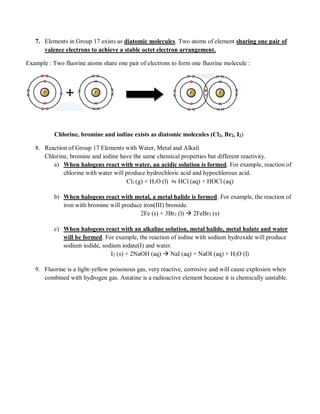
6. Reactivity of halogen decreases going down the group :
1. All the atoms in Group 17 have seven valence electrons
and achieve a stable octet electron arrangement by
accepting one electron to form a negatively-charged
ion.
2. The reactivity of a halogen atom depends on the
tendency of the atom to receive electron.
3. Going down Group 17, the number of shells increases,
atomic size increases.
4. Outer shell becomes further away from the nucleus.
5. The strength of attraction from the proton in the
nucleus to attract one electron into the outermost
occupied shell becomes weaker.
6. The strength of a halogen atom to attract electron
decreases from fluorine to tenessine (electronegativity
increases)
Reactivity
decreases
down
Group
17
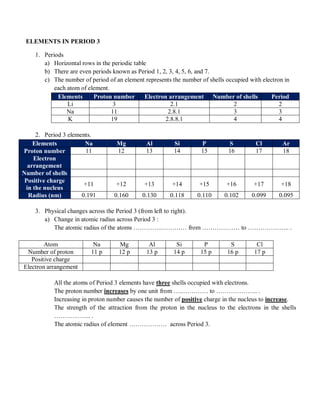
7. Elements in Group 17 exists as diatomic molecules. Two atoms of element sharing one pair of
valence electrons to achieve a stable octet electron arrangement.
Example : Two fluorine atoms share one pair of electrons to form one fluorine molecule :
Chlorine, bromine and iodine exists as diatomic molecules (Cl2, Br2, I2)
8. Reaction of Group 17 Elements with Water, Metal and Alkali
Chlorine, bromine and iodine have the same chemical properties but different reactivity.
a) When halogens react with water, an acidic solution is formed. For example, reaction of
chlorine with water will produce hydrochloric acid and hypochlorous acid.
Cl2 (g) + H2O (l) ⇋ HCl (aq) + HOCl (aq)
b) When halogens react with metal, a metal halide is formed. For example, the reaction of
iron with bromine will produce iron(III) bromide.
2Fe (s) + 3Br2 (l)  2FeBr3 (s)
c) When halogens react with an alkaline solution, metal halide, metal halate and water
will be formed. For example, the reaction of iodine with sodium hydroxide will produce
sodium iodide, sodium iodate(I) and water.
I2 (s) + 2NaOH (aq)  NaI (aq) + NaOI (aq) + H2O (l)
9. Fluorine is a light-yellow poisonous gas, very reactive, corrosive and will cause explosion when
combined with hydrogen gas. Astatine is a radioactive element because it is chemically unstable.
ELEMENTS IN PERIOD 3
1. Periods
a) Horizontal rows in the periodic table
b) There are even periods known as Period 1, 2, 3, 4, 5, 6, and 7.
c) The number of period of an element represents the number of shells occupied with electron in
each atom of element.
Elements Proton number Electron arrangement Number of shells Period
Li 3 2.1 2 2
Na 11 2.8.1 3 3
K 19 2.8.8.1 4 4
2. Period 3 elements.
Elements Na Mg Al Si P S Cl Ar
Proton number 11 12 13 14 15 16 17 18
Electron
arrangement
Number of shells
Positive charge
in the nucleus
+11 +12 +13 +14 +15 +16 +17 +18
Radius (nm) 0.191 0.160 0.130 0.118 0.110 0.102 0.099 0.095
3. Physical changes across the Period 3 (from left to right).
a) Change in atomic radius across Period 3 :
The atomic radius of the atoms …………..………… from ……………… to ……………….. .
Atom Na Mg Al Si P S Cl
Number of proton 11 p 12 p 13 p 14 p 15 p 16 p 17 p
Positive charge
Electron arrangement
All the atoms of Period 3 elements have three shells occupied with electrons.
The proton number increases by one unit from …..………… to ……………….. .
Increasing in proton number causes the number of positive charge in the nucleus to increase.
The strength of the attraction from the proton in the nucleus to the electrons in the shells
……………... .
The atomic radius of element ……………… across Period 3.
b) Changes in the properties of oxides of elements in Period 3.
Electronegativity : The strength of an atom in a molecule to attract electron towards its nucleus.
The atomic radius ……………………. due to the ……………………. of nuclei attraction on
the electrons in the shells from ………………….. to …………………. .
The electronegativity ………………….across Period 3 from …………… to ……………….. .
c) Physical state :
i) The physical state of elements in a period changes from solid to gas from left to right.
ii) Metals on the left are solid while non-metal on the right are usually gases.
d) Changes in metallic properties and electrical conductivity.
Element Na Mg Al Si P S Cl Ar
Metallic properties Metal Semi-metal or metalloid Non-metal
Electrical conductivity Good conductors Weak conductor of electric but
strong conductor in high
temperature.
Cannot conduct
electricity
4. Changes in the properties of oxides of elements in Period 3.
Na Mg Al Si P S Cl
Basic oxide Amphoteric oxide Acidic oxide
Basic oxide + Water  Alkali
Example :
Na2O + H2O  2NaOH
Basic oxide + Acid  Salt + Water
Example :
MgO + 2HCl  MgCl2 + H2O
Amphoteric oxide + Acid  Salt + Water
Amphoteric oxide + Alkali  Salt + Water
Example :
Al2O3 + 6HNO3  2Al(NO3)3 + 3H2O
Al2O3 + 2NaOH  2NaAlO2 + H2O
Acidic oxide + Water  Acid
Example :
SO2 + H2O  H2SO3
Acidic oxide + Alkali  Salt + Water
Example :
SiO2 + 2NaOH  Na2SiO3 + H2O
a) Elements in Period 3 can be classified as metals and non-metals based on basic and acidic
properties of their oxides.
i) Basic oxide is metal oxide that can react with acid to form salt and water.
ii) Acidic oxide is non-metal oxide that can react with alkali to form salt and water.
iii) Amphoteric oxide is oxide that can react with both acid and alkali to form salt and
water.
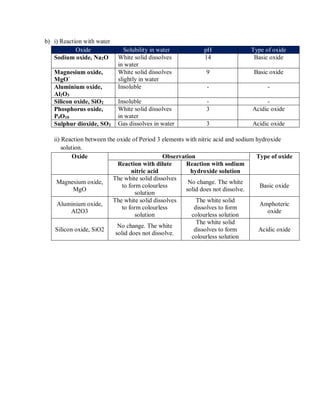
b) i) Reaction with water
Oxide Solubility in water pH Type of oxide
Sodium oxide, Na2O White solid dissolves
in water
14 Basic oxide
Magnesium oxide,
MgO`
White solid dissolves
slightly in water
9 Basic oxide
Aluminium oxide,
Al2O3
Insoluble - -
Silicon oxide, SiO2 Insoluble - -
Phosphorus oxide,
P4O10
White solid dissolves
in water
3 Acidic oxide
Sulphur dioxide, SO2 Gas dissolves in water 3 Acidic oxide
ii) Reaction between the oxide of Period 3 elements with nitric acid and sodium hydroxide
solution.
Oxide Observation Type of oxide
Reaction with dilute
nitric acid
Reaction with sodium
hydroxide solution
Magnesium oxide,
MgO
The white solid dissolves
to form colourless
solution
No change. The white
solid does not dissolve.
Basic oxide
Aluminium oxide,
Al2O3
The white solid dissolves
to form colourless
solution
The white solid
dissolves to form
colourless solution
Amphoteric
oxide
Silicon oxide, SiO2
No change. The white
solid does not dissolve.
The white solid
dissolves to form
colourless solution
Acidic oxide
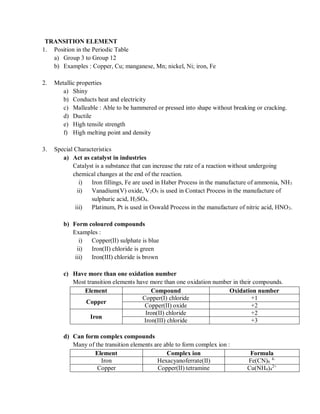
TRANSITION ELEMENT
1. Position in the Periodic Table
a) Group 3 to Group 12
b) Examples : Copper, Cu; manganese, Mn; nickel, Ni; iron, Fe
2. Metallic properties
a) Shiny
b) Conducts heat and electricity
c) Malleable : Able to be hammered or pressed into shape without breaking or cracking.
d) Ductile
e) High tensile strength
f) High melting point and density
3. Special Characteristics
a) Act as catalyst in industries
Catalyst is a substance that can increase the rate of a reaction without undergoing
chemical changes at the end of the reaction.
i) Iron fillings, Fe are used in Haber Process in the manufacture of ammonia, NH3
ii) Vanadium(V) oxide, V2O5 is used in Contact Process in the manufacture of
sulphuric acid, H2SO4.
iii) Platinum, Pt is used in Oswald Process in the manufacture of nitric acid, HNO3.
b) Form coloured compounds
Examples :
i) Copper(II) sulphate is blue
ii) Iron(II) chloride is green
iii) Iron(III) chloride is brown
c) Have more than one oxidation number
Most transition elements have more than one oxidation number in their compounds.
Element Compound Oxidation number
Copper
Copper(I) chloride +1
Copper(II) oxide +2
Iron
Iron(II) chloride +2
Iron(III) chloride +3
d) Can form complex compounds
Many of the transition elements are able to form complex ion :
Element Complex ion Formula
Iron Hexacyanoferrate(II) Fe(CN)6
4-
Copper Copper(II) tetramine Cu(NH4)4
2+

CHEMISTRY FORM 4 KSSM CHAPTER 4

  • 1.
    GROUP 18 NOBLEGASES 1. Consist of Helium (He), Neon (Ne), Argon (Ar), Krypton (Kr), Xenon (Xe) and Oganesson (Og). Elements Electron arrangement Helium 2 Neon 2.8 Argon 2.8.8 Krypton 2.8.18.8 Xenon 2.8.18.18.8 Radon 2.8.18.32.18.8 Oganesson 2.8.18.32.32.18.8 2. Noble gases are chemically inert because the outermost shell of the atom has achieved duplet electron arrangement for helium and octet electron arrangement for others. 3. Noble gases do not react with other elements (the atom does not accept, lose or share electrons). 4. These gases exist as monoatomic gases. 5. Going down group 18 : a) The atomic size is increasing because the number of shells increases. b) The melting point and boiling points are very low because the atoms of the noble gases atoms are attracted by weak Van der Waals force, hence less energy is required to overcome these forces. However, melting point and boiling point increase going down the group because atomic size increases, causing the Van der Waals forces to increase and more energy is required to overcome these forces. c) The density is low and increase gradually because the mass increases greatly compared to the volume when increasing down the group. 6. All noble gases are insoluble in water and cannot conduct electricity in all conditions. 7. Uses of noble gases : Noble gases Uses Helium Neon Argon Krypton Xenon Radon Oganesson
  • 2.
    GROUP 1 ALKALIMETALS 1. Consists of Lithium (Li), Sodium (Na), Potassium (K), Cesium (Cs) and Francium (Fr). Elements Symbol Proton number Electron arrangement Number of shells Lithium Li 3 Sodium Na 11 Potassium K 19 2. Physical properties : a) Grey solid with shiny surfaces b) Softer and the density is lower compared to other metals. c) Lower melting points compared to other metals. 3. Changes in physical properties going down the group : a) Atomic size increases because the number of shells increases. b) Density increases because mass increases faster than the increase in radius. c) Melting and boiling points decrease because when the atomic size increases, the metal bonds get weaker. 4. Chemical properties of Group 1 elements : All atoms of elements in Group 1 have ……….. valence electron and achieve a stable duplet/octet electron arrangement by releasing ………… electron to form ……… charged ions : Example : i) Lithium, Li atom releases one electron to achieve a stable duplet electron arrangement. Li Li+ + e- Electron arrangement : 2.1 Electron arrangement : 2 Number of protons = 3, total charge = +𝟑 Number of protons = 3, total charge = +𝟑 Number of electrons = 3, total charge = −𝟑 Number of electrons = 2, total charge = −𝟐 Lithium atom is neutral. Positively-charged lithium ion, Li+ is formed. ii) Sodium, Na atom releases one electron to achieve a stable octet electron arrangement. Na Na+ + e- Electron arrangement : 2.8.1 Electron arrangement : 2.8 Number of protons = 11, total charge = +𝟏𝟏 Number of protons = 11, total charge = +𝟏𝟏 Number of electrons = 11, total charge = −𝟏𝟏 Number of electrons = 10, total charge = −𝟏𝟎 Sodium atom is neutral. …………………. sodium ion, Na+ is formed.
  • 3.
    iii) All elementsin Group 1 have similar chemical properties because all atoms in Group 1 have one valence electron and achieve the stable duplet/octet electron arrangement by ……………… its valence electron to form a ………………. charged ions. 5. The reactivity of alkali metals increases going down the Group 1. a) Atoms of Group 1 metals achieve a stable duplet/octet electron arrangement by …………………… ……………….. valence electron to form …………… charged ion. b) The reactivity of Group 1 metals depends on the tendency for atoms to lose electrons; the easier it loses an electron, the reactivity of the metal increases. c) Going down Group 1, the number of shells increases, the atomic size increases and the valence electron in the outermost shell gets further away from the nucleus. d) The strength of attraction from the proton in the nucleus to the valence electron gets weaker. e) The valence electron is loosely held and it is easier for the electron to be released. Reactivity increases down Group 1.
  • 4.
    6. Chemical reactionsof Group 1 elements : a) Metal Group 1 reacts with water to produce alkali and hydrogen gas. 2X + 2H2O  2XOH + H2 , X is a metal of Group 1 Procedure : 1. Cut a small piece of lithium using a knife and forceps. 2. Dry the lithium using filter paper. 3. Place the lithium slowly onto a basin filled with water. 4. When the reaction stops, test the solution produced with red litmus paper. 5. Record the observation. 6. Repeat steps 1 to 5 using sodium and potassium to replace lithium. Observation : Elements Observation Inference Lithium, Li  Lithium moves randomly and slowly on the water surface.  The colorless solution formed turns red litmus paper to blue. Lithium is the least reactive metal reacts with water to produce alkaline solution, lithium hydroxide, LiOH : Balanced chemical equation : 2Li + 2H2O  2LiOH + H2 Sodium, Na  Sodium moves randomly and rapidly on the water surface and while emitting ‘hiss’ sound.  The colorless solution formed turns red litmus paper to blue. Sodium is reactive metal reacts with water to produce alkaline solution, sodium hydroxide, NaOH : Balanced chemical equation : 2Na + 2H2O  2NaOH + H2 Potassium, K  Potassium moves randomly and very rapidly on the water surface and produces reddish-purple flame.  ‘Hiss’ and ‘pop’ sound are produced.  The colorless solution formed turns red litmus paper to blue. Potassium is the most reactive metal reacts with water to produce alkaline solution, potassium hydroxide, KOH : Balanced chemical equation : 2K + 2H2O  2KOH + H2 Basin
  • 5.
    b) Metal Group1 reacts with oxygen to form metal oxide. The metal oxide dissolves in water to produce alkaline solution. 4X + O2  2X2O X2O + H2O  2XOH, X is a metal element of Group 1 (Li, Na and K) Procedure : 1. Cut a small piece of lithium using a knife and forceps. 2. Dry the lithium paper with filter paper. 3. Place the lithium onto a combustion spoon and heat the lithium until it starts to burn. 4. Immediately put the burning lithium into a gas jar filled with oxygen. 5. When the reaction is complete, add 10cm3 of water into the gas jar and shake. 6. Test the solution using red litmus paper. 7. Record the observation. 8. Repeat steps 1 to 7 using sodium and potassium. Oxygen gas
  • 6.
    Observation : Elements ObservationInference Reactivity Lithium, Li  Lithium burns slowly with a red flame to produce white solid.  The white solid dissolves in water to form colorless solution.  The solution turns red litmus paper blue.  Lithium is the least reactive metal towards oxygen.  Lithium reacts with oxygen to produce lithium oxide. Balanced chemical equation : 4Li + O2  2Li2O  Lithium oxide reacts with water to form alkaline solution, lithium hydroxide. Balanced chemical equation : Li2O + H2O  2LiOH Sodium, Na  Sodium burns brightly with a yellow flame to produce white solid.  The white solid dissolves in water to form colorless solution.  The solution turns red litmus paper blue.  Sodium is reactive metal towards oxygen.  Sodium reacts with oxygen to produce sodium oxide. Balanced chemical equation : 4Na + O2  2Na2O  Sodium oxide reacts with water to form alkaline solution, sodium hydroxide. Balanced chemical equation : Na2O + H2O  2NaOH Potassiu m, K  Potassium burns very brightly with a purple flame to produce white solid.  The white solid dissolves in water to form colorless solution.  The solution turns red litmus paper blue.  Potassium is the most reactive metal towards oxygen.  Potassium reacts with oxygen to produce potassium oxide. Balanced chemical equation : 4K + O2  2K2O  Potassium oxide reacts with water to form alkaline solution, potassium hydroxide. Balanced chemical equation : K2O + H2O  2KOH Reactivity increases down Group 1
  • 7.
    c) Metal Group1 reacts with chlorine to produce metal chloride. 2X + Cl2  2XCl X is a metal element of Group 1 (Li, Na and K) Procedure : 1. Cut a small piece of lithium using a knife and forceps. 2. Dry the lithium paper with filter paper. 3. Place the lithium onto a combustion spoon and heat the lithium until it starts to burn. 4. Immediately put the burning lithium into a gas jar filled with chlorine gas. 5. Record the observation. 6. Repeat steps 1 to 5 using sodium and potassium.
  • 8.
    Observation : Elements ObservationInference Reactivity Lithium, Li  Lithium burns slowly with a red flame.  White solid is formed.  Lithium is the least reactive metal towards chlorine.  Lithium reacts with chlorine to produce lithium chloride. Balanced chemical equation : 2Li + Cl2  2LiCl Sodium, Na  Sodium burns vigorously with a yellow flame.  White solid is formed.  Sodium is reactive metal towards chlorine.  Sodium reacts with chlorine to produce sodium chloride. Balanced chemical equation : 2Na + Cl2  2NaCl Potassiu m, K  Potassium burns very vigorously with a reddish-purple flame  White solid is formed.  Potassium is the most reactive metal towards chlorine.  Potassium reacts with chlorine to produce potassium chloride. Balanced chemical equation : 2K + Cl2  2KCl Reactivity increases down Group 1
  • 9.
    GROUP 17 HALOGENS 1.Consists of Fluorine, F, chlorine, Cl, bromine, Br, iodine, I, astatine, As and tenessine, Ts. Elements Symbol Proton number Electron arrangement Number of shells Fluorine F 9 2.7 2 Chlorine Cl 17 2.8.7 3 Bromine Br 35 2.8.18.7 4 Iodine I 53 2.8.18.18.7 5 2. Physical properties : Halogens cannot conduct heat and electricity in all states. 3. Changes in the physical properties going down the group : i) The melting point and boiling point are low because the molecules are attracted by weak Van der Waals forces, and small amount of energy is required to overcome these forces. However the melting and boiling points increase down the group. Explanation :  The atomic size increases going down the Group 17 because of increasing in number of shell, the size of molecules get larger.  The intermolecular forces (Van der Waals forces) become stronger.  More energy is needed to overcome the stronger attractive forces between molecules during melting or boiling. ii) Physical properties changes from gas (fluorine and chlorine) to liquid (bromine) and to solid (iodine) at room temperature due to increase in the strength of intermolecular forces from fluoride to iodine. iii) The density is low and increase down the group. iv) The colour of the elements becomes darker going down the group : fluorine (light yellow), chlorine (greenish yellow), bromine (brown red) and iodine (purplish black). 4. Chemical properties of Group 17 elements : a) All atoms of elements in Group 17 have seven valence electrons and achieve a stable octet electron arrangement by accepting one electron to form negatively-charged ion : Example : i) Fluorine, F atom receives one electron to achieve a stable octet electron arrangement. F + e- F- Electron arrangement : 2.7 Electron arrangement : 2.8 Number of protons = 9, total charge = +𝟗 Number of protons = 9, total charge = +𝟗 Number of electrons = 9, total charge = −𝟗 Number of electrons = 10, total charge = −𝟏𝟎 Fluorine atom is neutral. Negatively-charged fluoride ion, F- is formed.
  • 10.
    ii) Chlorine, Clatom receives one electron to achieve a stable octet electron arrangement. Cl + e- Cl- Electron arrangement : 2.8.7 Electron arrangement : 2.8.8 Number of protons = 17, total charge = +𝟏𝟕 Number of protons = 17, total charge = +𝟏𝟕 Number of electrons = 17, total charge = −𝟏𝟕 Number of electrons = 18, total charge = −𝟏𝟖 Chlorine atom is neutral. Negatively-charged chloride ion, Cl- is formed. 5. All elements in Group 17 have similar chemical properties because atoms in Group 17 have seven valence electrons and achieve stable octet electron arrangement by receiving one electron to form a negatively-charged ion. 6. Reactivity of halogen decreases going down the group : 1. All the atoms in Group 17 have seven valence electrons and achieve a stable octet electron arrangement by accepting one electron to form a negatively-charged ion. 2. The reactivity of a halogen atom depends on the tendency of the atom to receive electron. 3. Going down Group 17, the number of shells increases, atomic size increases. 4. Outer shell becomes further away from the nucleus. 5. The strength of attraction from the proton in the nucleus to attract one electron into the outermost occupied shell becomes weaker. 6. The strength of a halogen atom to attract electron decreases from fluorine to tenessine (electronegativity increases) Reactivity decreases down Group 17
  • 11.
    7. Elements inGroup 17 exists as diatomic molecules. Two atoms of element sharing one pair of valence electrons to achieve a stable octet electron arrangement. Example : Two fluorine atoms share one pair of electrons to form one fluorine molecule : Chlorine, bromine and iodine exists as diatomic molecules (Cl2, Br2, I2) 8. Reaction of Group 17 Elements with Water, Metal and Alkali Chlorine, bromine and iodine have the same chemical properties but different reactivity. a) When halogens react with water, an acidic solution is formed. For example, reaction of chlorine with water will produce hydrochloric acid and hypochlorous acid. Cl2 (g) + H2O (l) ⇋ HCl (aq) + HOCl (aq) b) When halogens react with metal, a metal halide is formed. For example, the reaction of iron with bromine will produce iron(III) bromide. 2Fe (s) + 3Br2 (l)  2FeBr3 (s) c) When halogens react with an alkaline solution, metal halide, metal halate and water will be formed. For example, the reaction of iodine with sodium hydroxide will produce sodium iodide, sodium iodate(I) and water. I2 (s) + 2NaOH (aq)  NaI (aq) + NaOI (aq) + H2O (l) 9. Fluorine is a light-yellow poisonous gas, very reactive, corrosive and will cause explosion when combined with hydrogen gas. Astatine is a radioactive element because it is chemically unstable.
  • 12.
    ELEMENTS IN PERIOD3 1. Periods a) Horizontal rows in the periodic table b) There are even periods known as Period 1, 2, 3, 4, 5, 6, and 7. c) The number of period of an element represents the number of shells occupied with electron in each atom of element. Elements Proton number Electron arrangement Number of shells Period Li 3 2.1 2 2 Na 11 2.8.1 3 3 K 19 2.8.8.1 4 4 2. Period 3 elements. Elements Na Mg Al Si P S Cl Ar Proton number 11 12 13 14 15 16 17 18 Electron arrangement Number of shells Positive charge in the nucleus +11 +12 +13 +14 +15 +16 +17 +18 Radius (nm) 0.191 0.160 0.130 0.118 0.110 0.102 0.099 0.095 3. Physical changes across the Period 3 (from left to right). a) Change in atomic radius across Period 3 : The atomic radius of the atoms …………..………… from ……………… to ……………….. . Atom Na Mg Al Si P S Cl Number of proton 11 p 12 p 13 p 14 p 15 p 16 p 17 p Positive charge Electron arrangement All the atoms of Period 3 elements have three shells occupied with electrons. The proton number increases by one unit from …..………… to ……………….. . Increasing in proton number causes the number of positive charge in the nucleus to increase. The strength of the attraction from the proton in the nucleus to the electrons in the shells ……………... . The atomic radius of element ……………… across Period 3.
  • 13.
    b) Changes inthe properties of oxides of elements in Period 3. Electronegativity : The strength of an atom in a molecule to attract electron towards its nucleus. The atomic radius ……………………. due to the ……………………. of nuclei attraction on the electrons in the shells from ………………….. to …………………. . The electronegativity ………………….across Period 3 from …………… to ……………….. . c) Physical state : i) The physical state of elements in a period changes from solid to gas from left to right. ii) Metals on the left are solid while non-metal on the right are usually gases. d) Changes in metallic properties and electrical conductivity. Element Na Mg Al Si P S Cl Ar Metallic properties Metal Semi-metal or metalloid Non-metal Electrical conductivity Good conductors Weak conductor of electric but strong conductor in high temperature. Cannot conduct electricity 4. Changes in the properties of oxides of elements in Period 3. Na Mg Al Si P S Cl Basic oxide Amphoteric oxide Acidic oxide Basic oxide + Water  Alkali Example : Na2O + H2O  2NaOH Basic oxide + Acid  Salt + Water Example : MgO + 2HCl  MgCl2 + H2O Amphoteric oxide + Acid  Salt + Water Amphoteric oxide + Alkali  Salt + Water Example : Al2O3 + 6HNO3  2Al(NO3)3 + 3H2O Al2O3 + 2NaOH  2NaAlO2 + H2O Acidic oxide + Water  Acid Example : SO2 + H2O  H2SO3 Acidic oxide + Alkali  Salt + Water Example : SiO2 + 2NaOH  Na2SiO3 + H2O a) Elements in Period 3 can be classified as metals and non-metals based on basic and acidic properties of their oxides. i) Basic oxide is metal oxide that can react with acid to form salt and water. ii) Acidic oxide is non-metal oxide that can react with alkali to form salt and water. iii) Amphoteric oxide is oxide that can react with both acid and alkali to form salt and water.
  • 14.
    b) i) Reactionwith water Oxide Solubility in water pH Type of oxide Sodium oxide, Na2O White solid dissolves in water 14 Basic oxide Magnesium oxide, MgO` White solid dissolves slightly in water 9 Basic oxide Aluminium oxide, Al2O3 Insoluble - - Silicon oxide, SiO2 Insoluble - - Phosphorus oxide, P4O10 White solid dissolves in water 3 Acidic oxide Sulphur dioxide, SO2 Gas dissolves in water 3 Acidic oxide ii) Reaction between the oxide of Period 3 elements with nitric acid and sodium hydroxide solution. Oxide Observation Type of oxide Reaction with dilute nitric acid Reaction with sodium hydroxide solution Magnesium oxide, MgO The white solid dissolves to form colourless solution No change. The white solid does not dissolve. Basic oxide Aluminium oxide, Al2O3 The white solid dissolves to form colourless solution The white solid dissolves to form colourless solution Amphoteric oxide Silicon oxide, SiO2 No change. The white solid does not dissolve. The white solid dissolves to form colourless solution Acidic oxide
  • 15.
    TRANSITION ELEMENT 1. Positionin the Periodic Table a) Group 3 to Group 12 b) Examples : Copper, Cu; manganese, Mn; nickel, Ni; iron, Fe 2. Metallic properties a) Shiny b) Conducts heat and electricity c) Malleable : Able to be hammered or pressed into shape without breaking or cracking. d) Ductile e) High tensile strength f) High melting point and density 3. Special Characteristics a) Act as catalyst in industries Catalyst is a substance that can increase the rate of a reaction without undergoing chemical changes at the end of the reaction. i) Iron fillings, Fe are used in Haber Process in the manufacture of ammonia, NH3 ii) Vanadium(V) oxide, V2O5 is used in Contact Process in the manufacture of sulphuric acid, H2SO4. iii) Platinum, Pt is used in Oswald Process in the manufacture of nitric acid, HNO3. b) Form coloured compounds Examples : i) Copper(II) sulphate is blue ii) Iron(II) chloride is green iii) Iron(III) chloride is brown c) Have more than one oxidation number Most transition elements have more than one oxidation number in their compounds. Element Compound Oxidation number Copper Copper(I) chloride +1 Copper(II) oxide +2 Iron Iron(II) chloride +2 Iron(III) chloride +3 d) Can form complex compounds Many of the transition elements are able to form complex ion : Element Complex ion Formula Iron Hexacyanoferrate(II) Fe(CN)6 4- Copper Copper(II) tetramine Cu(NH4)4 2+