Word equations
Chemical Reactions – Year 8 Science
Word equations
Chemists often use word equations as a way of quickly
informing us what the reactants and products are in a
reaction.
Reactants: a substance that takes part in and undergoes change during a
reaction
Products: The products are the substances that are formed during
the chemical change.
Structuring word equations
Like mathematical equations, chemical word equations are
structured the same throughout the world (this is called a scientific
convention).
- the names of the reactants are always on LEFT
- an arrow (meaning “reacts to give”)
- the names of the products are always on RIGHT
For example:
Magnesium + Copper Oxide Magnesium Oxide + Copper
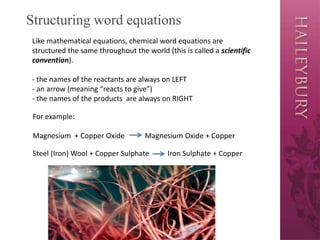
Steel (Iron) Wool + Copper Sulphate Iron Sulphate + Copper
Identifying States of matter
When writing worded equations, it will assist the
reader if you can communicate the state of matter
that the reactants and products are in.
To do this, the scientific convention is as follows:
A solid is identified by a subscript (s)
A liquid is identified by a subscript (l)
A gas is identified by a subscript (g)
An aqueous solution (a substance dissolved in
water) is identified by a subscript (aq)
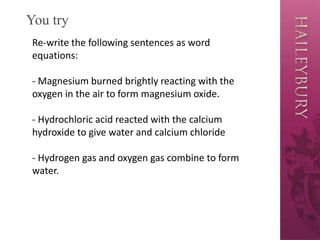
You try
Re-write the following sentences as word
equations:
- Magnesium burned brightly reacting with the
oxygen in the air to form magnesium oxide.
- Hydrochloric acid reacted with the calcium
hydroxide to give water and calcium chloride
- Hydrogen gas and oxygen gas combine to form
water.
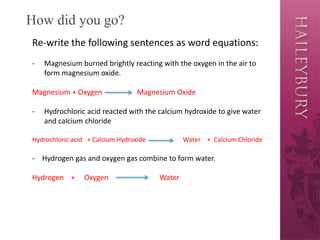
How did you go?
Re-write the following sentences as word equations:
- Magnesium burned brightly reacting with the oxygen in the air to
form magnesium oxide.
Magnesium + Oxygen Magnesium Oxide
- Hydrochloric acid reacted with the calcium hydroxide to give water
and calcium chloride
Hydrochloric acid + Calcium Hydroxide Water + Calcium Chloride
- Hydrogen gas and oxygen gas combine to form water.
Hydrogen + Oxygen Water
Remember!
Feel free to watch this video as many times as you like.
Pause, take notes, rewind if necessary.
Take note of any questions that you have – we will have time in
class to discuss these at length.
In class, rather than taking notes, we will be practicing the skills
covered in this video. We will do this individually, in small
groups, and as a whole class.
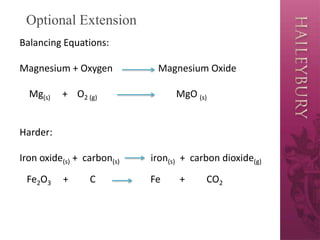
Optional Extension
Balancing Equations:
Magnesium + Oxygen Magnesium Oxide
Mg(s) + O2 (g) MgO (s)
Harder:
Iron oxide(s) + carbon(s) iron(s) + carbon dioxide(g)
Fe2O3 + C Fe + CO2

Word equations

  • 1.
  • 2.
    Word equations Chemists oftenuse word equations as a way of quickly informing us what the reactants and products are in a reaction. Reactants: a substance that takes part in and undergoes change during a reaction Products: The products are the substances that are formed during the chemical change.
  • 3.
    Structuring word equations Likemathematical equations, chemical word equations are structured the same throughout the world (this is called a scientific convention). - the names of the reactants are always on LEFT - an arrow (meaning “reacts to give”) - the names of the products are always on RIGHT For example: Magnesium + Copper Oxide Magnesium Oxide + Copper Steel (Iron) Wool + Copper Sulphate Iron Sulphate + Copper
  • 4.
    Identifying States ofmatter When writing worded equations, it will assist the reader if you can communicate the state of matter that the reactants and products are in. To do this, the scientific convention is as follows: A solid is identified by a subscript (s) A liquid is identified by a subscript (l) A gas is identified by a subscript (g) An aqueous solution (a substance dissolved in water) is identified by a subscript (aq)
  • 5.
    You try Re-write thefollowing sentences as word equations: - Magnesium burned brightly reacting with the oxygen in the air to form magnesium oxide. - Hydrochloric acid reacted with the calcium hydroxide to give water and calcium chloride - Hydrogen gas and oxygen gas combine to form water.
  • 6.
    How did yougo? Re-write the following sentences as word equations: - Magnesium burned brightly reacting with the oxygen in the air to form magnesium oxide. Magnesium + Oxygen Magnesium Oxide - Hydrochloric acid reacted with the calcium hydroxide to give water and calcium chloride Hydrochloric acid + Calcium Hydroxide Water + Calcium Chloride - Hydrogen gas and oxygen gas combine to form water. Hydrogen + Oxygen Water
  • 7.
    Remember! Feel free towatch this video as many times as you like. Pause, take notes, rewind if necessary. Take note of any questions that you have – we will have time in class to discuss these at length. In class, rather than taking notes, we will be practicing the skills covered in this video. We will do this individually, in small groups, and as a whole class.
  • 8.
    Optional Extension Balancing Equations: Magnesium+ Oxygen Magnesium Oxide Mg(s) + O2 (g) MgO (s) Harder: Iron oxide(s) + carbon(s) iron(s) + carbon dioxide(g) Fe2O3 + C Fe + CO2