METHODS OF PRODUCTION Business must decide on the most suitable method of production.  The objective is to minimise the cost per unit, ie productive efficiency. Which method? Job  batch  flow
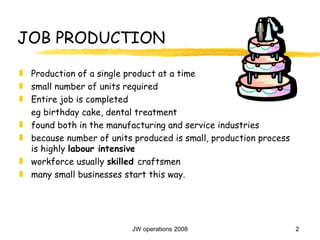
JOB PRODUCTION Production of a single product at a time small number of units required Entire job is completed eg birthday cake, dental treatment found both in the manufacturing and service industries because number of units produced is small, production process is highly  labour intensive workforce usually  skilled  craftsmen many small businesses start this way.
JOB PRODUCTION ADVANTAGES Can produce unique “one-offs”, specification can constantly be modified workers more likely to be motivated, tasks require high degree of skill and expertise.  Work more demanding and interesting organisation is simple, communication, co-ordination, supervision and inspection can be carried out. DISADVANTAGES labour costs high may be expensive to buy all the tools and equipment necessary lead times can be lengthy selling costs may be high Once demand for a firm’s product rises, job production may become costly.  Firms may prefer to use a method more suited to producing large quantities.
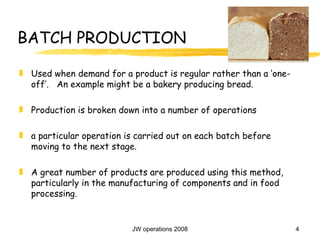
BATCH PRODUCTION Used when demand for a product is regular rather than a ‘one-off’.  An example might be a bakery producing bread. Production is broken down into a number of operations a particular operation is carried out on each batch before moving to the next stage. A great number of products are produced using this method, particularly in the manufacturing of components and in food processing.
BATCH PRODUCTION ADVANTAGES Flexibility - each batch can be changed to suit customer requirements employees can concentrate on one operation rather than whole task stocks of partly finished goods can be stored and completed when demanded by individual customers DISADVANTAGES careful planning and co-operation required or machines may lie idle workforce may be less motivated due to repetition if batches are small then unit costs are high a lot of money could be tied up in work-in-progress
FLOW PRODUCTION Production is organised so that different operations can be carried out one after the other, in a  continuous sequence . The main features are as follows: large quantities are produced a standardised product is made i.e all the same semi-skilled workforce large amounts of robotics, machinery and equipment  (capital intensive) large stocks of raw materials and component parts are required
FLOW PRODUCTION ADVANTAGES unit costs are reduced the process can be highly automated, many operations carried out by robots and other types of machinery Quality systems can be built into production DISADVANTAGES Set up costs are high product is standardised worker motivation can be low breakdowns can prove costly Supply may exceed demand
Some businesses may use a combination of the job, batch and flow,  eg a brewery may make batches of special ale but it is then sent to a bottling plant where continuous flow is used.
Questions  What is the main objective when choosing the method of    production? (1) Describe the process of  job  production, it’s most suitable application and its advantages and disadvantages. (8) Describe the process of  batch  production, it’s most suitable application and its advantages and disadvantages. (8) Describe the process of  flow  production, it’s most suitable application and the advantages and disadvantages. (8) Suggest why an organisation might use a combination of productions methods. (1)

Methods of Production

  • 1.
    METHODS OF PRODUCTIONBusiness must decide on the most suitable method of production. The objective is to minimise the cost per unit, ie productive efficiency. Which method? Job batch flow
  • 2.
    JOB PRODUCTION Productionof a single product at a time small number of units required Entire job is completed eg birthday cake, dental treatment found both in the manufacturing and service industries because number of units produced is small, production process is highly labour intensive workforce usually skilled craftsmen many small businesses start this way.
  • 3.
    JOB PRODUCTION ADVANTAGESCan produce unique “one-offs”, specification can constantly be modified workers more likely to be motivated, tasks require high degree of skill and expertise. Work more demanding and interesting organisation is simple, communication, co-ordination, supervision and inspection can be carried out. DISADVANTAGES labour costs high may be expensive to buy all the tools and equipment necessary lead times can be lengthy selling costs may be high Once demand for a firm’s product rises, job production may become costly. Firms may prefer to use a method more suited to producing large quantities.
  • 4.
    BATCH PRODUCTION Usedwhen demand for a product is regular rather than a ‘one-off’. An example might be a bakery producing bread. Production is broken down into a number of operations a particular operation is carried out on each batch before moving to the next stage. A great number of products are produced using this method, particularly in the manufacturing of components and in food processing.
  • 5.
    BATCH PRODUCTION ADVANTAGESFlexibility - each batch can be changed to suit customer requirements employees can concentrate on one operation rather than whole task stocks of partly finished goods can be stored and completed when demanded by individual customers DISADVANTAGES careful planning and co-operation required or machines may lie idle workforce may be less motivated due to repetition if batches are small then unit costs are high a lot of money could be tied up in work-in-progress
  • 6.
    FLOW PRODUCTION Productionis organised so that different operations can be carried out one after the other, in a continuous sequence . The main features are as follows: large quantities are produced a standardised product is made i.e all the same semi-skilled workforce large amounts of robotics, machinery and equipment (capital intensive) large stocks of raw materials and component parts are required
  • 7.
    FLOW PRODUCTION ADVANTAGESunit costs are reduced the process can be highly automated, many operations carried out by robots and other types of machinery Quality systems can be built into production DISADVANTAGES Set up costs are high product is standardised worker motivation can be low breakdowns can prove costly Supply may exceed demand
  • 8.
    Some businesses mayuse a combination of the job, batch and flow, eg a brewery may make batches of special ale but it is then sent to a bottling plant where continuous flow is used.
  • 9.
    Questions Whatis the main objective when choosing the method of production? (1) Describe the process of job production, it’s most suitable application and its advantages and disadvantages. (8) Describe the process of batch production, it’s most suitable application and its advantages and disadvantages. (8) Describe the process of flow production, it’s most suitable application and the advantages and disadvantages. (8) Suggest why an organisation might use a combination of productions methods. (1)