PowerPoint Guide
The news icon
is hyperlinked
to a related
article or
website.
Simply click to
access
The film icon is
hyperlinked to
a related clip.
Simply click to
access
The discuss
icon indicates
suggested
points to
discuss
The writing
icon indicates a
written activity
or question
time
2.3 Making operational decisions
2.3.1 The purpose of business operations/Production processes
Key elements to this topic
The purpose
of business
operations
Production
processes
What is the purpose of
business operations?
The purpose of business operations
is to turn raw materials into goods
and services that can be sold.
There are different types of
processes that can be used to
produce goods and services.
Different types of production
processes
All involve transforming inputs such
as labour, raw materials and energy
into outputs.
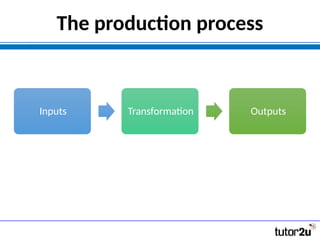
The production process
Inputs Transformation Outputs
Watch the clip and identify the inputs and
outputs
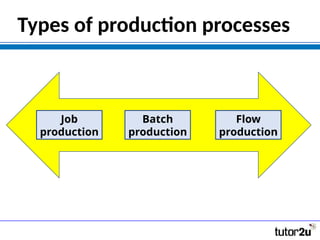
Types of production processes
Job
production
Batch
production
Flow
production
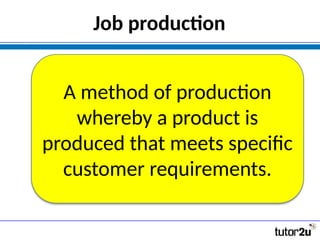
Job production
A method of production
whereby a product is
produced that meets specific
customer requirements.
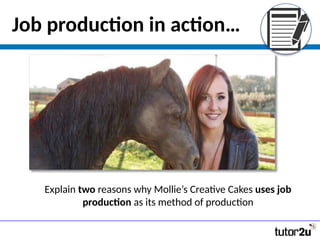
Context corner…
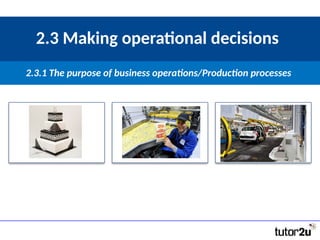
Mollie’s Creative cakes is
owned by Lancashire based
Mollie Robbins. Mollie designs
and makes high quality cakes
to meet individual customer
requirements. Mollie’s
greatest creation was her life
size Shetland pony cake that
was made for an animal
charity.
Explain two reasons why Mollie’s Creative Cakes uses job
production as its method of production
Job production in action…
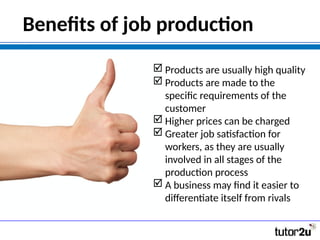
Benefits of job production
 Products are usually high quality
 Products are made to the
specific requirements of the
customer
 Higher prices can be charged
 Greater job satisfaction for
workers, as they are usually
involved in all stages of the
production process
 A business may find it easier to
differentiate itself from rivals
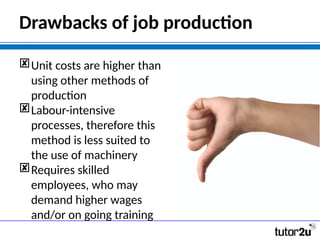
Drawbacks of job production
Unit costs are higher than
using other methods of
production
Labour-intensive
processes, therefore this
method is less suited to
the use of machinery
Requires skilled
employees, who may
demand higher wages
and/or on going training
Batch production
This involves making a group of identical
items together. Each batch goes through
one stage of the production process
together as a group, before moving onto
the next stage. The products produced by
batch production will be similar but have
some variation, for example different
style, different size or different colour.
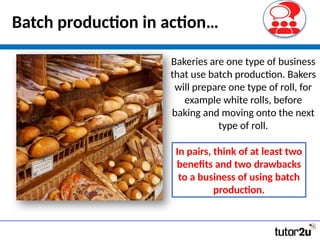
Bakeries are one type of business
that use batch production. Bakers
will prepare one type of roll, for
example white rolls, before
baking and moving onto the next
type of roll.
Batch production in action…
In pairs, think of at least two
benefits and two drawbacks
to a business of using batch
production.
Advantages and disadvantages of batch
production
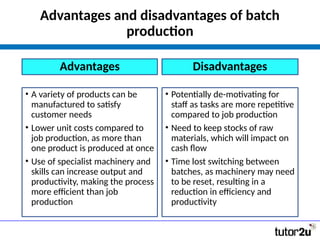
Advantages
• A variety of products can be
manufactured to satisfy
customer needs
• Lower unit costs compared to
job production, as more than
one product is produced at once
• Use of specialist machinery and
skills can increase output and
productivity, making the process
more efficient than job
production
Disadvantages
• Potentially de-motivating for
staff as tasks are more repetitive
compared to job production
• Need to keep stocks of raw
materials, which will impact on
cash flow
• Time lost switching between
batches, as machinery may need
to be reset, resulting in a
reduction in efficiency and
productivity
Flow production
The continuous movement
of items through the
production process. Flow
production uses production
lines to manufacture
products.
Seabrook Crisps
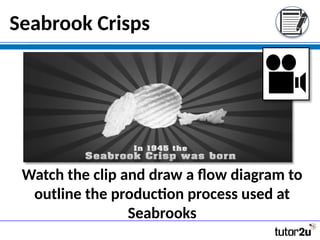
Watch the clip and draw a flow diagram to
outline the production process used at
Seabrooks
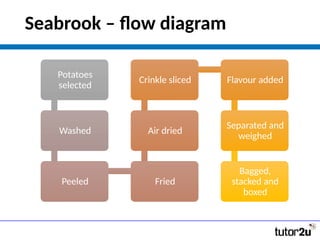
Seabrook – flow diagram
Potatoes
selected
Washed
Peeled Fried
Air dried
Crinkle sliced Flavour added
Separated and
weighed
Bagged,
stacked and
boxed
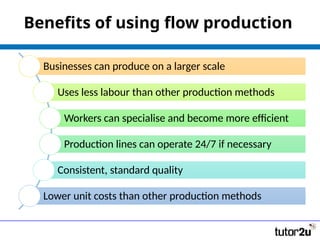
Benefits of using flow production
Businesses can produce on a larger scale
Uses less labour than other production methods
Workers can specialise and become more efficient
Production lines can operate 24/7 if necessary
Consistent, standard quality
Lower unit costs than other production methods
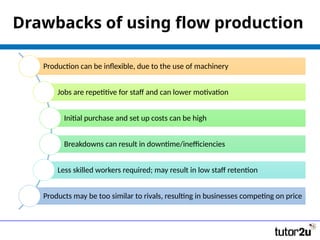
Drawbacks of using flow production
Production can be inflexible, due to the use of machinery
Jobs are repetitive for staff and can lower motivation
Initial purchase and set up costs can be high
Breakdowns can result in downtime/inefficiencies
Less skilled workers required; may result in low staff retention
Products may be too similar to rivals, resulting in businesses competing on price
Give me 5!
You have 5 minutes to list as many
different products as you can that you
believe would be produced by
job, batch and flow production
Explain why this production method is
appropriate to each of the products identified
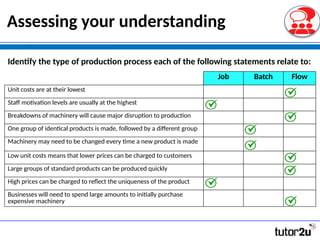
Assessing your understanding
Job Batch Flow
Unit costs are at their lowest
Staff motivation levels are usually at the highest
Breakdowns of machinery will cause major disruption to production
One group of identical products is made, followed by a different group
Machinery may need to be changed every time a new product is made
Low unit costs means that lower prices can be charged to customers
Large groups of standard products can be produced quickly
High prices can be charged to reflect the uniqueness of the product
Businesses will need to spend large amounts to initially purchase
expensive machinery
Identify the type of production process each of the following statements relate to:
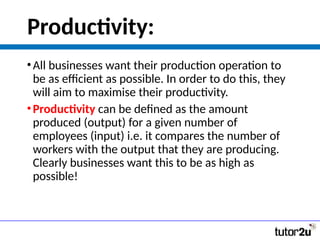
Productivity:
•All businesses want their production operation to
be as efficient as possible. In order to do this, they
will aim to maximise their productivity.
•Productivity can be defined as the amount
produced (output) for a given number of
employees (input) i.e. it compares the number of
workers with the output that they are producing.
Clearly businesses want this to be as high as
possible!
Let’s look at an example:
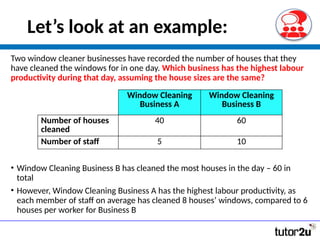
Two window cleaner businesses have recorded the number of houses that they
have cleaned the windows for in one day. Which business has the highest labour
productivity during that day, assuming the house sizes are the same?
• Window Cleaning Business B has cleaned the most houses in the day – 60 in
total
• However, Window Cleaning Business A has the highest labour productivity, as
each member of staff on average has cleaned 8 houses’ windows, compared to 6
houses per worker for Business B
Window Cleaning
Business A
Window Cleaning
Business B
Number of houses
cleaned
40 60
Number of staff 5 10
Why does this matter? Let’s take a look…
Window Cleaning
Business A
Window Cleaning
Business B
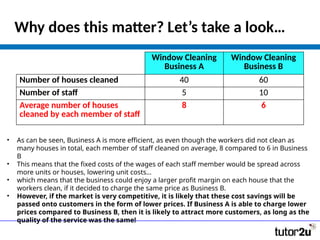
Number of houses cleaned 40 60
Number of staff 5 10
Average number of houses
cleaned by each member of staff
8 6
• As can be seen, Business A is more efficient, as even though the workers did not clean as
many houses in total, each member of staff cleaned on average, 8 compared to 6 in Business
B
• This means that the fixed costs of the wages of each staff member would be spread across
more units or houses, lowering unit costs…
• which means that the business could enjoy a larger profit margin on each house that the
workers clean, if it decided to charge the same price as Business B.
• However, if the market is very competitive, it is likely that these cost savings will be
passed onto customers in the form of lower prices. If Business A is able to charge lower
prices compared to Business B, then it is likely to attract more customers, as long as the
quality of the service was the same!
How could a business improve its
productivity levels?
Remember, productivity relates to
how much output each employee
produces and is linked to efficiency
and lowering unit costs.
Production relates to the total
quantity produced.
So, how could a business increase
its level of productivity?
In pairs, you have 60 seconds to come
up with as many ideas as you can.
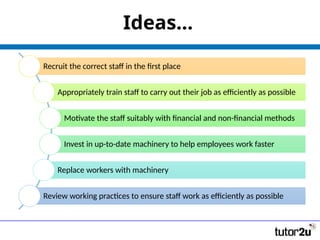
Ideas…
Recruit the correct staff in the first place
Appropriately train staff to carry out their job as efficiently as possible
Motivate the staff suitably with financial and non-financial methods
Invest in up-to-date machinery to help employees work faster
Replace workers with machinery
Review working practices to ensure staff work as efficiently as possible
Be the Business Advisor
Peter Hall & Son manufacture high
quality furniture by hand. The use of
machinery would enable the
business to increase its output.
Should the owners of the business
consider moving from job
production to flow production?
Justify your decision
Remember to contextualise
your answer!
About Peter Hall and Son
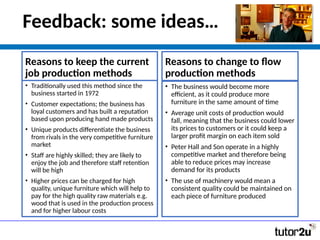
Feedback: some ideas…
Reasons to keep the current
job production methods
• Traditionally used this method since the
business started in 1972
• Customer expectations; the business has
loyal customers and has built a reputation
based upon producing hand made products
• Unique products differentiate the business
from rivals in the very competitive furniture
market
• Staff are highly skilled; they are likely to
enjoy the job and therefore staff retention
will be high
• Higher prices can be charged for high
quality, unique furniture which will help to
pay for the high quality raw materials e.g.
wood that is used in the production process
and for higher labour costs
Reasons to change to flow
production methods
• The business would become more
efficient, as it could produce more
furniture in the same amount of time
• Average unit costs of production would
fall, meaning that the business could lower
its prices to customers or it could keep a
larger profit margin on each item sold
• Peter Hall and Son operate in a highly
competitive market and therefore being
able to reduce prices may increase
demand for its products
• The use of machinery would mean a
consistent quality could be maintained on
each piece of furniture produced
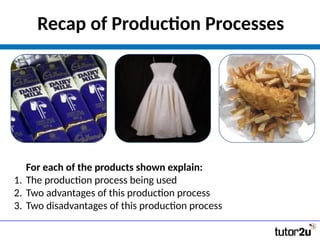
For each of the products shown explain:
1. The production process being used
2. Two advantages of this production process
3. Two disadvantages of this production process
Recap of Production Processes

2.3.1_Business_operations___production_processes_student.pptx

  • 1.
    PowerPoint Guide The newsicon is hyperlinked to a related article or website. Simply click to access The film icon is hyperlinked to a related clip. Simply click to access The discuss icon indicates suggested points to discuss The writing icon indicates a written activity or question time
  • 2.
    2.3 Making operationaldecisions 2.3.1 The purpose of business operations/Production processes
  • 3.
    Key elements tothis topic The purpose of business operations Production processes
  • 4.
    What is thepurpose of business operations? The purpose of business operations is to turn raw materials into goods and services that can be sold. There are different types of processes that can be used to produce goods and services.
  • 5.
    Different types ofproduction processes All involve transforming inputs such as labour, raw materials and energy into outputs.
  • 6.
    The production process InputsTransformation Outputs
  • 7.
    Watch the clipand identify the inputs and outputs
  • 8.
    Types of productionprocesses Job production Batch production Flow production
  • 9.
    Job production A methodof production whereby a product is produced that meets specific customer requirements.
  • 10.
    Context corner… Mollie’s Creativecakes is owned by Lancashire based Mollie Robbins. Mollie designs and makes high quality cakes to meet individual customer requirements. Mollie’s greatest creation was her life size Shetland pony cake that was made for an animal charity.
  • 11.
    Explain two reasonswhy Mollie’s Creative Cakes uses job production as its method of production Job production in action…
  • 12.
    Benefits of jobproduction  Products are usually high quality  Products are made to the specific requirements of the customer  Higher prices can be charged  Greater job satisfaction for workers, as they are usually involved in all stages of the production process  A business may find it easier to differentiate itself from rivals
  • 13.
    Drawbacks of jobproduction Unit costs are higher than using other methods of production Labour-intensive processes, therefore this method is less suited to the use of machinery Requires skilled employees, who may demand higher wages and/or on going training
  • 14.
    Batch production This involvesmaking a group of identical items together. Each batch goes through one stage of the production process together as a group, before moving onto the next stage. The products produced by batch production will be similar but have some variation, for example different style, different size or different colour.
  • 15.
    Bakeries are onetype of business that use batch production. Bakers will prepare one type of roll, for example white rolls, before baking and moving onto the next type of roll. Batch production in action… In pairs, think of at least two benefits and two drawbacks to a business of using batch production.
  • 16.
    Advantages and disadvantagesof batch production Advantages • A variety of products can be manufactured to satisfy customer needs • Lower unit costs compared to job production, as more than one product is produced at once • Use of specialist machinery and skills can increase output and productivity, making the process more efficient than job production Disadvantages • Potentially de-motivating for staff as tasks are more repetitive compared to job production • Need to keep stocks of raw materials, which will impact on cash flow • Time lost switching between batches, as machinery may need to be reset, resulting in a reduction in efficiency and productivity
  • 17.
    Flow production The continuousmovement of items through the production process. Flow production uses production lines to manufacture products.
  • 18.
    Seabrook Crisps Watch theclip and draw a flow diagram to outline the production process used at Seabrooks
  • 19.
    Seabrook – flowdiagram Potatoes selected Washed Peeled Fried Air dried Crinkle sliced Flavour added Separated and weighed Bagged, stacked and boxed
  • 20.
    Benefits of usingflow production Businesses can produce on a larger scale Uses less labour than other production methods Workers can specialise and become more efficient Production lines can operate 24/7 if necessary Consistent, standard quality Lower unit costs than other production methods
  • 21.
    Drawbacks of usingflow production Production can be inflexible, due to the use of machinery Jobs are repetitive for staff and can lower motivation Initial purchase and set up costs can be high Breakdowns can result in downtime/inefficiencies Less skilled workers required; may result in low staff retention Products may be too similar to rivals, resulting in businesses competing on price
  • 22.
    Give me 5! Youhave 5 minutes to list as many different products as you can that you believe would be produced by job, batch and flow production Explain why this production method is appropriate to each of the products identified
  • 23.
    Assessing your understanding JobBatch Flow Unit costs are at their lowest Staff motivation levels are usually at the highest Breakdowns of machinery will cause major disruption to production One group of identical products is made, followed by a different group Machinery may need to be changed every time a new product is made Low unit costs means that lower prices can be charged to customers Large groups of standard products can be produced quickly High prices can be charged to reflect the uniqueness of the product Businesses will need to spend large amounts to initially purchase expensive machinery Identify the type of production process each of the following statements relate to:
  • 24.
    Productivity: •All businesses wanttheir production operation to be as efficient as possible. In order to do this, they will aim to maximise their productivity. •Productivity can be defined as the amount produced (output) for a given number of employees (input) i.e. it compares the number of workers with the output that they are producing. Clearly businesses want this to be as high as possible!
  • 25.
    Let’s look atan example: Two window cleaner businesses have recorded the number of houses that they have cleaned the windows for in one day. Which business has the highest labour productivity during that day, assuming the house sizes are the same? • Window Cleaning Business B has cleaned the most houses in the day – 60 in total • However, Window Cleaning Business A has the highest labour productivity, as each member of staff on average has cleaned 8 houses’ windows, compared to 6 houses per worker for Business B Window Cleaning Business A Window Cleaning Business B Number of houses cleaned 40 60 Number of staff 5 10
  • 26.
    Why does thismatter? Let’s take a look… Window Cleaning Business A Window Cleaning Business B Number of houses cleaned 40 60 Number of staff 5 10 Average number of houses cleaned by each member of staff 8 6 • As can be seen, Business A is more efficient, as even though the workers did not clean as many houses in total, each member of staff cleaned on average, 8 compared to 6 in Business B • This means that the fixed costs of the wages of each staff member would be spread across more units or houses, lowering unit costs… • which means that the business could enjoy a larger profit margin on each house that the workers clean, if it decided to charge the same price as Business B. • However, if the market is very competitive, it is likely that these cost savings will be passed onto customers in the form of lower prices. If Business A is able to charge lower prices compared to Business B, then it is likely to attract more customers, as long as the quality of the service was the same!
  • 27.
    How could abusiness improve its productivity levels? Remember, productivity relates to how much output each employee produces and is linked to efficiency and lowering unit costs. Production relates to the total quantity produced. So, how could a business increase its level of productivity? In pairs, you have 60 seconds to come up with as many ideas as you can.
  • 28.
    Ideas… Recruit the correctstaff in the first place Appropriately train staff to carry out their job as efficiently as possible Motivate the staff suitably with financial and non-financial methods Invest in up-to-date machinery to help employees work faster Replace workers with machinery Review working practices to ensure staff work as efficiently as possible
  • 29.
    Be the BusinessAdvisor Peter Hall & Son manufacture high quality furniture by hand. The use of machinery would enable the business to increase its output. Should the owners of the business consider moving from job production to flow production? Justify your decision Remember to contextualise your answer!
  • 30.
  • 31.
    Feedback: some ideas… Reasonsto keep the current job production methods • Traditionally used this method since the business started in 1972 • Customer expectations; the business has loyal customers and has built a reputation based upon producing hand made products • Unique products differentiate the business from rivals in the very competitive furniture market • Staff are highly skilled; they are likely to enjoy the job and therefore staff retention will be high • Higher prices can be charged for high quality, unique furniture which will help to pay for the high quality raw materials e.g. wood that is used in the production process and for higher labour costs Reasons to change to flow production methods • The business would become more efficient, as it could produce more furniture in the same amount of time • Average unit costs of production would fall, meaning that the business could lower its prices to customers or it could keep a larger profit margin on each item sold • Peter Hall and Son operate in a highly competitive market and therefore being able to reduce prices may increase demand for its products • The use of machinery would mean a consistent quality could be maintained on each piece of furniture produced
  • 32.
    For each ofthe products shown explain: 1. The production process being used 2. Two advantages of this production process 3. Two disadvantages of this production process Recap of Production Processes