Distribution and Delivery Higher Business Management
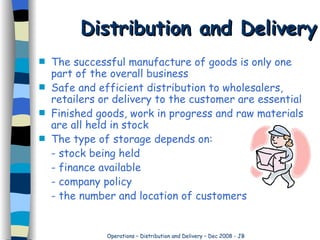
Distribution and Delivery The successful manufacture of goods is only one part of the overall business Safe and efficient distribution to wholesalers, retailers or delivery to the customer are essential Finished goods, work in progress and raw materials are all held in stock The type of storage depends on:  - stock being held - finance available - company policy - the number and location of customers
Warehousing Organisations make use of warehousing facilities to bulk store their goods Warehouse space may be owned, leased or rented by the organisation The warehouse may be a centralised function of the organisation or it may be located a distance from the main operations Stocks of finished goods are stored in order to meet demand quickly The main aspects of warehousing are: - design and layout - mechanical handling - transportation
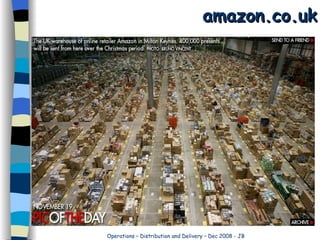
amazon.co.uk
Design and Layout Ideally warehouses should be located on the ground level Those goods that are moved most frequently should be located in a readily accessible area A stock rotation system should operate to avoid deterioration in quality
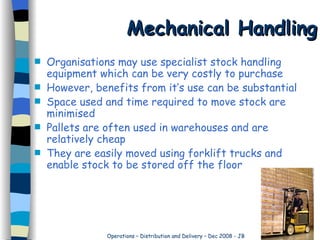
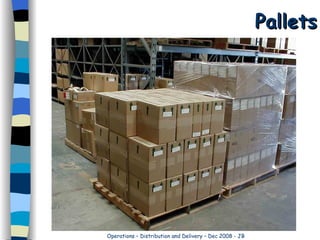
Mechanical Handling Organisations may use specialist stock handling equipment which can be very costly to purchase However, benefits from it’s use can be substantial Space used and time required to move stock are minimised Pallets are often used in warehouses and are relatively cheap They are easily moved using forklift trucks and enable stock to be stored off the floor
Pallets
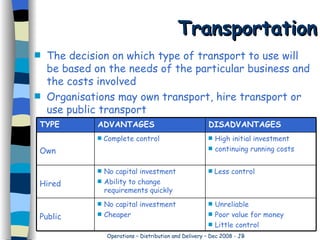
Transportation The decision on which type of transport to use will be based on the needs of the particular business and the costs involved Organisations may own transport, hire transport or use public transport Unreliable Poor value for money Little control No capital investment Cheaper Public Less control No capital investment Ability to change requirements quickly Hired High initial investment continuing running costs Complete control Own  DISADVANTAGES ADVANTAGES TYPE
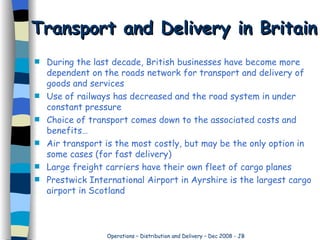
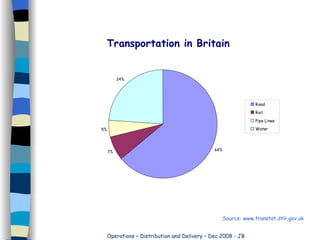
Transport and Delivery in Britain During the last decade, British businesses have become more dependent on the roads network for transport and delivery of goods and services Use of railways has decreased and the road system in under constant pressure Choice of transport comes down to the associated costs and benefits… Air transport is the most costly, but may be the only option in some cases (for fast delivery) Large freight carriers have their own fleet of cargo planes Prestwick International Airport in Ayrshire is the largest cargo airport in Scotland
Source: www.transtat.dtlr.gov.uk
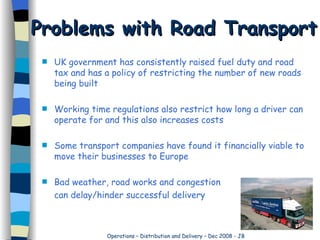
Problems with Road Transport UK government has consistently raised fuel duty and road tax and has a policy of restricting the number of new roads being built Working time regulations also restrict how long a driver can operate for and this also increases costs Some transport companies have found it financially viable to move their businesses to Europe Bad weather, road works and congestion  can delay/hinder successful delivery
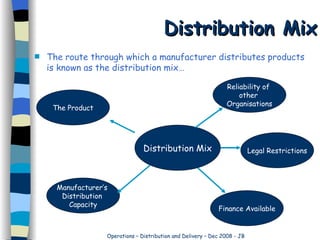
Distribution Mix The route through which a manufacturer distributes products is known as the distribution mix… Distribution Mix The Product Legal Restrictions Manufacturer’s  Distribution  Capacity Finance Available Reliability of  other  Organisations
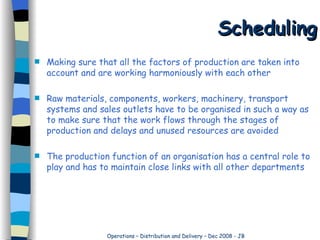
Scheduling Making sure that all the factors of production are taken into account and are working harmoniously with each other Raw materials, components, workers, machinery, transport systems and sales outlets have to be organised in such a way as to make sure that the work flows through the stages of production and delays and unused resources are avoided The production function of an organisation has a central role to play and has to maintain close links with all other departments
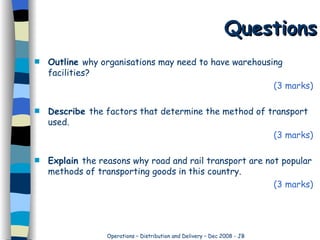
Questions Outline  why organisations may need to have warehousing facilities? (3 marks)   Describe  the factors that determine the method of transport used. (3 marks) Explain  the reasons why road and rail transport are not popular methods of transporting goods in this country.  ( 3 marks)
Solution ?
Solution ?
Solution ?

Distribution And Delivery

  • 1.
    Distribution and DeliveryHigher Business Management
  • 2.
    Distribution and DeliveryThe successful manufacture of goods is only one part of the overall business Safe and efficient distribution to wholesalers, retailers or delivery to the customer are essential Finished goods, work in progress and raw materials are all held in stock The type of storage depends on: - stock being held - finance available - company policy - the number and location of customers
  • 3.
    Warehousing Organisations makeuse of warehousing facilities to bulk store their goods Warehouse space may be owned, leased or rented by the organisation The warehouse may be a centralised function of the organisation or it may be located a distance from the main operations Stocks of finished goods are stored in order to meet demand quickly The main aspects of warehousing are: - design and layout - mechanical handling - transportation
  • 4.
  • 5.
    Design and LayoutIdeally warehouses should be located on the ground level Those goods that are moved most frequently should be located in a readily accessible area A stock rotation system should operate to avoid deterioration in quality
  • 6.
    Mechanical Handling Organisationsmay use specialist stock handling equipment which can be very costly to purchase However, benefits from it’s use can be substantial Space used and time required to move stock are minimised Pallets are often used in warehouses and are relatively cheap They are easily moved using forklift trucks and enable stock to be stored off the floor
  • 7.
  • 8.
    Transportation The decisionon which type of transport to use will be based on the needs of the particular business and the costs involved Organisations may own transport, hire transport or use public transport Unreliable Poor value for money Little control No capital investment Cheaper Public Less control No capital investment Ability to change requirements quickly Hired High initial investment continuing running costs Complete control Own DISADVANTAGES ADVANTAGES TYPE
  • 9.
    Transport and Deliveryin Britain During the last decade, British businesses have become more dependent on the roads network for transport and delivery of goods and services Use of railways has decreased and the road system in under constant pressure Choice of transport comes down to the associated costs and benefits… Air transport is the most costly, but may be the only option in some cases (for fast delivery) Large freight carriers have their own fleet of cargo planes Prestwick International Airport in Ayrshire is the largest cargo airport in Scotland
  • 10.
  • 11.
    Problems with RoadTransport UK government has consistently raised fuel duty and road tax and has a policy of restricting the number of new roads being built Working time regulations also restrict how long a driver can operate for and this also increases costs Some transport companies have found it financially viable to move their businesses to Europe Bad weather, road works and congestion can delay/hinder successful delivery
  • 12.
    Distribution Mix Theroute through which a manufacturer distributes products is known as the distribution mix… Distribution Mix The Product Legal Restrictions Manufacturer’s Distribution Capacity Finance Available Reliability of other Organisations
  • 13.
    Scheduling Making surethat all the factors of production are taken into account and are working harmoniously with each other Raw materials, components, workers, machinery, transport systems and sales outlets have to be organised in such a way as to make sure that the work flows through the stages of production and delays and unused resources are avoided The production function of an organisation has a central role to play and has to maintain close links with all other departments
  • 14.
    Questions Outline why organisations may need to have warehousing facilities? (3 marks)   Describe the factors that determine the method of transport used. (3 marks) Explain the reasons why road and rail transport are not popular methods of transporting goods in this country. ( 3 marks)
  • 15.
  • 16.
  • 17.