PURCHASING & STCOK Operations
The importance of purchasing This varies depending on size and nature of organisation.  Not as important in service industries e.g. hairdressing In manufacturing industries, likely to be a purchasing department and a team of specialists.  Responsible for: Delivering the best quality materials At the lowest cost Delivered in the correct quantities At the correct time.
Purchasing  Decisions have to be made as to how much raw material  (the quantity)  and from whom raw materials are to be purchased  (the supplier) Four main issues Stock of raw materials currently available Duration of time which will elapse between this order and any future orders Amount of raw materials likely to be required during period Storage space available and cost
Purchasing mix Decision needs to be taken on which supplier offers the best terms.  Following factors need to be considered: Quality  - acceptable and consistent for firm’s needs Quantity  - able to deliver correct quantity Time  - able to meet firm’s delivery dates Dependability  - are they likely to stay in business? Price  - lowest price for quality needed, discounts, terms Location  - check for additional charges on delivery Storage facilities  - what are the firm’s capabilities?
Question 1 The quality of materials will help an organisation decide which supplier to use.  Describe  other factors that a purchasing manager should consider when choosing a supplier. (4 marks)
Solution The purchasing manager would need to consider the whether the supplier could provide goods which were of a  quality  acceptable and consistent for firm’s needs. They would also need to consider whether the supplier had the capability to deliver goods in the  quantity  required and whether they could meet change in demand.  They would need to consider whether the supplier had the capability to meet their requirements on  time.   They would also need to think about the suppliers  dependability  and whether they are likely remain in business as it would cause disruption if they were to close down.
Definition of stock “ Raw materials, work in progress and finished goods”   Raw materials and components  - stored to meet changes in production, delays can be avoided work-in-progress  -  partially built products, valued according to percentage of completion finished goods  -  stored to meet changes in demand, firm can meet urgent orders immediately
Control of stock Procedure for monitoring, controlling and recording stock: Materials should only be issued to departments when a stock requisition received. Stock levels should be recorded on stock record cards or held on computer database.
Storage of stock Centralised Held in one central storage area Decentralised Located in different areas in which they are used
Benefits and costs of centralised stock storage Benefits Improved security from loss or theft Agreed procedures followed  Improved efficiency Bulk ordering may be cheaper Costs Time wasting going to and from stores Cost of specialist staff  Cost of dedicated storage area
Benefits and costs of decentralised stock storage Benefits Stock always ‘at hand’. Orders reflect actual production useage or sales levels Reduced likelihood of deterioration or decay due to speedier turnover.  Costs Less rigid control Takes up space in production areas
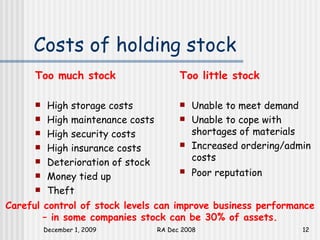
Costs of holding stock Too much stock High storage costs High maintenance costs High security costs High insurance costs Deterioration of stock Money tied up Theft Too little stock Unable to meet demand Unable to cope with shortages of materials Increased ordering/admin costs Poor reputation   Careful control of stock levels can improve business performance – in some companies stock can be 30% of assets.
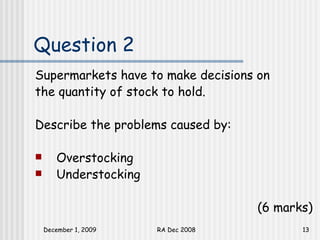
Question 2 Supermarkets have to make decisions on the quantity of stock to hold.  Describe the problems caused by: Overstocking Understocking (6 marks)
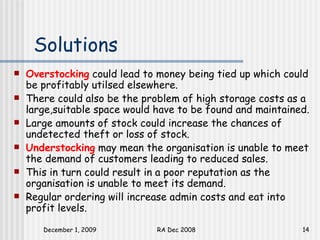
Solutions Overstocking   could lead to money being tied up which could be profitably utilsed elsewhere.  There could also be the problem of high storage costs as a large,suitable space would have to be found and maintained.  Large amounts of stock could increase the chances of undetected theft or loss of stock. Understocking   may mean the organisation is unable to meet the demand of customers leading to reduced sales.  This in turn could result in a poor reputation as the organisation is unable to meet its demand.  Regular ordering will increase admin costs and eat into profit levels.
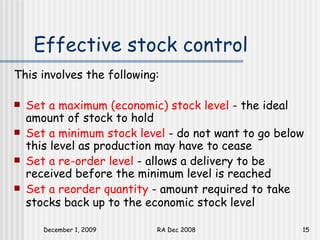
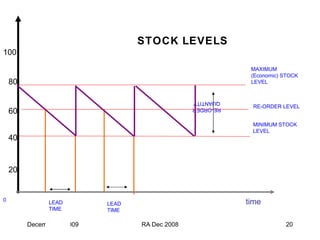
Effective stock control This involves the following: Set a maximum (economic) stock level  - t he ideal amount of stock to hold Set a minimum stock level  -  do not want to go below this level as production may have to cease Set a re-order level  -  allows a delivery to be received before the minimum level is reached   Set a reorder quantity  -  amount required to take stocks back up to the economic stock level
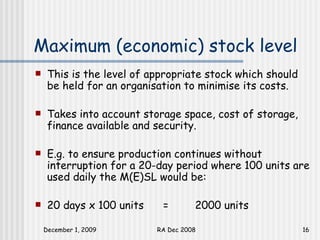
Maximum (economic) stock level This is the level of appropriate stock which should be held for an organisation to minimise its costs. Takes into account storage space, cost of storage, finance available and security.  E.g. to ensure production continues without interruption for a 20-day period where 100 units are used daily the M(E)SL would be: 20 days x 100 units = 2000 units
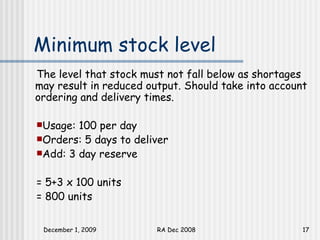
Minimum stock level The level that stock must not fall below as shortages may result in reduced output. Should take into account ordering and delivery times.  Usage: 100 per day Orders: 5 days to deliver Add: 3 day reserve = 5+3 x 100 units = 800 units
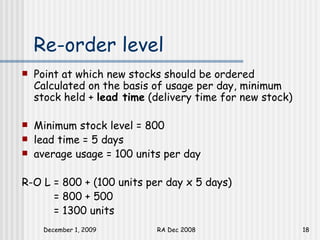
Re-order level Point at which new stocks should be ordered Calculated on the basis of usage per day, minimum stock held +  lead time  (delivery time for new stock) Minimum stock level = 800  lead time = 5 days average usage = 100 units per day R-O L = 800 + (100 units per day x 5 days) = 800 + 500 = 1300 units
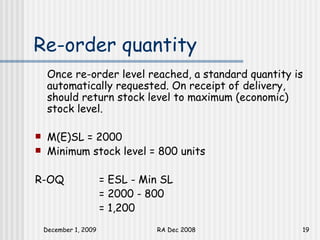
Re-order quantity Once re-order level reached, a standard quantity is automatically requested. On receipt of delivery, should return stock level to maximum (economic) stock level.  M(E)SL = 2000 Minimum stock level = 800 units R-OQ  = ESL - Min SL = 2000 - 800 = 1,200
0   20 40 60 80 100 time STOCK LEVELS MAXIMUM (Economic) STOCK LEVEL MINIMUM STOCK LEVEL RE-ORDER QUANTITY LEAD  TIME LEAD  TIME RE-ORDER LEVEL
Question 3 The efficient control of stock is essential for the liquidity of an organisation. Explain how an effective form of stock control can be used in a business.  (4 marks)
Solution They should set a maximum (economic) stock level  as this will ensure that they can continue production without any interruption but minimise storage costs etc. for the business. - t he ideal amount of stock to hold They should set a minimum stock level  as this will ensure that production is not disrupted by shortages as it takes into account how long is required for ordering and delivery times.  They should set a re-order level   and when this point is reached, new stock should be ordered. This will ensure that the organisation doesn’t run out.   They should also set a reorder quantity  which will ensure that when the re-order level is reached, the quantity requested will take the stock level back to the maximum (economic) stock level.
Computerised stock control Many businesses hold all information regarding stock on computer database.  Keeps balances up-to-date after stock has been issued and received.  Can be programmed to order automatically. E.g. supermarkets use bar codes - as each item is scanned, one taken from recorded stock level.
Costs and benefits of computerised stock control for a supermarket Benefits Stock levels can be checked Stock values can be checked Sales can be checked Can be programmed to reorder Best sellers & slow moving lines can be identified Costs Expensive to set up
Question 4 Department stores need to be able to identify best-selling items in order to maintain appropriate stock levels. Describe how ICT can help an organisation to maintain appropriate stock levels.  (3 marks)
Solution Stock levels can be updated quickly when receipts and issues are made scanning a barcode.  The computer can be programmed to automatically reorder stock when the reorder level is reached.  Managers can use ICT to identify best-selling products and make sure they sell more of them.
Just-in-time (JIT)  A Japanese concept Popular method for mass manufacturers Involves keeping stock levels to a minimum Stock arrives just in time to be used in production Works best where there is a close relationship between manufacturer and suppliers Goods not produced unless firm has an order from a customer Aims to get highest volume of output at the lowest unit cost.
Just-in-time (JIT)  A method of production control. No demand - no production! Anticipated/planned consumer demand triggers production Finished goods assembled just in time to be sold to customer Component parts assembled just in time to become finished goods Materials purchased just in time to make component parts.
Advantages of JIT Capital not tied up in stocks Less space required for stock Closer relationships with suppliers Reduced deterioration Less vulnerability to fashion and technology changes Reduction in stockholding costs Increase in cash flow
Disadvantages of JIT  Danger of disrupted production due to non-arrival of supplies Danger of lost sales High dependence on suppliers Less time for quality control on arrival of materials Increased ordering and admin costs May lose bulk-buying discounts
Question 5 Dell, the computer manufacturer, uses the JIT system of stock control.  Explain  the costs and benefits of Dell using this system. (4 marks)
Solution Dell  do not have to tie up capital in stock  which means they can invest it in other areas of the business, such as R&D or promotion, to increase sales. Dell require  less space for stock  which means they save money on storage facilities which will increase their profit margins.  Dell have a  high dependence on their suppliers  and should the suppliers fail them, it is Dell’s reputation and sales which would suffer if they were unable to meet demand from their customers. Dell may be  unable to benefit from bulk-buy discounts  which leaves them with an option of increasing the price to the customer or reducing their own profit margin.

Purchasing & Stock Slides

  • 1.
  • 2.
    The importance ofpurchasing This varies depending on size and nature of organisation. Not as important in service industries e.g. hairdressing In manufacturing industries, likely to be a purchasing department and a team of specialists. Responsible for: Delivering the best quality materials At the lowest cost Delivered in the correct quantities At the correct time.
  • 3.
    Purchasing Decisionshave to be made as to how much raw material (the quantity) and from whom raw materials are to be purchased (the supplier) Four main issues Stock of raw materials currently available Duration of time which will elapse between this order and any future orders Amount of raw materials likely to be required during period Storage space available and cost
  • 4.
    Purchasing mix Decisionneeds to be taken on which supplier offers the best terms. Following factors need to be considered: Quality - acceptable and consistent for firm’s needs Quantity - able to deliver correct quantity Time - able to meet firm’s delivery dates Dependability - are they likely to stay in business? Price - lowest price for quality needed, discounts, terms Location - check for additional charges on delivery Storage facilities - what are the firm’s capabilities?
  • 5.
    Question 1 Thequality of materials will help an organisation decide which supplier to use. Describe other factors that a purchasing manager should consider when choosing a supplier. (4 marks)
  • 6.
    Solution The purchasingmanager would need to consider the whether the supplier could provide goods which were of a quality acceptable and consistent for firm’s needs. They would also need to consider whether the supplier had the capability to deliver goods in the quantity required and whether they could meet change in demand. They would need to consider whether the supplier had the capability to meet their requirements on time. They would also need to think about the suppliers dependability and whether they are likely remain in business as it would cause disruption if they were to close down.
  • 7.
    Definition of stock“ Raw materials, work in progress and finished goods” Raw materials and components - stored to meet changes in production, delays can be avoided work-in-progress - partially built products, valued according to percentage of completion finished goods - stored to meet changes in demand, firm can meet urgent orders immediately
  • 8.
    Control of stockProcedure for monitoring, controlling and recording stock: Materials should only be issued to departments when a stock requisition received. Stock levels should be recorded on stock record cards or held on computer database.
  • 9.
    Storage of stockCentralised Held in one central storage area Decentralised Located in different areas in which they are used
  • 10.
    Benefits and costsof centralised stock storage Benefits Improved security from loss or theft Agreed procedures followed Improved efficiency Bulk ordering may be cheaper Costs Time wasting going to and from stores Cost of specialist staff Cost of dedicated storage area
  • 11.
    Benefits and costsof decentralised stock storage Benefits Stock always ‘at hand’. Orders reflect actual production useage or sales levels Reduced likelihood of deterioration or decay due to speedier turnover. Costs Less rigid control Takes up space in production areas
  • 12.
    Costs of holdingstock Too much stock High storage costs High maintenance costs High security costs High insurance costs Deterioration of stock Money tied up Theft Too little stock Unable to meet demand Unable to cope with shortages of materials Increased ordering/admin costs Poor reputation Careful control of stock levels can improve business performance – in some companies stock can be 30% of assets.
  • 13.
    Question 2 Supermarketshave to make decisions on the quantity of stock to hold. Describe the problems caused by: Overstocking Understocking (6 marks)
  • 14.
    Solutions Overstocking could lead to money being tied up which could be profitably utilsed elsewhere. There could also be the problem of high storage costs as a large,suitable space would have to be found and maintained. Large amounts of stock could increase the chances of undetected theft or loss of stock. Understocking may mean the organisation is unable to meet the demand of customers leading to reduced sales. This in turn could result in a poor reputation as the organisation is unable to meet its demand. Regular ordering will increase admin costs and eat into profit levels.
  • 15.
    Effective stock controlThis involves the following: Set a maximum (economic) stock level - t he ideal amount of stock to hold Set a minimum stock level - do not want to go below this level as production may have to cease Set a re-order level - allows a delivery to be received before the minimum level is reached Set a reorder quantity - amount required to take stocks back up to the economic stock level
  • 16.
    Maximum (economic) stocklevel This is the level of appropriate stock which should be held for an organisation to minimise its costs. Takes into account storage space, cost of storage, finance available and security. E.g. to ensure production continues without interruption for a 20-day period where 100 units are used daily the M(E)SL would be: 20 days x 100 units = 2000 units
  • 17.
    Minimum stock levelThe level that stock must not fall below as shortages may result in reduced output. Should take into account ordering and delivery times. Usage: 100 per day Orders: 5 days to deliver Add: 3 day reserve = 5+3 x 100 units = 800 units
  • 18.
    Re-order level Pointat which new stocks should be ordered Calculated on the basis of usage per day, minimum stock held + lead time (delivery time for new stock) Minimum stock level = 800 lead time = 5 days average usage = 100 units per day R-O L = 800 + (100 units per day x 5 days) = 800 + 500 = 1300 units
  • 19.
    Re-order quantity Oncere-order level reached, a standard quantity is automatically requested. On receipt of delivery, should return stock level to maximum (economic) stock level. M(E)SL = 2000 Minimum stock level = 800 units R-OQ = ESL - Min SL = 2000 - 800 = 1,200
  • 20.
    0   2040 60 80 100 time STOCK LEVELS MAXIMUM (Economic) STOCK LEVEL MINIMUM STOCK LEVEL RE-ORDER QUANTITY LEAD TIME LEAD TIME RE-ORDER LEVEL
  • 21.
    Question 3 Theefficient control of stock is essential for the liquidity of an organisation. Explain how an effective form of stock control can be used in a business. (4 marks)
  • 22.
    Solution They shouldset a maximum (economic) stock level as this will ensure that they can continue production without any interruption but minimise storage costs etc. for the business. - t he ideal amount of stock to hold They should set a minimum stock level as this will ensure that production is not disrupted by shortages as it takes into account how long is required for ordering and delivery times. They should set a re-order level and when this point is reached, new stock should be ordered. This will ensure that the organisation doesn’t run out. They should also set a reorder quantity which will ensure that when the re-order level is reached, the quantity requested will take the stock level back to the maximum (economic) stock level.
  • 23.
    Computerised stock controlMany businesses hold all information regarding stock on computer database. Keeps balances up-to-date after stock has been issued and received. Can be programmed to order automatically. E.g. supermarkets use bar codes - as each item is scanned, one taken from recorded stock level.
  • 24.
    Costs and benefitsof computerised stock control for a supermarket Benefits Stock levels can be checked Stock values can be checked Sales can be checked Can be programmed to reorder Best sellers & slow moving lines can be identified Costs Expensive to set up
  • 25.
    Question 4 Departmentstores need to be able to identify best-selling items in order to maintain appropriate stock levels. Describe how ICT can help an organisation to maintain appropriate stock levels. (3 marks)
  • 26.
    Solution Stock levelscan be updated quickly when receipts and issues are made scanning a barcode. The computer can be programmed to automatically reorder stock when the reorder level is reached. Managers can use ICT to identify best-selling products and make sure they sell more of them.
  • 27.
    Just-in-time (JIT) A Japanese concept Popular method for mass manufacturers Involves keeping stock levels to a minimum Stock arrives just in time to be used in production Works best where there is a close relationship between manufacturer and suppliers Goods not produced unless firm has an order from a customer Aims to get highest volume of output at the lowest unit cost.
  • 28.
    Just-in-time (JIT) A method of production control. No demand - no production! Anticipated/planned consumer demand triggers production Finished goods assembled just in time to be sold to customer Component parts assembled just in time to become finished goods Materials purchased just in time to make component parts.
  • 29.
    Advantages of JITCapital not tied up in stocks Less space required for stock Closer relationships with suppliers Reduced deterioration Less vulnerability to fashion and technology changes Reduction in stockholding costs Increase in cash flow
  • 30.
    Disadvantages of JIT Danger of disrupted production due to non-arrival of supplies Danger of lost sales High dependence on suppliers Less time for quality control on arrival of materials Increased ordering and admin costs May lose bulk-buying discounts
  • 31.
    Question 5 Dell,the computer manufacturer, uses the JIT system of stock control. Explain the costs and benefits of Dell using this system. (4 marks)
  • 32.
    Solution Dell do not have to tie up capital in stock which means they can invest it in other areas of the business, such as R&D or promotion, to increase sales. Dell require less space for stock which means they save money on storage facilities which will increase their profit margins. Dell have a high dependence on their suppliers and should the suppliers fail them, it is Dell’s reputation and sales which would suffer if they were unable to meet demand from their customers. Dell may be unable to benefit from bulk-buy discounts which leaves them with an option of increasing the price to the customer or reducing their own profit margin.