DIFFERENT TYPES OF
PRODUCTION PROCESS
WELL- BEING
TO
Group Members:
Name :- ID :-
1. Ealahi Rahamat Nabi IP2105075
2. Manik IP2105076
3. Tamama Islam IP2105077
4. Afi Ahmad Emon IP2105078
5.Habibur Rahman IP2105079
6.Takdir IP2105080
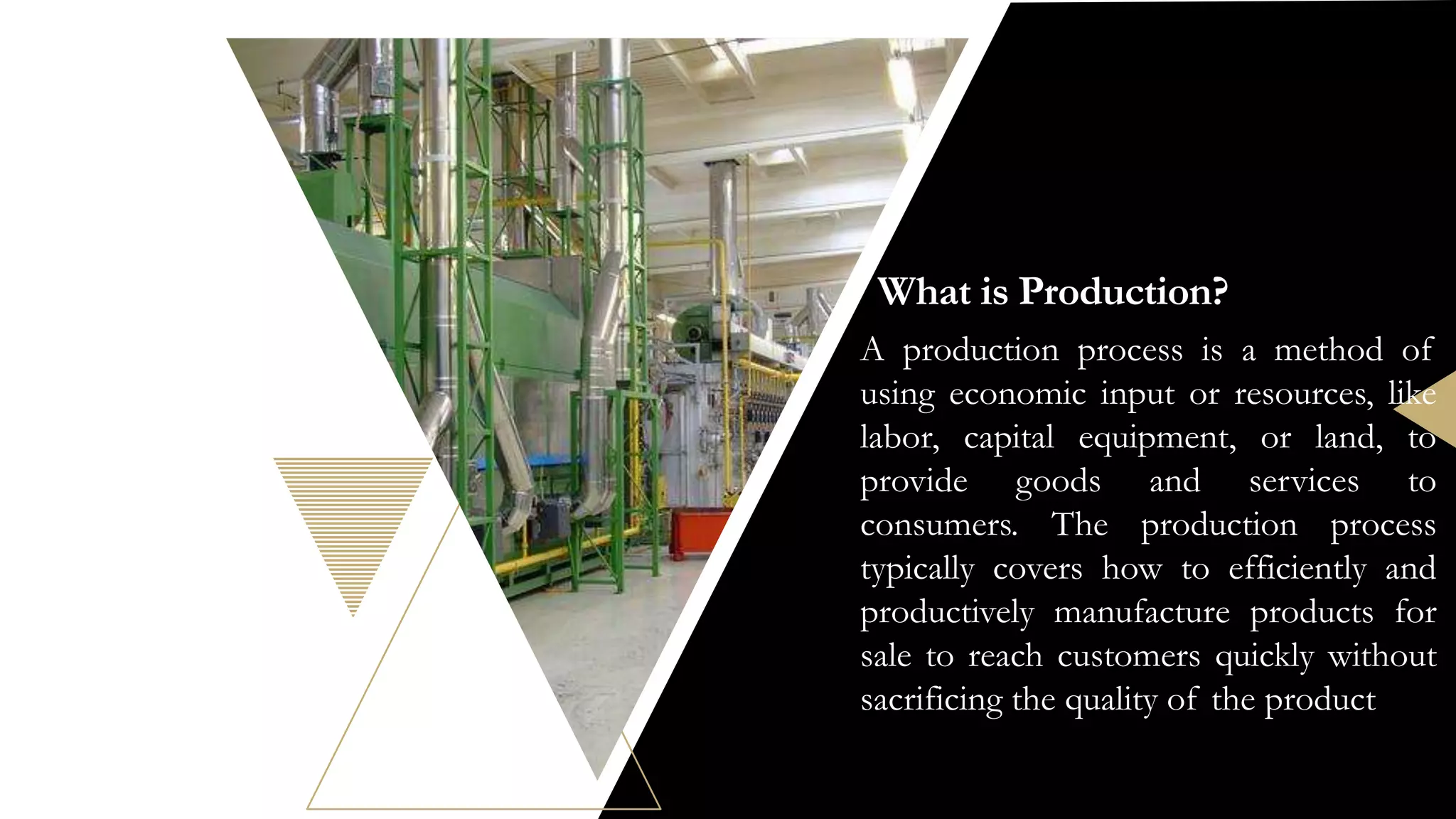
What is Production?
A production process is a method of
using economic input or resources, like
labor, capital equipment, or land, to
provide goods and services to
consumers. The production process
typically covers how to efficiently and
productively manufacture products for
sale to reach customers quickly without
sacrificing the quality of the product
Types of
production
Intermittent Contineous
Jobbing
Batch
Project Process
Mass
INTERMITTENT PRODUCTION
Intermittent production is an umbrella
term for manufacturing processes that use
irregular production schedules to create
several different products using one
production line. Include: Project
production flows, Jobbing production
flows, and Batch production flows.
CONTINEOUS PRODUCTION
Continuous production is a type of
production system in which materials
being processed are continuously in
motion. Continuous production, like
mass production, is a flow production
method. The types of continuous
production systems include; Process
production and Mass production.
Comparing “Intermittent” to “Contineous”
INTERMITTENT PRODUCTION:
Intermittent production is an umbrella term
for manufacturing processes that use
irregular production schedules to create
several different products using one
production line. The types of intermittent
production systems include: Project
production flows, Jobbing production
flows and Batch production flows.
PROJECT PRODUCTION
FLOWS:
: ADVANTAGES-
∎ Efficient Goal Setting.
∎ Improved Communication.
∎ Greater Customer Satisfaction.
Disadvantages-
∎ High Cost.
∎ Increased Complexity.
∎ Lack of Creativity.
Project or job-based production is
one-of-a-kind production in which
only one type of item is
manufactured at a time. This type
of production is often used for very
large projects.
Job production-
Job production is a manufacturing process that involves workers making a single
unique customized product for a single customer. Depending upon the
customer’s needs, the job production method is used to create a product from
start to finish.
Batch production is a method of manufacturing where
identical or similar items are produced together for
different sized Production runs. Baked goods, Clothing,
computer chips, computer software electrical goods, etc
Batch production-
PROCESS PRODUCTION FLOWS:
Advantages-
∎ Unit costs are lower since larger numbers are made
∎ Customers are offered some variety and choice
∎ Materials can be bought in bulk, so they are less expensive.
Process manufacturing is a production method that creates goods by combining
supplies, ingredients, or raw materials using a formula or recipe. It is frequently used
in industries that produce bulk quantities of goods, such as food, beverages, refined
oil, gasoline, pharmaceuticals, chemicals, and plastics.
MASS PRODUCTION
FLOWS:
Advantages of Mass production process-
∎ Economically Efficient
∎ Fast Production Rate
∎ Production Accuracy
Disadvantages Of Mass Production
Process-
∎ Inflexible to Consumer Demand
∎ Disengaged Workforce
∎ Difficult to restructure Production
Mass production produces
standardized goods in
considerably large quantities.
Mass production aims to ensure
that the whole process of
manufacturing remains at the
lowest cost possible while turning
out the highest volumes possible.
canned goods, over-the-counter
drugs, and household appliances.
• Production planning is critical for all businesses, whether you produce physical or
digital products. By understanding the process and scheduling your production
correctly, you can minimize waste, optimize resources, and ensure that your
customers are happy with their products.
Conclusion:
Thank You

DIFFERENT TYPES OF PRODUCTION PROCESS.pptx

  • 1.
    DIFFERENT TYPES OF PRODUCTIONPROCESS WELL- BEING TO
  • 2.
    Group Members: Name :-ID :- 1. Ealahi Rahamat Nabi IP2105075 2. Manik IP2105076 3. Tamama Islam IP2105077 4. Afi Ahmad Emon IP2105078 5.Habibur Rahman IP2105079 6.Takdir IP2105080
  • 3.
    What is Production? Aproduction process is a method of using economic input or resources, like labor, capital equipment, or land, to provide goods and services to consumers. The production process typically covers how to efficiently and productively manufacture products for sale to reach customers quickly without sacrificing the quality of the product
  • 4.
  • 5.
    INTERMITTENT PRODUCTION Intermittent productionis an umbrella term for manufacturing processes that use irregular production schedules to create several different products using one production line. Include: Project production flows, Jobbing production flows, and Batch production flows. CONTINEOUS PRODUCTION Continuous production is a type of production system in which materials being processed are continuously in motion. Continuous production, like mass production, is a flow production method. The types of continuous production systems include; Process production and Mass production. Comparing “Intermittent” to “Contineous”
  • 6.
    INTERMITTENT PRODUCTION: Intermittent productionis an umbrella term for manufacturing processes that use irregular production schedules to create several different products using one production line. The types of intermittent production systems include: Project production flows, Jobbing production flows and Batch production flows.
  • 7.
    PROJECT PRODUCTION FLOWS: : ADVANTAGES- ∎Efficient Goal Setting. ∎ Improved Communication. ∎ Greater Customer Satisfaction. Disadvantages- ∎ High Cost. ∎ Increased Complexity. ∎ Lack of Creativity. Project or job-based production is one-of-a-kind production in which only one type of item is manufactured at a time. This type of production is often used for very large projects.
  • 8.
    Job production- Job productionis a manufacturing process that involves workers making a single unique customized product for a single customer. Depending upon the customer’s needs, the job production method is used to create a product from start to finish. Batch production is a method of manufacturing where identical or similar items are produced together for different sized Production runs. Baked goods, Clothing, computer chips, computer software electrical goods, etc Batch production-
  • 9.
    PROCESS PRODUCTION FLOWS: Advantages- ∎Unit costs are lower since larger numbers are made ∎ Customers are offered some variety and choice ∎ Materials can be bought in bulk, so they are less expensive. Process manufacturing is a production method that creates goods by combining supplies, ingredients, or raw materials using a formula or recipe. It is frequently used in industries that produce bulk quantities of goods, such as food, beverages, refined oil, gasoline, pharmaceuticals, chemicals, and plastics.
  • 10.
    MASS PRODUCTION FLOWS: Advantages ofMass production process- ∎ Economically Efficient ∎ Fast Production Rate ∎ Production Accuracy Disadvantages Of Mass Production Process- ∎ Inflexible to Consumer Demand ∎ Disengaged Workforce ∎ Difficult to restructure Production Mass production produces standardized goods in considerably large quantities. Mass production aims to ensure that the whole process of manufacturing remains at the lowest cost possible while turning out the highest volumes possible. canned goods, over-the-counter drugs, and household appliances.
  • 11.
    • Production planningis critical for all businesses, whether you produce physical or digital products. By understanding the process and scheduling your production correctly, you can minimize waste, optimize resources, and ensure that your customers are happy with their products. Conclusion:
  • 12.