MANUFACTURING
SYSTEMS & LEAN
MANUFACTURING
By
SUMIT BHATTACHARYA 710
SHARVIL DALVI 713
Department Of Mechanical Engineering
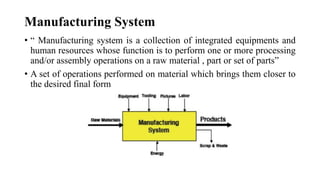
Manufacturing System
• “ Manufacturing system is a collection of integrated equipments and
human resources whose function is to perform one or more processing
and/or assembly operations on a raw material , part or set of parts”
• A set of operations performed on material which brings them closer to
the desired final form
All operation here are concerned with input-transformation-output
process.
• Input: Men, material, machines, drawings etc.
• Transformation: Operations, material handling , procurement etc.
• Output: The final goods and services.
Thus the combination of operations and activities mentioned before,
employed to create goods or services is termed as manufacturing
systems.
Selection of Manufacturing System:
It must be able to meet the specifications set for the final product and be
cost effective.
The factors affecting the selection :
• Effect of volume
• Capacity of plant
• Flexibility
• Lead time
• Efficiency
• Environment
Examples Of Manufacturing Systems
• Single station cells
• Machine clusters
• Manual assembly lines
• Automated transfer lines
• Automated assembly systems
• Flexible manufacturing system
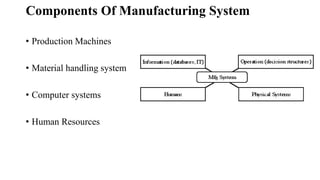
Components Of Manufacturing System
• Production Machines
• Material handling system
• Computer systems
• Human Resources
Production Machines:
• In all manufacturing systems, most of the actual assembly work is
accomplished by machines or with aid of tools
• Classification of manufacturing systems:
1. Manually operated machines which are controlled or supervised by
a human worker.
2. Semi-automated machines perform a portion of work cycle under
some form of program control, and worker tends the machine the
rest.
3. Fully automated machines.
Material Handling Systems:
The material handling functions in most manufacturing systems:
1. Loading work units at each station
2. Positioning work units at each station
3. Unloading work units at each station
4. Transporting work units at each station in multi-station systems
5. Temporary storage of work units
Work transport between stations:
• Fixed Routing
• Variable Routing
Computer Control Systems:
Typical computer functions in manufacturing systems:
• Communicate instruction to workers( receive processing or assembly
instructions fro specific work unit)
• Download part programs
• Control material handling system
• Schedule production
• Failure diagnosis
• Safety monitoring
• Quality control
• Operations management
Human Resources:
• To operate and manage the system/process
• Required either fulltime or periodically to keep the system running
• Humans refers to all personnel , operators, vendors
• In context of manufacturing system , human perform some or all of the
value added work that is accomplished on the parts/products.
• Performing either manual (direct)work on it or by controlling the
machines.
• In fully automated machine, direct labour is still needed.
• For example : loading or unloading parts, changing tools, resharpening
tools etc.
Classification Of Manufacturing Systems:
Factors that define and distinguish manufacturing systems:
• Types of operations performed
• Number of workstations
• System Layout
• Automation and manning level
• Part or product variety
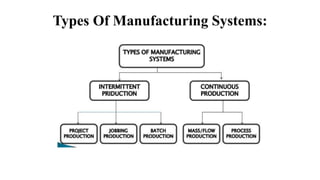
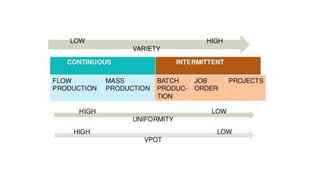
Types Of Manufacturing Systems:
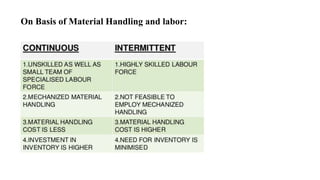
On Basis of Material Handling and labor:
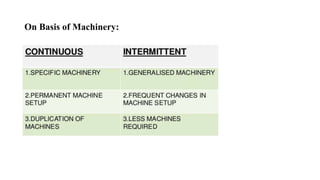
On Basis of Machinery:
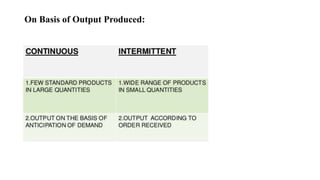
On Basis of Output Produced:
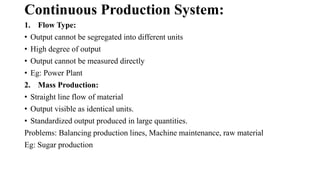
Continuous Production System:
1. Flow Type:
• Output cannot be segregated into different units
• High degree of output
• Output cannot be measured directly
• Eg: Power Plant
2. Mass Production:
• Straight line flow of material
• Output visible as identical units.
• Standardized output produced in large quantities.
Problems: Balancing production lines, Machine maintenance, raw material
Eg: Sugar production
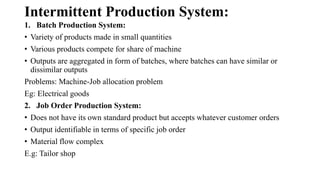
Intermittent Production System:
1. Batch Production System:
• Variety of products made in small quantities
• Various products compete for share of machine
• Outputs are aggregated in form of batches, where batches can have similar or
dissimilar outputs
Problems: Machine-Job allocation problem
Eg: Electrical goods
2. Job Order Production System:
• Does not have its own standard product but accepts whatever customer orders
• Output identifiable in terms of specific job order
• Material flow complex
E.g: Tailor shop
3. Project Production System:
• It uses resources on different projects
• Product remains remains fixed and manpower and facilitates put work on it
• PERT/CPM can be used for planning and control
LEAN MANUFACTURING
• "lean", is a systematic method for the elimination of waste within a manufacturing
system.
• The waste includes:-
1. Overproduction – producing more than the consumers demand.
2. Waiting –waiting for the next production step, interruptions of production during
shift change.
3. Inventory – supply levels and work in progress inventories too high.
4. Transportation – moving products that are not actually required to perform the
processing and the efficiency with which the product is transported.
5. Over-processing - working on the same product again and again thereby reducing its
efficiency.
• It aims at increasing the efficiency and minimizing the cost of the product.
BRIEF HISTORY OF LEAN MANUFACTURING
(Case Study)
• Lean principles are derived from the Japanese manufacturing industry introduced by John
Krafcik in 1988 who worked as a quality engineer in the Toyota industry.
• Toyota industry past improvements:-
1. Redesigning of the casting assembly thereby reducing repairs in the future.
2. Reducing overproduction (build to order)
3. Adopting the TPM approach.
• It lead to flexibility in operation, reduction in waste, smooth production flow, proper
sequencing and timing of processes, better customer supplier connection, etc.
• Henry Ford was one of the people to develop the idea behind Lean Manufacturing. He used the
idea of "continuous flow" on the assembly line for his automobile models, where he kept
production standards extremely tight, so each stage of the process fitted together with each
other stage, perfectly.
References:
• http://www.slideshare.net/pakkiaarzoo/types-of-production-system
• http://www.slideshare.net/akashbakshi/4types-of-manufacturing-
system-and-layouts?related=1
• https://www.scribd.com/doc/17341282/components-of-manufacturing-
system

Manufacturing systems

  • 1.
    MANUFACTURING SYSTEMS & LEAN MANUFACTURING By SUMITBHATTACHARYA 710 SHARVIL DALVI 713 Department Of Mechanical Engineering
  • 2.
    Manufacturing System • “Manufacturing system is a collection of integrated equipments and human resources whose function is to perform one or more processing and/or assembly operations on a raw material , part or set of parts” • A set of operations performed on material which brings them closer to the desired final form
  • 3.
    All operation hereare concerned with input-transformation-output process. • Input: Men, material, machines, drawings etc. • Transformation: Operations, material handling , procurement etc. • Output: The final goods and services. Thus the combination of operations and activities mentioned before, employed to create goods or services is termed as manufacturing systems.
  • 4.
    Selection of ManufacturingSystem: It must be able to meet the specifications set for the final product and be cost effective. The factors affecting the selection : • Effect of volume • Capacity of plant • Flexibility • Lead time • Efficiency • Environment
  • 5.
    Examples Of ManufacturingSystems • Single station cells • Machine clusters • Manual assembly lines • Automated transfer lines • Automated assembly systems • Flexible manufacturing system
  • 6.
    Components Of ManufacturingSystem • Production Machines • Material handling system • Computer systems • Human Resources
  • 7.
    Production Machines: • Inall manufacturing systems, most of the actual assembly work is accomplished by machines or with aid of tools • Classification of manufacturing systems: 1. Manually operated machines which are controlled or supervised by a human worker. 2. Semi-automated machines perform a portion of work cycle under some form of program control, and worker tends the machine the rest. 3. Fully automated machines.
  • 8.
    Material Handling Systems: Thematerial handling functions in most manufacturing systems: 1. Loading work units at each station 2. Positioning work units at each station 3. Unloading work units at each station 4. Transporting work units at each station in multi-station systems 5. Temporary storage of work units Work transport between stations: • Fixed Routing • Variable Routing
  • 9.
    Computer Control Systems: Typicalcomputer functions in manufacturing systems: • Communicate instruction to workers( receive processing or assembly instructions fro specific work unit) • Download part programs • Control material handling system • Schedule production • Failure diagnosis • Safety monitoring • Quality control • Operations management
  • 10.
    Human Resources: • Tooperate and manage the system/process • Required either fulltime or periodically to keep the system running • Humans refers to all personnel , operators, vendors • In context of manufacturing system , human perform some or all of the value added work that is accomplished on the parts/products. • Performing either manual (direct)work on it or by controlling the machines. • In fully automated machine, direct labour is still needed. • For example : loading or unloading parts, changing tools, resharpening tools etc.
  • 11.
    Classification Of ManufacturingSystems: Factors that define and distinguish manufacturing systems: • Types of operations performed • Number of workstations • System Layout • Automation and manning level • Part or product variety
  • 12.
  • 14.
    On Basis ofMaterial Handling and labor:
  • 15.
    On Basis ofMachinery:
  • 16.
    On Basis ofOutput Produced:
  • 17.
    Continuous Production System: 1.Flow Type: • Output cannot be segregated into different units • High degree of output • Output cannot be measured directly • Eg: Power Plant 2. Mass Production: • Straight line flow of material • Output visible as identical units. • Standardized output produced in large quantities. Problems: Balancing production lines, Machine maintenance, raw material Eg: Sugar production
  • 18.
    Intermittent Production System: 1.Batch Production System: • Variety of products made in small quantities • Various products compete for share of machine • Outputs are aggregated in form of batches, where batches can have similar or dissimilar outputs Problems: Machine-Job allocation problem Eg: Electrical goods 2. Job Order Production System: • Does not have its own standard product but accepts whatever customer orders • Output identifiable in terms of specific job order • Material flow complex E.g: Tailor shop
  • 19.
    3. Project ProductionSystem: • It uses resources on different projects • Product remains remains fixed and manpower and facilitates put work on it • PERT/CPM can be used for planning and control
  • 20.
    LEAN MANUFACTURING • "lean",is a systematic method for the elimination of waste within a manufacturing system. • The waste includes:- 1. Overproduction – producing more than the consumers demand. 2. Waiting –waiting for the next production step, interruptions of production during shift change. 3. Inventory – supply levels and work in progress inventories too high. 4. Transportation – moving products that are not actually required to perform the processing and the efficiency with which the product is transported. 5. Over-processing - working on the same product again and again thereby reducing its efficiency. • It aims at increasing the efficiency and minimizing the cost of the product.
  • 21.
    BRIEF HISTORY OFLEAN MANUFACTURING (Case Study) • Lean principles are derived from the Japanese manufacturing industry introduced by John Krafcik in 1988 who worked as a quality engineer in the Toyota industry. • Toyota industry past improvements:- 1. Redesigning of the casting assembly thereby reducing repairs in the future. 2. Reducing overproduction (build to order) 3. Adopting the TPM approach. • It lead to flexibility in operation, reduction in waste, smooth production flow, proper sequencing and timing of processes, better customer supplier connection, etc. • Henry Ford was one of the people to develop the idea behind Lean Manufacturing. He used the idea of "continuous flow" on the assembly line for his automobile models, where he kept production standards extremely tight, so each stage of the process fitted together with each other stage, perfectly.
  • 22.