METHODS/TYPES OF COMMUNICATION
VERBAL & NON-VERBAL
COMMUNICATION
Prof. Sandip Patil Asst. Prof. BVCOE, Navi
Mumbai
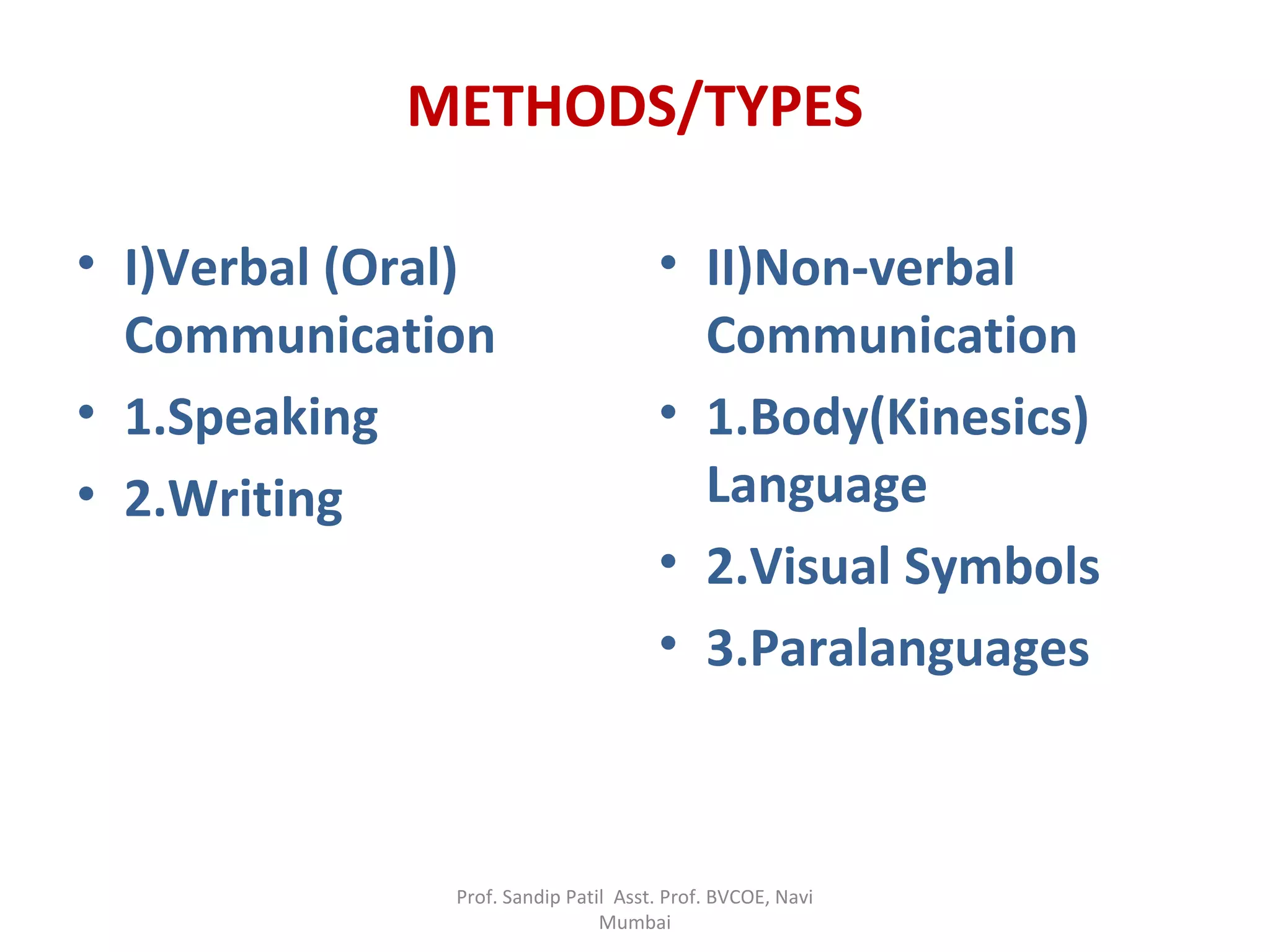
METHODS/TYPES
• I)Verbal (Oral)
Communication
• 1.Speaking
• 2.Writing
• II)Non-verbal
Communication
• 1.Body(Kinesics)
Language
• 2.Visual Symbols
• 3.Paralanguages
Prof. Sandip Patil Asst. Prof. BVCOE, Navi
Mumbai
I) Verbal (Oral) Communication
• 1.Speaking
• Face to face
communication
• Telephone
conversation
• Presentations
• Interview
• Group Discussions
• Public Speaking
• Meetings
• 2.Writing
• Letter
• Memo
• Notice
• Circular
• Report
• Minutes
Prof. Sandip Patil Asst. Prof. BVCOE, Navi
Mumbai
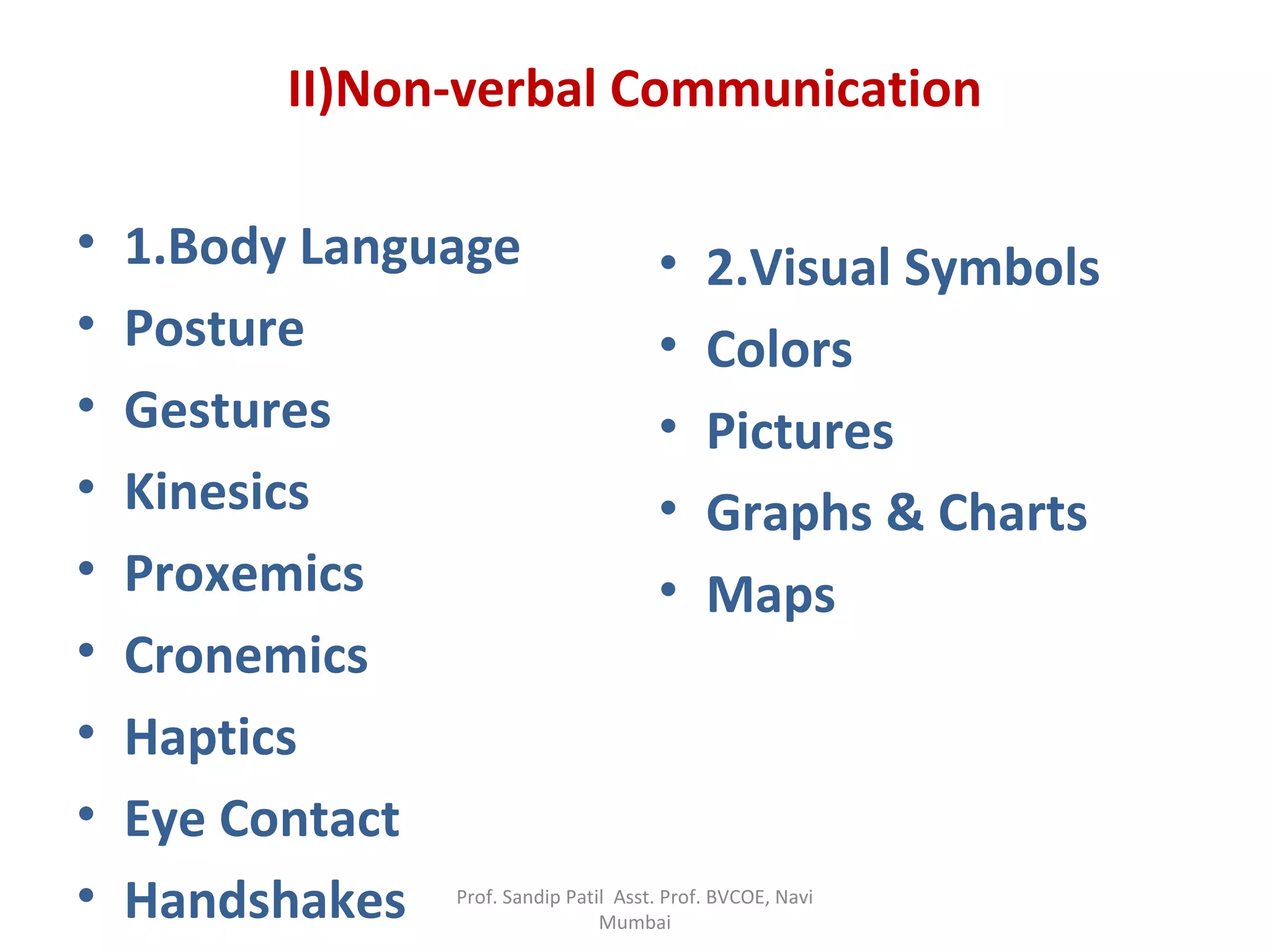
II)Non-verbal Communication
• 1.Body Language
• Posture
• Gestures
• Kinesics
• Proxemics
• Cronemics
• Haptics
• Eye Contact
• Handshakes
• 2.Visual Symbols
• Colors
• Pictures
• Graphs & Charts
• Maps
Prof. Sandip Patil Asst. Prof. BVCOE, Navi
Mumbai
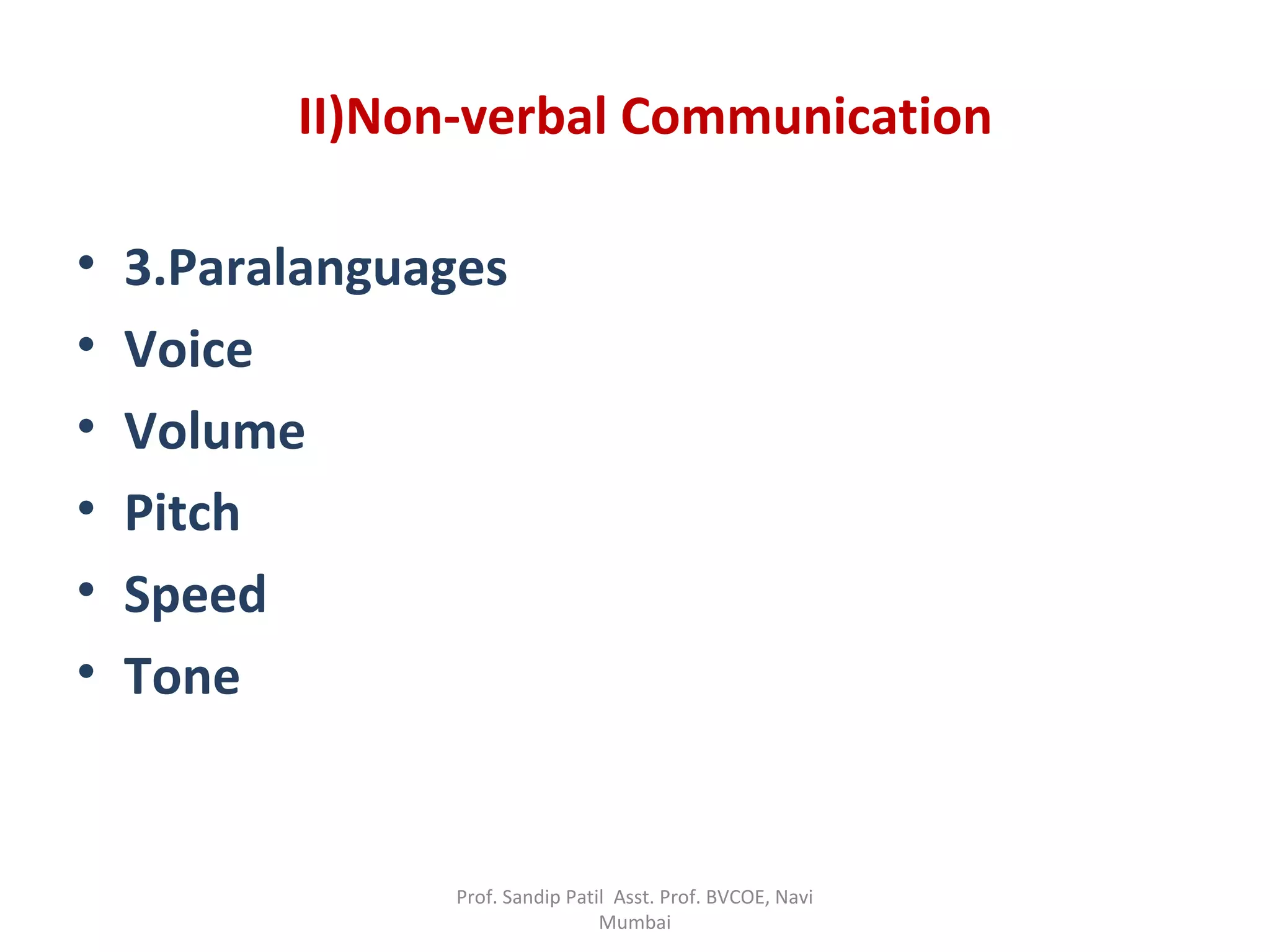
II)Non-verbal Communication
• 3.Paralanguages
• Voice
• Volume
• Pitch
• Speed
• Tone
Prof. Sandip Patil Asst. Prof. BVCOE, Navi
Mumbai
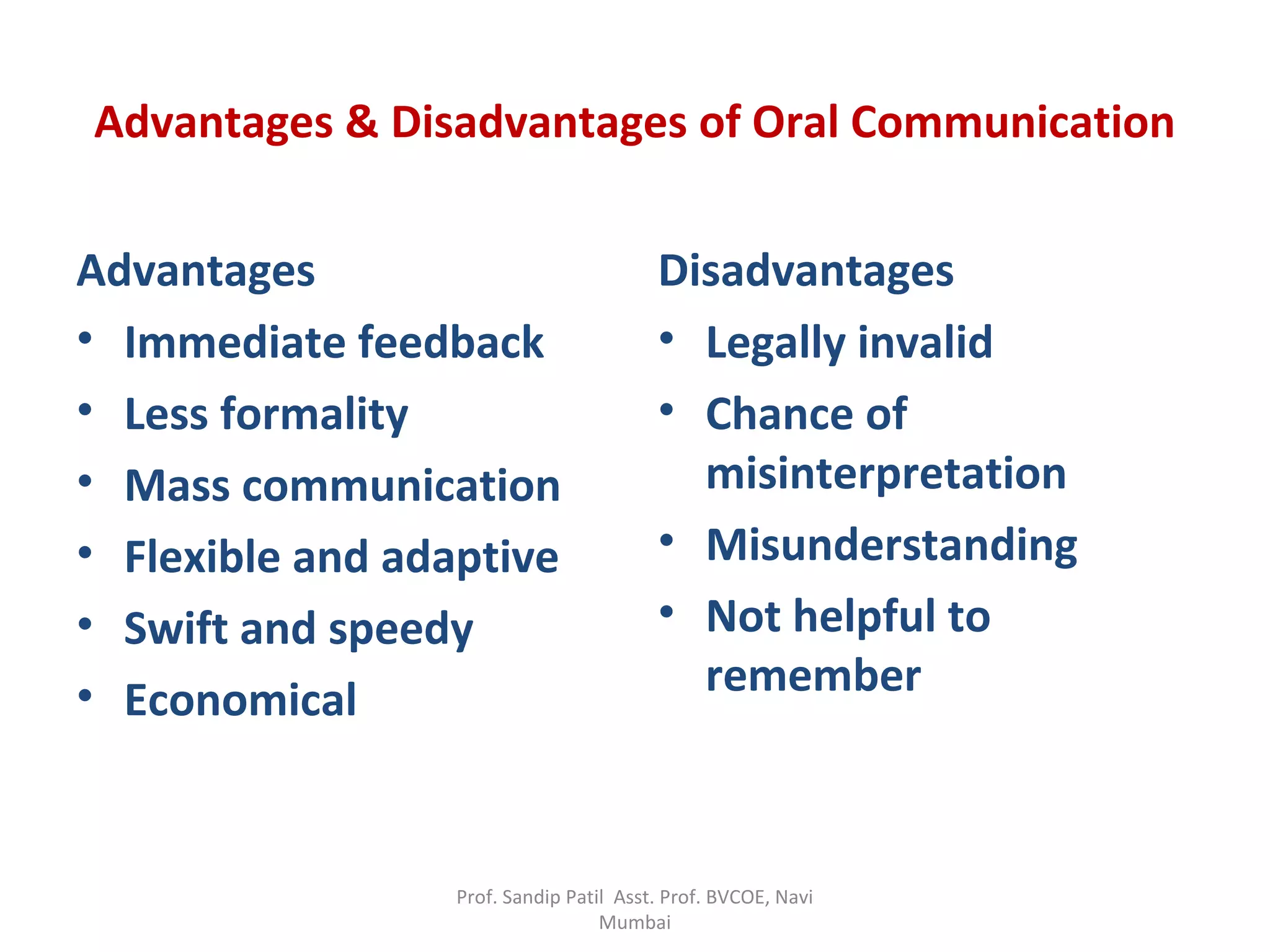
Advantages & Disadvantages of Oral Communication
Advantages
• Immediate feedback
• Less formality
• Mass communication
• Flexible and adaptive
• Swift and speedy
• Economical
Disadvantages
• Legally invalid
• Chance of
misinterpretation
• Misunderstanding
• Not helpful to
remember
Prof. Sandip Patil Asst. Prof. BVCOE, Navi
Mumbai
Advantages & Disadvantages of Written
Communication
Advantages
• Legally valid
• Provides detailed
information
• Easy to produce anytime
• Saves time, money &
energy
• Perfect
• Permanent record
• Scope to make changes
Disadvantages
• Slow & time consuming
• Difficult to change
• Delayed feedback
• Only for literate people
• Wastage of time
Prof. Sandip Patil Asst. Prof. BVCOE, Navi
Mumbai
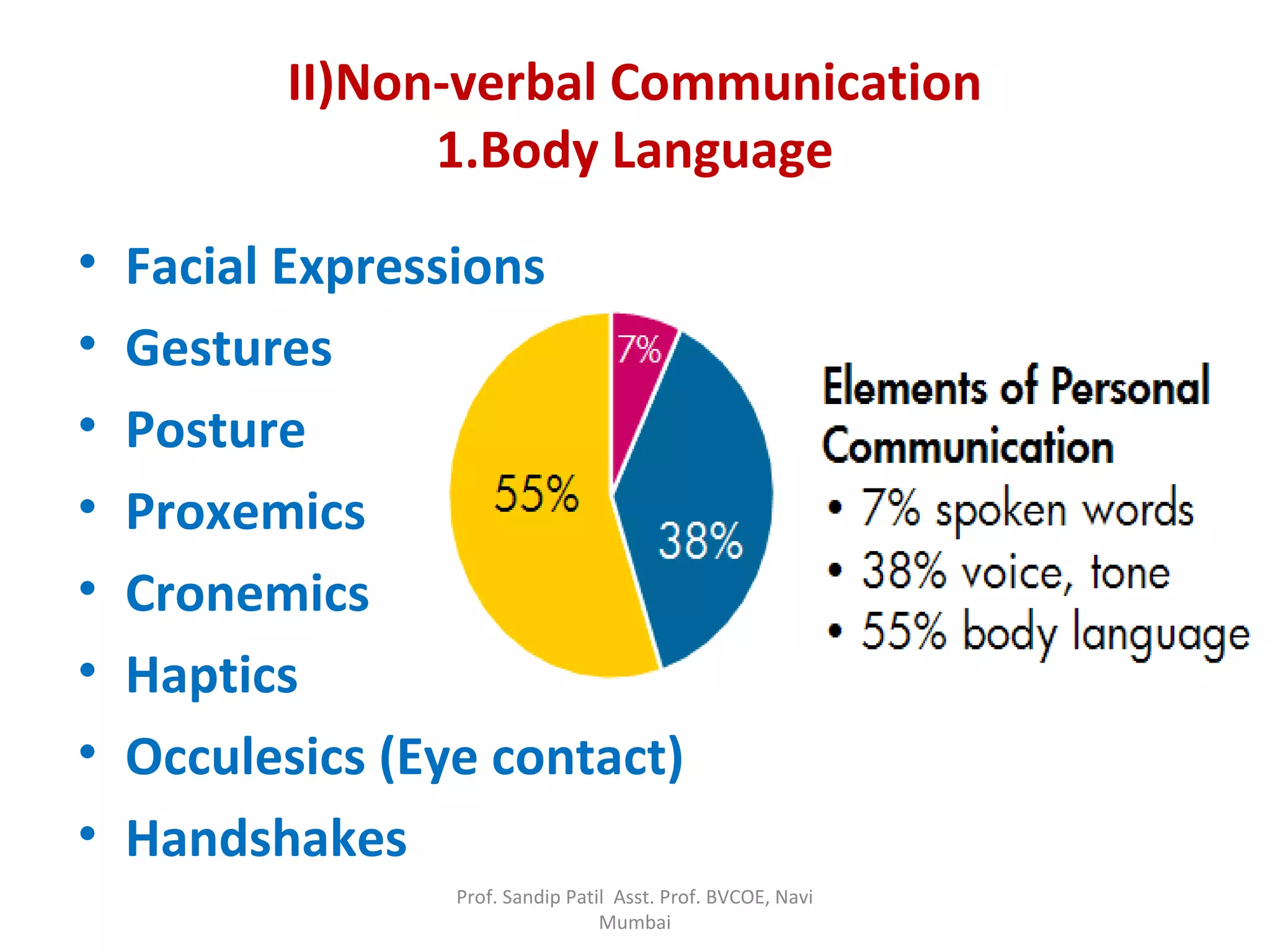
II)Non-verbal Communication
1.Body Language
• Facial Expressions
• Gestures
• Posture
• Proxemics
• Cronemics
• Haptics
• Occulesics (Eye contact)
• Handshakes
Prof. Sandip Patil Asst. Prof. BVCOE, Navi
Mumbai
1. Facial Expressions
• Facial expressions are more powerful than
words.
• Facial expression convey your mood and
attitude about the person, situation.
• Facial expressions are more effective when
accompanied by verbal speaking
Prof. Sandip Patil Asst. Prof. BVCOE, Navi
Mumbai
Prof. Sandip Patil Asst. Prof. BVCOE, Navi
Mumbai
Prof. Sandip Patil Asst. Prof. BVCOE, Navi
Mumbai
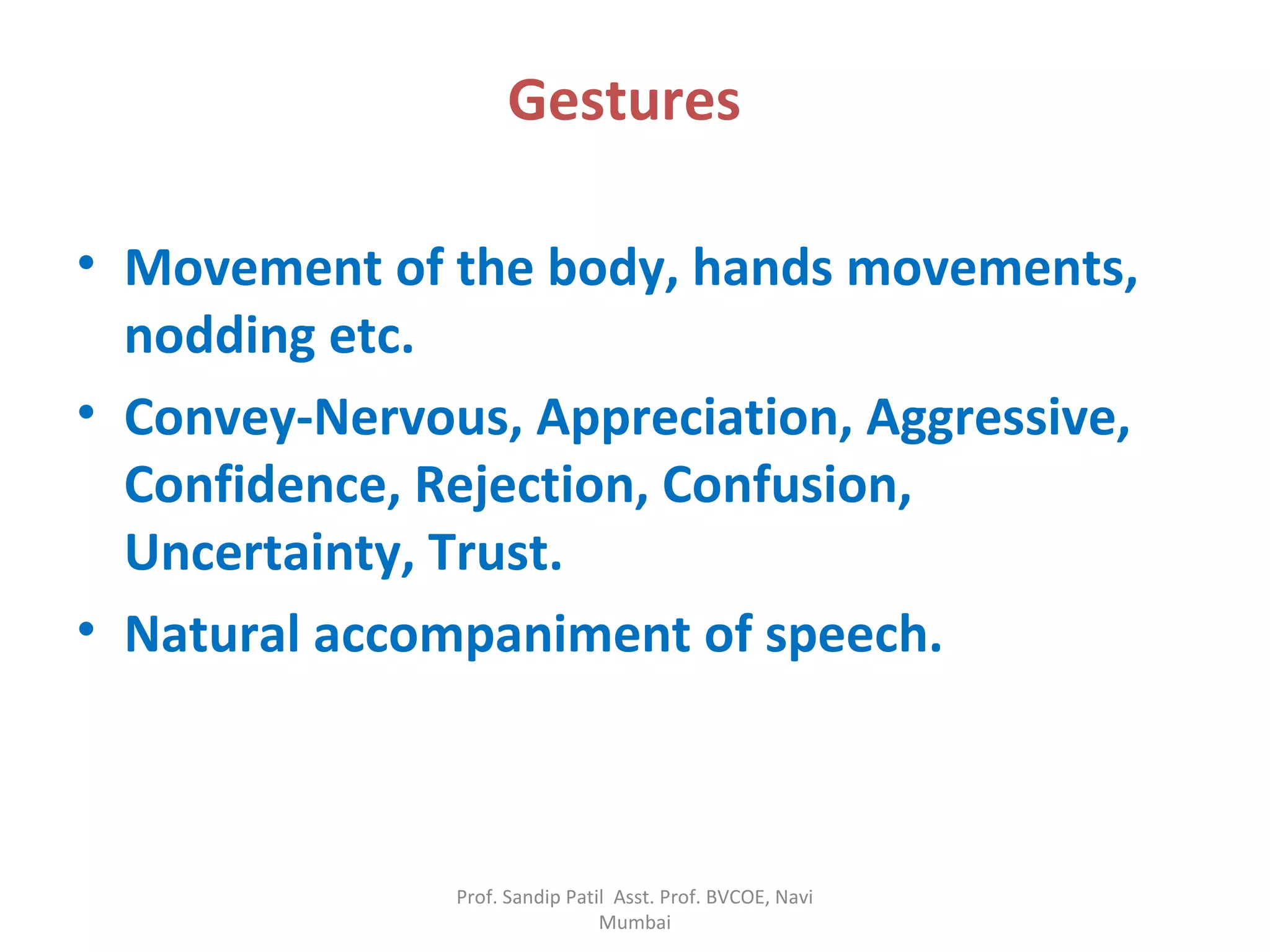
Gestures
• Movement of the body, hands movements,
nodding etc.
• Convey-Nervous, Appreciation, Aggressive,
Confidence, Rejection, Confusion,
Uncertainty, Trust.
• Natural accompaniment of speech.
Prof. Sandip Patil Asst. Prof. BVCOE, Navi
Mumbai
Prof. Sandip Patil Asst. Prof. BVCOE, Navi
Mumbai
Prof. Sandip Patil Asst. Prof. BVCOE, Navi
Mumbai
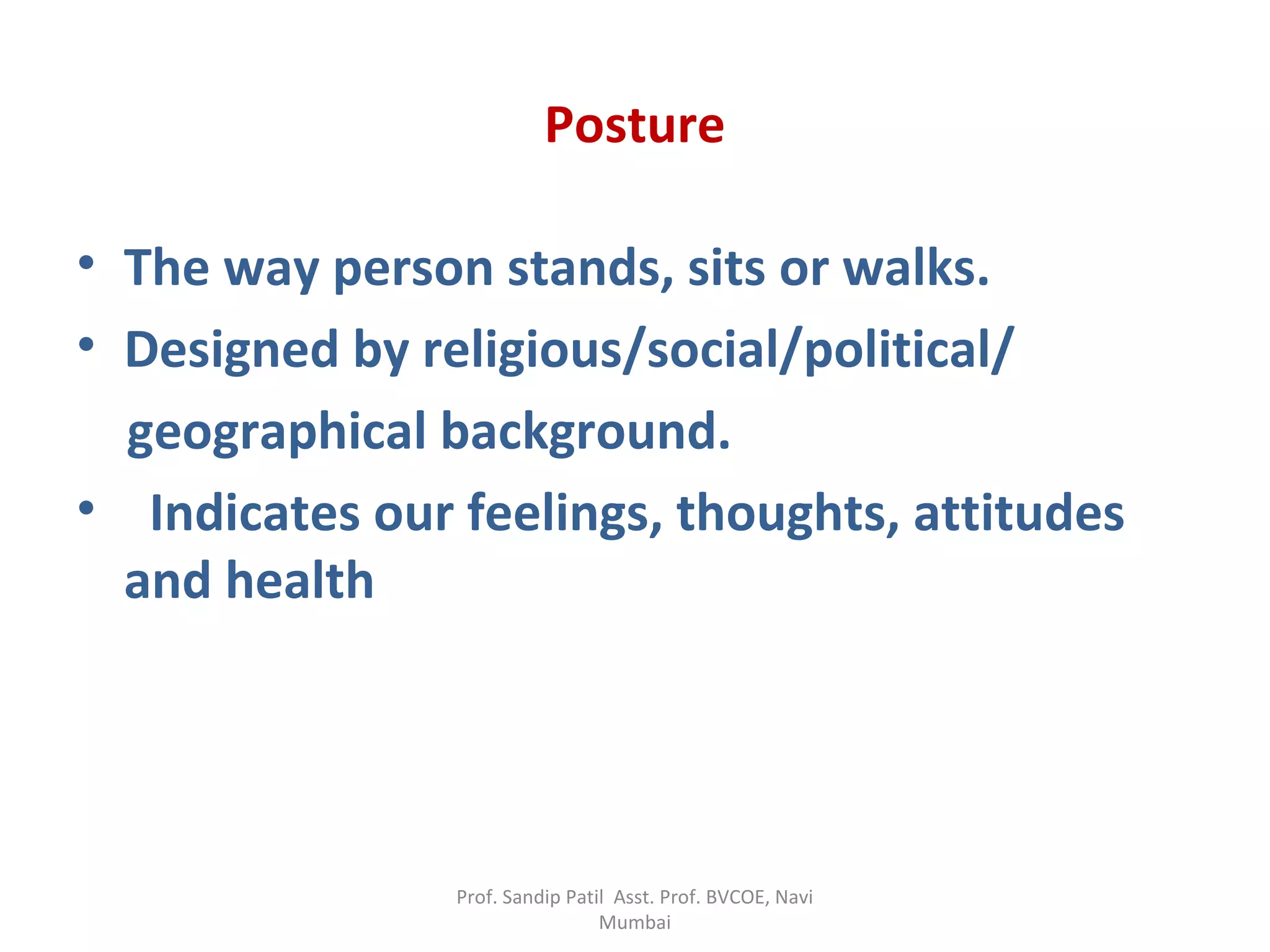
Posture
• The way person stands, sits or walks.
• Designed by religious/social/political/
geographical background.
• Indicates our feelings, thoughts, attitudes
and health
Prof. Sandip Patil Asst. Prof. BVCOE, Navi
Mumbai
Prof. Sandip Patil Asst. Prof. BVCOE, Navi
Mumbai
Posture
Prof. Sandip Patil Asst. Prof. BVCOE, Navi
Mumbai
Proxemics
• Proxemics is the way of maintaining a space
between two or more people in the process
of communication.
• Space Zones
• 1. Intimate
• 2.Personal
• 3.Social
• 4.Public
Prof. Sandip Patil Asst. Prof. BVCOE, Navi
Mumbai
Proxemics
Prof. Sandip Patil Asst. Prof. BVCOE, Navi
Mumbai
Cronemics
• Chronemics is the study of how human
beings communicate through their use of
time.
• What does time mean to one person to
another?
• How do we communicate to others?
Prof. Sandip Patil Asst. Prof. BVCOE, Navi
Mumbai
Prof. Sandip Patil Asst. Prof. BVCOE, Navi
Mumbai
Haptics
• Haptics is way of touching to another person
in the communication.
• Haptics used to show respect, love, to ease,
to support in communication.
• It shows our feelings and attitude to the
particular person or situation.
Prof. Sandip Patil Asst. Prof. BVCOE, Navi
Mumbai
Haptics
Prof. Sandip Patil Asst. Prof. BVCOE, Navi
Mumbai
Occulestics (Eye contact)
• Eye contact shows interest/disinterest,
confidence/lack of confidence,
assertiveness/aggressiveness in
communication.
Prof. Sandip Patil Asst. Prof. BVCOE, Navi
Mumbai
Occulestics (Eye contact)
Prof. Sandip Patil Asst. Prof. BVCOE, Navi
Mumbai
Handshakes
Importance of handshake
• The physical connection of
shaking hands can leave
powerful impression.
• A firm handshake with
direct eye contact set the
stage for positive
encounter.
• Proper handshake is
important
Prof. Sandip Patil Asst. Prof. BVCOE, Navi
Mumbai
2. Visual Symbols
Color
• Powerful means of communication.
• Used in clothing, design, decoration and to enliven
a dull environment.
• Associated with different moods and feelings-
white-peace and purity, red-danger, black-death
and sorrow.
• Sport teams have color in their uniform; countries
have their colors on their flags.
Prof. Sandip Patil Asst. Prof. BVCOE, Navi
Mumbai
Pictures
• “ A picture is worth of thousand words”.
• Oldest form of communication
• Pictures are used in brochures, posters and
advertisements.
• Pictures can be universally understood, easily
remembered and make an immediate
impact.
Prof. Sandip Patil Asst. Prof. BVCOE, Navi
Mumbai
Graphs & Charts
• Can present statistical information
differently.
• Special skills are needed to prepare and to
understand a chart or a graph.
• Reader can able to grasp or locate overall
information represented in a chart or a
graph.
Prof. Sandip Patil Asst. Prof. BVCOE, Navi
Mumbai
Types of Charts
Prof. Sandip Patil Asst. Prof. BVCOE, Navi
Mumbai
Maps
• Maps are representations of territory and
used for conveying the space relationships
between places.
• They can convey geographical information
like transport routes, climatic conditions,
distribution of population, crops and animal
life.
• Maps of small areas are used to give
information about routes and locate places.
Prof. Sandip Patil Asst. Prof. BVCOE, Navi
Mumbai
III. Paralanguages
• The non-verbal aspects of the spoken word
are known as paralanguage.
• Have characteristic like volume and pitch,
qualities of speed, rhythm, pronunciation,
accent, tone and stress.
Prof. Sandip Patil Asst. Prof. BVCOE, Navi
Mumbai
Paralanguages
1. Volume
• Is the loudness or softness, which can be
consciously adjusted to the number of
persons and distance in the audience.
• Too loudness suggests lack of self command
or a dominating nature.
• Volume is also influenced by one’s
surroundings and by cultural background.
Prof. Sandip Patil Asst. Prof. BVCOE, Navi
Mumbai
2. Pitch
• Is high or low note on the scale.
• A high pitch voice is unpleasant and suggests
immaturity or emotional disturbance.
• A frightened person speaks in a high pitched
voice.
Prof. Sandip Patil Asst. Prof. BVCOE, Navi
Mumbai
3. Speed
• Is partly cultural habit and is partly
influenced by emotions.
• Rapid speech indicates excitement and
reduce speed to explain a difficult idea.
Prof. Sandip Patil Asst. Prof. BVCOE, Navi
Mumbai
4. Tone
• Is the way the voice sounds and shows the
speaker’s feelings.
• The tone defines the role the speaker puts
himself in; for e.g.
• One may have authoritative tone, an
aggressive tone, a hurt tone, a sarcastic tone.
• The tone of voice can send positive or
negative signals.
Prof. Sandip Patil Asst. Prof. BVCOE, Navi
Mumbai

Methods of communication

  • 1.
    METHODS/TYPES OF COMMUNICATION VERBAL& NON-VERBAL COMMUNICATION Prof. Sandip Patil Asst. Prof. BVCOE, Navi Mumbai
  • 2.
    METHODS/TYPES • I)Verbal (Oral) Communication •1.Speaking • 2.Writing • II)Non-verbal Communication • 1.Body(Kinesics) Language • 2.Visual Symbols • 3.Paralanguages Prof. Sandip Patil Asst. Prof. BVCOE, Navi Mumbai
  • 3.
    I) Verbal (Oral)Communication • 1.Speaking • Face to face communication • Telephone conversation • Presentations • Interview • Group Discussions • Public Speaking • Meetings • 2.Writing • Letter • Memo • Notice • Circular • Report • Minutes Prof. Sandip Patil Asst. Prof. BVCOE, Navi Mumbai
  • 4.
    II)Non-verbal Communication • 1.BodyLanguage • Posture • Gestures • Kinesics • Proxemics • Cronemics • Haptics • Eye Contact • Handshakes • 2.Visual Symbols • Colors • Pictures • Graphs & Charts • Maps Prof. Sandip Patil Asst. Prof. BVCOE, Navi Mumbai
  • 5.
    II)Non-verbal Communication • 3.Paralanguages •Voice • Volume • Pitch • Speed • Tone Prof. Sandip Patil Asst. Prof. BVCOE, Navi Mumbai
  • 6.
    Advantages & Disadvantagesof Oral Communication Advantages • Immediate feedback • Less formality • Mass communication • Flexible and adaptive • Swift and speedy • Economical Disadvantages • Legally invalid • Chance of misinterpretation • Misunderstanding • Not helpful to remember Prof. Sandip Patil Asst. Prof. BVCOE, Navi Mumbai
  • 7.
    Advantages & Disadvantagesof Written Communication Advantages • Legally valid • Provides detailed information • Easy to produce anytime • Saves time, money & energy • Perfect • Permanent record • Scope to make changes Disadvantages • Slow & time consuming • Difficult to change • Delayed feedback • Only for literate people • Wastage of time Prof. Sandip Patil Asst. Prof. BVCOE, Navi Mumbai
  • 8.
    II)Non-verbal Communication 1.Body Language •Facial Expressions • Gestures • Posture • Proxemics • Cronemics • Haptics • Occulesics (Eye contact) • Handshakes Prof. Sandip Patil Asst. Prof. BVCOE, Navi Mumbai
  • 9.
    1. Facial Expressions •Facial expressions are more powerful than words. • Facial expression convey your mood and attitude about the person, situation. • Facial expressions are more effective when accompanied by verbal speaking Prof. Sandip Patil Asst. Prof. BVCOE, Navi Mumbai
  • 10.
    Prof. Sandip PatilAsst. Prof. BVCOE, Navi Mumbai
  • 11.
    Prof. Sandip PatilAsst. Prof. BVCOE, Navi Mumbai
  • 12.
    Gestures • Movement ofthe body, hands movements, nodding etc. • Convey-Nervous, Appreciation, Aggressive, Confidence, Rejection, Confusion, Uncertainty, Trust. • Natural accompaniment of speech. Prof. Sandip Patil Asst. Prof. BVCOE, Navi Mumbai
  • 13.
    Prof. Sandip PatilAsst. Prof. BVCOE, Navi Mumbai
  • 14.
    Prof. Sandip PatilAsst. Prof. BVCOE, Navi Mumbai
  • 15.
    Posture • The wayperson stands, sits or walks. • Designed by religious/social/political/ geographical background. • Indicates our feelings, thoughts, attitudes and health Prof. Sandip Patil Asst. Prof. BVCOE, Navi Mumbai
  • 16.
    Prof. Sandip PatilAsst. Prof. BVCOE, Navi Mumbai
  • 17.
    Posture Prof. Sandip PatilAsst. Prof. BVCOE, Navi Mumbai
  • 18.
    Proxemics • Proxemics isthe way of maintaining a space between two or more people in the process of communication. • Space Zones • 1. Intimate • 2.Personal • 3.Social • 4.Public Prof. Sandip Patil Asst. Prof. BVCOE, Navi Mumbai
  • 19.
    Proxemics Prof. Sandip PatilAsst. Prof. BVCOE, Navi Mumbai
  • 20.
    Cronemics • Chronemics isthe study of how human beings communicate through their use of time. • What does time mean to one person to another? • How do we communicate to others? Prof. Sandip Patil Asst. Prof. BVCOE, Navi Mumbai
  • 21.
    Prof. Sandip PatilAsst. Prof. BVCOE, Navi Mumbai
  • 22.
    Haptics • Haptics isway of touching to another person in the communication. • Haptics used to show respect, love, to ease, to support in communication. • It shows our feelings and attitude to the particular person or situation. Prof. Sandip Patil Asst. Prof. BVCOE, Navi Mumbai
  • 23.
    Haptics Prof. Sandip PatilAsst. Prof. BVCOE, Navi Mumbai
  • 24.
    Occulestics (Eye contact) •Eye contact shows interest/disinterest, confidence/lack of confidence, assertiveness/aggressiveness in communication. Prof. Sandip Patil Asst. Prof. BVCOE, Navi Mumbai
  • 25.
    Occulestics (Eye contact) Prof.Sandip Patil Asst. Prof. BVCOE, Navi Mumbai
  • 26.
    Handshakes Importance of handshake •The physical connection of shaking hands can leave powerful impression. • A firm handshake with direct eye contact set the stage for positive encounter. • Proper handshake is important Prof. Sandip Patil Asst. Prof. BVCOE, Navi Mumbai
  • 27.
    2. Visual Symbols Color •Powerful means of communication. • Used in clothing, design, decoration and to enliven a dull environment. • Associated with different moods and feelings- white-peace and purity, red-danger, black-death and sorrow. • Sport teams have color in their uniform; countries have their colors on their flags. Prof. Sandip Patil Asst. Prof. BVCOE, Navi Mumbai
  • 28.
    Pictures • “ Apicture is worth of thousand words”. • Oldest form of communication • Pictures are used in brochures, posters and advertisements. • Pictures can be universally understood, easily remembered and make an immediate impact. Prof. Sandip Patil Asst. Prof. BVCOE, Navi Mumbai
  • 29.
    Graphs & Charts •Can present statistical information differently. • Special skills are needed to prepare and to understand a chart or a graph. • Reader can able to grasp or locate overall information represented in a chart or a graph. Prof. Sandip Patil Asst. Prof. BVCOE, Navi Mumbai
  • 30.
    Types of Charts Prof.Sandip Patil Asst. Prof. BVCOE, Navi Mumbai
  • 31.
    Maps • Maps arerepresentations of territory and used for conveying the space relationships between places. • They can convey geographical information like transport routes, climatic conditions, distribution of population, crops and animal life. • Maps of small areas are used to give information about routes and locate places. Prof. Sandip Patil Asst. Prof. BVCOE, Navi Mumbai
  • 32.
    III. Paralanguages • Thenon-verbal aspects of the spoken word are known as paralanguage. • Have characteristic like volume and pitch, qualities of speed, rhythm, pronunciation, accent, tone and stress. Prof. Sandip Patil Asst. Prof. BVCOE, Navi Mumbai
  • 33.
    Paralanguages 1. Volume • Isthe loudness or softness, which can be consciously adjusted to the number of persons and distance in the audience. • Too loudness suggests lack of self command or a dominating nature. • Volume is also influenced by one’s surroundings and by cultural background. Prof. Sandip Patil Asst. Prof. BVCOE, Navi Mumbai
  • 34.
    2. Pitch • Ishigh or low note on the scale. • A high pitch voice is unpleasant and suggests immaturity or emotional disturbance. • A frightened person speaks in a high pitched voice. Prof. Sandip Patil Asst. Prof. BVCOE, Navi Mumbai
  • 35.
    3. Speed • Ispartly cultural habit and is partly influenced by emotions. • Rapid speech indicates excitement and reduce speed to explain a difficult idea. Prof. Sandip Patil Asst. Prof. BVCOE, Navi Mumbai
  • 36.
    4. Tone • Isthe way the voice sounds and shows the speaker’s feelings. • The tone defines the role the speaker puts himself in; for e.g. • One may have authoritative tone, an aggressive tone, a hurt tone, a sarcastic tone. • The tone of voice can send positive or negative signals. Prof. Sandip Patil Asst. Prof. BVCOE, Navi Mumbai