Communication
The Process and its Elements
Presented By
What is Communication?
• Transmitting information, ideas and attitudes from one person to another.
• Personal process
• Occurs between people
• Involves change in behavior
• Expression of thoughts and emotions through words & actions.
• It is a social and emotional process.
Features of Communication
• Two-way Process
• Information Sharing and Understanding
• Verbal and Non-Verbal
• Circular Flow
• Goal Oriented
• Continuous Process
• Pervasive Activity
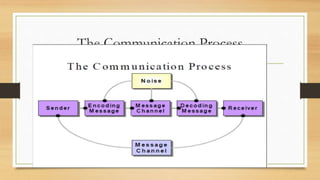
The Communication Process
Components of Communication
• Message
• Message is a key idea that the sender wants to communicate. It is a sign that
elicits the response of recipient. Communication process begins with
deciding about the message to be conveyed. It must be ensured that the main
objective of the message is clear
Components of Communication
• Sender / Encoder
• The person who sends the message. A sender makes use of symbols (words
or graphic or visual aids) to convey the message and produce the required
response. For instance - a training manager conducting training for new
batch of employees. Sender may be an individual or a group or an
organization. The views, background, approach, skills, competencies, and
knowledge of the sender have a great impact on the message.
Components of Communication
• Encoding
• Encoding is the process where the information you would like to
communicate gets transferred into a form to be sent and decoded by the
receiver.
Components of Communication
• Channel/Medium
• Channels are the way you convey your message.
• Include verbal such as telephone, and face-to-face conversations as well as non-
verbal such as e-mail and text messaging.
• Own strengths and weaknesses in terms of communicating. For instance - Written
medium is chosen when a message has to be conveyed to a small group of people,
while an oral medium is chosen when spontaneous feedback is required from the
recipient as misunderstandings are cleared then and there.
Components of Communication
• Decoding
• Decoding is on the receiving end of communication. This stage is just as
important as encoding. Communication can go downhill at this stage if the
receiver is not practicing active listening skills or if they do not possess
enough information to accurately decode the message
Components of Communication
• Receiver
• Receiver is a person for whom the message is intended or aimed. The degree
to which the decoder understands the message is dependent upon various
factors such as knowledge of recipient, their responsiveness to the message,
and the reliance of encoder on decoder.
Components of Communication
• Feedback
• Feedback is the main component of communication process as it permits
the sender to analyze the efficacy of the message. It helps the sender in
confirming the correct interpretation of message by the decoder. Feedback
may be verbal (through words) or non-verbal (in form of smiles, sighs, etc.).
It may take written form also in form of memos, reports, etc.
Components of Communication
• Noise
• Every communication process is bound to be disturbed by one or another
kind of noise. It interfere with the transportation and interpretation of
information from the sender to the receiver.
• Can be physical or psychological
• Impacts the effectivity of communication
THANK YOU
FOR THE
ATTENTION
ANY QUESTIONS??

Communication and its elements

  • 1.
  • 2.
  • 3.
    What is Communication? •Transmitting information, ideas and attitudes from one person to another. • Personal process • Occurs between people • Involves change in behavior • Expression of thoughts and emotions through words & actions. • It is a social and emotional process.
  • 4.
    Features of Communication •Two-way Process • Information Sharing and Understanding • Verbal and Non-Verbal • Circular Flow • Goal Oriented • Continuous Process • Pervasive Activity
  • 5.
  • 6.
    Components of Communication •Message • Message is a key idea that the sender wants to communicate. It is a sign that elicits the response of recipient. Communication process begins with deciding about the message to be conveyed. It must be ensured that the main objective of the message is clear
  • 7.
    Components of Communication •Sender / Encoder • The person who sends the message. A sender makes use of symbols (words or graphic or visual aids) to convey the message and produce the required response. For instance - a training manager conducting training for new batch of employees. Sender may be an individual or a group or an organization. The views, background, approach, skills, competencies, and knowledge of the sender have a great impact on the message.
  • 8.
    Components of Communication •Encoding • Encoding is the process where the information you would like to communicate gets transferred into a form to be sent and decoded by the receiver.
  • 9.
    Components of Communication •Channel/Medium • Channels are the way you convey your message. • Include verbal such as telephone, and face-to-face conversations as well as non- verbal such as e-mail and text messaging. • Own strengths and weaknesses in terms of communicating. For instance - Written medium is chosen when a message has to be conveyed to a small group of people, while an oral medium is chosen when spontaneous feedback is required from the recipient as misunderstandings are cleared then and there.
  • 10.
    Components of Communication •Decoding • Decoding is on the receiving end of communication. This stage is just as important as encoding. Communication can go downhill at this stage if the receiver is not practicing active listening skills or if they do not possess enough information to accurately decode the message
  • 11.
    Components of Communication •Receiver • Receiver is a person for whom the message is intended or aimed. The degree to which the decoder understands the message is dependent upon various factors such as knowledge of recipient, their responsiveness to the message, and the reliance of encoder on decoder.
  • 12.
    Components of Communication •Feedback • Feedback is the main component of communication process as it permits the sender to analyze the efficacy of the message. It helps the sender in confirming the correct interpretation of message by the decoder. Feedback may be verbal (through words) or non-verbal (in form of smiles, sighs, etc.). It may take written form also in form of memos, reports, etc.
  • 13.
    Components of Communication •Noise • Every communication process is bound to be disturbed by one or another kind of noise. It interfere with the transportation and interpretation of information from the sender to the receiver. • Can be physical or psychological • Impacts the effectivity of communication
  • 14.