

Non verbal communication
Shashiknth
Nurse Consultant
TVET Authority , Male , Maldives
Introduction
 Nonverbal communication is
does not involve words, but is
equally important in the
healthcare setting.
 A great deal about others can
be learnt simply by observing
people or their nonverbal
behaviour
Objective elements
 Identify the key components of non verbal
communication.
 State the role of non verbal stimulus in communication
 Identify the key components of body language and their
functions in communication
 Identify at least five qualities of an effective
communicator.
What is nonverbal communication?
 Nonverbal Communication =
Communication without words
Nonverbal communication involves everything
except spoken or written words.
According to Kozier, Erb, Berman & Snyder,
(2004) nonverbal communication is sometimes
called body language and includes gestures,
body movements, use of touch, and physical
appearance, including adornment.
Importance of Nonverbal
Communication
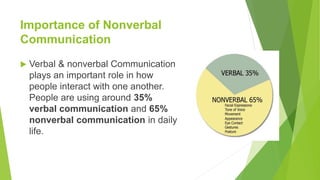
 Verbal & nonverbal Communication
plays an important role in how
people interact with one another.
People are using around 35%
verbal communication and 65%
nonverbal communication in daily
life.
Key components of nonverbal
communication
 Facial expression
 Eye contact
 Gesture
 Touch
 Posture
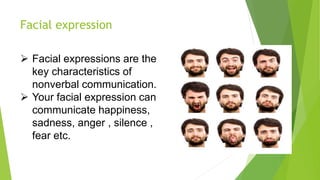
Facial expression
 Facial expressions are the
key characteristics of
nonverbal communication.
 Your facial expression can
communicate happiness,
sadness, anger , silence ,
fear etc.
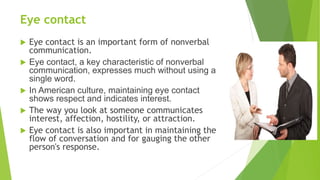
Eye contact
 Eye contact is an important form of nonverbal
communication.
 Eye contact, a key characteristic of nonverbal
communication, expresses much without using a
single word.
 In American culture, maintaining eye contact
shows respect and indicates interest.
 The way you look at someone communicates
interest, affection, hostility, or attraction.
 Eye contact is also important in maintaining the
flow of conversation and for gauging the other
person's response.
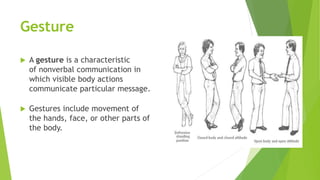
Gesture
 A gesture is a characteristic
of nonverbal communication in
which visible body actions
communicate particular message.
 Gestures include movement of
the hands, face, or other parts of
the body.
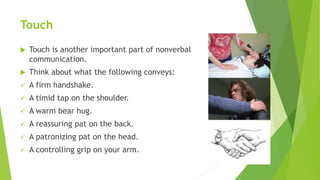
Touch
 Touch is another important part of nonverbal
communication.
 Think about what the following conveys:
 A firm handshake.
 A timid tap on the shoulder.
 A warm bear hug.
 A reassuring pat on the back.
 A patronizing pat on the head.
 A controlling grip on your arm.
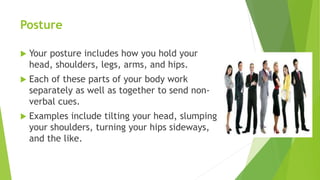
Posture
 Your posture includes how you hold your
head, shoulders, legs, arms, and hips.
 Each of these parts of your body work
separately as well as together to send non-
verbal cues.
 Examples include tilting your head, slumping
your shoulders, turning your hips sideways,
and the like.
Role of nonverbal stimulus in
communication
 Nonverbal communication either reinforces or contradicts
the verbal message.
 For example, if a nurse says to a client, "I'd be happy to
sit here and talk to you for a while," yet glances nervously
at a watch every few seconds, the actions contradict the
verbal message.
 The client is more likely to believe the nonverbal
behaviour, which conveys "I am very busy and need to
leave."
Contnd…
 Observing nonverbal behaviour requires a
systematic assessment of the person's overall
physical appearance, posture, gait, facial
expressions, and gestures and whatever observed
should be clarified from the client.
 For example, the nurse might say, "You look like
you have been crying. Is something upsetting
you?"
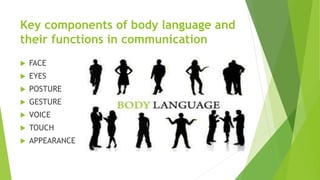
Key components of body language and
their functions in communication
 FACE
 EYES
 POSTURE
 GESTURE
 VOICE
 TOUCH
 APPEARANCE
Qualities of an effective communicator
 Listen
 Simplify the Complex
 Knows When to Speak Up
 Confidence
 Specific
 Clarity
 Ask Questions

Nonverbal communication

  • 1.
    Non verbal communication Shashiknth NurseConsultant TVET Authority , Male , Maldives
  • 2.
    Introduction  Nonverbal communicationis does not involve words, but is equally important in the healthcare setting.  A great deal about others can be learnt simply by observing people or their nonverbal behaviour
  • 3.
    Objective elements  Identifythe key components of non verbal communication.  State the role of non verbal stimulus in communication  Identify the key components of body language and their functions in communication  Identify at least five qualities of an effective communicator.
  • 4.
    What is nonverbalcommunication?  Nonverbal Communication = Communication without words Nonverbal communication involves everything except spoken or written words. According to Kozier, Erb, Berman & Snyder, (2004) nonverbal communication is sometimes called body language and includes gestures, body movements, use of touch, and physical appearance, including adornment.
  • 5.
    Importance of Nonverbal Communication Verbal & nonverbal Communication plays an important role in how people interact with one another. People are using around 35% verbal communication and 65% nonverbal communication in daily life.
  • 6.
    Key components ofnonverbal communication  Facial expression  Eye contact  Gesture  Touch  Posture
  • 7.
    Facial expression  Facialexpressions are the key characteristics of nonverbal communication.  Your facial expression can communicate happiness, sadness, anger , silence , fear etc.
  • 8.
    Eye contact  Eyecontact is an important form of nonverbal communication.  Eye contact, a key characteristic of nonverbal communication, expresses much without using a single word.  In American culture, maintaining eye contact shows respect and indicates interest.  The way you look at someone communicates interest, affection, hostility, or attraction.  Eye contact is also important in maintaining the flow of conversation and for gauging the other person's response.
  • 9.
    Gesture  A gestureis a characteristic of nonverbal communication in which visible body actions communicate particular message.  Gestures include movement of the hands, face, or other parts of the body.
  • 10.
    Touch  Touch isanother important part of nonverbal communication.  Think about what the following conveys:  A firm handshake.  A timid tap on the shoulder.  A warm bear hug.  A reassuring pat on the back.  A patronizing pat on the head.  A controlling grip on your arm.
  • 11.
    Posture  Your postureincludes how you hold your head, shoulders, legs, arms, and hips.  Each of these parts of your body work separately as well as together to send non- verbal cues.  Examples include tilting your head, slumping your shoulders, turning your hips sideways, and the like.
  • 12.
    Role of nonverbalstimulus in communication  Nonverbal communication either reinforces or contradicts the verbal message.  For example, if a nurse says to a client, "I'd be happy to sit here and talk to you for a while," yet glances nervously at a watch every few seconds, the actions contradict the verbal message.  The client is more likely to believe the nonverbal behaviour, which conveys "I am very busy and need to leave."
  • 13.
    Contnd…  Observing nonverbalbehaviour requires a systematic assessment of the person's overall physical appearance, posture, gait, facial expressions, and gestures and whatever observed should be clarified from the client.  For example, the nurse might say, "You look like you have been crying. Is something upsetting you?"
  • 14.
    Key components ofbody language and their functions in communication  FACE  EYES  POSTURE  GESTURE  VOICE  TOUCH  APPEARANCE
  • 15.
    Qualities of aneffective communicator  Listen  Simplify the Complex  Knows When to Speak Up  Confidence  Specific  Clarity  Ask Questions