NON-VERBAL
COMMUNICATION
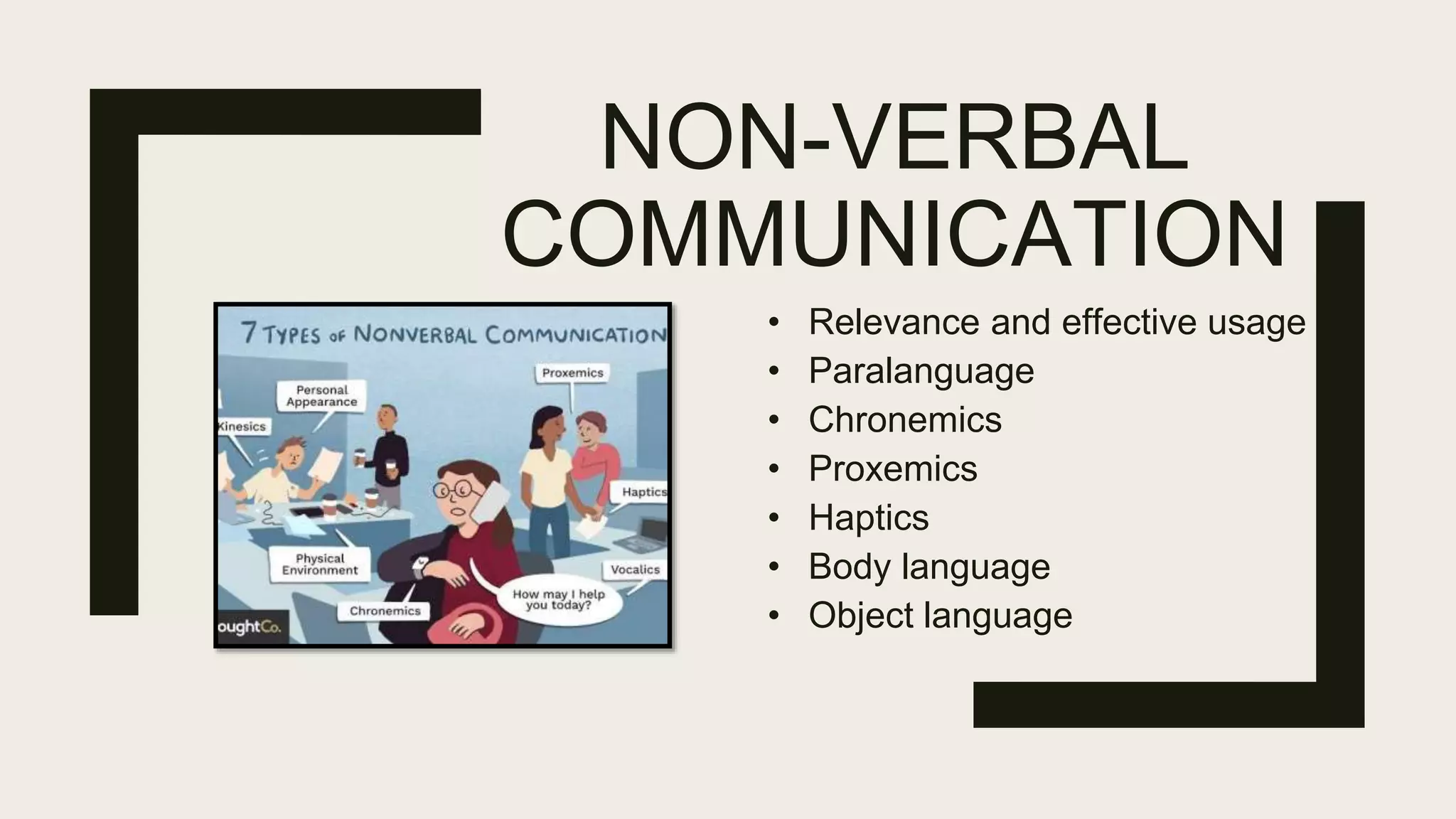
• Relevance and effective usage
• Paralanguage
• Chronemics
• Proxemics
• Haptics
• Body language
• Object language
Introduction:
How do you make people feel when
you enter the room?
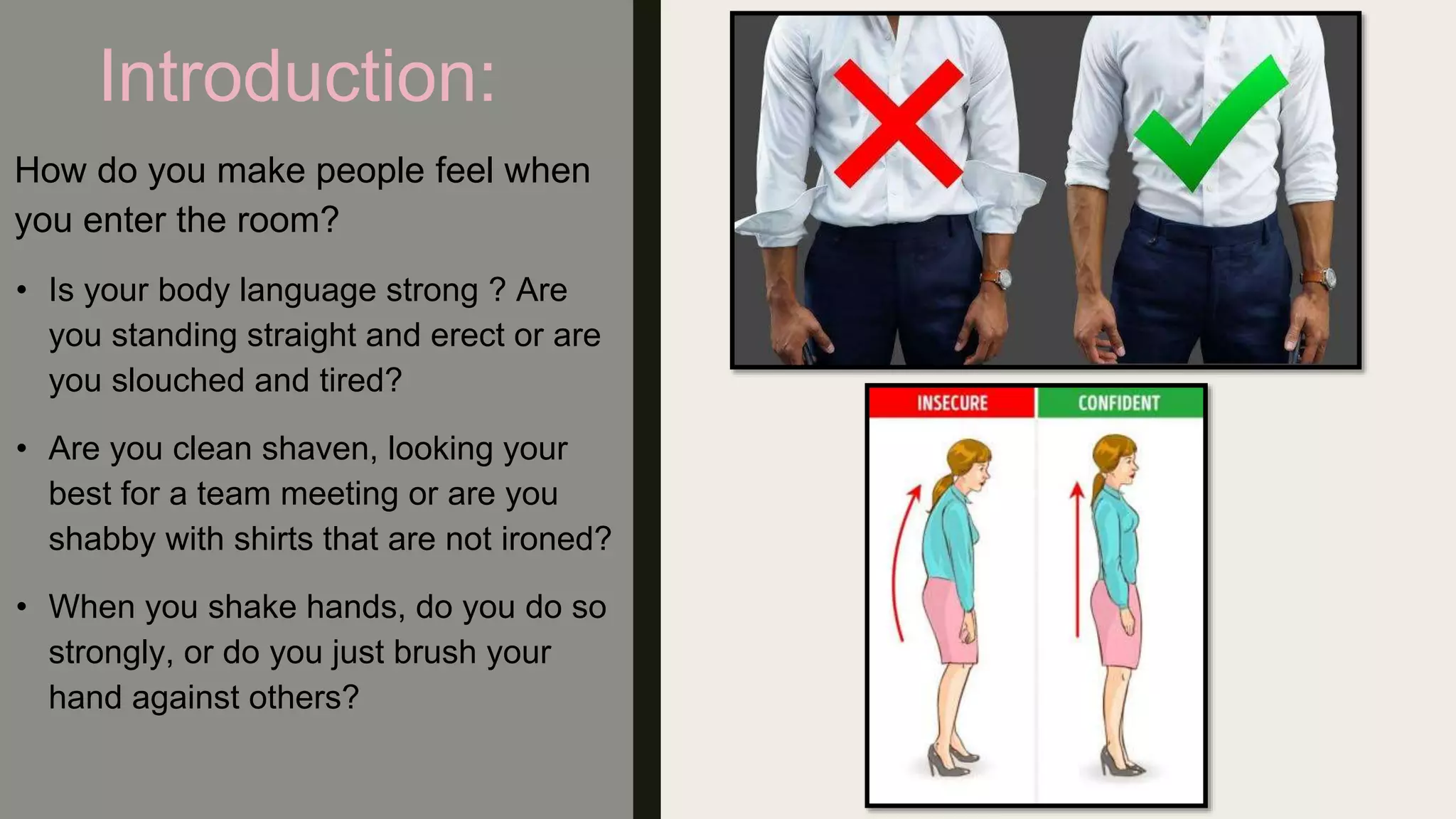
• Is your body language strong ? Are
you standing straight and erect or are
you slouched and tired?
• Are you clean shaven, looking your
best for a team meeting or are you
shabby with shirts that are not ironed?
• When you shake hands, do you do so
strongly, or do you just brush your
hand against others?
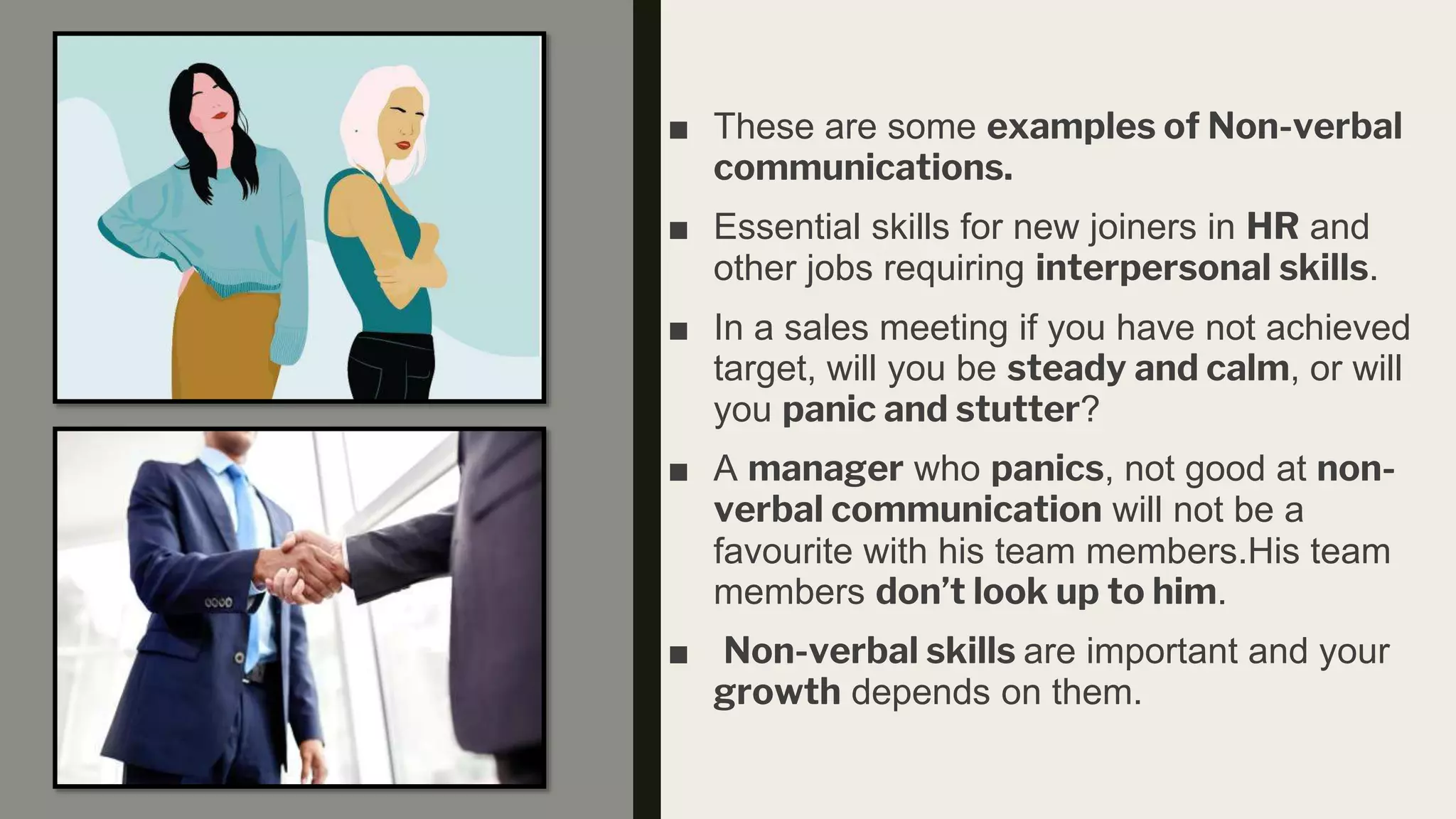
■ These are some examples of Non-verbal
communications.
■ Essential skills for new joiners in HR and
other jobs requiring interpersonal skills.
■ In a sales meeting if you have not achieved
target, will you be steady and calm, or will
you panic and stutter?
■ A manager who panics, not good at non-
verbal communication will not be a
favourite with his team members.His team
members don’t look up to him.
■ Non-verbal skills are important and your
growth depends on them.
Verbal and Non-verbal
communication:
■ Verbal communication happens through
verbally, vocally or through written words
which express or convey the message to
others.
– Types:
■ Verbal Communication
■ Non-Verbal Communication
■ Non-verbal communication happens
without word of mouth, spoken words,
conversation and written languages.
■ Happens through signs, symbols, colours,
gestures, body language or any facial
expressions and paralanguage.
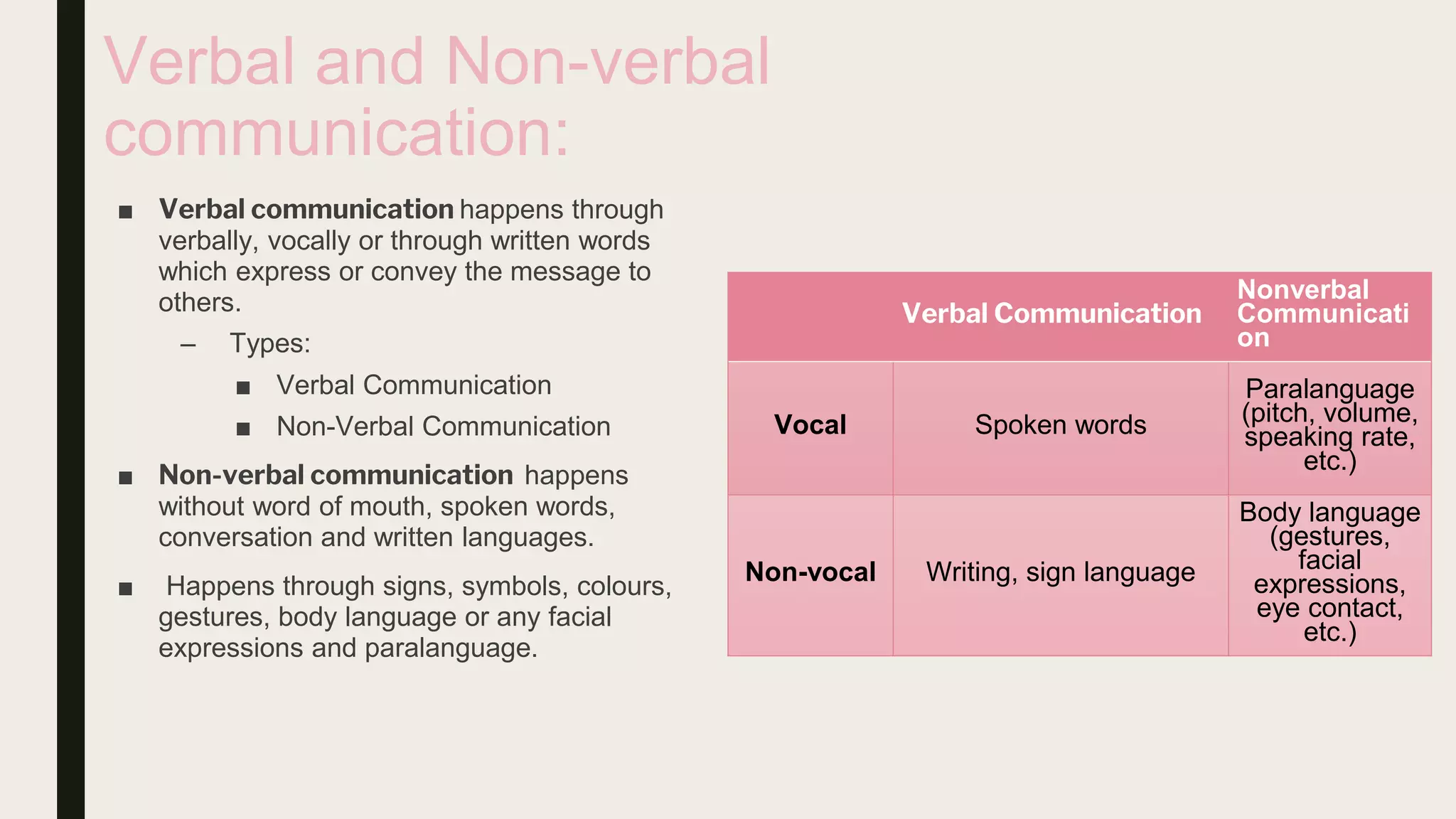
Verbal Communication
Nonverbal
Communicati
on
Vocal Spoken words
Paralanguage
(pitch, volume,
speaking rate,
etc.)
Non-vocal Writing, sign language
Body language
(gestures,
facial
expressions,
eye contact,
etc.)
Characteristics:
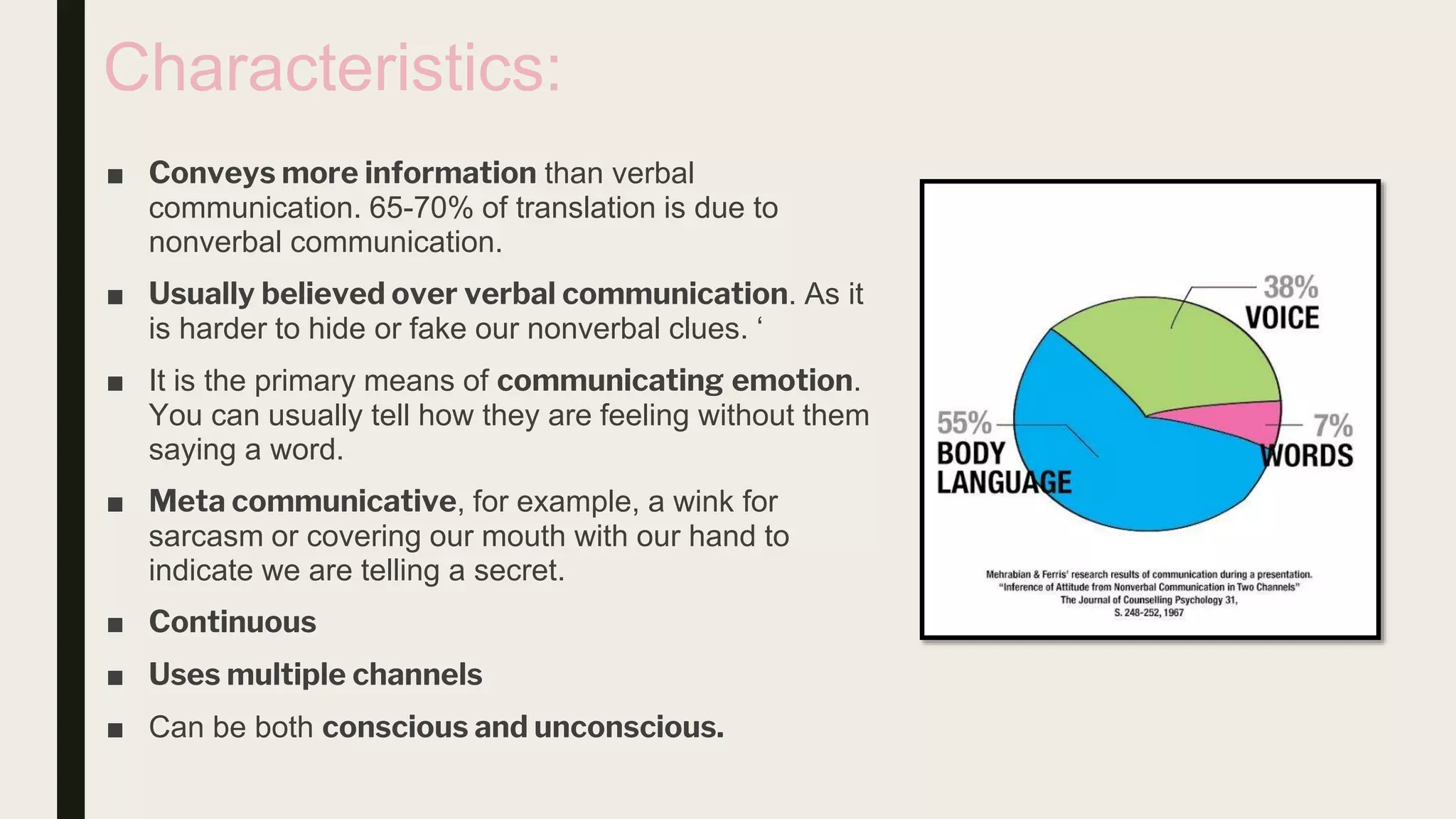
■ Conveys more information than verbal
communication. 65-70% of translation is due to
nonverbal communication.
■ Usually believed over verbal communication. As it
is harder to hide or fake our nonverbal clues. ‘
■ It is the primary means of communicating emotion.
You can usually tell how they are feeling without them
saying a word.
■ Meta communicative, for example, a wink for
sarcasm or covering our mouth with our hand to
indicate we are telling a secret.
■ Continuous
■ Uses multiple channels
■ Can be both conscious and unconscious.
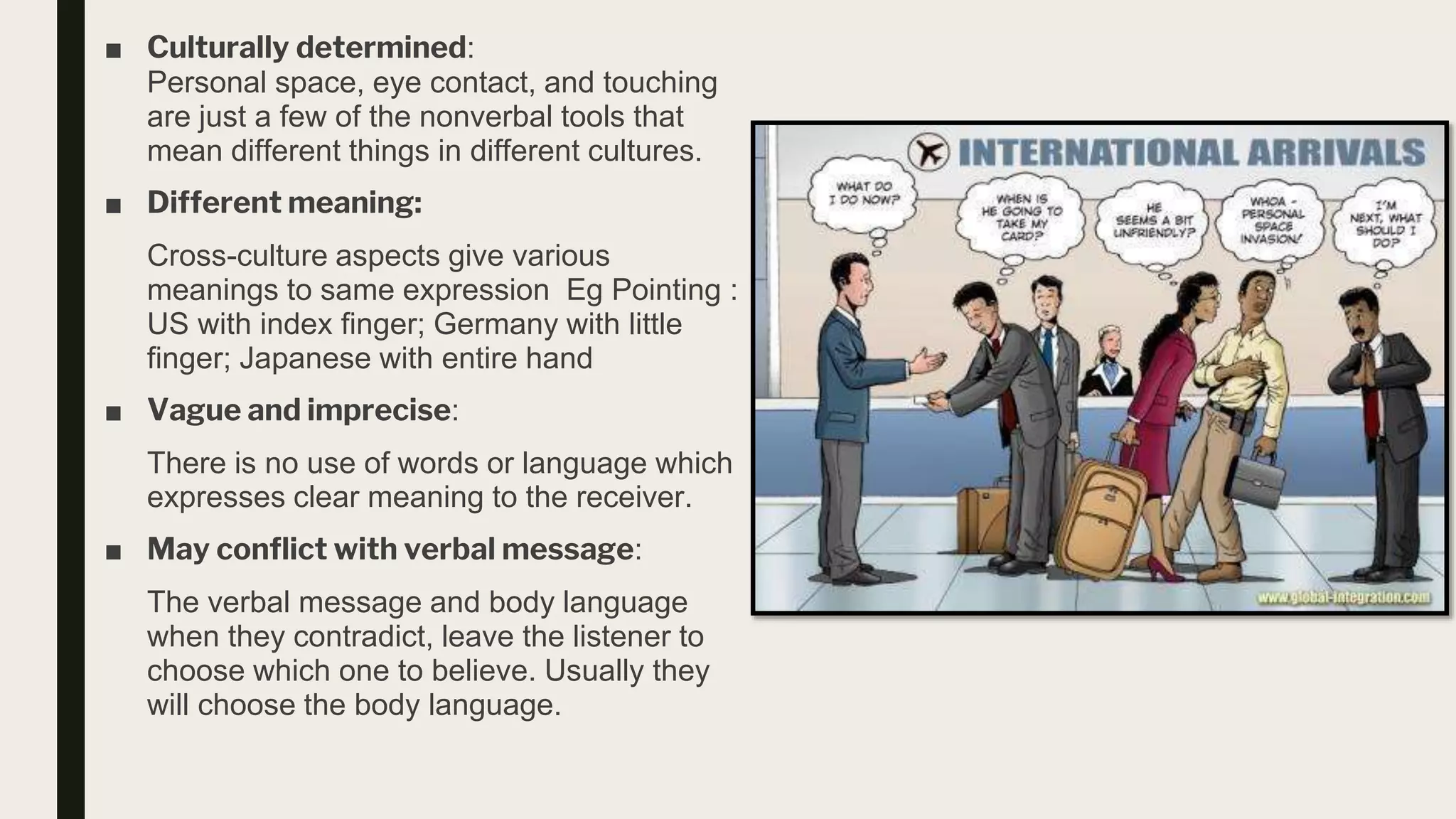
■ Culturally determined:
Personal space, eye contact, and touching
are just a few of the nonverbal tools that
mean different things in different cultures.
■ Different meaning:
Cross-culture aspects give various
meanings to same expression Eg Pointing :
US with index finger; Germany with little
finger; Japanese with entire hand
■ Vague and imprecise:
There is no use of words or language which
expresses clear meaning to the receiver.
■ May conflict with verbal message:
The verbal message and body language
when they contradict, leave the listener to
choose which one to believe. Usually they
will choose the body language.
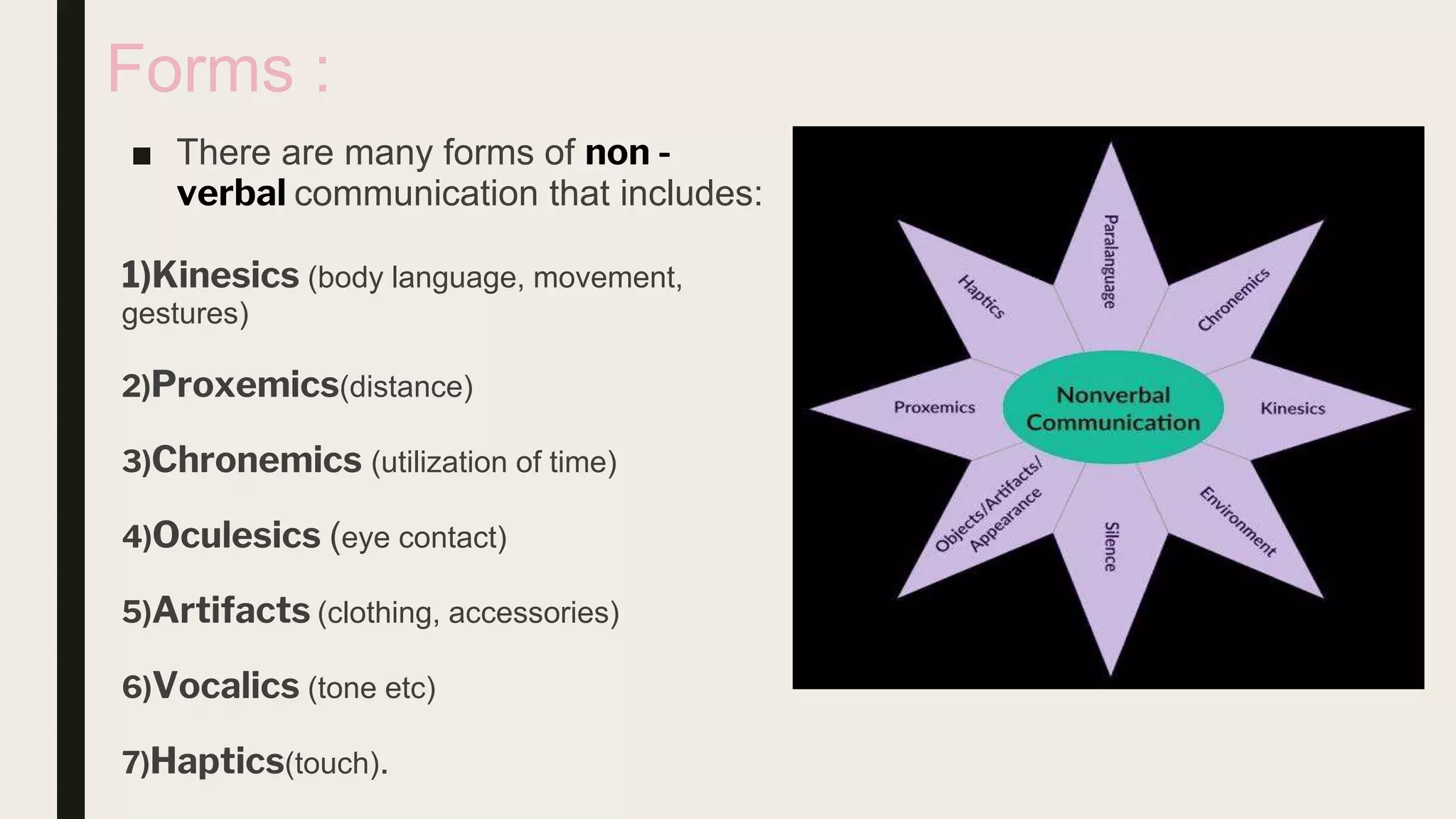
■ There are many forms of non -
verbal communication that includes:
1)Kinesics (body language, movement,
gestures)
2)Proxemics(distance)
3)Chronemics (utilization of time)
4)Oculesics (eye contact)
5)Artifacts (clothing, accessories)
6)Vocalics (tone etc)
7)Haptics(touch).
Forms :
Types
■ It is divided into four basic types –
physical, aesthetic, symbolic and
communication through signs.
■ Physical - includes facial
expressions, touch, smell, body
movements, etc.
■ Aesthetic – includes conveying
messages through painting,
sculpture, dancing, etc.
■ Symbolic – includes those
involved in religion and maintaining
status.
■ Signs – includes both mechanical
and physical.
We use nonverbal communication to
■ contradict verbal communication.
■ to mislead others When trying to detect
deception, it is more effective to examine both
verbal and nonverbal communication to see if
they are consistent .
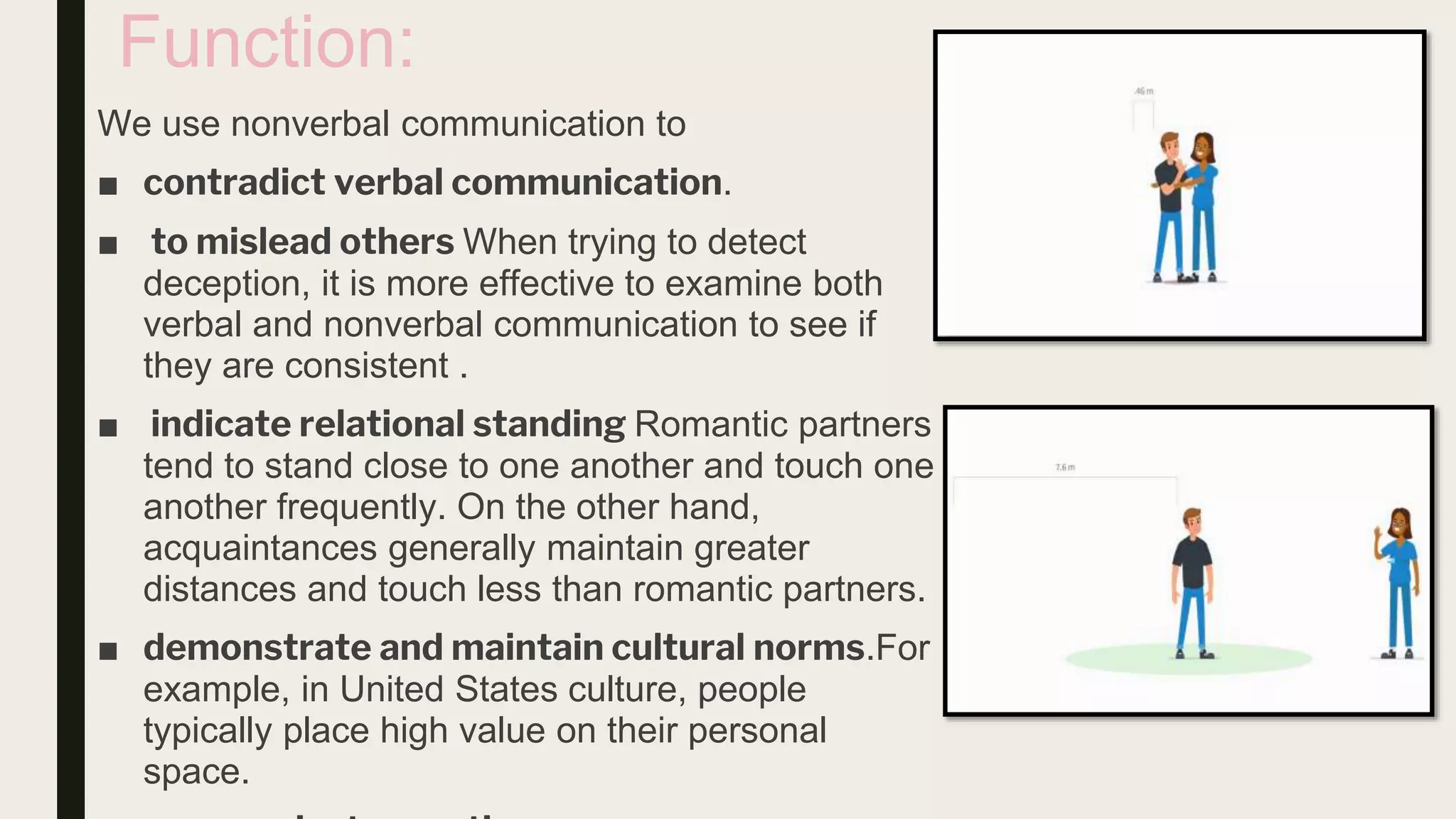
■ indicate relational standing Romantic partners
tend to stand close to one another and touch one
another frequently. On the other hand,
acquaintances generally maintain greater
distances and touch less than romantic partners.
■ demonstrate and maintain cultural norms.For
example, in United States culture, people
typically place high value on their personal
space.
Function:
Relevance
■ Repetition: strengthens the message
you’re making verbally.
■ Contradiction: indicating to your
listener that you may not be telling the
truth.
■ Substitution: For example, your facial
expression often conveys a far more
vivid message than words ever can.
■ Complementing: As a boss, if you pat
an employee on the back in addition to
giving praise, it can increase the impact
of your message.
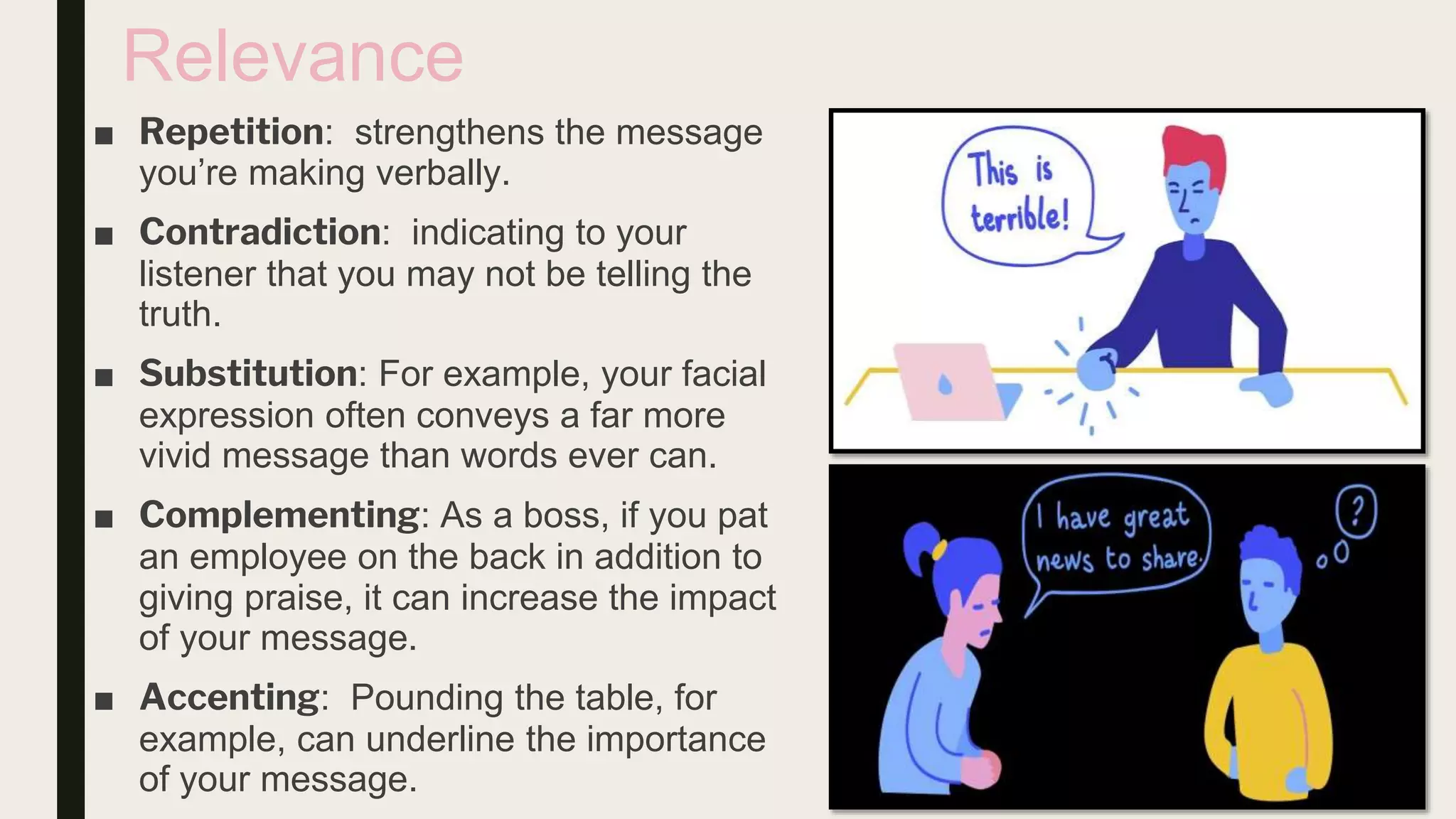
■ Accenting: Pounding the table, for
example, can underline the importance
of your message.
Paralanguage: non-verbal cues of
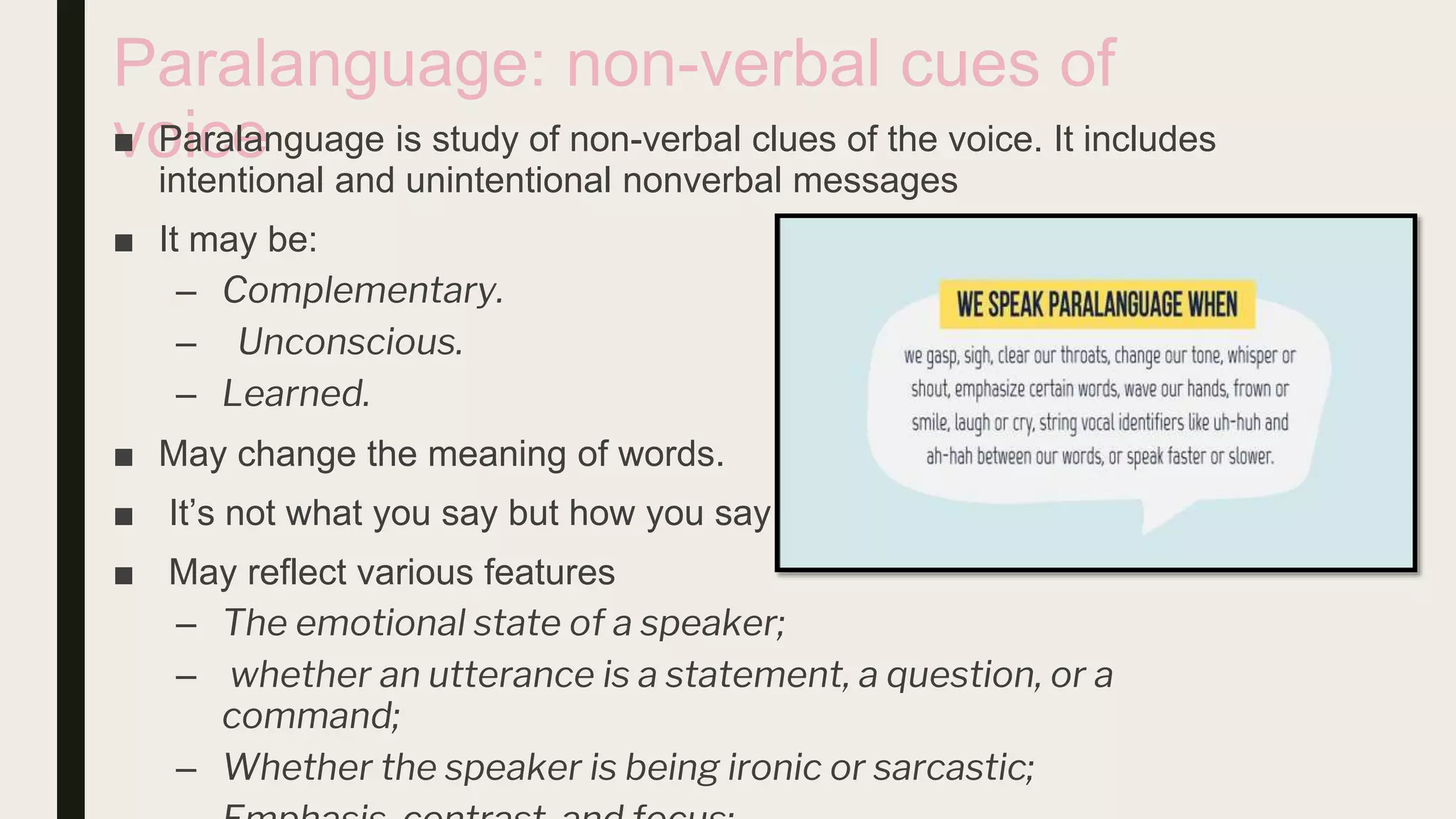
voice■ Paralanguage is study of non-verbal clues of the voice. It includes
intentional and unintentional nonverbal messages
■ It may be:
– Complementary.
– Unconscious.
– Learned.
■ May change the meaning of words.
■ It’s not what you say but how you say it.
■ May reflect various features
– The emotional state of a speaker;
– whether an utterance is a statement, a question, or a
command;
– Whether the speaker is being ironic or sarcastic;
Clues of Paralinguistics :
Volume of voice(loudness)
Speed of voice(pace)
Pitch
Intonation
Tone
Pronunciation
Articulation
Pause
Punctuation marks
Fluency
Volume
■ Volume:
How loudly or quietly you speak is called volume.
– Whispering conveys secrecy.
– While addressing an audience, if your volume
is not loud enough, it suggest lack of
confidence or shyness.
– While talking to someone on phone your
speaking loudly is suggestive of your lack of
good manners and etiquette as well as irritable
– Those who speak loudly are generally seen as
aggressive and domineering,
– speakers with soft voices are perceived as
timid and polite.
Tone
– Tone refers to the emotional content
carried by our voices.
– tells about the attitude of the
speaker.
– Sarcastic, aggressive, critical,
nervous, monotonous,
disappointed, friendly,
enthusiastic, vivid or persuasive.
– can be largely determined by
cultural context.
– In speeches, by altering our tone
and using gestures, we can
■ Highlight what we are saying
■ Emphasize what we want our
audiences to remember.
Speed, fluency and intonation
■ Speed: pace of speaking words
– If you are speak very fast, they may not
connect the previous idea with the next
one
– , If the speed is very slow then also it is
likely that listener loses connection
– is to be viewed as lacking confidence as
well as nervous if lacking fluency.
■ Intonation: Intonation is the modulation of
the voice and the shift in stress.
– a message with serious contents should
not be delivered in a high tone, but in a
somber tone.
– It tells the listener if the message is in
form of a question, statement or
exclamation.
Pitch
■ Pitch is the vocal slant of the voice.
■ It reveals the speaker’s frame of mind.
■ An unusually high pitch may reflect agitation.
■ An unchanging pitch maybe boring or monotonous, decreasing the
listener’s span of attention.
■ It can be seen as people tend to lower their pitch when sad and raise it
when excited.
■ On the other hand, if a person bored, he/she may speak in a monotone
that reflects his/her lack of interest.
■ Usually it is seen that a lively animated pitch encourages interaction, but
a monotone discourages it.
Articulation and pause
■ Articulation :
Articulation is the clarity in your voice.
– Clearly articulated message indicates competence and
confidence.
– We should not speak in a style that makes us sound too
uncultured for our client.
– Eg : Do not say : “I dunno whats gonna happen”,say, “ I don’t
know what is going to happen”.
■ Pause :
The break a person takes while speaking and its duration is known
as “Pause”. A Pause can have two different functions:
– 1. A temporary vocal inaction: This indicates the speaker’s
uncertainty, hesitation, tension or uneasiness.
– 2. A Pause: This shows favour or disfavour, Agreement or
Disagreement.
Punctuation marks and Pronunciation
■ Punctuation Marks
They are very helpful in written form. Appropriate
use of punctuation marks brings clarity to the
content and prevents confusion.
– Example:
– Go slow, Man at work.
– Go, slow man at work.
– Word stress is important to convey
meaning.
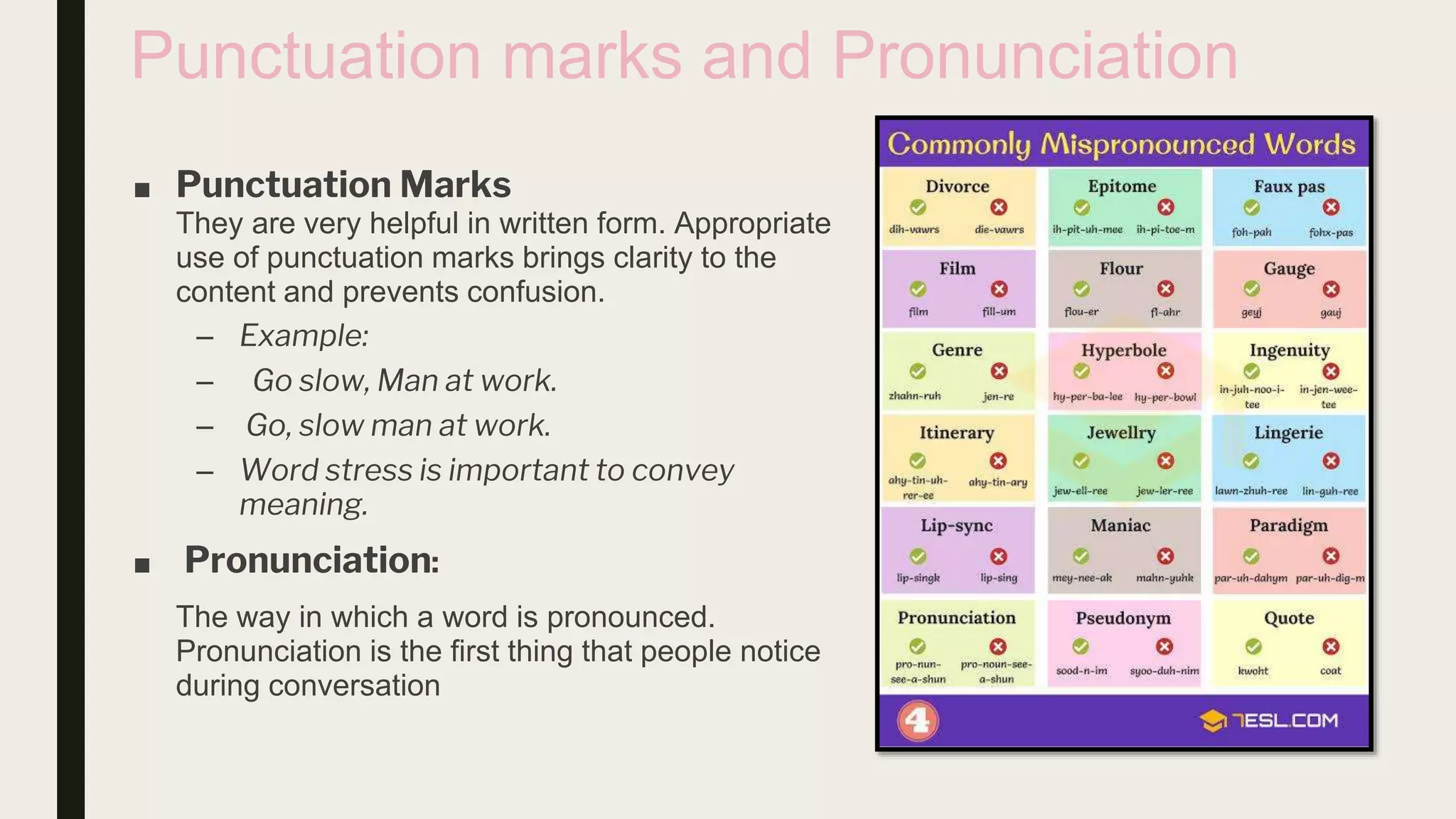
■ Pronunciation:
The way in which a word is pronounced.
Pronunciation is the first thing that people notice
during conversation
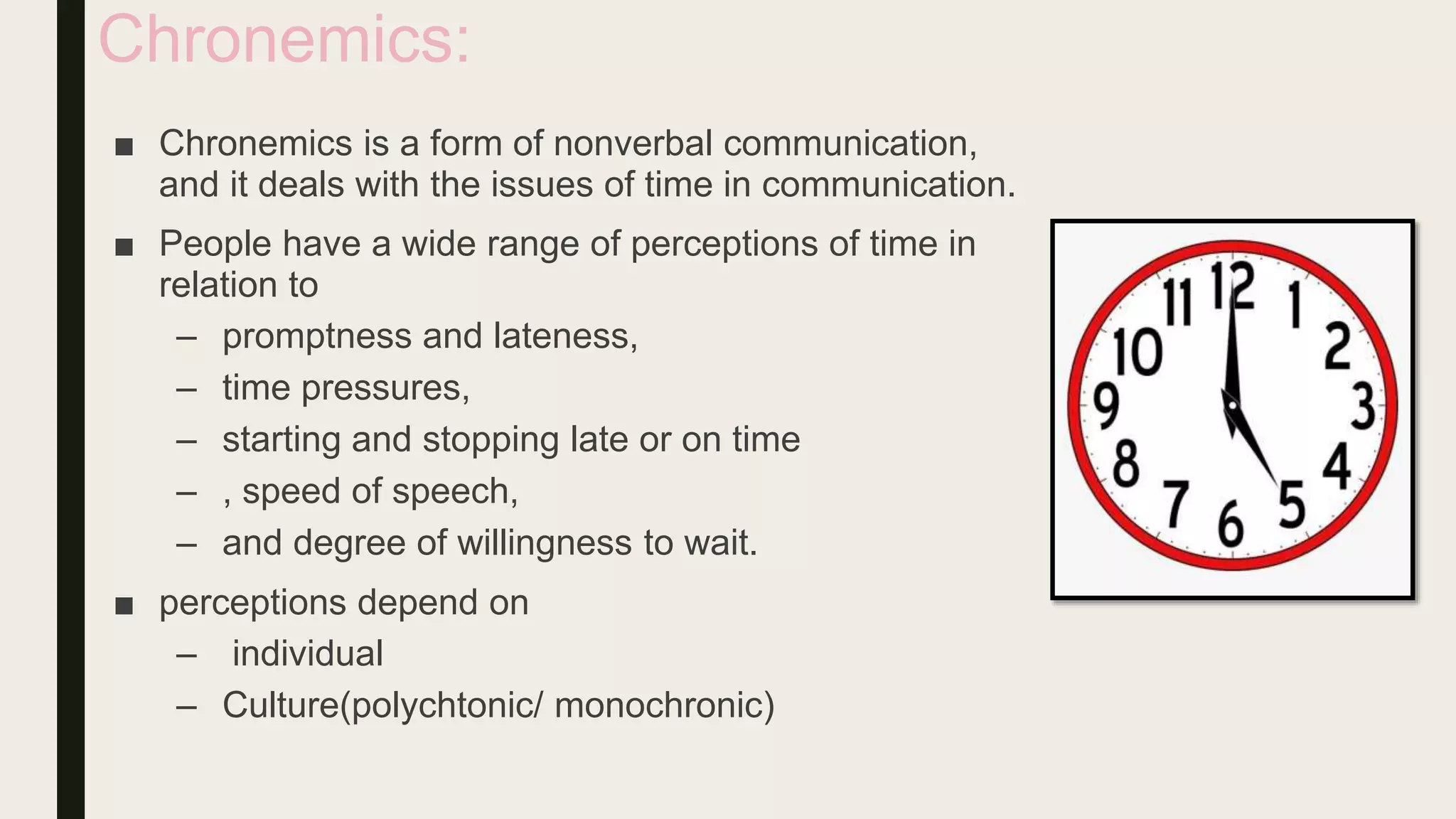
Chronemics:
■ Chronemics is a form of nonverbal communication,
and it deals with the issues of time in communication.
■ People have a wide range of perceptions of time in
relation to
– promptness and lateness,
– time pressures,
– starting and stopping late or on time
– , speed of speech,
– and degree of willingness to wait.
■ perceptions depend on
– individual
– Culture(polychtonic/ monochronic)
■ INDIVIDUAL PERCEPTIONS
PEOPLE JUDGE MATURITY, SUCCESS BY
CHRONEMICS .
– A manager who has a meeting
with the CEO, a late arrival will be
considered as a nonverbal cue
that he / she does not give
adequate respect to his superior.
– People who tend to be on time or
early for things may be viewed as
more capabl
– Being late will be perperhap as a
lack of interest
Often people who have less time
to talk with others, and appear
busy, focused, receive respect
and an appearance of being more
important and powerful people.
■ Cross cultural perception:
– Monochronic time: Everything is organized, scheduled, and pre-
planned.
■ Events and occasions are conducted at one point in time.
■ holds tight to schedules.
■ emphasizes individualism
■ Switzerland, Germany, and Canada
– Polychronic time: Multiple proceedings are conducted at once,
■ scheduling time is highly flexible.
■ places more importance on relationships.
■ Latin America, Africa, and Asia are polychronic.
■ IF a polychronic person on the way to a meeting runs into an aunt, he or
she must stop to talk and is justified in being late for the meeting. A
monochronic person is more likely to brush off the aunt with “Sorry I can’t
talk now. I’m on my way to a meeting.”
Proxemics:
■ Proxemics is the study of human use of space
and the effects that population density has on
behavior, communication, and social
interaction. how it makes us feel more or less
comfortable.
■ There are four types of “distance” which
people use to communicate on a face-to-
face basis.
These include:
· Intimate distance (0-2 ft.)
■ Partners, lovers
■ Unique level of comfort
■ Unfamiliarity can cause social
discomfort/ awkwardness
■ hugging, holding hands, or standing
side-by-side.
■ Personal distance (2-4ft.)
– family and close friends.
– close in proximity, More distant than
intimate distance
– May involve touching.
– Strangers can cause discomfort.
■ Social distance (4-12 ft.)
– Business transactions, meeting new
people and interacting with groups
of people
– Depends on situation
– Coworkers, acquaintance and
students
– Intrusion can lead to back up
response.
■ Public distance (>12 ft.)
– It is How close we sit or stand to someone, like a
public figure or public speaker.
– Can depend on factors such as culture and
space available
■ Proxemics can convey various meanings such as:
Authority-authority can be communicated by the
height from which one person interacts with another. If
one stands while the other sits or lies down, the person
standing has placed himself or herself in a position of
authority.
Assertive Power- if a manager Invades the personal
space of a employee it implies the assertive power of
the manager.
Therapists use proxemics for effective non verbal
communication and understanding client.
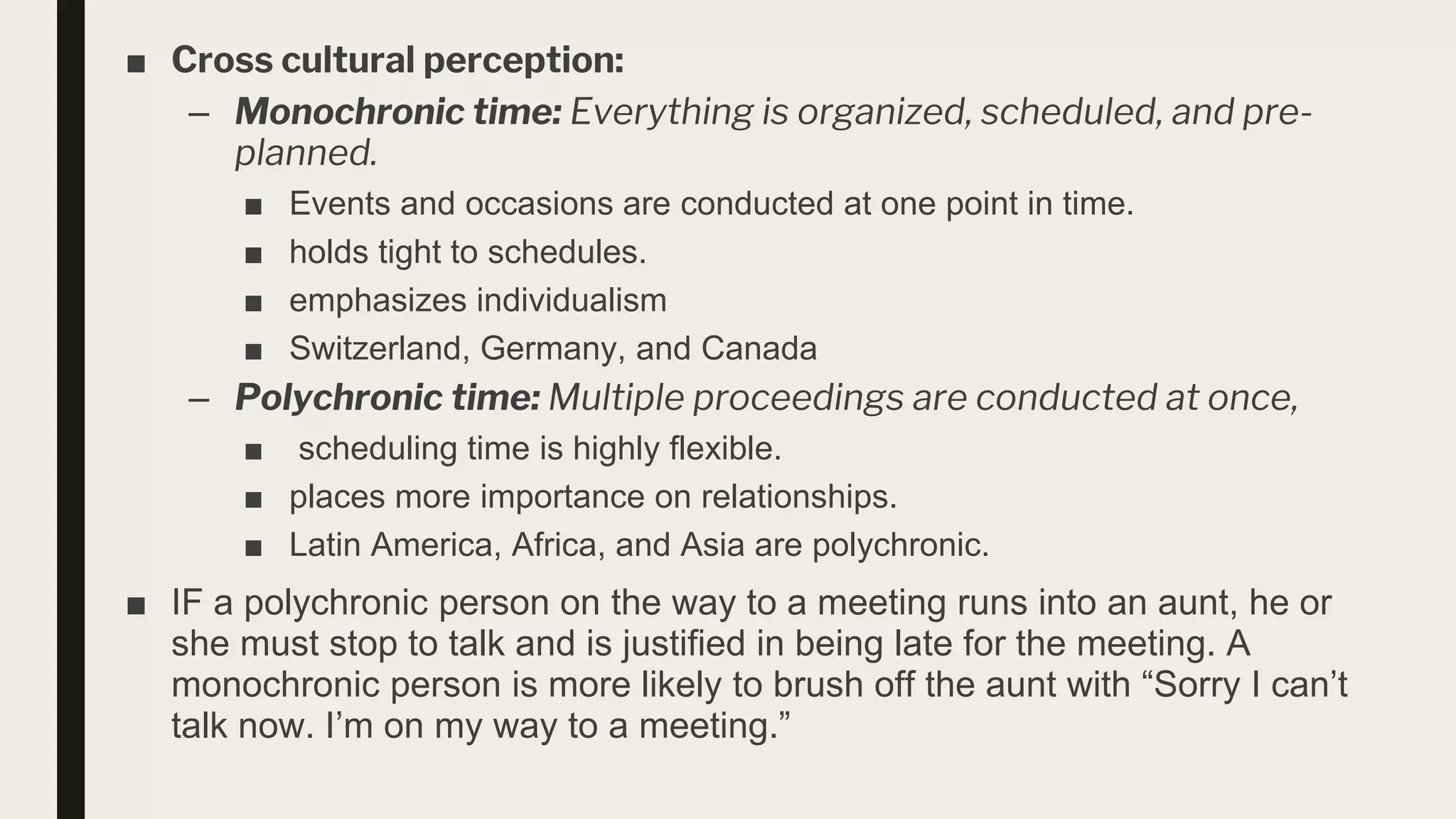
Haptics
■ Haptic communication is the means by which people and other
animals communicate via touching
■ Verbal communication becomes more impactful
■ With holding touch may communicate negative feelings
Types
– Functional/Professional
■ Related to a goal or part of a routine professional
interaction
■ Functional-barbers, hair stylists, doctors, nurses
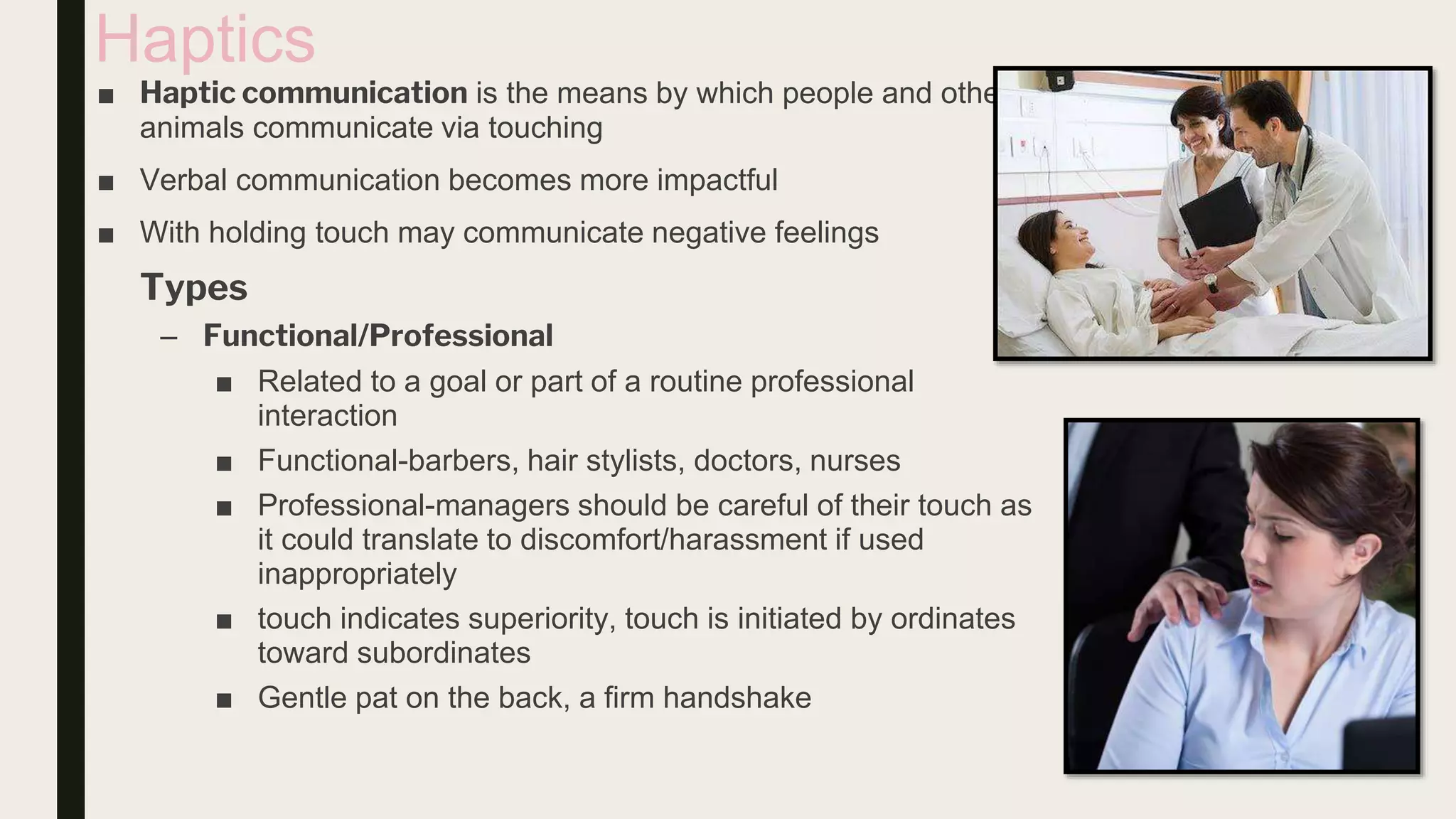
■ Professional-managers should be careful of their touch as
it could translate to discomfort/harassment if used
inappropriately
■ touch indicates superiority, touch is initiated by ordinates
toward subordinates
■ Gentle pat on the back, a firm handshake
– Social/ Polite
■ to keep good relationships with others
■ Limited interpersonal communication with
acquaintances
■ Show that others are included and respected
■ Blessing someone , handshake
– Friendship/Warmth
■ Communicate closeness, liking, care, and
concern.
■ Friends/family
■ Too much touch can signal sexual or romantic
interest,
■ too little touch can signal distance or
unfriendliness
■ Hugging, holding hands
– Love/Intimacy
■ Touch is more personal
■ Best friends, close family members, and romantic partners.
■ Public touch can serve as a ‘tie sign’ that shows others that
your partner is “taken”
■ Touching face, holding waist, hugging
– Sexual/Aarousal
■ Touch that leads to sexual arousal
■ most intimate form of touch
■ Lovers, romantic partners
■ Kissing
■ Cultural context determines the interpretation of touch to a large
extent. Example: In Us handshake/hugging is a form of greeting
whereas in Japan bows are greeting and touching conveys
intimacy.
Body language(kinesics)
■ Body language stands for the way the body
communicates without words, through the movement of
its parts.
■ Body language is usually grouped along two lines. Parts
and intent.
■ 1. Parts of the body
– The head
– Body postures
– Gestures
– Facial expressions
■ 2. Intent
– Voluntary/Intentional movements - Usually called
"Gestures". These are movements you intended to
make, like shaking a hand, giving the finger, blinking
with one eye...
– Involuntary movements - Usually called "tells", but
"ticks" also fall into this category. Any body movement
you have no cotrol over falls in this category
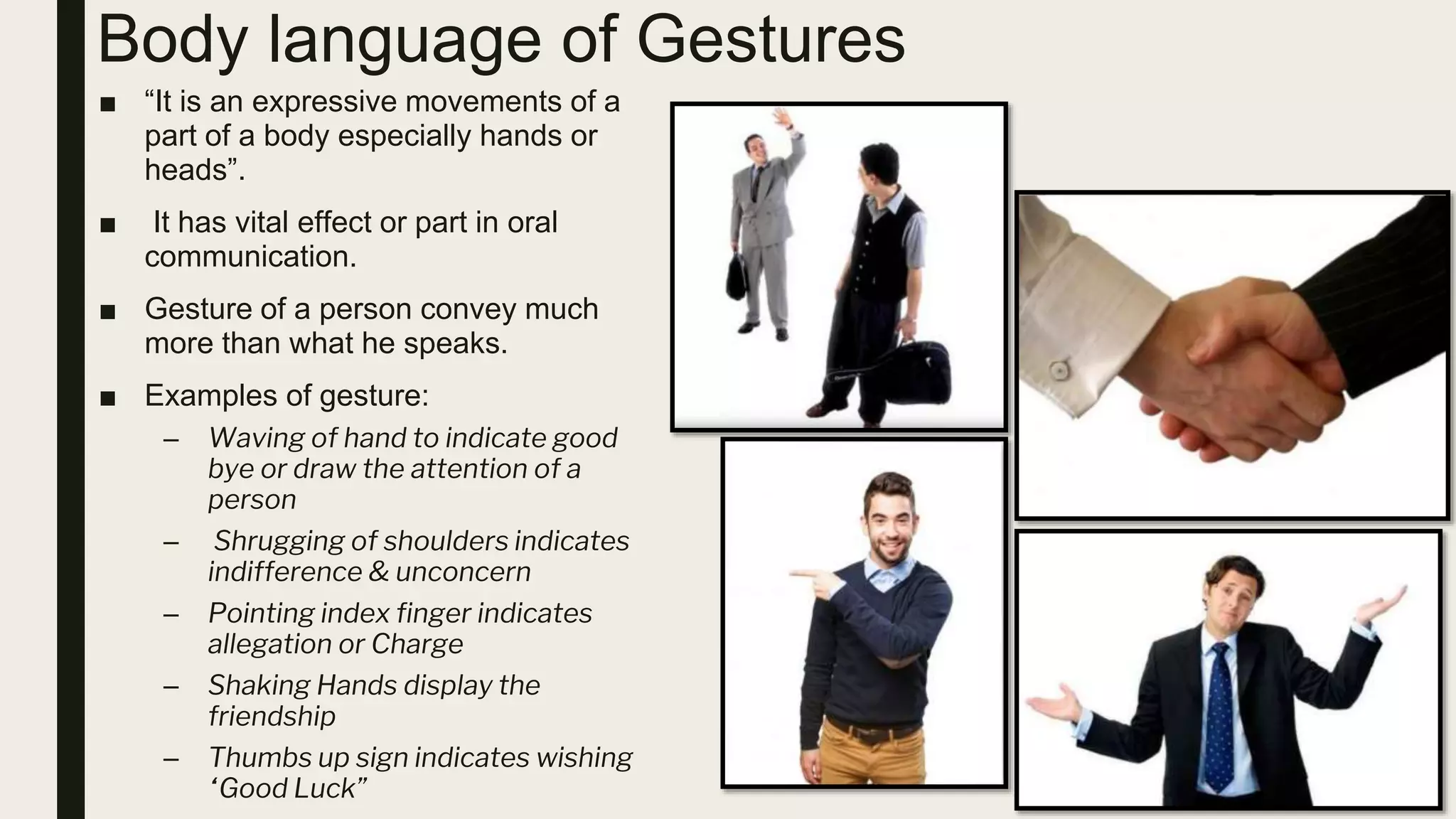
Body language of Gestures
■ “It is an expressive movements of a
part of a body especially hands or
heads”.
■ It has vital effect or part in oral
communication.
■ Gesture of a person convey much
more than what he speaks.
■ Examples of gesture:
– Waving of hand to indicate good
bye or draw the attention of a
person
– Shrugging of shoulders indicates
indifference & unconcern
– Pointing index finger indicates
allegation or Charge
– Shaking Hands display the
friendship
– Thumbs up sign indicates wishing
“Good Luck”
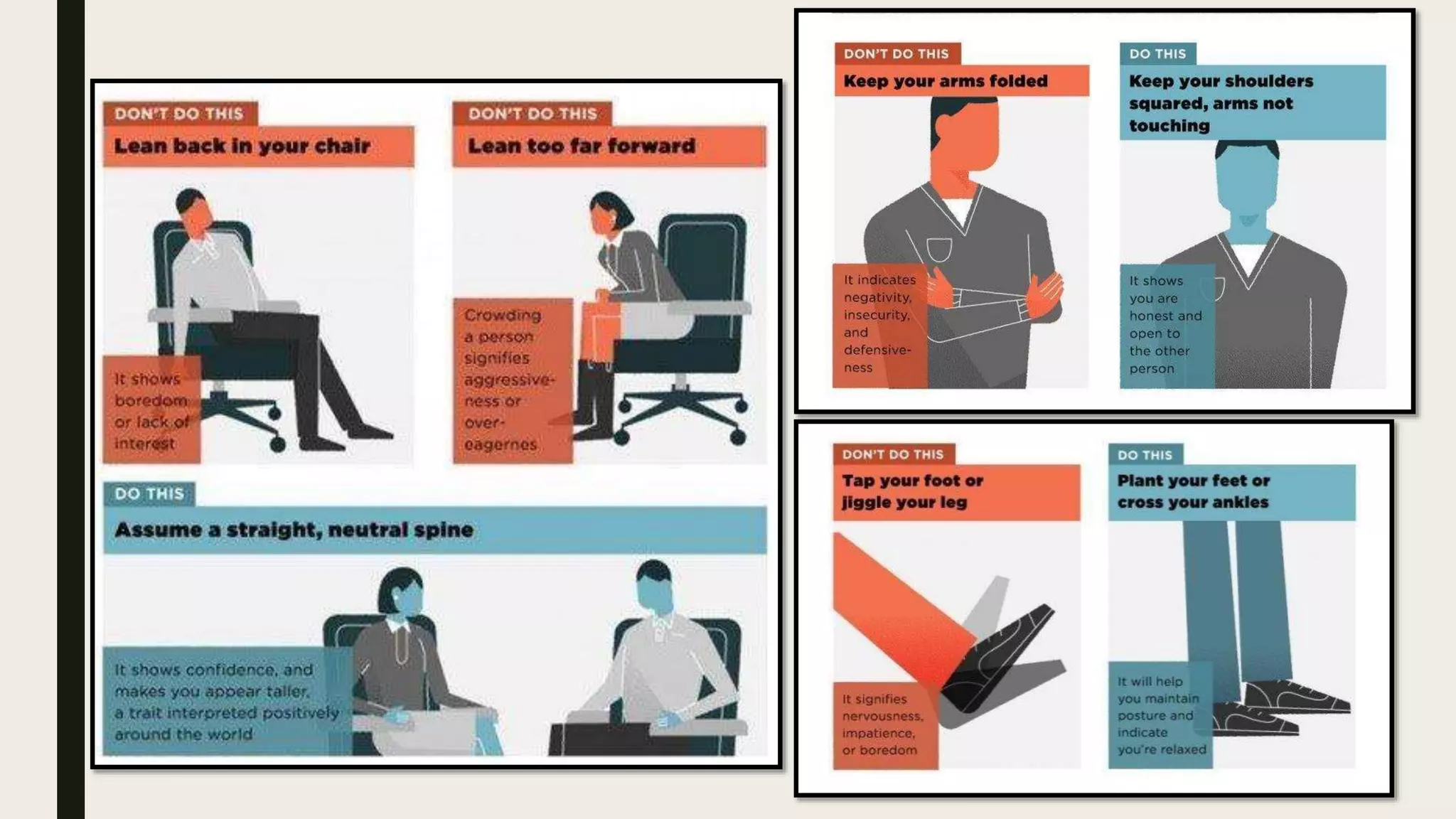
The Body Language of Posture
■ The way you place your body and arms and legs, in
relation to each other, and in relation to other
people:
– Body proximity - How far or close to other
people.
– Shoulder movements - Up, down, hanging,
hunched.
– Arm placement - up, down, crossed, straight.
– Leg and feet placement - straight, crossed,
weight placement, feet towards
■ speaking partner or pointing elsewhere, dangling of
shoes.
■ Means “an attitude or position of body”
■ Each movement of body has expressive &
defensive functions.
■ The way, in which we sit or stand, walk in walk out
tells a lot about us.
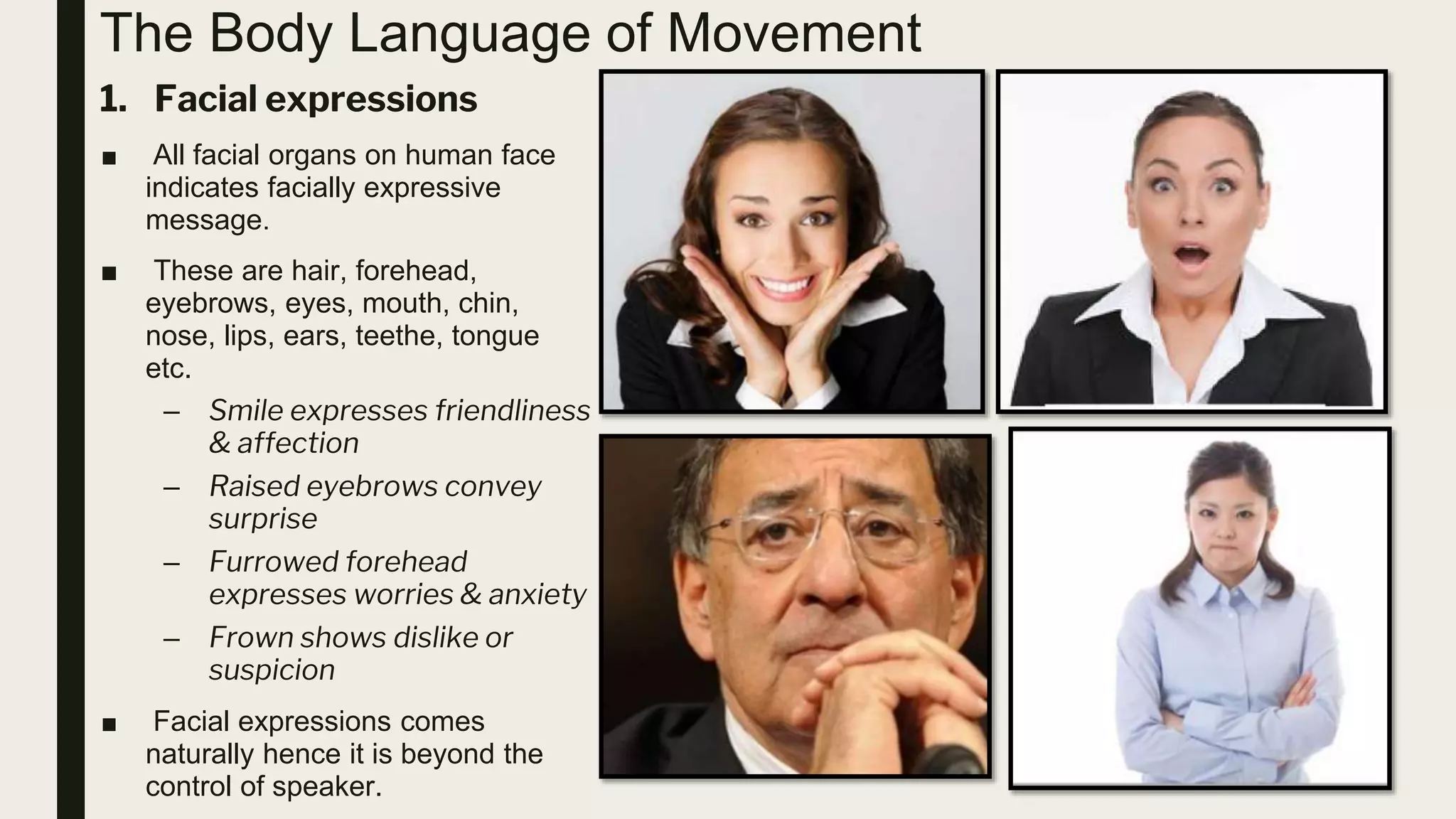
The Body Language of Movement
1. Facial expressions
■ All facial organs on human face
indicates facially expressive
message.
■ These are hair, forehead,
eyebrows, eyes, mouth, chin,
nose, lips, ears, teethe, tongue
etc.
– Smile expresses friendliness
& affection
– Raised eyebrows convey
surprise
– Furrowed forehead
expresses worries & anxiety
– Frown shows dislike or
suspicion
■ Facial expressions comes
naturally hence it is beyond the
control of speaker.
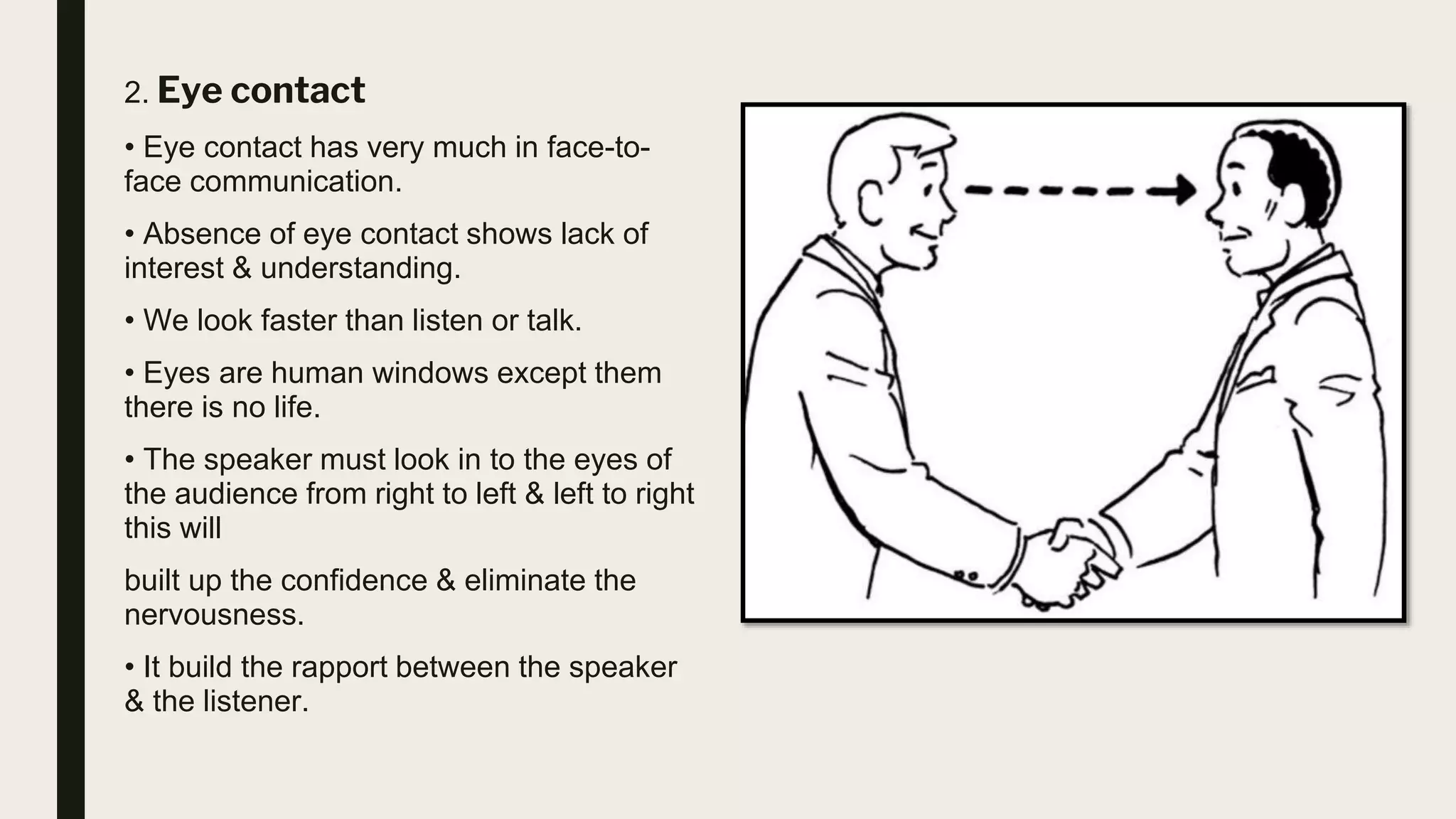
2. Eye contact
• Eye contact has very much in face-to-
face communication.
• Absence of eye contact shows lack of
interest & understanding.
• We look faster than listen or talk.
• Eyes are human windows except them
there is no life.
• The speaker must look in to the eyes of
the audience from right to left & left to right
this will
built up the confidence & eliminate the
nervousness.
• It build the rapport between the speaker
& the listener.
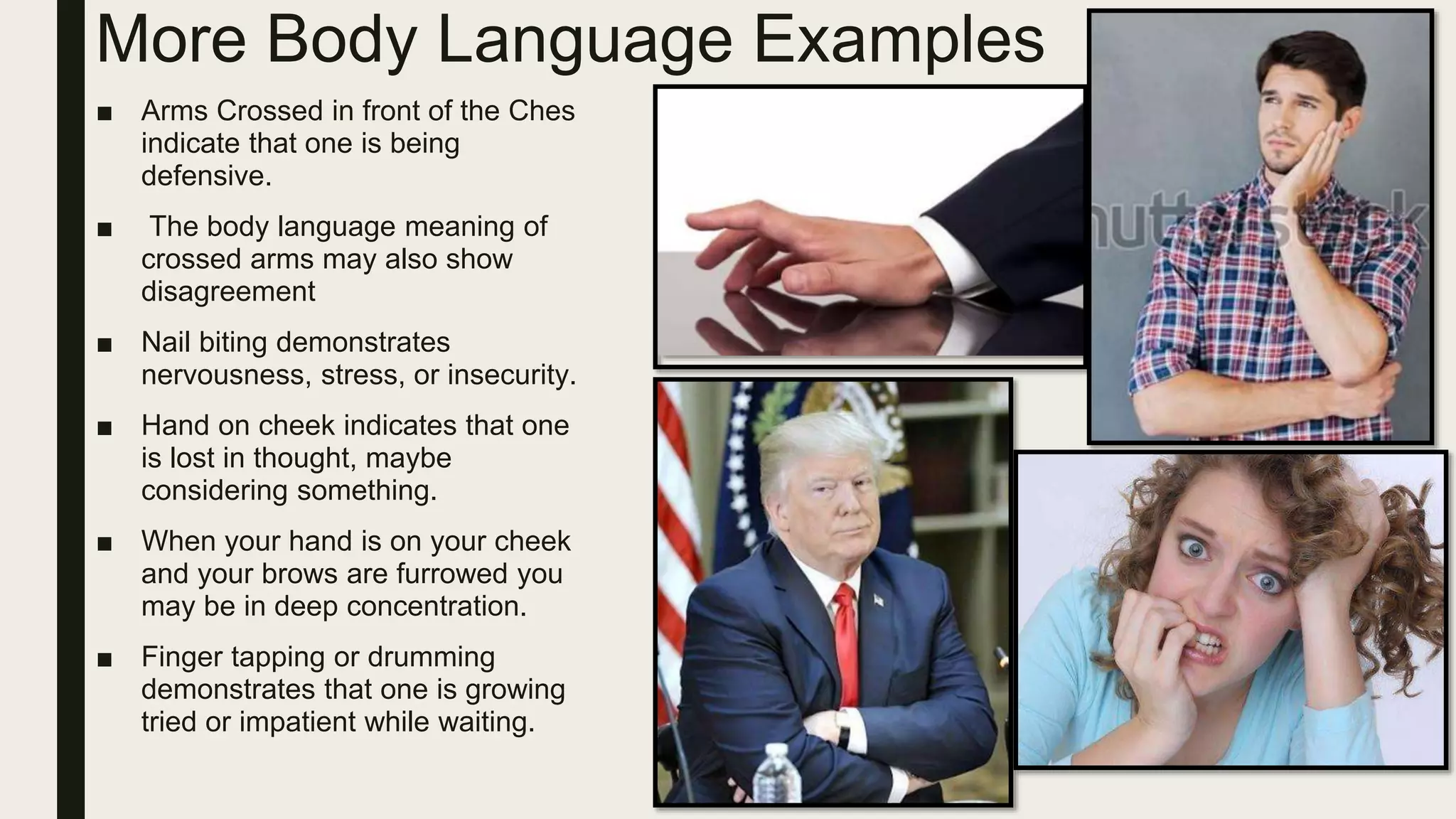
More Body Language Examples
■ Arms Crossed in front of the Ches
indicate that one is being
defensive.
■ The body language meaning of
crossed arms may also show
disagreement
■ Nail biting demonstrates
nervousness, stress, or insecurity.
■ Hand on cheek indicates that one
is lost in thought, maybe
considering something.
■ When your hand is on your cheek
and your brows are furrowed you
may be in deep concentration.
■ Finger tapping or drumming
demonstrates that one is growing
tried or impatient while waiting.
■ Touching the nose or rubbing
the nose signifies disbelief,
rejection, or lying about
something.
■ Prisk rubbing of the hands
may show that one is excited
about something, or waiting
eagerly.
■ Placing Finger tips together to
demonstrate control or
authority.
■ Open palms, facing upward is
a sign of honesty,
submission, and innocence.
■ Head in hand may be of
Boredom, being upset, or
being ashamed, so one does
not want to show their face.
■ Locking of ankles, sitting or
standing, when your ankles
are locked, you are
communicating apprehension
or nervousness.
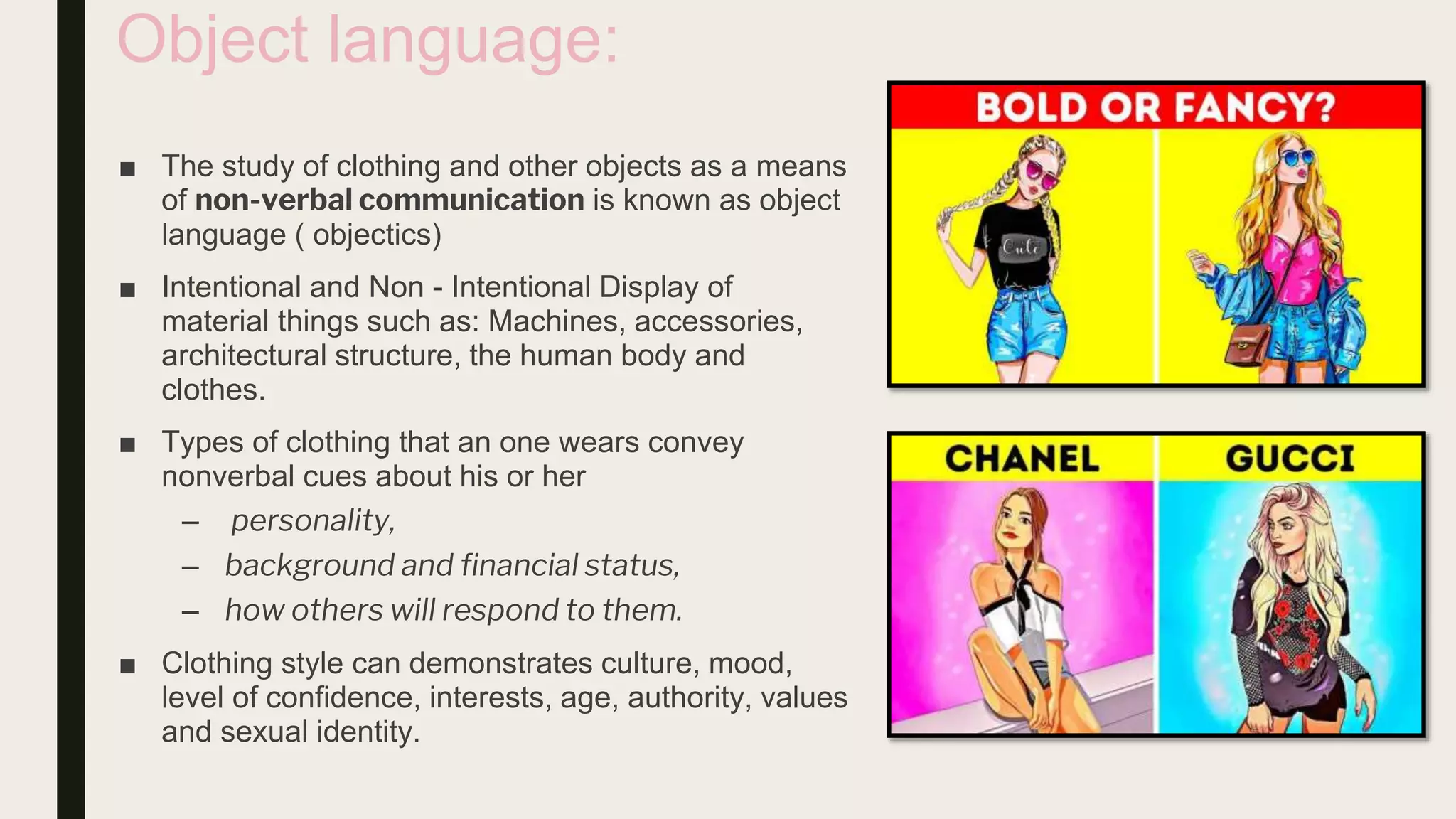
Object language:
■ The study of clothing and other objects as a means
of non-verbal communication is known as object
language ( objectics)
■ Intentional and Non - Intentional Display of
material things such as: Machines, accessories,
architectural structure, the human body and
clothes.
■ Types of clothing that an one wears convey
nonverbal cues about his or her
– personality,
– background and financial status,
– how others will respond to them.
■ Clothing style can demonstrates culture, mood,
level of confidence, interests, age, authority, values
and sexual identity.
■ Machines - your car, your computer, your mobile, and all your personal accessories.
■ your possession of I-Phone 10 indicate your
– identity by your choice of brand.
– your affordability to buy expensive goods.
– that you are stylish, sophisticated and have an eye for the latest gadgets.
■ Architectural structure conveys about the cultural identity of a country.
– The Taj Mahal makes people think of India,
– associate it with romance and magnificence.
■ the physical objects symbolize
– professional identity, stethoscope connotes a doctor.
– personal commitments ,wedding ring.
– School T-shirt indicate the local group
– Cars are invariably perceived as status symbols.
Thankyou
■ Submitted by
1. Dhriti Dhawan A51340719043
2. Ashmi Agarwal A51340719017
3. Surja Kaul A51340719050
4. Simran Arora A51340719045
5. Dimpee Das A51340719053
6. Puja Saikia A51340719035

communication skills non verbal communication

  • 1.
    NON-VERBAL COMMUNICATION • Relevance andeffective usage • Paralanguage • Chronemics • Proxemics • Haptics • Body language • Object language
  • 2.
    Introduction: How do youmake people feel when you enter the room? • Is your body language strong ? Are you standing straight and erect or are you slouched and tired? • Are you clean shaven, looking your best for a team meeting or are you shabby with shirts that are not ironed? • When you shake hands, do you do so strongly, or do you just brush your hand against others?
  • 3.
    ■ These aresome examples of Non-verbal communications. ■ Essential skills for new joiners in HR and other jobs requiring interpersonal skills. ■ In a sales meeting if you have not achieved target, will you be steady and calm, or will you panic and stutter? ■ A manager who panics, not good at non- verbal communication will not be a favourite with his team members.His team members don’t look up to him. ■ Non-verbal skills are important and your growth depends on them.
  • 4.
    Verbal and Non-verbal communication: ■Verbal communication happens through verbally, vocally or through written words which express or convey the message to others. – Types: ■ Verbal Communication ■ Non-Verbal Communication ■ Non-verbal communication happens without word of mouth, spoken words, conversation and written languages. ■ Happens through signs, symbols, colours, gestures, body language or any facial expressions and paralanguage. Verbal Communication Nonverbal Communicati on Vocal Spoken words Paralanguage (pitch, volume, speaking rate, etc.) Non-vocal Writing, sign language Body language (gestures, facial expressions, eye contact, etc.)
  • 5.
    Characteristics: ■ Conveys moreinformation than verbal communication. 65-70% of translation is due to nonverbal communication. ■ Usually believed over verbal communication. As it is harder to hide or fake our nonverbal clues. ‘ ■ It is the primary means of communicating emotion. You can usually tell how they are feeling without them saying a word. ■ Meta communicative, for example, a wink for sarcasm or covering our mouth with our hand to indicate we are telling a secret. ■ Continuous ■ Uses multiple channels ■ Can be both conscious and unconscious.
  • 6.
    ■ Culturally determined: Personalspace, eye contact, and touching are just a few of the nonverbal tools that mean different things in different cultures. ■ Different meaning: Cross-culture aspects give various meanings to same expression Eg Pointing : US with index finger; Germany with little finger; Japanese with entire hand ■ Vague and imprecise: There is no use of words or language which expresses clear meaning to the receiver. ■ May conflict with verbal message: The verbal message and body language when they contradict, leave the listener to choose which one to believe. Usually they will choose the body language.
  • 7.
    ■ There aremany forms of non - verbal communication that includes: 1)Kinesics (body language, movement, gestures) 2)Proxemics(distance) 3)Chronemics (utilization of time) 4)Oculesics (eye contact) 5)Artifacts (clothing, accessories) 6)Vocalics (tone etc) 7)Haptics(touch). Forms :
  • 8.
    Types ■ It isdivided into four basic types – physical, aesthetic, symbolic and communication through signs. ■ Physical - includes facial expressions, touch, smell, body movements, etc. ■ Aesthetic – includes conveying messages through painting, sculpture, dancing, etc. ■ Symbolic – includes those involved in religion and maintaining status. ■ Signs – includes both mechanical and physical.
  • 9.
    We use nonverbalcommunication to ■ contradict verbal communication. ■ to mislead others When trying to detect deception, it is more effective to examine both verbal and nonverbal communication to see if they are consistent . ■ indicate relational standing Romantic partners tend to stand close to one another and touch one another frequently. On the other hand, acquaintances generally maintain greater distances and touch less than romantic partners. ■ demonstrate and maintain cultural norms.For example, in United States culture, people typically place high value on their personal space. Function:
  • 10.
    Relevance ■ Repetition: strengthensthe message you’re making verbally. ■ Contradiction: indicating to your listener that you may not be telling the truth. ■ Substitution: For example, your facial expression often conveys a far more vivid message than words ever can. ■ Complementing: As a boss, if you pat an employee on the back in addition to giving praise, it can increase the impact of your message. ■ Accenting: Pounding the table, for example, can underline the importance of your message.
  • 12.
    Paralanguage: non-verbal cuesof voice■ Paralanguage is study of non-verbal clues of the voice. It includes intentional and unintentional nonverbal messages ■ It may be: – Complementary. – Unconscious. – Learned. ■ May change the meaning of words. ■ It’s not what you say but how you say it. ■ May reflect various features – The emotional state of a speaker; – whether an utterance is a statement, a question, or a command; – Whether the speaker is being ironic or sarcastic;
  • 13.
    Clues of Paralinguistics: Volume of voice(loudness) Speed of voice(pace) Pitch Intonation Tone Pronunciation Articulation Pause Punctuation marks Fluency
  • 14.
    Volume ■ Volume: How loudlyor quietly you speak is called volume. – Whispering conveys secrecy. – While addressing an audience, if your volume is not loud enough, it suggest lack of confidence or shyness. – While talking to someone on phone your speaking loudly is suggestive of your lack of good manners and etiquette as well as irritable – Those who speak loudly are generally seen as aggressive and domineering, – speakers with soft voices are perceived as timid and polite.
  • 15.
    Tone – Tone refersto the emotional content carried by our voices. – tells about the attitude of the speaker. – Sarcastic, aggressive, critical, nervous, monotonous, disappointed, friendly, enthusiastic, vivid or persuasive. – can be largely determined by cultural context. – In speeches, by altering our tone and using gestures, we can ■ Highlight what we are saying ■ Emphasize what we want our audiences to remember.
  • 16.
    Speed, fluency andintonation ■ Speed: pace of speaking words – If you are speak very fast, they may not connect the previous idea with the next one – , If the speed is very slow then also it is likely that listener loses connection – is to be viewed as lacking confidence as well as nervous if lacking fluency. ■ Intonation: Intonation is the modulation of the voice and the shift in stress. – a message with serious contents should not be delivered in a high tone, but in a somber tone. – It tells the listener if the message is in form of a question, statement or exclamation.
  • 17.
    Pitch ■ Pitch isthe vocal slant of the voice. ■ It reveals the speaker’s frame of mind. ■ An unusually high pitch may reflect agitation. ■ An unchanging pitch maybe boring or monotonous, decreasing the listener’s span of attention. ■ It can be seen as people tend to lower their pitch when sad and raise it when excited. ■ On the other hand, if a person bored, he/she may speak in a monotone that reflects his/her lack of interest. ■ Usually it is seen that a lively animated pitch encourages interaction, but a monotone discourages it.
  • 18.
    Articulation and pause ■Articulation : Articulation is the clarity in your voice. – Clearly articulated message indicates competence and confidence. – We should not speak in a style that makes us sound too uncultured for our client. – Eg : Do not say : “I dunno whats gonna happen”,say, “ I don’t know what is going to happen”. ■ Pause : The break a person takes while speaking and its duration is known as “Pause”. A Pause can have two different functions: – 1. A temporary vocal inaction: This indicates the speaker’s uncertainty, hesitation, tension or uneasiness. – 2. A Pause: This shows favour or disfavour, Agreement or Disagreement.
  • 19.
    Punctuation marks andPronunciation ■ Punctuation Marks They are very helpful in written form. Appropriate use of punctuation marks brings clarity to the content and prevents confusion. – Example: – Go slow, Man at work. – Go, slow man at work. – Word stress is important to convey meaning. ■ Pronunciation: The way in which a word is pronounced. Pronunciation is the first thing that people notice during conversation
  • 20.
    Chronemics: ■ Chronemics isa form of nonverbal communication, and it deals with the issues of time in communication. ■ People have a wide range of perceptions of time in relation to – promptness and lateness, – time pressures, – starting and stopping late or on time – , speed of speech, – and degree of willingness to wait. ■ perceptions depend on – individual – Culture(polychtonic/ monochronic)
  • 21.
    ■ INDIVIDUAL PERCEPTIONS PEOPLEJUDGE MATURITY, SUCCESS BY CHRONEMICS . – A manager who has a meeting with the CEO, a late arrival will be considered as a nonverbal cue that he / she does not give adequate respect to his superior. – People who tend to be on time or early for things may be viewed as more capabl – Being late will be perperhap as a lack of interest Often people who have less time to talk with others, and appear busy, focused, receive respect and an appearance of being more important and powerful people.
  • 22.
    ■ Cross culturalperception: – Monochronic time: Everything is organized, scheduled, and pre- planned. ■ Events and occasions are conducted at one point in time. ■ holds tight to schedules. ■ emphasizes individualism ■ Switzerland, Germany, and Canada – Polychronic time: Multiple proceedings are conducted at once, ■ scheduling time is highly flexible. ■ places more importance on relationships. ■ Latin America, Africa, and Asia are polychronic. ■ IF a polychronic person on the way to a meeting runs into an aunt, he or she must stop to talk and is justified in being late for the meeting. A monochronic person is more likely to brush off the aunt with “Sorry I can’t talk now. I’m on my way to a meeting.”
  • 23.
    Proxemics: ■ Proxemics isthe study of human use of space and the effects that population density has on behavior, communication, and social interaction. how it makes us feel more or less comfortable. ■ There are four types of “distance” which people use to communicate on a face-to- face basis. These include: · Intimate distance (0-2 ft.) ■ Partners, lovers ■ Unique level of comfort ■ Unfamiliarity can cause social discomfort/ awkwardness ■ hugging, holding hands, or standing side-by-side.
  • 24.
    ■ Personal distance(2-4ft.) – family and close friends. – close in proximity, More distant than intimate distance – May involve touching. – Strangers can cause discomfort. ■ Social distance (4-12 ft.) – Business transactions, meeting new people and interacting with groups of people – Depends on situation – Coworkers, acquaintance and students – Intrusion can lead to back up response.
  • 25.
    ■ Public distance(>12 ft.) – It is How close we sit or stand to someone, like a public figure or public speaker. – Can depend on factors such as culture and space available ■ Proxemics can convey various meanings such as: Authority-authority can be communicated by the height from which one person interacts with another. If one stands while the other sits or lies down, the person standing has placed himself or herself in a position of authority. Assertive Power- if a manager Invades the personal space of a employee it implies the assertive power of the manager. Therapists use proxemics for effective non verbal communication and understanding client.
  • 26.
    Haptics ■ Haptic communicationis the means by which people and other animals communicate via touching ■ Verbal communication becomes more impactful ■ With holding touch may communicate negative feelings Types – Functional/Professional ■ Related to a goal or part of a routine professional interaction ■ Functional-barbers, hair stylists, doctors, nurses ■ Professional-managers should be careful of their touch as it could translate to discomfort/harassment if used inappropriately ■ touch indicates superiority, touch is initiated by ordinates toward subordinates ■ Gentle pat on the back, a firm handshake
  • 27.
    – Social/ Polite ■to keep good relationships with others ■ Limited interpersonal communication with acquaintances ■ Show that others are included and respected ■ Blessing someone , handshake – Friendship/Warmth ■ Communicate closeness, liking, care, and concern. ■ Friends/family ■ Too much touch can signal sexual or romantic interest, ■ too little touch can signal distance or unfriendliness ■ Hugging, holding hands
  • 28.
    – Love/Intimacy ■ Touchis more personal ■ Best friends, close family members, and romantic partners. ■ Public touch can serve as a ‘tie sign’ that shows others that your partner is “taken” ■ Touching face, holding waist, hugging – Sexual/Aarousal ■ Touch that leads to sexual arousal ■ most intimate form of touch ■ Lovers, romantic partners ■ Kissing ■ Cultural context determines the interpretation of touch to a large extent. Example: In Us handshake/hugging is a form of greeting whereas in Japan bows are greeting and touching conveys intimacy.
  • 29.
    Body language(kinesics) ■ Bodylanguage stands for the way the body communicates without words, through the movement of its parts. ■ Body language is usually grouped along two lines. Parts and intent. ■ 1. Parts of the body – The head – Body postures – Gestures – Facial expressions ■ 2. Intent – Voluntary/Intentional movements - Usually called "Gestures". These are movements you intended to make, like shaking a hand, giving the finger, blinking with one eye... – Involuntary movements - Usually called "tells", but "ticks" also fall into this category. Any body movement you have no cotrol over falls in this category
  • 30.
    Body language ofGestures ■ “It is an expressive movements of a part of a body especially hands or heads”. ■ It has vital effect or part in oral communication. ■ Gesture of a person convey much more than what he speaks. ■ Examples of gesture: – Waving of hand to indicate good bye or draw the attention of a person – Shrugging of shoulders indicates indifference & unconcern – Pointing index finger indicates allegation or Charge – Shaking Hands display the friendship – Thumbs up sign indicates wishing “Good Luck”
  • 31.
    The Body Languageof Posture ■ The way you place your body and arms and legs, in relation to each other, and in relation to other people: – Body proximity - How far or close to other people. – Shoulder movements - Up, down, hanging, hunched. – Arm placement - up, down, crossed, straight. – Leg and feet placement - straight, crossed, weight placement, feet towards ■ speaking partner or pointing elsewhere, dangling of shoes. ■ Means “an attitude or position of body” ■ Each movement of body has expressive & defensive functions. ■ The way, in which we sit or stand, walk in walk out tells a lot about us.
  • 33.
    The Body Languageof Movement 1. Facial expressions ■ All facial organs on human face indicates facially expressive message. ■ These are hair, forehead, eyebrows, eyes, mouth, chin, nose, lips, ears, teethe, tongue etc. – Smile expresses friendliness & affection – Raised eyebrows convey surprise – Furrowed forehead expresses worries & anxiety – Frown shows dislike or suspicion ■ Facial expressions comes naturally hence it is beyond the control of speaker.
  • 35.
    2. Eye contact •Eye contact has very much in face-to- face communication. • Absence of eye contact shows lack of interest & understanding. • We look faster than listen or talk. • Eyes are human windows except them there is no life. • The speaker must look in to the eyes of the audience from right to left & left to right this will built up the confidence & eliminate the nervousness. • It build the rapport between the speaker & the listener.
  • 36.
    More Body LanguageExamples ■ Arms Crossed in front of the Ches indicate that one is being defensive. ■ The body language meaning of crossed arms may also show disagreement ■ Nail biting demonstrates nervousness, stress, or insecurity. ■ Hand on cheek indicates that one is lost in thought, maybe considering something. ■ When your hand is on your cheek and your brows are furrowed you may be in deep concentration. ■ Finger tapping or drumming demonstrates that one is growing tried or impatient while waiting.
  • 37.
    ■ Touching thenose or rubbing the nose signifies disbelief, rejection, or lying about something. ■ Prisk rubbing of the hands may show that one is excited about something, or waiting eagerly. ■ Placing Finger tips together to demonstrate control or authority. ■ Open palms, facing upward is a sign of honesty, submission, and innocence. ■ Head in hand may be of Boredom, being upset, or being ashamed, so one does not want to show their face. ■ Locking of ankles, sitting or standing, when your ankles are locked, you are communicating apprehension or nervousness.
  • 39.
    Object language: ■ Thestudy of clothing and other objects as a means of non-verbal communication is known as object language ( objectics) ■ Intentional and Non - Intentional Display of material things such as: Machines, accessories, architectural structure, the human body and clothes. ■ Types of clothing that an one wears convey nonverbal cues about his or her – personality, – background and financial status, – how others will respond to them. ■ Clothing style can demonstrates culture, mood, level of confidence, interests, age, authority, values and sexual identity.
  • 40.
    ■ Machines -your car, your computer, your mobile, and all your personal accessories. ■ your possession of I-Phone 10 indicate your – identity by your choice of brand. – your affordability to buy expensive goods. – that you are stylish, sophisticated and have an eye for the latest gadgets. ■ Architectural structure conveys about the cultural identity of a country. – The Taj Mahal makes people think of India, – associate it with romance and magnificence. ■ the physical objects symbolize – professional identity, stethoscope connotes a doctor. – personal commitments ,wedding ring. – School T-shirt indicate the local group – Cars are invariably perceived as status symbols.
  • 42.
    Thankyou ■ Submitted by 1.Dhriti Dhawan A51340719043 2. Ashmi Agarwal A51340719017 3. Surja Kaul A51340719050 4. Simran Arora A51340719045 5. Dimpee Das A51340719053 6. Puja Saikia A51340719035