Communication Skills
Randeep Chauhan
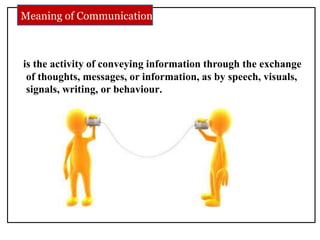
is the activity of conveying information through the exchange
of thoughts, messages, or information, as by speech, visuals,
signals, writing, or behaviour.
Meaning of Communication
 To ensure that we develop our Body Language while communicating with
others
 To be able to understand and interpret the Body Language of others
 To use the right vocabulary and language while communicating with others
 To ensure we use the right language in any other form of verbal
communication.
 To use the right tone of voice while speaking.
 To develop our listening skills
Objectives
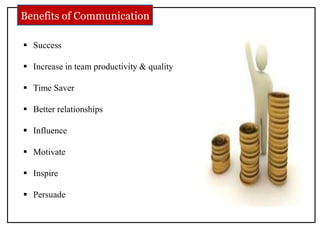
 Success
 Increase in team productivity & quality
 Time Saver
 Better relationships
 Influence
 Motivate
 Inspire
 Persuade
Benefits of Communication
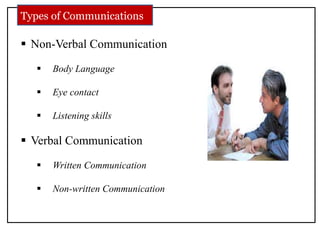
 Non-Verbal Communication
 Body Language
 Eye contact
 Listening skills
 Verbal Communication
 Written Communication
 Non-written Communication
Types of Communications
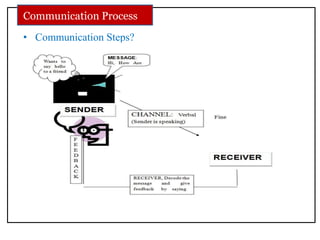
• Communication Steps?
Communication Process
Activity
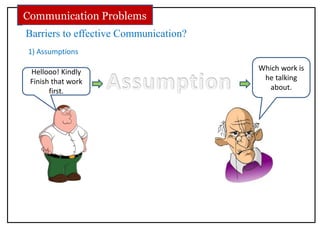
Barriers to effective Communication?
Communication Problems
Hellooo! Kindly
Finish that work
first.
Which work is
he talking
about.
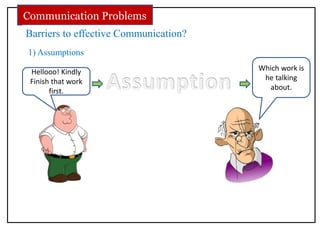
1) Assumptions
Barriers to effective Communication?
Communication Problems
Hellooo! Kindly
Finish that work
first.
Which work is
he talking
about.
1) Assumptions
Barriers to effective Communication?
Communication Problems
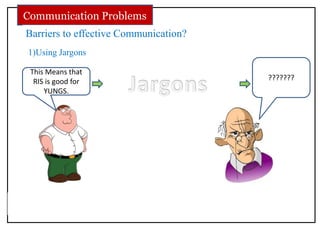
This Means that
RIS is good for
YUNGS.
???????
1)Using Jargons
Barriers to effective Communication?
Communication Problems
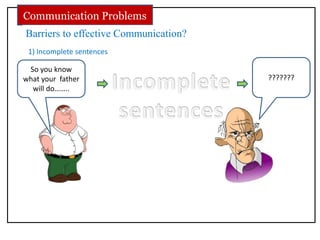
???????
1) Incomplete sentences
So you know
what your father
will do……..
Barriers to effective Communication?
Communication Problems
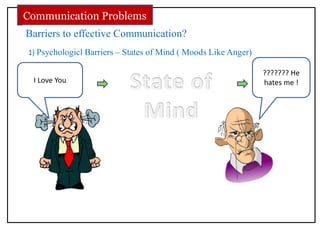
??????? He
hates me !
1) Psychologicl Barriers – States of Mind ( Moods Like Anger)
I Love You
Barriers to effective Communication?
Communication Problems
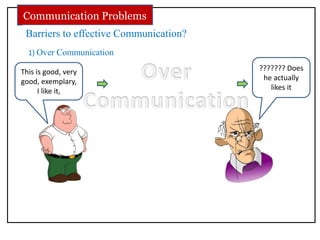
??????? Does
he actually
likes it
1) Over Communication
This is good, very
good, exemplary,
I like it,
Barriers to effective Communication?
Communication Problems
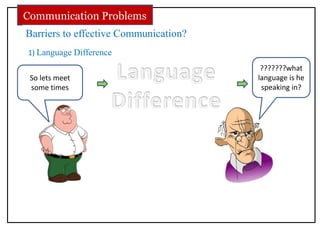
???????what
language is he
speaking in?
1) Language Difference
So lets meet
some times
Barriers to effective Communication?
Communication Problems
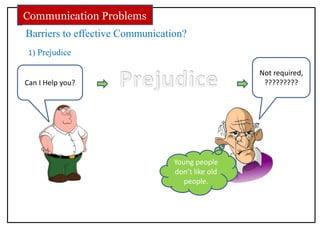
Not required,
?????????
1) Prejudice
Can I Help you?
Young people
don’t like old
people.
Barriers to effective Communication?
Communication Problems
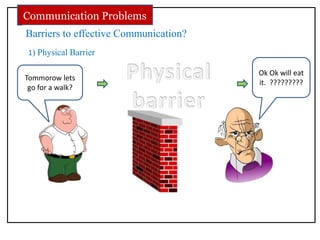
Ok Ok will eat
it. ?????????
1) Physical Barrier
Tommorow lets
go for a walk?
Barriers to effective Communication?
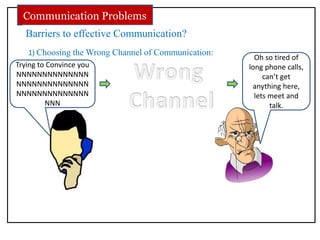
Communication Problems
Oh so tired of
long phone calls,
can’t get
anything here,
lets meet and
talk.
1) Choosing the Wrong Channel of Communication:
Trying to Convince you
NNNNNNNNNNNNNN
NNNNNNNNNNNNNN
NNNNNNNNNNNNNN
NNN
Overcoming the barriers of communication
 Connect with your Audience, maintain eye contact and be aware of proper
body gestures
 Ask questions for better clarity.
 Use simple words as far as possible.
 Summarize in the end whatever has been said .
 Read as widely as possible.
 Polish your language skills , especially grammar .
 Ask for feedback where ever possible.
Communication Problems
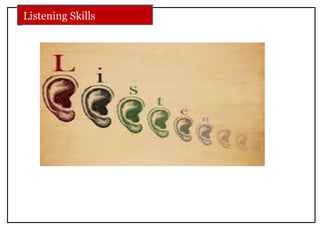
Listening Skills
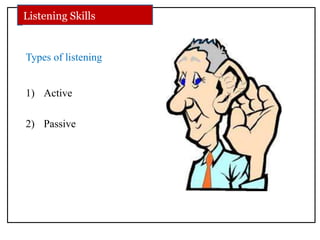
Types of listening
1) Active
2) Passive
Listening Skills
Listening:
Traits of a Good Listener: Active Listening
 Being non-evaluative
 Paraphrasing
 Reflecting implications
 Reflecting hidden feelings
 Inviting further contributions
 Responding non-verbally
Listening
Listening:
How to listen Actively :
 Be open minded
 Ask questions to clarify and not to overshadow intelligence
 Paraphrase from time to time
 Send appropriate non-verbal signals time to time
 Be mentally prepared to listen
 Evaluate the speech not the speaker
 Be unbiased to the speaker by depersonalizing your feelings
 Fight distractions by closing off sound sources
 Analyze and evaluate without being judgmental.
Communication Skills
Communication Process
Activity
Body Language
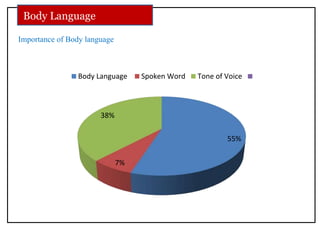
Body Language
55%
7%
38%
Body Language Spoken Word Tone of Voice
Importance of Body language
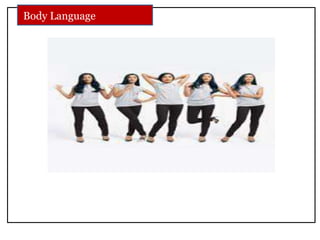
Body Language is basically the manifestation of the mind
through Gestures and Postures.
Divisions of body Language
• Eye Signals
• Arms Signals
• Hand & Thumb gestures
• Posturing with legs
• Facial Expressions
Body Language
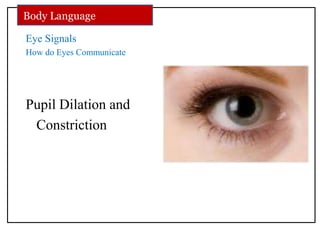
Eye Signals
How do Eyes Communicate
Pupil Dilation and
Constriction
Body Language
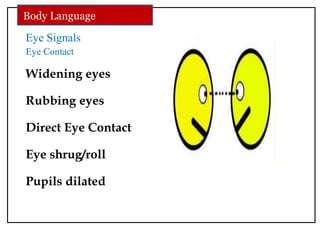
Eye Signals
Eye Contact
Widening eyes
Rubbing eyes
Direct Eye Contact
Eye shrug/roll
Pupils dilated
Body Language
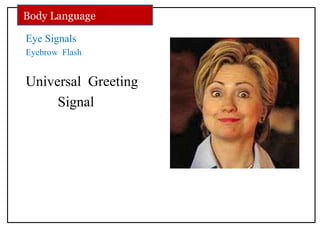
Eye Signals
Eyebrow Flash
Universal Greeting
Signal
Body Language
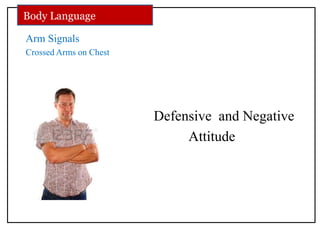
Arm Signals
Crossed Arms on Chest
Defensive and Negative
Attitude
Body Language
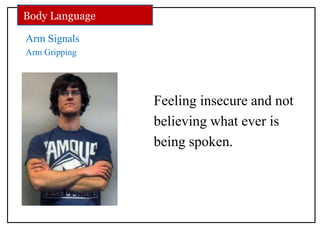
Arm Signals
Arm Gripping
Feeling insecure and not
believing what ever is
being spoken.
Body Language
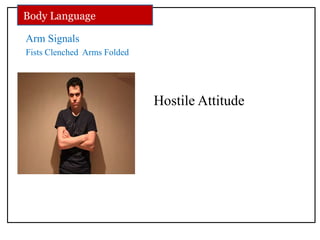
Arm Signals
Fists Clenched Arms Folded
Hostile Attitude
Body Language
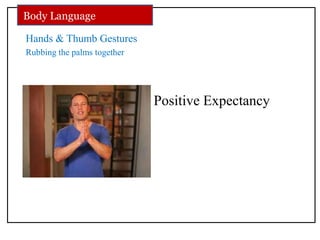
Hands & Thumb Gestures
Rubbing the palms together
Positive Expectancy
Body Language
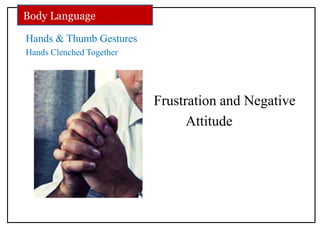
Hands & Thumb Gestures
Hands Clenched Together
Frustration and Negative
Attitude
Body Language
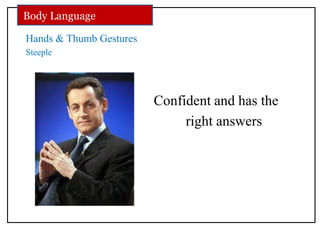
Hands & Thumb Gestures
Steeple
Confident and has the
right answers
Body Language
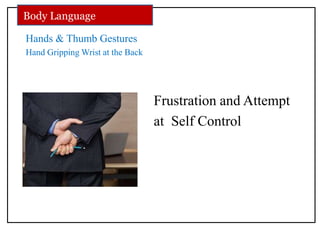
Hands & Thumb Gestures
Hand Gripping Wrist at the Back
Frustration and Attempt
at Self Control
Body Language
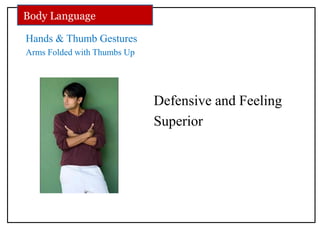
Hands & Thumb Gestures
Arms Folded with Thumbs Up
Defensive and Feeling
Superior
Body Language
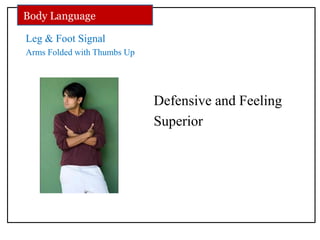
Leg & Foot Signal
Arms Folded with Thumbs Up
Defensive and Feeling
Superior
Body Language
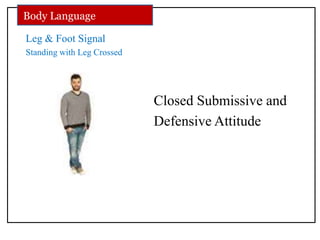
Leg & Foot Signal
Standing with Leg Crossed
Closed Submissive and
Defensive Attitude
Body Language
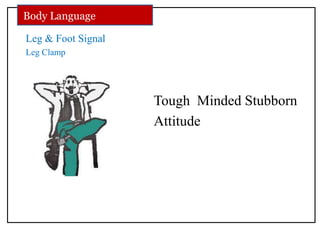
Leg & Foot Signal
Leg Clamp
Tough Minded Stubborn
Attitude
Body Language
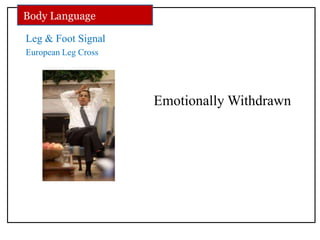
Leg & Foot Signal
European Leg Cross
Emotionally Withdrawn
Body Language
Communication Process
Activity
Hand Shakes
 Determines attitudes
 Confidence Level of an Individual
 Cultural differences to be considered
Body Language
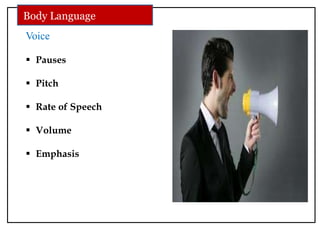
Voice
 Pauses
 Pitch
 Rate of Speech
 Volume
 Emphasis
Body Language
Spaces
 Intimate distance :
• [ 0-18 inches (46 cms)]
 Personal distance :
• 18 inches to 4 ft ( arm’s length away)
 Social distance :
• 4- 8 ft
 Public distance:
• beyond 8 feet
Body Language
Thank You Very Much
Questions ?

Communication skills PPT

  • 1.
  • 2.
    is the activityof conveying information through the exchange of thoughts, messages, or information, as by speech, visuals, signals, writing, or behaviour. Meaning of Communication
  • 3.
     To ensurethat we develop our Body Language while communicating with others  To be able to understand and interpret the Body Language of others  To use the right vocabulary and language while communicating with others  To ensure we use the right language in any other form of verbal communication.  To use the right tone of voice while speaking.  To develop our listening skills Objectives
  • 4.
     Success  Increasein team productivity & quality  Time Saver  Better relationships  Influence  Motivate  Inspire  Persuade Benefits of Communication
  • 5.
     Non-Verbal Communication Body Language  Eye contact  Listening skills  Verbal Communication  Written Communication  Non-written Communication Types of Communications
  • 6.
  • 7.
  • 8.
    Barriers to effectiveCommunication? Communication Problems Hellooo! Kindly Finish that work first. Which work is he talking about. 1) Assumptions
  • 9.
    Barriers to effectiveCommunication? Communication Problems Hellooo! Kindly Finish that work first. Which work is he talking about. 1) Assumptions
  • 10.
    Barriers to effectiveCommunication? Communication Problems This Means that RIS is good for YUNGS. ??????? 1)Using Jargons
  • 11.
    Barriers to effectiveCommunication? Communication Problems ??????? 1) Incomplete sentences So you know what your father will do……..
  • 12.
    Barriers to effectiveCommunication? Communication Problems ??????? He hates me ! 1) Psychologicl Barriers – States of Mind ( Moods Like Anger) I Love You
  • 13.
    Barriers to effectiveCommunication? Communication Problems ??????? Does he actually likes it 1) Over Communication This is good, very good, exemplary, I like it,
  • 14.
    Barriers to effectiveCommunication? Communication Problems ???????what language is he speaking in? 1) Language Difference So lets meet some times
  • 15.
    Barriers to effectiveCommunication? Communication Problems Not required, ????????? 1) Prejudice Can I Help you? Young people don’t like old people.
  • 16.
    Barriers to effectiveCommunication? Communication Problems Ok Ok will eat it. ????????? 1) Physical Barrier Tommorow lets go for a walk?
  • 17.
    Barriers to effectiveCommunication? Communication Problems Oh so tired of long phone calls, can’t get anything here, lets meet and talk. 1) Choosing the Wrong Channel of Communication: Trying to Convince you NNNNNNNNNNNNNN NNNNNNNNNNNNNN NNNNNNNNNNNNNN NNN
  • 18.
    Overcoming the barriersof communication  Connect with your Audience, maintain eye contact and be aware of proper body gestures  Ask questions for better clarity.  Use simple words as far as possible.  Summarize in the end whatever has been said .  Read as widely as possible.  Polish your language skills , especially grammar .  Ask for feedback where ever possible. Communication Problems
  • 19.
  • 20.
    Types of listening 1)Active 2) Passive Listening Skills
  • 21.
    Listening: Traits of aGood Listener: Active Listening  Being non-evaluative  Paraphrasing  Reflecting implications  Reflecting hidden feelings  Inviting further contributions  Responding non-verbally Listening
  • 22.
    Listening: How to listenActively :  Be open minded  Ask questions to clarify and not to overshadow intelligence  Paraphrase from time to time  Send appropriate non-verbal signals time to time  Be mentally prepared to listen  Evaluate the speech not the speaker  Be unbiased to the speaker by depersonalizing your feelings  Fight distractions by closing off sound sources  Analyze and evaluate without being judgmental. Communication Skills
  • 23.
  • 24.
  • 25.
    Body Language 55% 7% 38% Body LanguageSpoken Word Tone of Voice Importance of Body language
  • 26.
    Body Language isbasically the manifestation of the mind through Gestures and Postures. Divisions of body Language • Eye Signals • Arms Signals • Hand & Thumb gestures • Posturing with legs • Facial Expressions Body Language
  • 27.
    Eye Signals How doEyes Communicate Pupil Dilation and Constriction Body Language
  • 28.
    Eye Signals Eye Contact Wideningeyes Rubbing eyes Direct Eye Contact Eye shrug/roll Pupils dilated Body Language
  • 29.
    Eye Signals Eyebrow Flash UniversalGreeting Signal Body Language
  • 30.
    Arm Signals Crossed Armson Chest Defensive and Negative Attitude Body Language
  • 31.
    Arm Signals Arm Gripping Feelinginsecure and not believing what ever is being spoken. Body Language
  • 32.
    Arm Signals Fists ClenchedArms Folded Hostile Attitude Body Language
  • 33.
    Hands & ThumbGestures Rubbing the palms together Positive Expectancy Body Language
  • 34.
    Hands & ThumbGestures Hands Clenched Together Frustration and Negative Attitude Body Language
  • 35.
    Hands & ThumbGestures Steeple Confident and has the right answers Body Language
  • 36.
    Hands & ThumbGestures Hand Gripping Wrist at the Back Frustration and Attempt at Self Control Body Language
  • 37.
    Hands & ThumbGestures Arms Folded with Thumbs Up Defensive and Feeling Superior Body Language
  • 38.
    Leg & FootSignal Arms Folded with Thumbs Up Defensive and Feeling Superior Body Language
  • 39.
    Leg & FootSignal Standing with Leg Crossed Closed Submissive and Defensive Attitude Body Language
  • 40.
    Leg & FootSignal Leg Clamp Tough Minded Stubborn Attitude Body Language
  • 41.
    Leg & FootSignal European Leg Cross Emotionally Withdrawn Body Language
  • 42.
  • 43.
    Hand Shakes  Determinesattitudes  Confidence Level of an Individual  Cultural differences to be considered Body Language
  • 44.
    Voice  Pauses  Pitch Rate of Speech  Volume  Emphasis Body Language
  • 45.
    Spaces  Intimate distance: • [ 0-18 inches (46 cms)]  Personal distance : • 18 inches to 4 ft ( arm’s length away)  Social distance : • 4- 8 ft  Public distance: • beyond 8 feet Body Language
  • 46.
    Thank You VeryMuch Questions ?