

COMMUNICATION
IN ORGANIZATION
ASSIGNMENT II
PRESENTED TO:- NEHA MAM
PRESENTED BY :- SHIPRA VERMA
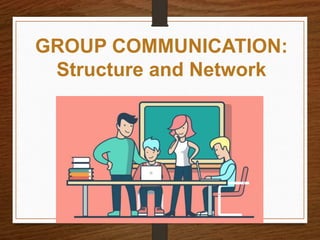
GROUP COMMUNICATION:
Structure and Network
What is Group
Communication ?
 Group communication is a mode of
communication in an organization, between
employers and employees, and employees in
teams/groups.
 Group communication can further be
looked from an marketing perspective as
communicating to a group of people or target
customers in order to market a product.
Importance of Group
Communication
Sharing ideas
Solving problems
Delegating tasks
Democratic engagement
Making friends
Learning about each other
Developing a sense of group identity
Purpose Of Group
Communication
To share and exchange information and ideas
 To collect information or feedback on any
project/policy/scheme
To arrive at a decision on important matters
 To solve a problem which is of concern to the
organization as a whole
To discuss the issues related to a particular topic in
relation to the group itself or for the benefit of a larger
audience
To elaborate upon any work undertaken or
research done in order to elicit feedback
Characteristics of
Group Communication
Clear purpose
Participation
Healthy Conflict
Open Communication
Clear Roles and Assignments
External Resources
Functional Diversity
Self Assessment
Types of Group
Communication
Small Group
Communication
Large Group Communication
What is Small Group
Communication?
Small group communication refers to interactions
among three or more people who are connected
through a common purpose, mutual influence, and a
shared identity.
Small group communication often takes place in the
workplace when coworkers need to solve a problem or
come up with ideas for a project.
This type of communication can benefit group
members by allowing them to express their ideas
freely, but it can also hinder expression if members of
the group do not communicate in a healthy manner.
Types of Small Group
Communication
Brainstorming
Information Sharing
Problem Solving
Groupthink
What is Large Group
Communication
Large group communication is a general
description for organizational communication as a
communication context describing large numbers
of individuals who are members of a group.
Large group contexts can
include communities of interest, geography, or
economy brought together by need or self-
identification.
Examples of large group -workers of the same
office, members of the same NGO, members of
the club etc
Large Group
Communication
Large group can be a challenge
to even the most experience of
presenters
Anxiety due to:
Lack of contact with the
audience
Fear of making mistakes
Difficulty in delivering the
information to the audience
Guideline for achieving the best
communication with any large group
The Speaker-
Criteria of a Good Presenter:
Appearance
Body Language
Voice Tone
The Material-
What?
Why?
Identifying clear main points.
Additional Detail.
Audience attention and
understanding.
Hangouts?
Structure and Network of
Group Communication
Wheel Network
Chain Network
Circle Network
All channel Network
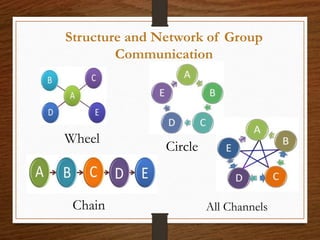
Wheel
Circle
All ChannelsChain
Structure and Network of Group
Communication
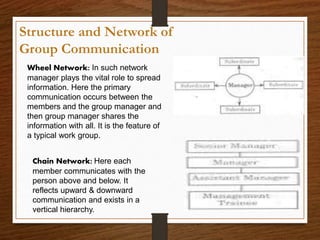
Wheel Network: In such network
manager plays the vital role to spread
information. Here the primary
communication occurs between the
members and the group manager and
then group manager shares the
information with all. It is the feature of
a typical work group.
Chain Network: Here each
member communicates with the
person above and below. It
reflects upward & downward
communication and exists in a
vertical hierarchy.
Structure and Network of
Group Communication
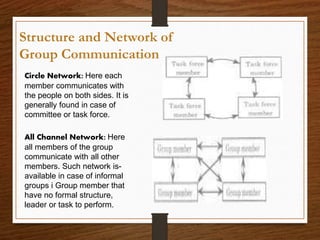
Circle Network: Here each
member communicates with
the people on both sides. It is
generally found in case of
committee or task force.
All Channel Network: Here
all members of the group
communicate with all other
members. Such network is-
available in case of informal
groups i Group member that
have no formal structure,
leader or task to perform.
Structure and Network of
Group Communication
CASE STUDY:
Group Communication and Interaction in project-based
Learning: The Use of Facebook
in a Taiwanese EFL Context
This study shows how Facebook and its interactive and collaborative
features can help English as a foreign language (EFL) undergraduates to
process and reconstruct knowledge regarding project-based learning.
The research questions included: What types of communication
interaction behaviors do participants exhibit? How do participants
behave at various stages? How do student collaborations on Facebook
help them to process and reconstruct knowledge regarding the EFL
project? Open-coding and content analysis were conducted to determine
what learners discussed and their communication patterns.
 Among the various topics that students discussed, shared, and
explored on Facebook, they linked existing knowledge with new stimuli to
gain a new understanding of their experience.
The popularization of the Internet and the convenience of online social
utilities have changed how people communicate and influenced how
students learn.
English is the most commonly studied foreign language in Taiwan.
Students are required to learn English as a foreign language (EFL) at
various levels of schooling.
Several Studies have examined how Facebook assists EFL and ESL
students in enhancing their English ability.
This paper explored how Facebook is used in constructing knowledge
when working within an EFL project-based learning environment. Text
communication on Facebook was analyzed to identify participant
communication interaction behaviors and their learning process.
Thank You

Group Communication

  • 1.
    COMMUNICATION IN ORGANIZATION ASSIGNMENT II PRESENTEDTO:- NEHA MAM PRESENTED BY :- SHIPRA VERMA
  • 2.
  • 3.
    What is Group Communication?  Group communication is a mode of communication in an organization, between employers and employees, and employees in teams/groups.  Group communication can further be looked from an marketing perspective as communicating to a group of people or target customers in order to market a product.
  • 4.
    Importance of Group Communication Sharingideas Solving problems Delegating tasks Democratic engagement Making friends Learning about each other Developing a sense of group identity
  • 5.
    Purpose Of Group Communication Toshare and exchange information and ideas  To collect information or feedback on any project/policy/scheme To arrive at a decision on important matters  To solve a problem which is of concern to the organization as a whole To discuss the issues related to a particular topic in relation to the group itself or for the benefit of a larger audience To elaborate upon any work undertaken or research done in order to elicit feedback
  • 6.
    Characteristics of Group Communication Clearpurpose Participation Healthy Conflict Open Communication Clear Roles and Assignments External Resources Functional Diversity Self Assessment
  • 7.
    Types of Group Communication SmallGroup Communication Large Group Communication
  • 8.
    What is SmallGroup Communication? Small group communication refers to interactions among three or more people who are connected through a common purpose, mutual influence, and a shared identity. Small group communication often takes place in the workplace when coworkers need to solve a problem or come up with ideas for a project. This type of communication can benefit group members by allowing them to express their ideas freely, but it can also hinder expression if members of the group do not communicate in a healthy manner.
  • 9.
    Types of SmallGroup Communication Brainstorming Information Sharing Problem Solving Groupthink
  • 10.
    What is LargeGroup Communication Large group communication is a general description for organizational communication as a communication context describing large numbers of individuals who are members of a group. Large group contexts can include communities of interest, geography, or economy brought together by need or self- identification. Examples of large group -workers of the same office, members of the same NGO, members of the club etc
  • 11.
    Large Group Communication Large groupcan be a challenge to even the most experience of presenters Anxiety due to: Lack of contact with the audience Fear of making mistakes Difficulty in delivering the information to the audience
  • 12.
    Guideline for achievingthe best communication with any large group The Speaker- Criteria of a Good Presenter: Appearance Body Language Voice Tone The Material- What? Why? Identifying clear main points. Additional Detail. Audience attention and understanding. Hangouts?
  • 13.
    Structure and Networkof Group Communication Wheel Network Chain Network Circle Network All channel Network
  • 14.
    Wheel Circle All ChannelsChain Structure andNetwork of Group Communication
  • 15.
    Wheel Network: Insuch network manager plays the vital role to spread information. Here the primary communication occurs between the members and the group manager and then group manager shares the information with all. It is the feature of a typical work group. Chain Network: Here each member communicates with the person above and below. It reflects upward & downward communication and exists in a vertical hierarchy. Structure and Network of Group Communication
  • 16.
    Circle Network: Hereeach member communicates with the people on both sides. It is generally found in case of committee or task force. All Channel Network: Here all members of the group communicate with all other members. Such network is- available in case of informal groups i Group member that have no formal structure, leader or task to perform. Structure and Network of Group Communication
  • 17.
    CASE STUDY: Group Communicationand Interaction in project-based Learning: The Use of Facebook in a Taiwanese EFL Context This study shows how Facebook and its interactive and collaborative features can help English as a foreign language (EFL) undergraduates to process and reconstruct knowledge regarding project-based learning. The research questions included: What types of communication interaction behaviors do participants exhibit? How do participants behave at various stages? How do student collaborations on Facebook help them to process and reconstruct knowledge regarding the EFL project? Open-coding and content analysis were conducted to determine what learners discussed and their communication patterns.
  • 18.
     Among thevarious topics that students discussed, shared, and explored on Facebook, they linked existing knowledge with new stimuli to gain a new understanding of their experience. The popularization of the Internet and the convenience of online social utilities have changed how people communicate and influenced how students learn. English is the most commonly studied foreign language in Taiwan. Students are required to learn English as a foreign language (EFL) at various levels of schooling. Several Studies have examined how Facebook assists EFL and ESL students in enhancing their English ability. This paper explored how Facebook is used in constructing knowledge when working within an EFL project-based learning environment. Text communication on Facebook was analyzed to identify participant communication interaction behaviors and their learning process.
  • 19.