Schrödinger’s Time
Independent Wave Equation
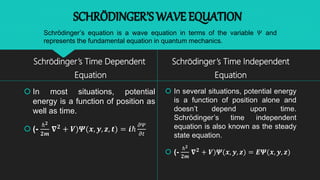
SCHRÖDINGER’S WAVE EQUATION
Schrödinger’s Time Dependent
Equation
 In most situations, potential
energy is a function of position as
well as time.
 (-
ℏ𝟐
𝟐𝒎
𝛁𝟐 + 𝑽)𝜳(𝒙, 𝒚, 𝒛, 𝒕) = 𝒊ℏ
𝜕𝛹
𝜕𝑡
Schrödinger’s Time Independent
Equation
 In several situations, potential energy
is a function of position alone and
doesn’t depend upon time.
Schrödinger’s time independent
equation is also known as the steady
state equation.
 (-
ℏ𝟐
𝟐𝒎
𝛁𝟐
+ 𝑽)𝜳(𝒙, 𝒚, 𝒛) = 𝑬𝜳(𝒙, 𝒚, 𝒛)
Schrödinger’s equation is a wave equation in terms of the variable 𝛹 and
represents the fundamental equation in quantum mechanics.
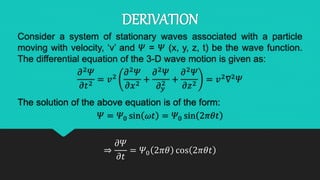
DERIVATION
Consider a system of stationary waves associated with a particle
moving with velocity, ‘v’ and 𝛹 = 𝛹 (x, y, z, t) be the wave function.
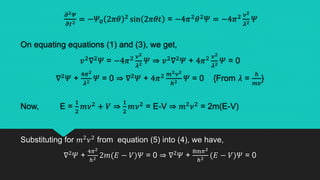
The differential equation of the 3-D wave motion is given as:
𝜕2
𝛹
𝜕𝑡2
= 𝑣2
𝜕2
𝛹
𝜕𝑥2
+
𝜕2
𝛹
𝜕𝑦
2 +
𝜕2
𝛹
𝜕𝑧2
= 𝑣2∇2𝛹
The solution of the above equation is of the form:
𝛹 = 𝛹0 sin 𝜔𝑡 = 𝛹0 sin 2𝜋𝜃𝑡
⇒
𝜕𝛹
𝜕𝑡
= 𝛹0 2𝜋𝜃 cos 2𝜋𝜃𝑡
𝜕2𝛹
𝜕𝑡2 = −𝛹0 2𝜋𝜃 2
sin 2𝜋𝜃𝑡 = −4𝜋2
𝜃2
𝛹 = −4𝜋2 𝜈2
𝜆2 𝛹
On equating equations (1) and (3), we get,
𝑣2
∇2
𝛹 = −4𝜋2 𝜈2
𝜆2 𝛹 ⇒ 𝑣2
∇2
𝛹 + 4𝜋2 𝜈2
𝜆2 𝛹 = 0
∇2
𝛹 +
4𝜋2
𝜆2 𝛹 = 0 ⇒ ∇2
𝛹 + 4𝜋2 𝑚2𝜈2
ℎ2 𝛹 = 0 {From 𝜆 =
ℎ
𝑚𝑣
}
Now, E =
1
2
𝑚𝜈2
+ 𝑉 ⇒
1
2
𝑚𝜈2
= E-V ⇒ 𝑚2
𝜈2
= 2m(E-V)
Substituting for 𝑚2
𝜈2
from equation (5) into (4), we have,
∇2𝛹 +
4𝜋2
ℎ2 2𝑚(𝐸 − 𝑉)𝛹 = 0 ⇒ ∇2𝛹 +
8m𝜋2
ℎ2 (𝐸 − 𝑉)𝛹 = 0
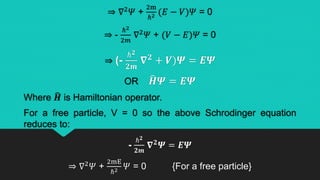
⇒ ∇2
𝛹 +
2m
ℏ2 (𝐸 − 𝑉)𝛹 = 0
⇒ -
ℏ2
2𝑚
∇2𝛹 + (𝑉 − 𝐸)𝛹 = 0
⇒ (-
ℏ𝟐
𝟐𝒎
𝛁𝟐
+ 𝑽)𝜳 = 𝑬𝜳
OR 𝑯𝜳 = 𝑬𝜳
Where 𝑯 is Hamiltonian operator.
For a free particle, V = 0 so the above Schrodinger equation
reduces to:
-
ℏ𝟐
𝟐𝒎
𝛁𝟐
𝜳 = 𝑬𝜳
⇒ ∇2𝛹 +
2mE
ℏ2 𝛹 = 0 {For a free particle}
APPLICATION OF
SCHRÖDINGER’S TIME
INDEPENDENT WAVE
EQUATION
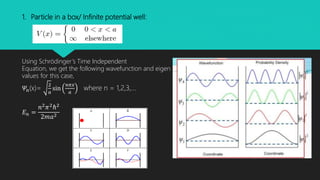
1. Particle in a box/ Infinite potential well:
Using Schrödinger’s Time Independent
Equation, we get the following wavefunction and eigen
values for this case,
𝛹n(x)=
2
𝑎
sin
𝑛𝜋𝑥
𝑎
where n = 1,2,3,…
𝐸𝑛 =
𝑛2𝜋2ℏ2
2𝑚𝑎2
2. Quantum Harmonic Oscillator:
Using Schrödinger’s Time Independent
Equation, we get the following wavefunction and eigen values for
this case,
𝐸𝑛 = 𝑛 +
1
2
ℏ𝜔
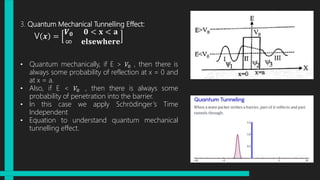
3. Quantum Mechanical Tunnelling Effect:
• Quantum mechanically, if E > 𝑉0 , then there is
always some probability of reflection at x = 0 and
at x = a.
• Also, if E < 𝑉0 , then there is always some
probability of penetration into the barrier.
• In this case we apply Schrödinger’s Time
Independent
• Equation to understand quantum mechanical
tunnelling effect.
V 𝒙 =
𝑽𝟎 𝟎 < 𝐱 < 𝐚
∞ 𝐞𝐥𝐬𝐞𝐰𝐡𝐞𝐫𝐞
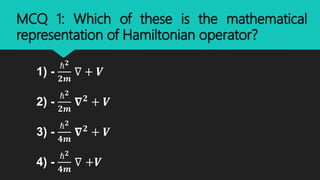
MCQ 1: Which of these is the mathematical
representation of Hamiltonian operator?
1) -
ℏ𝟐
𝟐𝒎
∇ + 𝑽
2) -
ℏ𝟐
𝟐𝒎
𝛁𝟐
+ 𝑽
3) -
ℏ𝟐
𝟒𝒎
𝛁𝟐
+ 𝑽
4) -
ℏ𝟐
𝟒𝒎
∇ +𝑽
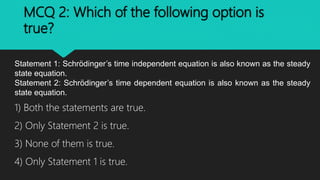
MCQ 2: Which of the following option is
true?
Statement 1: Schrödinger’s time independent equation is also known as the steady
state equation.
Statement 2: Schrödinger’s time dependent equation is also known as the steady
state equation.
1) Both the statements are true.
2) Only Statement 2 is true.
3) None of them is true.
4) Only Statement 1 is true.
THANK YOU

Schrodinger's time independent wave equation

  • 1.
  • 2.
    SCHRÖDINGER’S WAVE EQUATION Schrödinger’sTime Dependent Equation  In most situations, potential energy is a function of position as well as time.  (- ℏ𝟐 𝟐𝒎 𝛁𝟐 + 𝑽)𝜳(𝒙, 𝒚, 𝒛, 𝒕) = 𝒊ℏ 𝜕𝛹 𝜕𝑡 Schrödinger’s Time Independent Equation  In several situations, potential energy is a function of position alone and doesn’t depend upon time. Schrödinger’s time independent equation is also known as the steady state equation.  (- ℏ𝟐 𝟐𝒎 𝛁𝟐 + 𝑽)𝜳(𝒙, 𝒚, 𝒛) = 𝑬𝜳(𝒙, 𝒚, 𝒛) Schrödinger’s equation is a wave equation in terms of the variable 𝛹 and represents the fundamental equation in quantum mechanics.
  • 3.
    DERIVATION Consider a systemof stationary waves associated with a particle moving with velocity, ‘v’ and 𝛹 = 𝛹 (x, y, z, t) be the wave function. The differential equation of the 3-D wave motion is given as: 𝜕2 𝛹 𝜕𝑡2 = 𝑣2 𝜕2 𝛹 𝜕𝑥2 + 𝜕2 𝛹 𝜕𝑦 2 + 𝜕2 𝛹 𝜕𝑧2 = 𝑣2∇2𝛹 The solution of the above equation is of the form: 𝛹 = 𝛹0 sin 𝜔𝑡 = 𝛹0 sin 2𝜋𝜃𝑡 ⇒ 𝜕𝛹 𝜕𝑡 = 𝛹0 2𝜋𝜃 cos 2𝜋𝜃𝑡
  • 4.
    𝜕2𝛹 𝜕𝑡2 = −𝛹02𝜋𝜃 2 sin 2𝜋𝜃𝑡 = −4𝜋2 𝜃2 𝛹 = −4𝜋2 𝜈2 𝜆2 𝛹 On equating equations (1) and (3), we get, 𝑣2 ∇2 𝛹 = −4𝜋2 𝜈2 𝜆2 𝛹 ⇒ 𝑣2 ∇2 𝛹 + 4𝜋2 𝜈2 𝜆2 𝛹 = 0 ∇2 𝛹 + 4𝜋2 𝜆2 𝛹 = 0 ⇒ ∇2 𝛹 + 4𝜋2 𝑚2𝜈2 ℎ2 𝛹 = 0 {From 𝜆 = ℎ 𝑚𝑣 } Now, E = 1 2 𝑚𝜈2 + 𝑉 ⇒ 1 2 𝑚𝜈2 = E-V ⇒ 𝑚2 𝜈2 = 2m(E-V) Substituting for 𝑚2 𝜈2 from equation (5) into (4), we have, ∇2𝛹 + 4𝜋2 ℎ2 2𝑚(𝐸 − 𝑉)𝛹 = 0 ⇒ ∇2𝛹 + 8m𝜋2 ℎ2 (𝐸 − 𝑉)𝛹 = 0
  • 5.
    ⇒ ∇2 𝛹 + 2m ℏ2(𝐸 − 𝑉)𝛹 = 0 ⇒ - ℏ2 2𝑚 ∇2𝛹 + (𝑉 − 𝐸)𝛹 = 0 ⇒ (- ℏ𝟐 𝟐𝒎 𝛁𝟐 + 𝑽)𝜳 = 𝑬𝜳 OR 𝑯𝜳 = 𝑬𝜳 Where 𝑯 is Hamiltonian operator. For a free particle, V = 0 so the above Schrodinger equation reduces to: - ℏ𝟐 𝟐𝒎 𝛁𝟐 𝜳 = 𝑬𝜳 ⇒ ∇2𝛹 + 2mE ℏ2 𝛹 = 0 {For a free particle}
  • 6.
  • 7.
    1. Particle ina box/ Infinite potential well: Using Schrödinger’s Time Independent Equation, we get the following wavefunction and eigen values for this case, 𝛹n(x)= 2 𝑎 sin 𝑛𝜋𝑥 𝑎 where n = 1,2,3,… 𝐸𝑛 = 𝑛2𝜋2ℏ2 2𝑚𝑎2
  • 8.
    2. Quantum HarmonicOscillator: Using Schrödinger’s Time Independent Equation, we get the following wavefunction and eigen values for this case, 𝐸𝑛 = 𝑛 + 1 2 ℏ𝜔
  • 9.
    3. Quantum MechanicalTunnelling Effect: • Quantum mechanically, if E > 𝑉0 , then there is always some probability of reflection at x = 0 and at x = a. • Also, if E < 𝑉0 , then there is always some probability of penetration into the barrier. • In this case we apply Schrödinger’s Time Independent • Equation to understand quantum mechanical tunnelling effect. V 𝒙 = 𝑽𝟎 𝟎 < 𝐱 < 𝐚 ∞ 𝐞𝐥𝐬𝐞𝐰𝐡𝐞𝐫𝐞
  • 10.
    MCQ 1: Whichof these is the mathematical representation of Hamiltonian operator? 1) - ℏ𝟐 𝟐𝒎 ∇ + 𝑽 2) - ℏ𝟐 𝟐𝒎 𝛁𝟐 + 𝑽 3) - ℏ𝟐 𝟒𝒎 𝛁𝟐 + 𝑽 4) - ℏ𝟐 𝟒𝒎 ∇ +𝑽
  • 11.
    MCQ 2: Whichof the following option is true? Statement 1: Schrödinger’s time independent equation is also known as the steady state equation. Statement 2: Schrödinger’s time dependent equation is also known as the steady state equation. 1) Both the statements are true. 2) Only Statement 2 is true. 3) None of them is true. 4) Only Statement 1 is true.
  • 12.