
Zinc-air batteries
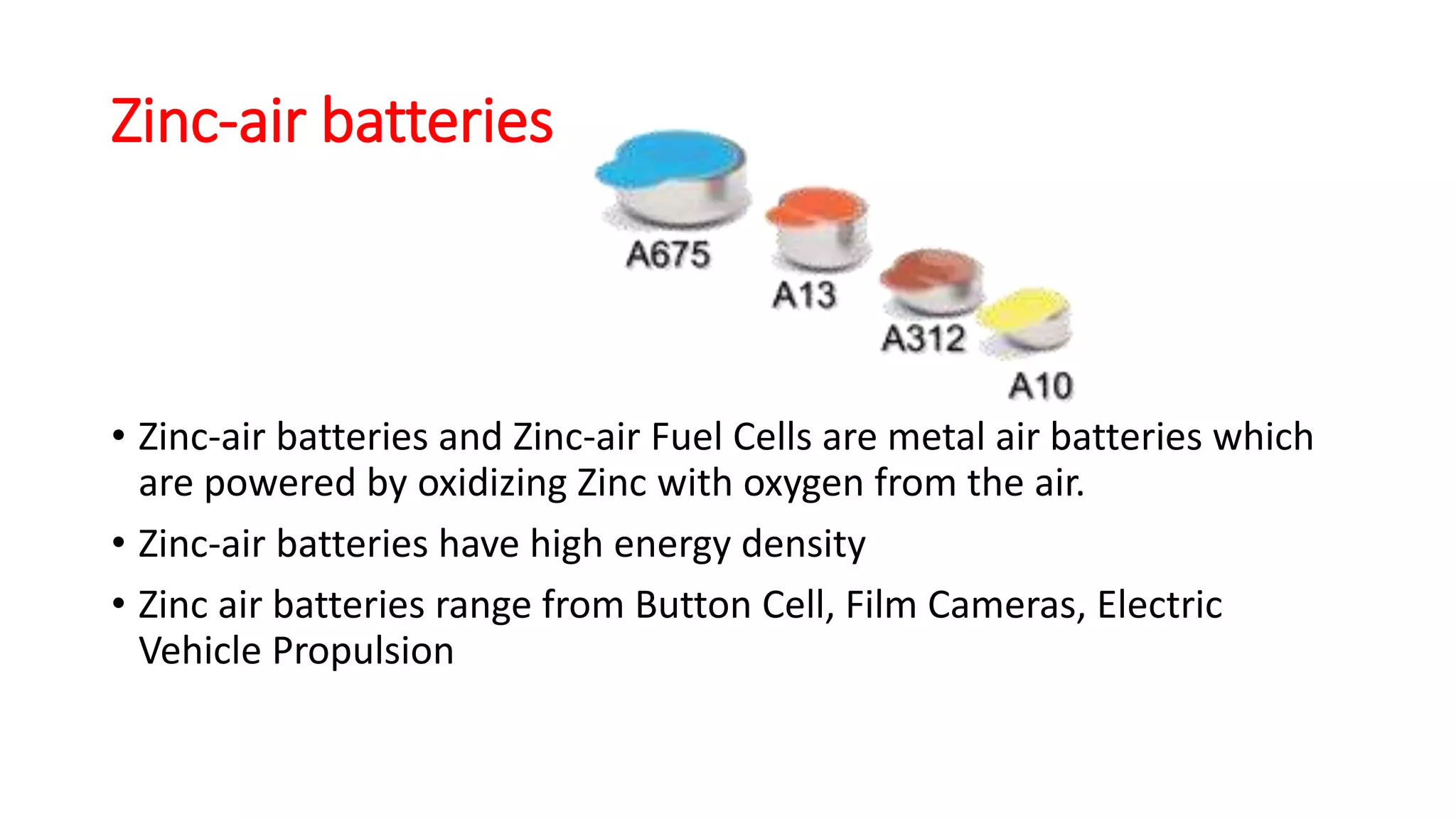
• Zinc-air batteries and Zinc-air Fuel Cells are metal air batteries which
are powered by oxidizing Zinc with oxygen from the air.
• Zinc-air batteries have high energy density
• Zinc air batteries range from Button Cell, Film Cameras, Electric
Vehicle Propulsion
ZINC AIR BATTERIES
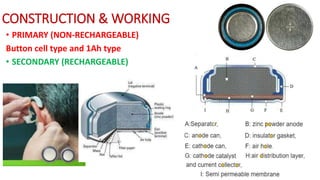
CONSTRUCTION & WORKING
• PRIMARY (NON-RECHARGEABLE)
Button cell type and 1Ah type
• SECONDARY (RECHARGEABLE)
WORKING
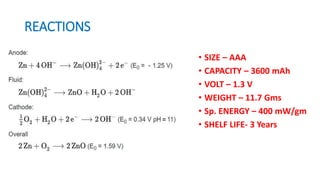
• In Zinc-air battery the Oxygen from the air
reacts at the cathode and
forms hydroxyl ions which migrate into the
zinc paste and form zincate (Zn(OH)2−
4), releasing electrons to travel to the
cathode.
• The zincate decays into zinc oxide and
water returns to the electrolyte.
• The water and hydroxyl from
the anode are recycled at the cathode, so
the water is not consumed.
• The reactions produce a theoretical
1.65 volts, but this is reduced to 1.35–1.4
V in available cells.
REACTIONS
• SIZE – AAA
• CAPACITY – 3600 mAh
• VOLT – 1.3 V
• WEIGHT – 11.7 Gms
• Sp. ENERGY – 400 mW/gm
• SHELF LIFE- 3 Years
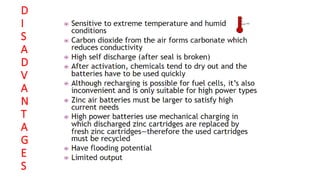
A
D
V
A
N
T
A
G
E
S
D
I
S
A
D
V
A
N
T
A
G
E
S
Aluminium Air Battery
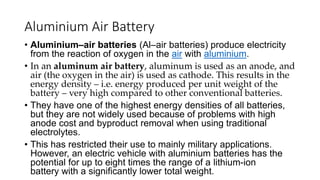
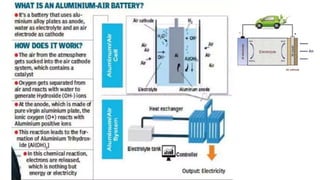
• Aluminium–air batteries (Al–air batteries) produce electricity
from the reaction of oxygen in the air with aluminium.
• In an aluminum air battery, aluminum is used as an anode, and
air (the oxygen in the air) is used as cathode. This results in the
energy density – i.e. energy produced per unit weight of the
battery – very high compared to other conventional batteries.
• They have one of the highest energy densities of all batteries,
but they are not widely used because of problems with high
anode cost and byproduct removal when using traditional
electrolytes.
• This has restricted their use to mainly military applications.
However, an electric vehicle with aluminium batteries has the
potential for up to eight times the range of a lithium-ion
battery with a significantly lower total weight.
Drawbacks
• Once the aluminium anode is consumed by its reaction with
atmospheric oxygen at a cathode immersed in a water-based
electrolyte to form hydrated aluminium oxide, the battery will no
longer produce electricity.
• However, it is possible to mechanically recharge the battery with
new aluminium anodes made from recycling the hydrated
aluminium oxide. Such recycling would be essential if
aluminium–air batteries were to be widely adopted.
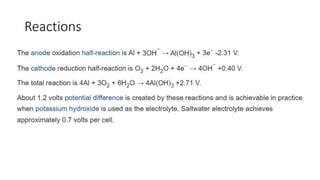
Reactions
Activity
• Read the given text and summarise in 150 words
• https://www.electrical4u.com/aluminum-air-battery/
Sodium-ion batteries
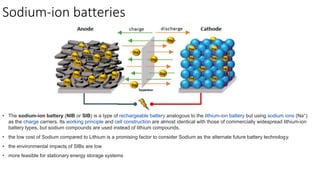
• The sodium-ion battery (NIB or SIB) is a type of rechargeable battery analogous to the lithium-ion battery but using sodium ions (Na+)
as the charge carriers. Its working principle and cell construction are almost identical with those of commercially widespread lithium-ion
battery types, but sodium compounds are used instead of lithium compounds.
• the low cost of Sodium compared to Lithium is a promising factor to consider Sodium as the alternate future battery technology.
• the environmental impacts of SIBs are low
• more feasible for stationary energy storage systems
Challenges in use of sodium ion batteries
• SIBs are heavier than LIBs
• No electric vehicles use sodium-ion batteries. Challenges to
adoption include low energy density and a limited number
of charge-discharge cycles
Principle of operation
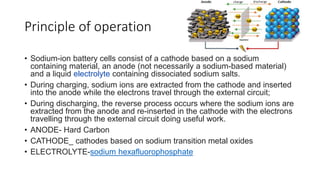
• Sodium-ion battery cells consist of a cathode based on a sodium
containing material, an anode (not necessarily a sodium-based material)
and a liquid electrolyte containing dissociated sodium salts.
• During charging, sodium ions are extracted from the cathode and inserted
into the anode while the electrons travel through the external circuit;
• During discharging, the reverse process occurs where the sodium ions are
extracted from the anode and re-inserted in the cathode with the electrons
travelling through the external circuit doing useful work.
• ANODE- Hard Carbon
• CATHODE_ cathodes based on sodium transition metal oxides
• ELECTROLYTE-sodium hexafluorophosphate
zinc air batteries.pptx

zinc air batteries.pptx

  • 1.
    Zinc-air batteries • Zinc-airbatteries and Zinc-air Fuel Cells are metal air batteries which are powered by oxidizing Zinc with oxygen from the air. • Zinc-air batteries have high energy density • Zinc air batteries range from Button Cell, Film Cameras, Electric Vehicle Propulsion
  • 2.
  • 3.
    CONSTRUCTION & WORKING •PRIMARY (NON-RECHARGEABLE) Button cell type and 1Ah type • SECONDARY (RECHARGEABLE)
  • 4.
    WORKING • In Zinc-airbattery the Oxygen from the air reacts at the cathode and forms hydroxyl ions which migrate into the zinc paste and form zincate (Zn(OH)2− 4), releasing electrons to travel to the cathode. • The zincate decays into zinc oxide and water returns to the electrolyte. • The water and hydroxyl from the anode are recycled at the cathode, so the water is not consumed. • The reactions produce a theoretical 1.65 volts, but this is reduced to 1.35–1.4 V in available cells.
  • 5.
    REACTIONS • SIZE –AAA • CAPACITY – 3600 mAh • VOLT – 1.3 V • WEIGHT – 11.7 Gms • Sp. ENERGY – 400 mW/gm • SHELF LIFE- 3 Years
  • 6.
  • 7.
  • 8.
    Aluminium Air Battery •Aluminium–air batteries (Al–air batteries) produce electricity from the reaction of oxygen in the air with aluminium. • In an aluminum air battery, aluminum is used as an anode, and air (the oxygen in the air) is used as cathode. This results in the energy density – i.e. energy produced per unit weight of the battery – very high compared to other conventional batteries. • They have one of the highest energy densities of all batteries, but they are not widely used because of problems with high anode cost and byproduct removal when using traditional electrolytes. • This has restricted their use to mainly military applications. However, an electric vehicle with aluminium batteries has the potential for up to eight times the range of a lithium-ion battery with a significantly lower total weight.
  • 10.
    Drawbacks • Once thealuminium anode is consumed by its reaction with atmospheric oxygen at a cathode immersed in a water-based electrolyte to form hydrated aluminium oxide, the battery will no longer produce electricity. • However, it is possible to mechanically recharge the battery with new aluminium anodes made from recycling the hydrated aluminium oxide. Such recycling would be essential if aluminium–air batteries were to be widely adopted.
  • 11.
  • 12.
    Activity • Read thegiven text and summarise in 150 words • https://www.electrical4u.com/aluminum-air-battery/
  • 13.
    Sodium-ion batteries • Thesodium-ion battery (NIB or SIB) is a type of rechargeable battery analogous to the lithium-ion battery but using sodium ions (Na+) as the charge carriers. Its working principle and cell construction are almost identical with those of commercially widespread lithium-ion battery types, but sodium compounds are used instead of lithium compounds. • the low cost of Sodium compared to Lithium is a promising factor to consider Sodium as the alternate future battery technology. • the environmental impacts of SIBs are low • more feasible for stationary energy storage systems
  • 14.
    Challenges in useof sodium ion batteries • SIBs are heavier than LIBs • No electric vehicles use sodium-ion batteries. Challenges to adoption include low energy density and a limited number of charge-discharge cycles
  • 15.
    Principle of operation •Sodium-ion battery cells consist of a cathode based on a sodium containing material, an anode (not necessarily a sodium-based material) and a liquid electrolyte containing dissociated sodium salts. • During charging, sodium ions are extracted from the cathode and inserted into the anode while the electrons travel through the external circuit; • During discharging, the reverse process occurs where the sodium ions are extracted from the anode and re-inserted in the cathode with the electrons travelling through the external circuit doing useful work. • ANODE- Hard Carbon • CATHODE_ cathodes based on sodium transition metal oxides • ELECTROLYTE-sodium hexafluorophosphate